宽松货币政策

Search documents
不到半月,日本再遭股债“双杀”
Zhong Guo Xin Wen Wang· 2025-12-01 13:20
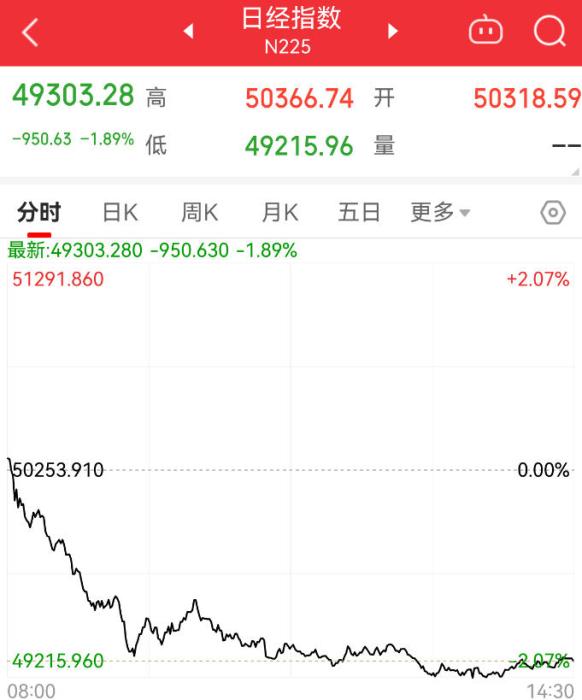
Core Points - Japan's stock and bond markets faced significant declines on December 1, with the Nikkei 225 index dropping by 1.89% and bond prices plummeting, leading to the highest yields since 2008 [1][3] Group 1: Market Performance - The Nikkei 225 index experienced a high opening but fell over 1,000 points during the day, closing with a 1.89% decline [1] - Japanese government bond prices fell sharply, with the two-year bond yield rising by 2.5 basis points to 1.015%, marking the highest level since 2008 [1] - The yield on the newly issued 10-year government bonds reached 1.840%, the highest since June 2008 [1] Group 2: Economic Policies and Market Reactions - Concerns over Japan's fiscal situation have intensified due to Prime Minister Fumio Kishida's push for aggressive fiscal policies and a commitment to maintain loose monetary policy [1] - The Bank of Japan's Governor Kazuo Ueda indicated that the central bank would weigh the pros and cons of a potential interest rate hike, suggesting a cautious approach [3] - Speculation about a possible interest rate increase in December has been growing, with the yen depreciating by 5% against the dollar this quarter, making it the worst-performing currency among G10 currencies [4] Group 3: Government Bond Issuance - The Japanese Ministry of Finance plans to increase the issuance of short-term bonds to support the economic stimulus plan proposed by Prime Minister Kishida, raising the issuance of two-year and five-year bonds by 300 billion yen [4] - The issuance of 6.3 trillion yen in treasury bills is also planned, which may exert pressure on Japan's short-term sovereign bonds [4] - Analysts suggest that caution regarding Japanese bonds is prudent due to potential inflation acceleration and a significant increase in mid-term government bond issuance affecting supply-demand balance [4]

日本股债双杀,日经225一度跌超1000点,加密货币21万人爆仓
2 1 Shi Ji Jing Ji Bao Dao· 2025-12-01 09:03
Group 1 - Japan's stock market faced a significant decline, with the Nikkei 225 index dropping over 2% to 49,224.94 points, and closing down 1.89% at 49,303.28 points [1][2] - Japanese government bonds plummeted due to renewed expectations of interest rate hikes, with the 2-year bond yield surpassing 1% for the first time since 2008, and the 10-year yield rising to 1.85%, marking the highest levels since June 2008 [1][2] - The probability of a Bank of Japan interest rate hike in December increased to 64%, as Governor Kazuo Ueda signaled a potential adjustment to the monetary policy [2] Group 2 - The cryptocurrency market continued to decline, with Bitcoin falling to around $86,000, down 5.34%, and Ethereum dropping over 5%, while other cryptocurrencies like Solana and Dogecoin fell more than 7% [2] - Over the past 24 hours, more than 210,000 individuals in the cryptocurrency market faced liquidation, totaling approximately $639 million [2]
特朗普:已确定美联储主席继任者,很快就会宣布
Sou Hu Cai Jing· 2025-12-01 02:01
Core Viewpoint - President Trump has confirmed that he has selected a candidate for the next Federal Reserve Chair, with strong indications pointing towards Kevin Hassett, the current Director of the White House Council of Economic Advisers [1][2]. Group 1: Candidate Profile - Kevin Hassett, aged 63, holds a Ph.D. in economics from the University of Pennsylvania and has a background that includes working at the Federal Reserve and serving as an economic advisor to several Republican leaders [2]. - Hassett is known for advocating tax cuts and loose monetary policy, and he has publicly supported faster and more frequent interest rate cuts [2]. Group 2: Market Reactions - Market data indicates a significant increase in the probability of Hassett's nomination, rising to 64% from less than 40% in the previous week, while other candidates have much lower probabilities [1]. - The market reacted positively to the news of Trump's impending nomination announcement, with improved performance in Treasury auctions and a decrease in interest rates [3]. Group 3: Current Federal Reserve Context - Under Jerome Powell's leadership, the Federal Reserve has recently cut interest rates, bringing the benchmark rate to its lowest level in three years [5]. - Trump has been critical of Powell, suggesting that he would like to dismiss him and has made various accusations regarding the Federal Reserve's management [6][7].

2026年度展望:中国外贸&人民币汇率
2025-12-01 00:49
Summary of Key Points from Conference Call Records Industry Overview - The records primarily discuss the **Chinese export market** and the **RMB exchange rate** outlook for 2026, highlighting the resilience of Chinese exports despite US-China trade tensions and the strategic shift towards non-US markets [1][3][5]. Core Insights and Arguments - **Export Growth**: Chinese exports are expected to recover to approximately **5% growth** in 2026, aided by demand from Africa and Central Asia, compensating for the decline in exports to the US [1][2]. - **US Tariff Impact**: The likelihood of significant new tariffs from the US on Chinese goods is low, with existing tariffs having a diminished marginal impact due to the reduced share of exports to the US, now around **10%** [5][3]. - **Global Economic Policies**: The dual monetary and fiscal easing policies in major economies are expected to sustain overseas demand, with the US likely to continue a **rate cut cycle** into 2026, potentially lowering rates four times [1][7]. - **AI Investment Influence**: The expansion of AI investments in the US is driving demand for semiconductors and related products, positively impacting Chinese exports in these sectors [9][6]. - **Strengthening Trade Relations with Africa**: China has established zero-tariff treatment for all products with African nations, significantly increasing exports of construction machinery and related products, which are expected to grow further due to infrastructure demands [10][3]. Additional Important Insights - **RMB Exchange Rate Forecast**: The RMB is projected to appreciate against the USD, potentially reaching **6.7-6.8** by the end of 2026, driven by a surplus in the current account and increased net capital inflows [13][14]. - **Investment Trends**: Foreign investment in Chinese financial assets has been increasing, with a notable **62.29 billion CNY** net increase in A-shares, indicating a positive outlook for capital inflows [16]. - **Long-term RMB Outlook**: The RMB is expected to experience gradual appreciation with low volatility, potentially breaking below **7.0** against the USD by 2026, supported by favorable economic conditions and capital flows [17]. Risks and Opportunities - **Risks**: The main risks for Chinese exports in 2026 include potential fluctuations in US tariffs and global economic conditions, although these risks are expected to be mitigated by ongoing trade agreements and reduced reliance on the US market [5][6]. - **Opportunities**: The continued growth in non-US markets, particularly in Africa and ASEAN, presents significant opportunities for Chinese exports, enhancing resilience against market fluctuations [12][6]. This summary encapsulates the key points from the conference call records, focusing on the Chinese export landscape and the RMB exchange rate outlook, while highlighting both risks and opportunities in the current economic environment.
日本东京都23区11月核心CPI同比上涨2.8%
Zhong Guo Xin Wen Wang· 2025-11-28 05:41
Core Insights - The core consumer price index (CPI) for Tokyo's 23 wards increased by 2.8% year-on-year in November, reaching a value of 111.4 [1] Price Changes - Excluding fresh food, food prices rose by 6.5% year-on-year in November [1] - Specific price increases include: - Regular japonica rice: up 38.5% - Sushi: up 14.5% - Rice balls: up 17.3% - Chocolate: up 32.5% - Coffee beans: up 63.4% - Chicken: up 12.3% [1] Energy and Accommodation Costs - Electricity prices increased by 4.5% year-on-year due to the suspension of government subsidies for electricity and gas [1] - Hotel accommodation costs rose by 9.2% year-on-year [1] Economic Policy Concerns - There are concerns among Japanese media and experts that the expansionary fiscal and loose monetary policies implemented by Prime Minister Fumio Kishida may exacerbate yen depreciation and further increase inflationary pressures in Japan [1]
涨了!大涨了!全线上涨!!
Sou Hu Cai Jing· 2025-11-27 14:20
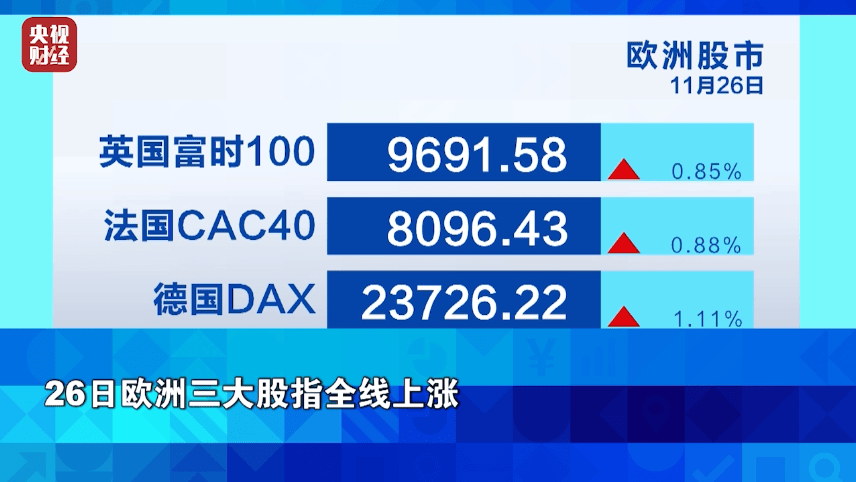
Group 1 - The Federal Reserve's latest Beige Book indicates a further decline in overall consumer spending in the U.S. and signs of weakness in the job market, with AI technology applications suppressing hiring demand and tariff policies increasing costs for U.S. manufacturing and retail sectors [1] - Economic data reflects a slowdown in consumer spending growth, raising concerns about the job market, leading to heightened expectations for a 25 basis point rate cut by the Federal Reserve in December, with over 90% probability according to the interest rate swap market [1] - U.S. technology stocks, including popular chip and AI concept stocks, rebounded on the news, with major indices closing higher: Dow Jones up 0.67%, S&P 500 up 0.69%, and Nasdaq up 0.82% [1] Group 2 - In Europe, the rising expectations for a Federal Reserve rate cut and potential peace talks regarding the Russia-Ukraine conflict have boosted market risk appetite, leading to gains in retail, banking, and defense stocks, with all major European indices closing higher: UK up 0.85%, France up 0.88%, and Germany up 1.11% [3] Group 3 - The U.S. Energy Information Administration reported a significant increase in daily crude oil imports by 1.05 million barrels, reaching a two-month high, indicating a rebound in oil consumption demand ahead of the holiday season, which contributed to a rise in international oil prices [5] - As of the close, light crude oil futures for January delivery were priced at $58.65 per barrel, up 1.21%, while Brent crude oil futures for January delivery closed at $63.13 per barrel, up 1.04% [5] Group 4 - The market's anticipation of a Federal Reserve rate cut in December, along with the leading "dovish" candidates for the next Fed chair, has led to a favorable outlook for continued monetary easing, resulting in a decline in U.S. Treasury yields and the dollar index, which in turn significantly boosted international gold prices [8] - As of the close, December gold futures were priced at $4,202.3 per ounce, reflecting a 1.50% increase [8]
按兵不动!韩国央行不降息,背后有哪些考虑?
Sou Hu Cai Jing· 2025-11-27 03:32
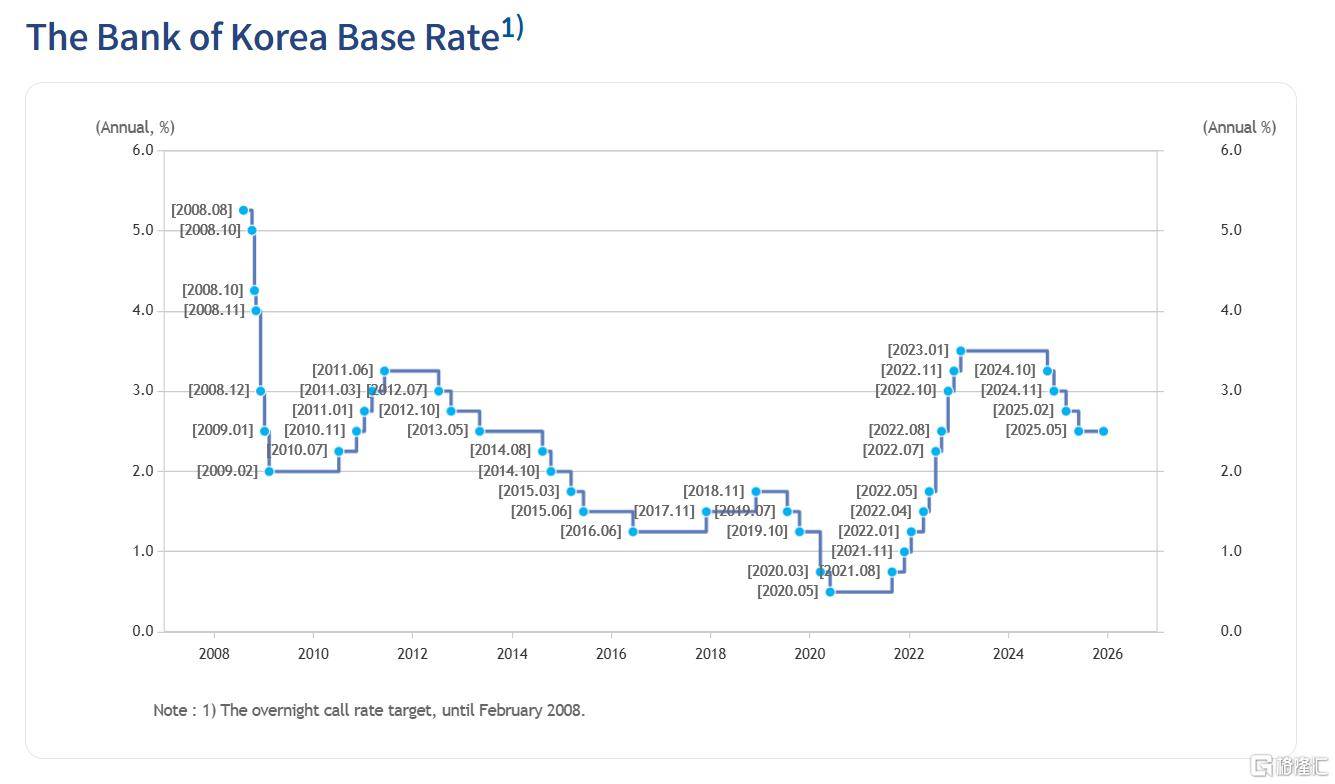
Group 1 - The Bank of Korea has shifted to a loose monetary policy since October last year, with multiple rate cuts due to weak domestic demand and the impact of U.S. tariffs [3][4] - The current benchmark interest rate is maintained at 2.50%, with analysts suggesting that further rate cuts remain an option if financial stability risks ease [3][7] - Economic growth in South Korea is projected at 1.8% for next year, with inflation rates expected to stabilize around 2.1% for 2025 and 2026 [5][6] Group 2 - Despite a slight increase in inflation, the economic outlook remains uncertain, with financial stability risks still present [4] - The Korean economy is showing improvement driven by consumer recovery and export growth, although construction investment remains weak [4][5] - The depreciation of the Korean won against the U.S. dollar is partly due to domestic investors' overseas securities investments and net selling by foreign investors in the domestic stock market [5][9] Group 3 - The Bank of Korea is monitoring the housing market risks in Seoul, as recent government policies have not significantly improved housing prices [12][13] - The Consumer Price Index (CPI) rose by 2.4% year-on-year in October, marking the largest increase since July 2024, with inflation rates exceeding the central bank's 2% target for several months [14][13] - Citigroup predicts that South Korea's GDP growth could reach 2.2% in 2026, supported by a recovery in the semiconductor industry and low inflation [15][18]
银行贷款利率低位运行在三方面产生积极影响
Guo Ji Jin Rong Bao· 2025-11-25 13:40
Core Viewpoint - The recent decline in loan interest rates in China's banking sector is a result of the central bank's effective monetary policy, which aims to stimulate economic recovery and consumer spending by lowering financing costs for businesses and households [1][2][3] Group 1: Impact of Low Loan Rates - The average interest rate for new corporate loans in October was 3.1%, down approximately 40 basis points year-on-year, while the rate for personal housing loans was also 3.1%, down about 8 basis points [1] - The low loan rates indicate the success of the central bank's accommodative monetary policy, which includes multiple reserve requirement ratio cuts and reductions in the Loan Prime Rate (LPR), aimed at creating a favorable borrowing environment for the real economy [1][2] - The central bank's actions, including 12 reserve requirement ratio cuts releasing about 9 trillion yuan in long-term liquidity and 9 policy rate cuts, have significantly contributed to the current low interest rates [1] Group 2: Alleviation of Financing Challenges - The release of 9 trillion yuan in long-term funds has alleviated the "expensive, difficult, and short" financing bottlenecks, creating a more relaxed credit environment for businesses and households [2] - The reduction in average corporate loan rates to 3.1% and personal housing loan rates to the same level has significantly lowered financing costs, enabling businesses to invest more in research and development and expansion [2] - A more relaxed credit environment boosts confidence among business entities and stimulates consumer demand, contributing positively to domestic demand [2] Group 3: International Financial Stability - The alignment of domestic and international interest rates helps prevent cross-border capital arbitrage and maintains financial stability in China [3] - The central bank's shift from a "prudent" to a "moderately accommodative" monetary policy is designed to support domestic economic recovery while mitigating external financial shocks [3] - By adjusting policy rates to a moderately accommodative level, the central bank aims to reduce interest rate differentials and ensure financial security amid global economic uncertainties [3]
宝城期货国债期货早报(2025年11月21日)-20251121
Bao Cheng Qi Huo· 2025-11-21 01:50
Report Summary 1. Report Industry Investment Rating - Not provided in the given content. 2. Core View of the Report - The overall view of treasury bond futures is to maintain a sideways consolidation in the short term. The short - term expectation of interest rate cuts has decreased, while the medium - to - long - term expectation of a loose monetary environment still exists. The market driving force is weak, and there is a divergence in the trends among different varieties [1][5]. 3. Summary by Relevant Catalogs 3.1 Variety View Reference - Financial Futures Stock Index Sector - For the TL2512 variety, the short - term view is sideways, the medium - term view is sideways, and the intraday view is weak. The reference view is sideways consolidation. The core logic is that the short - term expectation of interest rate cuts has decreased, while the medium - to - long - term loose expectation still exists [1]. 3.2 Main Variety Price Market Driving Logic - Financial Futures Stock Index Sector - The varieties include TL, T, TF, and TS. The intraday view is weak, the medium - term view is sideways, and the reference view is sideways consolidation. The core logic is that treasury bond futures continued to move in a sideways consolidation yesterday, with a divergence in the trends among varieties. The market driving force is weak. The 1 - year and 5 - year LPR remained unchanged yesterday, resulting in a weak short - term expectation of interest rate cuts. The latest economic data such as consumption, investment, and exports have weakened, indicating a lack of effective domestic demand. A relatively loose monetary environment is needed in the medium - to - long - term to stabilize domestic demand, providing strong support for treasury bond futures. However, there is no strong need for the policy side to increase efforts this year, and the possibility of a short - term policy interest rate cut is low, resulting in insufficient upward momentum for treasury bond futures [5].
203%!黄金ETF破2300亿,中国大妈笑醒,美联储权力更迭前的疯狂
Sou Hu Cai Jing· 2025-11-20 16:14
看着手机银行里黄金资产的数字,55岁的刘阿姨有点不敢相信自己的眼睛。 仅仅一年时间,她之前"被套"的黄金投资不仅全部解套,还实现了超过50%的收 益。 这个早晨,她和跳舞的姐妹们讨论的不再是菜价,而是该不该继续加仓黄金。 这样的场景不仅发生在广场舞大妈之间。 2025年11月,国内黄金ETF总规模已经突破2300亿元,较年初暴增超过200%。 数百亿资金正以前所未有的速度涌 入这个曾经相对小众的市场。 与此同时,在大洋彼岸,一场可能影响全球资金流向的权力更迭正在悄悄进行。 美国总统特朗普已在白宫椭圆形办公室宣布,下任美联储主席人选的面试 工作正式启动。 财政部长贝森特进一步披露,特朗普将在12月中旬与最后三名候选人会面,最终人选有望在圣诞节前敲定。 五位候选人组成了一个"兼顾理论与实践"的组合,包括现任美联储理事沃勒、鲍曼、前理事沃什、白宫国家经济委员会主任哈西特,以及贝莱德集团管理层 里德。 市场分析显示,这些候选人多数呈现鸽派倾向,预示着未来可能维持甚至加大宽松货币政策。 美联储领导层的更迭正发生在全球市场的敏感时刻。 2025年9月,美联储启动了降息周期,将联邦基金利率下调25个基点。 随后在10月再次 ...