马太效应

Search documents
外卖大战时代的新茶饮,原来是生死内功局
3 6 Ke· 2025-09-03 07:20
Core Viewpoint - The recent delivery subsidy war has led to a temporary boost in sales for tea beverage stocks, particularly milk tea, but raises questions about the sustainability of this growth once subsidies are withdrawn [1][5][11]. Group 1: Financial Performance of Listed Tea Beverage Companies - Six listed tea beverage companies have shown a divergence in their financial performance for the first half of 2025, with significant differences in revenue growth and profitability [2]. - Mixue Group reported a revenue of 14.87 billion yuan, a year-on-year increase of 39.3%, and a net profit of 2.72 billion yuan, up 44.1% [2]. - Gu Ming achieved a net profit of approximately 1.625 billion yuan, a staggering increase of 121.5%, with revenue of 5.663 billion yuan, up 41.2% [3]. - Other companies like Hu Shang A Yi and Cha Bai Dao showed modest growth, while Ba Wang Cha Ji experienced a decline in net profit despite revenue growth [4]. - Nai Xue's Tea reported a revenue of 2.178 billion yuan, a decline of 14.4%, and a net loss of 118 million yuan, indicating significant challenges in maintaining market position [4]. Group 2: Impact of Delivery Subsidy War - The delivery subsidy war has unexpectedly disrupted the tea beverage industry, with analysts suggesting that subsidy resources will increasingly concentrate on leading brands [5][7]. - High order volumes are primarily manageable by top tea beverage brands, which possess the necessary supply chain capabilities to meet increased demand [5][8]. - The competition has led to a "Matthew Effect," where companies with strong supply chains benefit the most, while smaller brands struggle to survive [8][11]. - Gu Ming reported a peak weekly delivery order volume of over 8 million, a threefold increase compared to normal levels, highlighting the impact of the subsidy war on operational capacity [8]. Group 3: Future Industry Trends - As subsidies are expected to diminish, the demand stimulated by these incentives may also decline, leading to a potential market shakeout [11][12]. - Companies are encouraged to focus on strengthening their supply chains and diversifying product offerings to remain competitive in a challenging market environment [12][13]. - The introduction of coffee products by brands like Gu Ming and Mixue indicates a strategic shift towards cross-category competition, which may become a key growth area [9][12].

24家理财公司净利合计超156亿元 万亿头部玩家喜忧参半
Bei Jing Shang Bao· 2025-09-03 00:56
Core Viewpoint - The performance of bank wealth management companies in the first half of 2025 shows a mixed trend, with a total net profit of 15.667 billion yuan, indicating growth for most companies while some experienced declines [1][2]. Profitability - A total of 24 banks reported their wealth management companies' performance, achieving a combined net profit of 15.667 billion yuan [2]. - Leading wealth management companies include Zhaoyin Wealth Management with a net profit of 1.364 billion yuan, followed by Bank of China Wealth Management and Agricultural Bank Wealth Management, each exceeding 1 billion yuan [2]. Growth Rate - Wealth management companies displayed significant differentiation in growth rates, with Puyin Wealth Management achieving the highest net profit growth of 76.19%, reaching 925 million yuan [3]. - Other companies like Bank of China Wealth Management and Huaxia Wealth Management also showed strong growth, with net profit growth rates exceeding 20% [3]. Declines in Profit - Some wealth management companies, such as Ping An Wealth Management, reported a decline in net profit, with a decrease of 41.28% to 700 million yuan [4]. - Factors contributing to the profit pressure include the limitations of scale effects and the industry's trend of reducing fees, which compresses profit margins [4]. Industry Scale - As of June 2025, the total number of wealth management products reached 27.48 trillion yuan, reflecting a year-on-year growth of 12.98% [5]. - Zhaoyin Wealth Management leads the industry with an asset management scale of 2.46 trillion yuan, although it experienced a slight decline compared to the previous year [5][6]. Competitive Landscape - The industry is characterized by a "Matthew Effect," where leading institutions consolidate their positions through comprehensive advantages in research, risk control, and distribution channels [7]. - Smaller institutions face challenges in customer acquisition and asset gathering, necessitating a shift towards niche markets or partnerships [7]. Future Opportunities - The recovery of the equity market and the growing acceptance of retirement wealth management products present new development opportunities for wealth management companies [7]. - Companies are encouraged to innovate product offerings and enhance investor education to adapt to changing market dynamics [7].
自主品牌8月份销量揭榜:4家车企进入“25万辆俱乐部”
Zheng Quan Ri Bao Zhi Sheng· 2025-09-02 16:39
Core Insights - In August, major domestic automakers such as BYD, SAIC Group, FAW Group, and Geely all surpassed 250,000 units in vehicle sales, collectively contributing over 1.26 million units, becoming the core engine of industry growth [1][2] - The differentiation among leading automakers is becoming more pronounced, shifting from mere sales figures to multiple dimensions including technology reserves, market layout, brand premium, and profitability [1] Company Performance - BYD led the market with sales of 373,600 units in August, achieving a cumulative sales figure of 2.86 million units for the first eight months of the year, reflecting a year-on-year growth of 23.5% [1] - SAIC Group followed closely with sales of 363,400 units in August, marking a year-on-year increase of 41.04%, with significant growth in joint venture brands and steady expansion in new energy vehicles [2] - FAW Group reported sales of 277,800 units in August, with a cumulative total of 2.08 million units for the first eight months, focusing on structural upgrades in its self-owned brands [2] - Geely's August sales reached 250,200 units, a 38% year-on-year increase, with new energy vehicles accounting for over half of its sales, demonstrating its commitment to transformation [2] Market Trends - The performance of other automakers shows a clear divide, with some achieving growth through niche market advantages while others lag due to issues in technology reserves and product iteration [3] - Chery Group sold 242,700 units in August, with a year-on-year increase of 14.6%, driven by strong export performance and steady growth in new energy vehicles [3] - Chang'an Automobile reported sales of 233,000 units in August, with new energy vehicle sales growing by 80%, although its joint venture brands remain weak [3] - The upcoming "Golden September and Silver October" sales season is expected to intensify competition among automakers, with many planning to launch new products to enhance their product matrix [4]



金融中报观|24家理财公司净利超156亿元 万亿头部玩家喜忧参半
Bei Jing Shang Bao· 2025-09-02 15:22
Core Viewpoint - The performance of bank wealth management companies in the first half of 2025 shows a mixed trend, with a total net profit of 15.667 billion yuan, indicating growth for most companies while some experienced declines [1][2]. Profitability - A total of 24 banks reported their wealth management companies' performance, achieving a combined net profit of 15.667 billion yuan [2]. - Leading wealth management companies include Zhaoyin Wealth Management with a net profit of 1.364 billion yuan, followed by Bank of China Wealth Management and Agricultural Bank Wealth Management, each exceeding 1 billion yuan [2]. Growth Rate - Wealth management companies displayed significant differentiation in growth rates, with Puyin Wealth Management achieving the highest net profit growth of 76.19%, reaching 925 million yuan [3]. - Other companies like Bank of China Wealth Management and Huaxia Wealth Management also showed strong growth, with net profit growth rates exceeding 20% [3]. Declines in Profit - Some wealth management companies, such as Ping An Wealth Management, reported a decline in net profit, with a decrease of 41.28% to 700 million yuan [4]. - Factors contributing to the profit pressure include the limitations of scale effects and the industry's trend of reducing fees, which compresses profit margins [4]. Market Size and Trends - As of June 2025, the wealth management market saw a total of 27.48 trillion yuan in assets under management, reflecting a year-to-date growth of 4.44% and a year-on-year increase of 12.98% [5]. - Zhaoyin Wealth Management leads the market with an asset management scale of 2.46 trillion yuan, although it experienced a slight decline compared to the previous year [5][6]. Competitive Landscape - The market is characterized by a "Matthew Effect," where leading institutions consolidate their positions through comprehensive advantages in research, risk control, and distribution channels [7]. - Smaller institutions face challenges in customer acquisition and asset gathering, necessitating a shift towards niche markets or partnerships [7]. Future Opportunities - The recovery of equity markets and the growing acceptance of retirement wealth management products present new growth opportunities for wealth management companies [7]. - Companies are encouraged to innovate product offerings and enhance investor education to adapt to changing market dynamics [7].
金融中报观|24家理财公司净利超156亿元,万亿头部玩家喜忧参半
Bei Jing Shang Bao· 2025-09-02 15:11
Core Insights - The overall performance of bank wealth management companies in the first half of 2025 shows a majority of profit growth, with a total net profit of 15.667 billion yuan reported by 24 banks [1][3][4] - There is a significant divergence in the growth rates of different wealth management companies, with some achieving over 10% growth while others experienced declines [1][4][5] Profitability - The leading wealth management companies dominate the profit landscape, with Zhaoyin Wealth Management reporting the highest net profit of 1.364 billion yuan, followed closely by Bank of China Wealth Management and others, all exceeding 1 billion yuan [3][4] - The second tier includes companies like ICBC Wealth Management and Ping An Wealth Management, with net profits ranging from 700 million to 1 billion yuan [3][4] Growth Rates - The highest net profit growth rate was observed in Pudong Development Bank Wealth Management, which achieved a 76.19% year-on-year increase, followed by Shangyin Wealth Management and Chongqing Rural Commercial Bank Wealth Management with growth rates of 37.35% and 28.26% respectively [4][5] - Several companies, including Bank of China Wealth Management and Huaxia Wealth Management, also demonstrated strong growth momentum with over 20% year-on-year increases [4] Market Trends - The wealth management market is experiencing a shift towards net value products, with a total of 27.48 trillion yuan in assets under management as of June 2025, reflecting a 4.44% increase from the beginning of the year [6][7] - The top players, including Zhaoyin Wealth Management, continue to lead the market, although some have seen slight declines in asset management scale compared to the previous year [6][7] Competitive Landscape - The market is characterized by a "Matthew Effect," where leading institutions consolidate their positions through superior research, risk control, and distribution channels, thereby increasing pressure on smaller firms [8] - Smaller institutions are advised to focus on niche markets or seek partnerships to survive in a competitive environment [8] Future Opportunities - Analysts suggest that the recovery of equity markets and the growing acceptance of retirement wealth management products present new growth opportunities for wealth management companies [8] - Companies are encouraged to innovate product offerings, such as low-volatility equity products and target-date retirement plans, to attract investors [8]

24家理财公司净利超156亿元,万亿头部玩家喜忧参半
Bei Jing Shang Bao· 2025-09-02 15:10
Core Insights - The report highlights the performance of 24 banks' wealth management companies in the first half of 2025, showing a total net profit of 15.667 billion yuan, with most companies experiencing growth while a few faced declines [1][3][4] Group 1: Profitability - The leading wealth management company, Zhaoyin Wealth Management, reported a net profit of 1.364 billion yuan, followed by several others exceeding 1 billion yuan, including Bank of China Wealth Management and Agricultural Bank Wealth Management [3][4] - The second tier of companies, such as ICBC Wealth Management and Ping An Wealth Management, reported net profits ranging from 700 million to 1 billion yuan [3][4] Group 2: Growth Rates - The highest net profit growth rate was observed in Pudong Wealth Management, with a year-on-year increase of 76.19%, followed by Shangyin Wealth Management and Chongqing Rural Commercial Bank Wealth Management with growth rates of 37.35% and 28.26% respectively [4][5] - Several companies, including Bank of China Wealth Management and Huaxia Wealth Management, also demonstrated strong growth, with net profit growth rates exceeding 20% [4] Group 3: Market Trends - The wealth management market is experiencing a shift as residents move towards net value-based products due to declining deposit rates, leading to stable inflows into the wealth management sector [4][8] - The total number of wealth management products reached 27.48 trillion yuan by mid-2025, reflecting a 4.44% increase from the beginning of the year and a 12.98% year-on-year growth [6][7] Group 4: Competitive Landscape - Major players like Zhaoyin Wealth Management maintain a strong market position with an asset management scale of 2.46 trillion yuan, although it saw a slight decline from the previous year [6][7] - The report indicates a "Matthew Effect" in the industry, where leading institutions consolidate their positions, making it challenging for smaller firms to compete [8] Group 5: Strategic Recommendations - Analysts suggest that wealth management companies should enhance their multi-asset research capabilities, innovate product differentiation, improve digital operational efficiency, and strengthen comprehensive risk management systems to build core competitiveness [1][8] - There is an opportunity for wealth management firms to develop low-volatility equity products and target date/target risk retirement products to cater to evolving market demands [8]


近30家公募上半年业绩曝光:易方达净利领跑,3家中小公司亏损超千万
Mei Ri Jing Ji Xin Wen· 2025-09-02 12:43
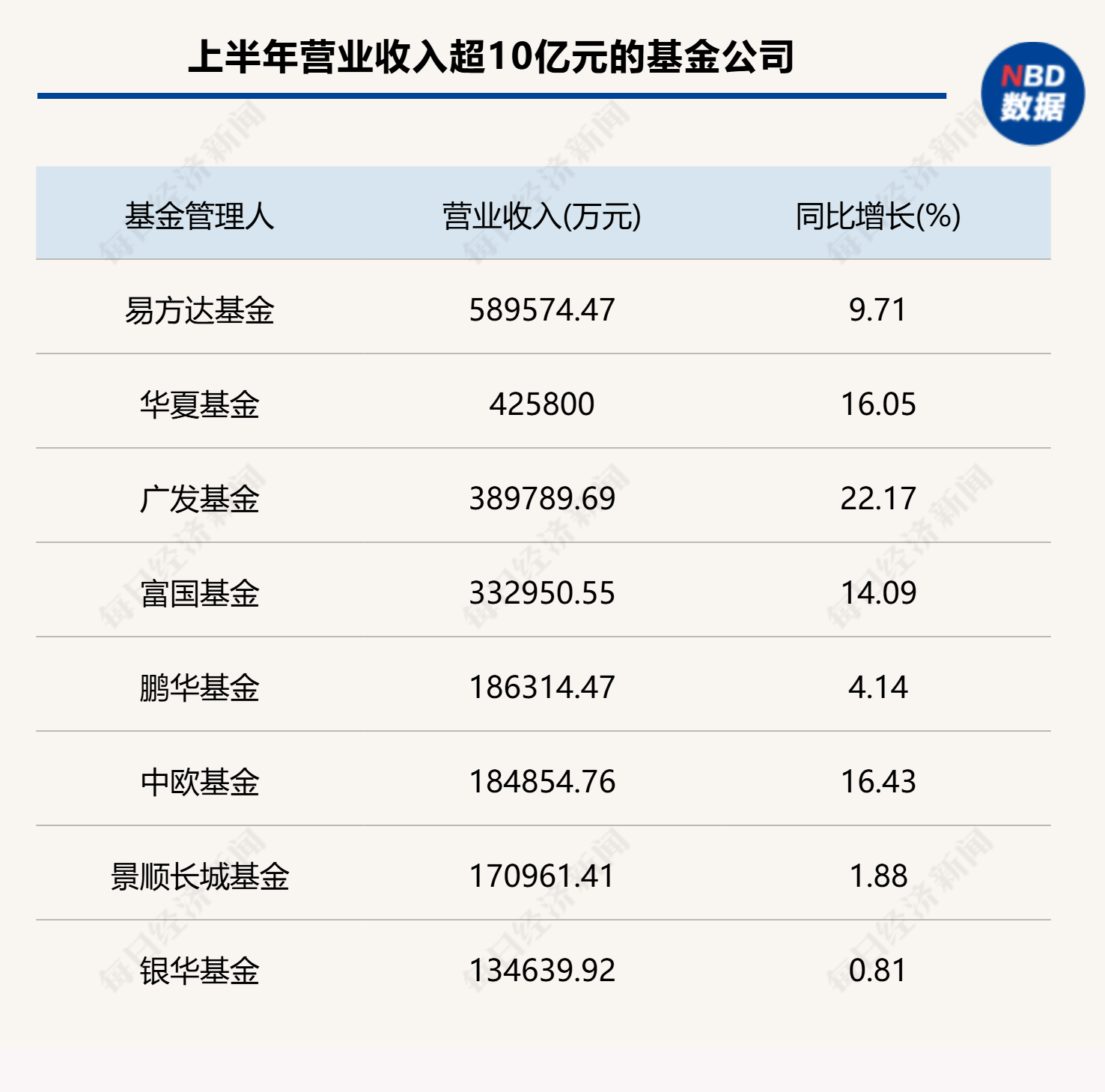
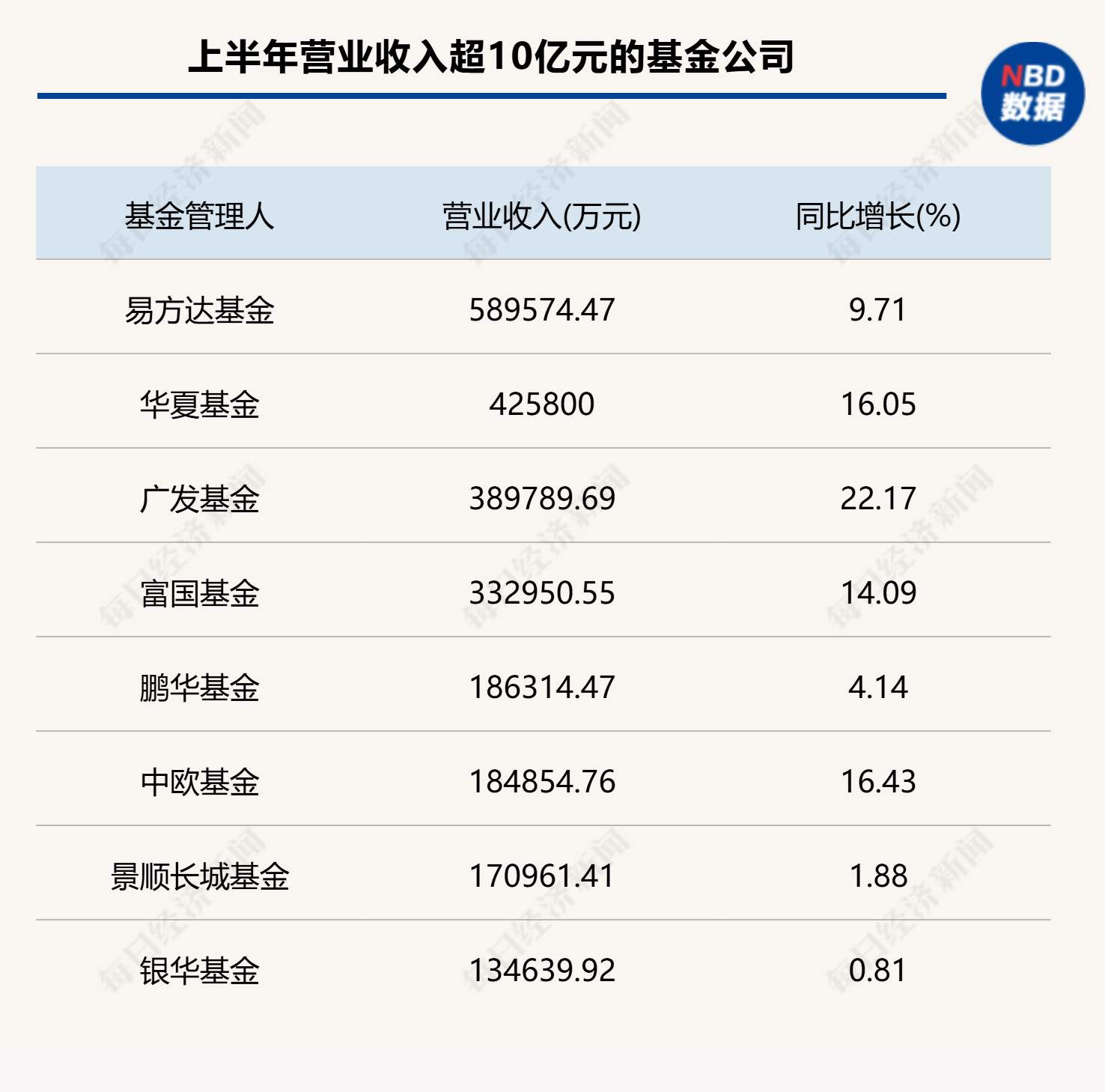
Core Insights - The performance of public mutual funds in the first half of 2025 shows significant disparities, with leading firms achieving substantial profits while several smaller firms reported losses [1][11][12] Revenue Performance - A total of 28 public fund companies have reported their revenue, with 8 companies exceeding 1 billion yuan in revenue [2][4] - The top three companies by revenue are: - E Fund: 58.96 billion yuan - Huaxia Fund: 42.58 billion yuan - GF Fund: 38.98 billion yuan [2][4] - Notably, some companies experienced remarkable revenue growth, such as Su Xin Fund, which saw a 4079.97% increase, albeit with a low revenue of 2.33 million yuan [4][11] Profitability Analysis - Among the fund companies, 11 reported net profits exceeding 100 million yuan, with E Fund leading at 18.77 billion yuan, followed by GF Fund at 11.8 billion yuan and Huaxia Fund at 11.23 billion yuan [5][9] - Conversely, several smaller firms, including Jiangxin Fund, Zheshang Fund, and Huaxi Fund, reported losses exceeding 10 million yuan [8][12] Growth Trends - 11 companies experienced a year-on-year revenue growth of over 10%, with notable increases from smaller firms [4][11] - E Fund, Huaxia Fund, and GF Fund also maintained strong growth rates, with increases of 9.71%, 16.05%, and 22.17% respectively [9][10] Market Dynamics - The disparity between large and small fund companies is widening, with larger firms benefiting from comprehensive product lines and robust research capabilities [11][12] - Smaller firms often struggle due to limited resources and market presence, leading to a reliance on a narrow range of products [12]
近30家公募上半年业绩曝光:易方达净利18.77亿元领跑,3家中小公司亏损超千万
Mei Ri Jing Ji Xin Wen· 2025-09-02 12:26
Core Insights - The performance of publicly offered fund companies in the first half of 2025 shows a significant disparity between leading firms and smaller firms, with top companies achieving substantial profits while many smaller firms face losses [1][11]. Revenue Performance - A total of 28 fund companies have reported their revenue, with 22 companies generating over 100 million yuan, and 8 companies exceeding 1 billion yuan in revenue [2][4]. - The top three fund companies by revenue are E Fund, Huaxia Fund, and GF Fund, with revenues of 5.896 billion yuan, 4.258 billion yuan, and 3.898 billion yuan respectively [2][4]. - Notably, some companies have only disclosed net profit data, indicating that the number of companies with revenues exceeding 1 billion yuan may be higher [2]. Profitability Analysis - Among the fund companies with available data, 11 companies reported net profits exceeding 100 million yuan, with E Fund, GF Fund, and Huaxia Fund leading with net profits of 1.877 billion yuan, 1.178 billion yuan, and 1.123 billion yuan respectively [5][8]. - Conversely, several companies reported significant losses, with Jiangxin Fund, Zheshang Fund, and Huaxi Fund each losing over 10 million yuan [8]. Growth Trends - Eleven companies experienced a year-on-year revenue growth of over 10%, with notable growth from smaller firms like Suxin Fund, which saw a staggering increase of 4079.97% despite low revenue [4][9]. - Larger firms also maintained strong growth, with GF Fund and Huaxia Fund reporting revenue growth rates of 22.17% and 16.05% respectively [4][9]. Market Dynamics - The gap between leading and smaller fund companies is widening, with top firms benefiting from comprehensive product lines and robust research capabilities, while smaller firms struggle due to limited resources and market presence [11][12]. - The current public fund industry is undergoing a phase of quality improvement, where leading companies leverage their scale and research advantages, while smaller firms need to find niche markets and develop unique products to survive [12].
中金:25H1商管运营商提效趋势延续 行业具备边际积极催化
智通财经网· 2025-09-02 06:26
Core Viewpoint - The report from CICC indicates that the performance of key commercial operators in the retail sector has shown differentiation in the first half of 2025, with expectations for leading companies to strengthen their competitive advantages in the medium to long term due to location, customer loyalty, and operational capabilities [1][5]. Group 1: Performance Overview - Key commercial operators reported their 1H25 performance, with China Resources Vientiane Life's core net profit increasing by 15%, while major Hong Kong developers saw a core net profit decline of 4-9%, aligning with market expectations [1]. - High-end commercial operators experienced an average same-store sales growth of 2.2% in 1H25, an increase of 8.6 percentage points compared to the full year of 2024, while mass-market operators saw a slight increase of 0.1 percentage points to 7.6% [2]. Group 2: Rental and Operational Efficiency - Rental income for major operators in mainland China showed resilience, with average rental growth of 0.5% in both 2024 and 1H25, which is significantly better than retail sales performance [3]. - Heavy asset operators reported a gross profit margin increase of 0.3 percentage points to 73.9%, indicating ongoing operational efficiency improvements [4]. Group 3: Future Trends - The industry is expected to benefit from a "Matthew Effect," with leading commercial operators likely to solidify their competitive barriers in the medium to long term [5]. - The second half of the year is anticipated to have positive catalysts, including low base effects from last year's retail sales and continued supportive consumption policies [5]. Group 4: Investment Recommendations - The report recommends China Resources Vientiane Life and Swire Properties for their dual returns of growth and dividends, while suggesting to accumulate Hongkong Land at lower prices to capitalize on the Federal Reserve's interest rate cut window [6].


券商分仓佣金排行榜来了!行业下滑超30% “黑马”却暴增21倍
Zheng Quan Shi Bao Wang· 2025-09-01 05:21
Core Viewpoint - The overall commission income from brokerage firms has significantly declined due to the implementation of new regulations, with a notable drop of over 30% year-on-year in the first half of 2025 [1][6]. Brokerage Commission Data - In the first half of 2025, the total commission income from brokerage firms was 44.58 billion yuan, reflecting a decline of more than 30% compared to the previous year [1]. - The top ten brokerage firms maintained a stable position, collectively holding a market share of 48.11%, with total commission income amounting to 21.52 billion yuan [3]. - CITIC Securities ranked first with a commission income of 3.47 billion yuan, followed by Guotai Junan with 2.83 billion yuan, and GF Securities and Changjiang Securities with 2.51 billion yuan and 2.30 billion yuan, respectively [3][4]. Industry Trends - The "Matthew Effect" is becoming increasingly evident in the brokerage industry, with larger firms consolidating their market positions [1]. - Smaller brokerage firms like Huafu Securities and Huayuan Securities have shown resilience, achieving significant growth despite the overall industry decline [7]. Regulatory Impact - The new commission regulations, effective from July 1, 2024, are expected to standardize commission rates, leading to an anticipated 40% reduction in trading commission fees [6]. - The impact of these regulations is already visible, with major firms like Zhongxin JianTou experiencing a 53.70% decline in commission income [6]. Emerging Business Models - The brokerage industry is increasingly focusing on the "券结模式" (券结 model), which has gained traction post-regulation, allowing firms to enhance their service capabilities [8][9]. - In the first half of 2025, commissions from the券结 model accounted for 12.44% of total commissions, with CITIC Securities leading this segment [8]. Research and Development Focus - Firms like Shenwan Hongyuan are emphasizing research capabilities to adapt to market changes, integrating research with business services to enhance client decision-making [4]. - The establishment of specialized research centers within firms is aimed at fostering talent and providing in-depth analysis across various sectors [7].