
自动驾驶

Search documents
企业竞争图谱:2025年智能物流车,头豹词条报告系列
Tou Bao Yan Jiu Yuan· 2025-11-25 12:44
Investment Rating - The report rates the smart logistics vehicle industry with a compound annual growth rate (CAGR) of 74.76% from 2025 to 2030, with the market size expected to grow from 0.511 billion to 8.337 billion [30]. Core Insights - The smart logistics vehicle industry has evolved from a technology incubation phase (2015-2019) to a large-scale development phase (2020-2022), and is currently in a scenario pilot phase since 2023, with significant cost reductions and regulatory improvements facilitating commercialization [4][13]. - The industry faces three main bottlenecks: technological limitations, insufficient infrastructure, and a lack of regulatory frameworks [12]. - The logistics cost pressure is driving the adoption of smart logistics vehicles, as last-mile delivery costs have risen significantly, prompting companies to seek automation solutions [11]. Summary by Sections Industry Definition - The definition of unmanned delivery vehicles varies, with the industry leaning towards classifying them as N1 (total mass less than 3,500 kg) and A class (equipped with autonomous driving systems) vehicles [5]. Industry Classification - Unmanned logistics vehicles are categorized into low-speed, medium-speed, and other unmanned delivery vehicles based on their maximum design speed [6][7][8]. Development History - The industry has undergone a complete development cycle since 2015, with key milestones including the introduction of various unmanned delivery vehicles and significant policy support in China [13][14][16][17]. Industry Chain Analysis - The industry chain consists of upstream core component suppliers, midstream solution providers, and downstream application segments focused on reducing last-mile delivery costs [18]. Cost and Technology Drivers - The significant reduction in core component prices has led to a drastic decrease in vehicle costs, facilitating commercialization [19][23]. - The industry is transitioning towards a lightweight perception approach, utilizing visual systems supplemented by minimal laser radar [27]. Market Size and Growth - The smart logistics vehicle market is projected to grow from 0.511 billion to 8.337 billion from 2025 to 2030, driven by the need for cost reduction and efficiency improvements in logistics [30][31]. Policy Overview - Various policies have been introduced to support the application of unmanned delivery vehicles, emphasizing their role in enhancing logistics efficiency and reducing costs [36][37]. Competitive Landscape - The competitive landscape is characterized by a tiered structure, with leading companies like Jiusi and New Stone Technology at the forefront, while others are positioned in the second and third tiers based on their market strategies and capital investments [38][39][40].
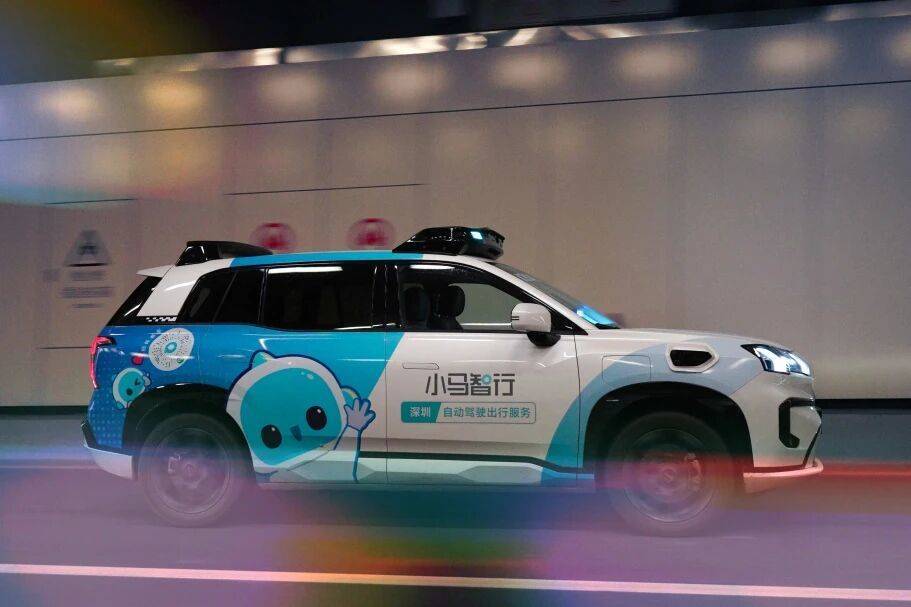
小马智行发布三季报:营收1.81亿元,城市级别单车盈利转正
Sou Hu Cai Jing· 2025-11-25 12:37
Core Insights - Pony.ai has achieved unit profitability for its seventh-generation Robotaxi in urban areas, marking a significant milestone in its business model [1] Financial Performance - In Q3 2025, Pony.ai reported total revenue of 181 million RMB, a 72% increase year-over-year [1] - Revenue from the Robotaxi business reached 47.7 million RMB, reflecting an 89.5% year-over-year growth, with passenger fare income increasing by over 200% [1] Production and Growth Plans - The total number of Robotaxi vehicles has reached 961, with 667 being the seventh-generation model; the company anticipates exceeding its target of 1,000 vehicles by the end of the year [1] - Pony.ai plans to triple its fleet size to over 3,000 vehicles by the end of 2026 [1] Business Expansion - In addition to the growth in the Robotaxi segment, Pony.ai's Robotruck and technology licensing businesses also saw year-over-year increases, with revenues of 72.5 million RMB and 61 million RMB, respectively, in Q3 2025 [1] - The company has announced collaborations with SANY Heavy Truck and Dongfeng Liuzhou Motor for the development of the fourth-generation Robotruck, with plans for mass production in 2026 and a target of over 1,000 units [1]

停工放假!毫末智行被曝“停摆”,内部人士称“来得很突然”
Nan Fang Du Shi Bao· 2025-11-25 12:07
"突然来了个停工通知,此前没有任何说辞。"毫末智行一位员工向南都·湾财社记者描述这两天的状 态,"同事们没办法,依然正常到岗。但早上还能正常打卡,现在发现已经无效了。但公司里不乏孕 妇、背负房贷车贷的员工。公司账户冻结得很突然,停工通知同样突然,高管至今没有发声。" 2025年11月24日,曾估值超10亿美元的自动驾驶独角兽企业——毫末智行科技有限公司(简称"毫末智 行"),被曝陷入全面停摆。多位公司内部人士向南都·湾财社证实,公司于11月22日下午通过内部群组 发布了"停工放假通知",宣布自11月24日起,北京、上海、深圳、保定四地所有在职员工停工放假,复 工时间另行通知。 一纸通知突袭全员,300名员工陷入困局 "通知是突然发的,没有任何预兆。"一位毫末智行员工向南都记者透露,通知内容极为简短,仅称"基 于公司经营现状",决定全员停工放假,但对停工期限、薪资发放、社保公积金缴纳以及赔偿方式等关 键问题只字未提,而公司核心管理层也集体沉默,只留下"复工待通知"的模糊表述。 "据传公司控制权早就在长城了,高管也无能为力。"一位公司内部人士透露,"极小部分员工收到了长 城的工作邀约,但此外没有看到任何引荐或者员 ...

盘前大涨超6%!城市级别单车盈利转正,小马智行Q3营收同比增72%,毛利率升至18.4%
美股IPO· 2025-11-25 11:20
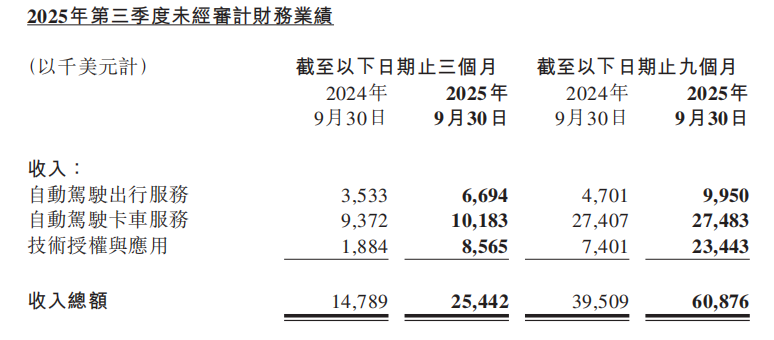
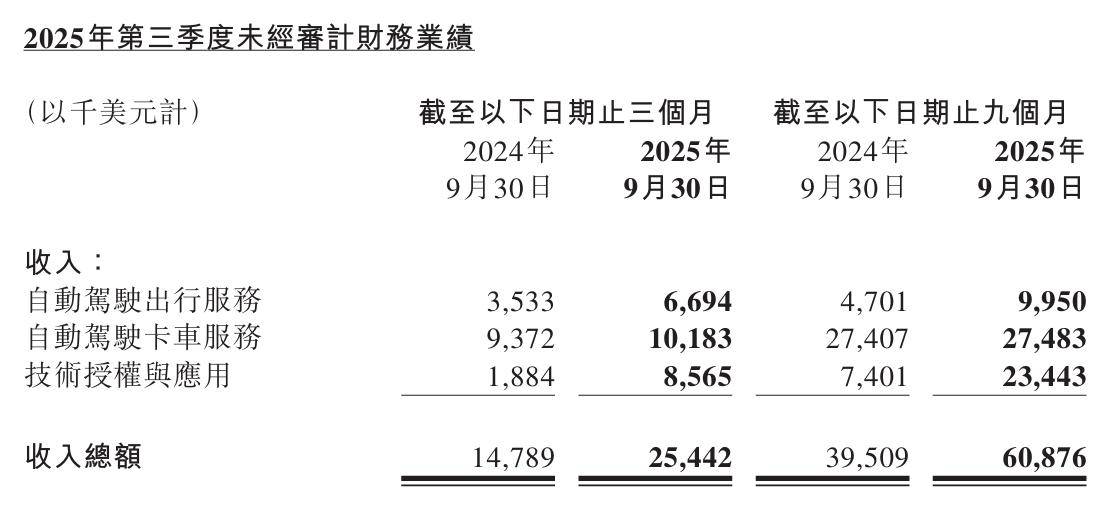
Core Viewpoint - The company reported a significant revenue growth of 72% year-on-year in Q3, driven primarily by its Robotaxi business, which achieved a milestone in urban single-vehicle profitability [1][3][9]. Revenue Performance - Total revenue for Q3 reached $25.4 million, marking a 72% increase compared to the previous year [5]. - Robotaxi service revenue was $6.7 million, up 89.5% year-on-year, with passenger fare revenue surging over 200% [1][5]. - Robotruck service revenue was $10.2 million, reflecting an 8.7% increase year-on-year [5]. - The overall gross margin improved to 18.4%, up from 9.2% in the same quarter last year [5][9]. Profitability Challenges - Despite revenue growth, the company faced a significant operating loss of $69.7 million and a net loss of $61.6 million [5][9]. - The company continues to experience structural challenges with "increasing revenue but not increasing profit" [4][9]. Cash Flow and Financial Health - As of the end of September, the company had cash and cash equivalents of $587.7 million, a decrease of $160 million from the end of June [10]. - The free cash flow outflow for the first nine months reached $173.6 million, primarily used for investments in joint ventures and operational expenses [10]. Commercialization Progress - The seventh-generation Robotaxi has been fully operational in cities like Guangzhou, Shenzhen, and Beijing, achieving urban single-vehicle profitability [7][12]. - The company is collaborating with partners to enhance capital efficiency through a light-asset model [7]. Cost Reduction and Technology Development - The company is focused on reducing costs, with the seventh-generation ADK system expected to see a 20% cost reduction by 2026 [12]. - The application of the "world model" PonyWorld has contributed to cost reductions through unsupervised training and AI learning [12].

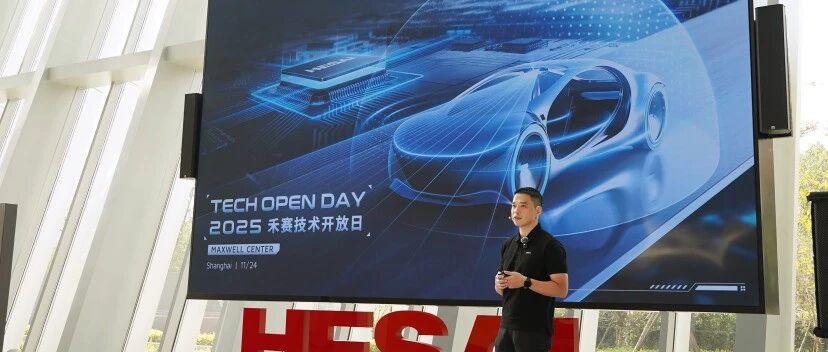
禾赛科技发布自研RISC-V激光雷达主控芯片费米C500,256线ATX升级焕新
IPO早知道· 2025-11-25 10:34
Core Viewpoint - HeSai Technology has officially launched the Fermi C500 chip based on RISC-V architecture and the updated ATX laser radar, which is set to begin mass production in April 2026 with over 4 million orders already secured [2][11]. Group 1: Product Development - The Fermi C500 chip completes HeSai's fourth-generation chip platform, integrating MCU, FPGA, and ADC into a single chip, ensuring supply chain security and technological independence [4]. - The ATX laser radar has been updated to include the Fermi C500 chip, featuring 256 lines and a maximum range of 230 meters, with a point frequency of 3,840,000 points per second, doubling the performance of the previous generation [9][11]. Group 2: Market Position and Achievements - HeSai is the only company in the industry to have fully self-developed all seven key components of laser radar, including laser drivers and digital signal processors [6]. - By November 2025, HeSai had delivered 185 million self-developed chips and achieved AEC-Q automotive certification for 16 chip models, ranking first globally [7]. Group 3: Industry Trends and Customer Base - The penetration rate of laser radar in new energy passenger vehicles has reached 20%, with one in five new cars equipped with it as standard [12]. - HeSai has secured partnerships with leading automotive manufacturers, including top European brands and major Chinese automakers, for the 2026 model year, ensuring 100% standardization of laser radar in their vehicles [12].

城市级别单车盈利转正,小马智行Q3营收同比增72%,毛利率升至18.4%|财报见闻
Hua Er Jie Jian Wen· 2025-11-25 10:21
Core Viewpoint - The autonomous driving company Pony.ai reported a 72% year-on-year revenue growth in Q3, primarily driven by strong performance in its Robotaxi business, achieving a key milestone of single-vehicle profitability in Guangzhou with its seventh-generation Robotaxi [1][6]. Financial Performance - Total revenue for Q3 reached $25.4 million, marking a 72% increase year-on-year, with significant contributions from various service segments [4][6]. - The revenue breakdown includes: - Autonomous driving ride-hailing services: $3.53 million for Q3 2025, up 89.5% from $0.35 million in Q3 2024 [4]. - Autonomous truck services: $1.02 million for Q3 2025, an 8.7% increase from $0.94 million in Q3 2024 [4]. - Technology licensing and applications: $0.86 million for Q3 2025, a 354.6% increase [8]. - Gross margin improved to 18.4% from 9.2% year-on-year, driven by a higher proportion of high-margin ride-hailing service revenue [6]. Operational Developments - The seventh-generation autonomous driving taxi has commenced full commercial operations in Guangzhou, Shenzhen, and Beijing, achieving a significant operational milestone [5]. - The company is collaborating with partners like Xihu Group and Sunshine Travel to enhance capital efficiency through a light-asset cooperation model [5]. Cost and Cash Flow Management - Operating expenses surged by 76.7% year-on-year to $7.43 million, with R&D expenses of $1.27 million allocated to the development of the seventh-generation system [6]. - As of September, the company had cash and cash equivalents of $587.7 million, down $160 million from June, with a cumulative free cash outflow of $173.6 million for the first nine months [7]. Technological Advancements - The company aims to reduce the cost of the seventh-generation ADK system by 20% from 2025 levels, with the fourth-generation autonomous truck's ADK cost reduced by 70% compared to the previous generation [8]. - The application of the "World Model" PonyWorld is expected to contribute to cost reductions through unsupervised closed-loop training and AI-driven learning [8].
小马智行第三季度营收同比增长72%,城市级单车盈利转正
Sou Hu Cai Jing· 2025-11-25 10:20
Core Viewpoint - The company reported a significant increase in revenue for Q3 2025, driven by strong growth in autonomous driving services and technology licensing, achieving a total revenue of $25.442 million, a 72% year-over-year increase [3][9]. Revenue Breakdown - Autonomous driving ride-hailing services generated $6.694 million in revenue, up 89.5% year-over-year, with passenger fare revenue increasing by over 200% due to rising demand in first-tier cities and optimized fleet operations [3][9]. - Autonomous truck services brought in $10.183 million, reflecting an 8.7% increase year-over-year, aided by the launch of the fourth-generation autonomous truck, which reduced the BOM cost by 70% compared to the previous generation [3][9]. - Revenue from technology licensing and applications surged to $8.565 million, a remarkable 354.6% increase year-over-year, driven by strong demand for autonomous driving domain controllers in the automated delivery sector [3][9]. Profitability Milestones - The company achieved city-level single-vehicle profitability for its seventh-generation Robotaxi, with an average of 23 orders per vehicle per day since the launch of commercial operations in Guangzhou [5][6]. - The total number of Robotaxi vehicles reached 961, with plans to expand to over 3,000 vehicles next year, exceeding the initial target of 1,000 vehicles for this year [8][9]. Cost Reduction and Efficiency - The fourth-generation Robotruck is set to enter mass production next year, with a fleet size expected to exceed 1,000 units, and a BOM cost reduction of over 70% compared to previous models [15]. - The innovative truck platooning scheme, which includes one lead vehicle with a safety driver and four fully autonomous following vehicles, is projected to reduce freight costs by over 29% and increase total freight profit by 195% based on current demonstration scenarios [17].
谷歌"全栈"反击,强势夺回AI主导权!
美股IPO· 2025-11-25 10:17
Core Viewpoint - Huatai Securities believes that Google is making a strong comeback with its self-developed TPU v7p chip and the Gemini model, establishing a full-stack AI ecosystem that enhances its competitive position in the market [1][3]. Cloud Business Growth - The TPU has driven a 34% growth in Google's cloud business, second only to Azure, with cloud revenue reaching $15.2 billion in Q3 [8]. - Google's cloud market share increased from 18.6% to 19.3% year-over-year, showcasing its competitive edge against AWS and Oracle [8]. AI Ecosystem and User Engagement - Google is building a self-sufficient ecosystem from chip (TPU v7p) to model (Gemini 3.0) to applications (search and Waymo), which is expected to translate into financial returns [3]. - Gemini has reached 650 million monthly active users, and the AI Overviews service has served over 2 billion users, indicating strong user engagement [11]. Search and Advertising Strength - Google's search market share has rebounded to over 90%, supported by robust advertising cash flow that funds AI investments [10][13]. - The advertising business, empowered by Gemini, shows strong monetization potential, providing a stable cash flow for ongoing capital expenditures [13]. Technological Advancements - The TPU v7p chip, with an FP8 computing power of 4.5 PF, directly competes with Nvidia's B300 chip, showcasing Google's technological leadership [7]. - Google has initiated TPU deployment to third-party cloud service providers, opening new growth avenues [7]. Future Projections - Huatai Securities has raised Google's target price to $380, indicating over an 18% upside potential, corresponding to a 30x PE ratio for 2026 [4][15]. - Revenue forecasts for Google have been adjusted upwards, with expected revenue of approximately $405.2 billion in 2025 and net profit of $131.5 billion [14].


小马智行第三季度营收1.81亿元,Robotaxi车辆总数已达961辆
Cai Jing Wang· 2025-11-25 10:04
Core Insights - The company reported a total revenue of 181 million RMB for Q3 2025, with the Robotaxi business generating 47.7 million RMB [1] - The total number of Robotaxi vehicles has reached 961, with 667 being the seventh generation, and the company anticipates exceeding its target of 1,000 vehicles by the end of the year [1] - The company plans to triple its fleet size to over 3,000 vehicles by the end of 2026 [1] - The head of the Robotaxi business indicated that achieving a fleet size of 1,000 vehicles is necessary for reaching the breakeven point in operations [1] - The company completed a dual listing on both the US and Hong Kong stock exchanges in early November [1]
小马智行-W发布第三季度业绩 收入总额约2540万美元 同比增长72%
Zhi Tong Cai Jing· 2025-11-25 09:45
Core Insights - The company reported a total revenue of $25.4 million (RMB 181 million) for Q3 2025, representing a 72.0% increase compared to $14.8 million in Q3 2024, driven by strong growth in autonomous driving ride-hailing services and technology licensing [1] - The gross margin improved to 18.4% in Q3 2025 from 9.2% in Q3 2024, primarily due to an optimized revenue structure with higher-margin autonomous driving ride-hailing services contributing significantly [1] - The net loss for the quarter was $61.6 million (RMB 438 million), with a basic loss per share of $0.16 [1] Financial Performance - Revenue growth of 72.0% year-over-year was attributed to robust performance in autonomous driving ride-hailing and technology licensing services [2] - The company achieved single-vehicle profitability for its seventh-generation autonomous taxi in urban areas [1] - The recent dual primary listing in Hong Kong raised over $800 million, aimed at accelerating mass production, commercialization, technology R&D, and market expansion [1] Operational Highlights - The seventh-generation autonomous taxi has officially commenced operations in major Chinese cities such as Guangzhou, Shenzhen, and Beijing, promoting the further adoption of fully autonomous ride-hailing services [2] - Revenue from autonomous driving ride-hailing services grew by 89.5% year-over-year, with passenger fare revenue surging over 200% [1] - The company plans to expand its fleet to over 3,000 vehicles by the end of next year, ahead of schedule [1] Technological Advancements - The company emphasizes its technological advantage through the use of a world model, which combines high-fidelity simulation and AI-based self-learning mechanisms for closed-loop training [2] - The seventh-generation autonomous taxi leverages this technological edge to convert it into scalable commercial value [2] - The company aims to attract top AI talent and continue investing in technology R&D to enhance its technical capabilities [2]