第四代自动驾驶卡车

Search documents
小马智行Q3实现营收1.81亿元,亏损为4.96亿元
Ju Chao Zi Xun· 2025-11-26 02:53
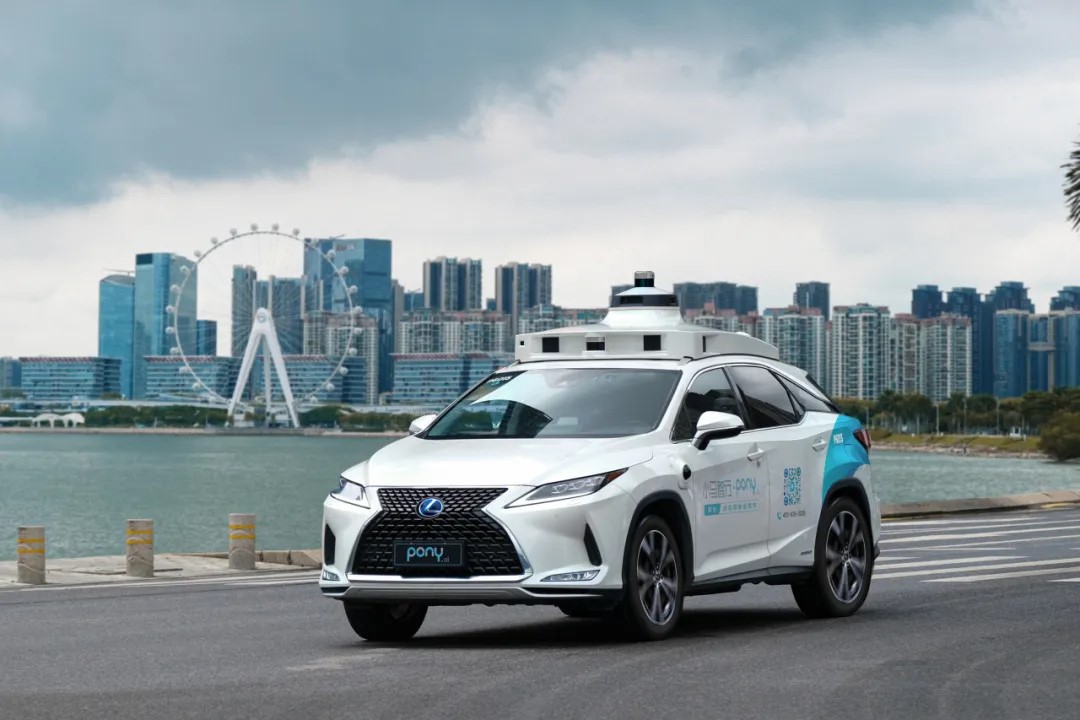
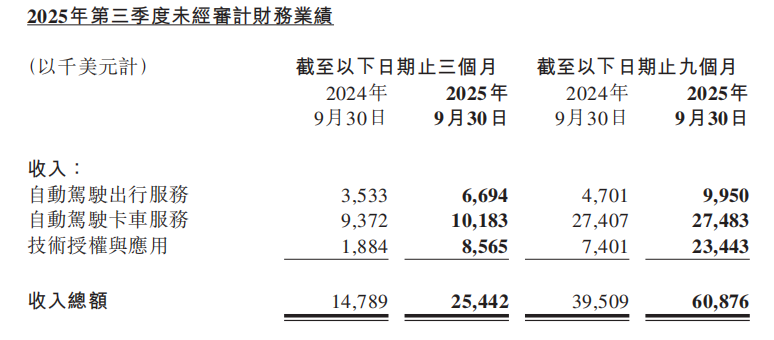
Core Insights - The company, Pony.ai, reported a significant revenue increase of 72% year-over-year for Q3 2025, reaching $25.4 million (approximately RMB 181 million) [2] - The Robotaxi fleet is nearing 1,000 vehicles, with the seventh-generation model achieving profitability in Guangzhou, marking a critical milestone in commercialization [2][6] Revenue Breakdown - Revenue from autonomous ride-hailing services reached $6.7 million (approximately RMB 47.7 million) in Q3 2025, reflecting an 89.5% increase year-over-year, with passenger fare revenue growing over 200% [5] - Autonomous trucking services generated $1.03 million (approximately RMB 7.25 million) in Q3 2025, an 8.7% increase year-over-year [5] - Revenue from technology licensing and applications surged by 354.6% year-over-year to $8.6 million (approximately RMB 61 million), driven by strong demand for autonomous driving domain controllers [4] Profitability and Expenses - The gross profit for Q3 2025 was $4.7 million (approximately RMB 33.2 million), with a gross margin of 18.4%, up from 9.2% in Q3 2024, attributed to an improved revenue mix [3] - R&D expenses increased by 79.6% year-over-year to $60.4 million (approximately RMB 429.9 million), primarily due to investments in the seventh-generation model and expansion of R&D personnel [4] Financial Position - As of September 30, the company had cash and cash equivalents totaling approximately RMB 4.184 billion, bolstered by an additional RMB 6 billion from its Hong Kong listing, providing ample funding for R&D and commercialization [6] Fleet Expansion and Market Strategy - The company aims to expand its Robotaxi fleet to over 3,000 vehicles by the end of 2026, tripling its current size [6] - Collaborations with major automotive manufacturers and ride-hailing platforms are being established to accelerate the deployment of autonomous vehicle fleets in major cities [7]

城市级别单车盈利转正,小马智行Q3营收同比增72%,毛利率升至18.4%|财报见闻
Hua Er Jie Jian Wen· 2025-11-25 10:21
Core Viewpoint - The autonomous driving company Pony.ai reported a 72% year-on-year revenue growth in Q3, primarily driven by strong performance in its Robotaxi business, achieving a key milestone of single-vehicle profitability in Guangzhou with its seventh-generation Robotaxi [1][6]. Financial Performance - Total revenue for Q3 reached $25.4 million, marking a 72% increase year-on-year, with significant contributions from various service segments [4][6]. - The revenue breakdown includes: - Autonomous driving ride-hailing services: $3.53 million for Q3 2025, up 89.5% from $0.35 million in Q3 2024 [4]. - Autonomous truck services: $1.02 million for Q3 2025, an 8.7% increase from $0.94 million in Q3 2024 [4]. - Technology licensing and applications: $0.86 million for Q3 2025, a 354.6% increase [8]. - Gross margin improved to 18.4% from 9.2% year-on-year, driven by a higher proportion of high-margin ride-hailing service revenue [6]. Operational Developments - The seventh-generation autonomous driving taxi has commenced full commercial operations in Guangzhou, Shenzhen, and Beijing, achieving a significant operational milestone [5]. - The company is collaborating with partners like Xihu Group and Sunshine Travel to enhance capital efficiency through a light-asset cooperation model [5]. Cost and Cash Flow Management - Operating expenses surged by 76.7% year-on-year to $7.43 million, with R&D expenses of $1.27 million allocated to the development of the seventh-generation system [6]. - As of September, the company had cash and cash equivalents of $587.7 million, down $160 million from June, with a cumulative free cash outflow of $173.6 million for the first nine months [7]. Technological Advancements - The company aims to reduce the cost of the seventh-generation ADK system by 20% from 2025 levels, with the fourth-generation autonomous truck's ADK cost reduced by 70% compared to the previous generation [8]. - The application of the "World Model" PonyWorld is expected to contribute to cost reductions through unsupervised closed-loop training and AI-driven learning [8].
45辆公交车招标结果公布!
第一商用车网· 2025-11-23 13:23
Core Points - The procurement project for public transport vehicles in Zhuji has been successfully completed, with the announcement of the bidding results [1] - The procurement was organized by Zhuji Yueda Public Transport Co., Ltd. and was conducted through a single-source procurement method [1] - The bid was confirmed on November 20, 2025, and the evaluation committee has been established [3] Procurement Details - The procurement project name is "2025 Yueda Public Transport Vehicle Procurement Project" [1] - The procurement organization type is decentralized procurement entrusted agency [1] - The procurement method used was single-source [1] Evaluation and Contact Information - The evaluation committee members include Zhou Lijiang, Fu Wulin, Shou Zuping, Peng Zhanglin, Jiang Linyu, Li Qingguang, and representatives from the purchaser [3] - Contact information for the purchaser and the procurement agency is provided, including names and phone numbers [3] Announcement Period - The announcement is valid for three working days from the date of publication [3] Additional Information - Suppliers who believe their rights have been harmed by the bidding results can raise objections in writing within three working days from the announcement [4]

车百会理事长张永伟:全球汽车供应链加速重构,中国角色愈发突出!
第一商用车网· 2025-11-22 13:29
Group 1 - The global automotive supply chain is undergoing profound changes, with China playing an increasingly prominent role in both vehicle manufacturing and component supply [2][3] - China's share in global battery installations is nearing 70%, maintaining a leading position for several years, and the country has transitioned from importing to exporting intelligent automotive components and solutions [3] - The concept of "含中率" (the proportion of Chinese components in global vehicles) is introduced as a critical indicator of China's growing influence in the automotive supply chain [3] Group 2 - The future competition in the automotive supply chain will focus on three key areas: power batteries, chips, and software, which are characterized by their extreme importance and uncertainty [4][5] - Despite being a strong player in the battery sector, China faces challenges from countries building localized battery supply chains, and the supply security of critical resources like lithium, cobalt, and nickel is a concern [5] - The chip industry in China is rapidly developing, but the domestic production ratio of control chips remains low, posing a significant technological bottleneck for the automotive industry [6] Group 3 - China's automotive supply chain is now facing new opportunities and challenges in global development, with a shift from primarily input-based to a more internationalized approach [7][8] - The "双工厂" (dual factory) model is emerging as an innovative strategy for companies to maintain core processes domestically while establishing automated production facilities abroad [8] - Multinational companies are shifting their strategies from "in China, for China" to "in China, for the world," facilitating the global distribution of Chinese components [8] Group 4 - The automotive supply chain is extending into new fields such as robotics, low-altitude economy, and unmanned vessels, providing new growth avenues for automotive companies [9][10] - This cross-industry extension allows automotive companies to leverage existing supply chains to support emerging intelligent industries, enhancing their competitive edge [10] Group 5 - Automotive companies need to rethink their supply chain strategies, moving from a focus on lean production and zero inventory to building secure and stable supply chain systems [11][12] - Many companies have yet to prioritize supply chain security strategically, indicating a need for increased investment in capital, human resources, and regional distribution [12] Group 6 - Component manufacturers are encouraged to adopt proactive strategies such as "fast response and near supply" and continuous technological iteration to adapt to the rapidly changing automotive landscape [13][14] - The automotive industry is experiencing shorter development cycles, necessitating quick response capabilities from component suppliers [13] Group 7 - A new structural contradiction exists in the relationship between vehicle manufacturers and component suppliers, where manufacturers struggle to find reliable new components while tech companies face barriers to entry [15][16] - Establishing a supply-demand platform to facilitate collaboration between vehicle manufacturers and technology providers is recommended to enhance matching efficiency [16] Group 8 - The development of the automotive supply chain should align with the "14th Five-Year Plan" goals of high-end, intelligent, green, and integrated development [16] - Emphasizing integration across various sectors, including cross-industry development and the fusion of hardware and software, is crucial for maintaining a competitive edge in the global market [16]

重磅官宣!三一重卡第四代自动驾驶卡车明年量产
第一商用车网· 2025-11-22 04:08
Core Viewpoint - The strategic cooperation between SANY Heavy Truck and Pony.ai marks a significant step towards the large-scale commercialization of autonomous freight transport in China, with the fourth-generation autonomous trucks set for mass production and operation starting next year [1][14]. Group 1: Product Development and Features - The fourth-generation autonomous truck is built on SANY Heavy Truck's advanced pure electric platform, featuring a battery capacity of over 400 kWh, which is expected to reduce carbon emissions by approximately 60 tons annually, setting a benchmark for low-carbon transformation in the industry [3][14]. - The vehicle incorporates a fully redundant control chassis design, enhancing safety and reliability by covering six core systems: steering, braking, communication, power, computing, and sensors, thus elevating safety standards in autonomous freight transport [5][14]. Group 2: Operational Efficiency - The "1+4" autonomous driving solution (one manned lead vehicle and four unmanned follower vehicles) is projected to reduce freight costs by 29% per kilometer and increase profits by 195%, providing a replicable solution for cost reduction and efficiency enhancement in smart logistics [8][14]. Group 3: Strategic Collaboration and Industry Impact - Since the initiation of their strategic partnership in 2022, SANY Heavy Truck's expertise in control chassis and vehicle development has complemented Pony.ai's leading autonomous driving technology, achieving the world's first application of "5G + autonomous driving + electrification" [11][12]. - The collaboration has established a "vehicle + technology + scenario" model, which serves as a paradigm for efficient industry cooperation, laying a solid foundation for the upcoming mass production of a thousand units [12][14].

与三一重卡、东风柳汽达成合作,小马智行:第四代自动驾驶卡车家族明年量产
Zheng Quan Shi Bao· 2025-11-20 03:04
Core Insights - The collaboration between Xiaoma Zhixing, SANY Heavy Truck, and Dongfeng Liuzhou Motor aims to develop a fourth-generation autonomous truck family, enhancing the adaptability of vehicle models through a platform-based design [1][2] - The first two models will be based on advanced pure electric platforms, targeting mass production of around a thousand units, with operations expected to commence next year [1][2] - The new autonomous truck suite will utilize 100% automotive-grade components, significantly reducing the bill of materials (BOM) cost by approximately 70% compared to the previous generation [1][2] Cost and Efficiency Improvements - The "1+4" platooning autonomous driving scheme is projected to reduce freight costs by 29% per kilometer compared to traditional freight, while increasing freight profits by 195% [1][2] - The annual carbon emissions per vehicle are expected to decrease by about 60 tons, aligning with national goals for green and low-carbon logistics [1][2] Safety and Reliability Enhancements - The fourth-generation autonomous trucks will feature a fully redundant design for critical systems, enhancing safety and reliability for freight logistics [2] - The system is designed for a lifespan of 20,000 hours and can support up to 1 million kilometers of freight operations, ensuring robust performance in various conditions [2] Market Position and Strategic Alignment - China is the largest long-haul truck freight market globally, and the push for intelligent logistics transformation is accelerating [2] - Since 2018, Xiaoma Zhixing has been developing autonomous truck technology, currently operating around 200 autonomous trucks with a freight volume exceeding 10 billion ton-kilometers [2] - The launch of the fourth-generation autonomous trucks aligns with multiple strategic opportunities, including the promotion of new energy heavy trucks and the maturation of autonomous driving technology [2][3]
与三一重卡、东风柳汽达成合作,小马智行:第四代自动驾驶卡车家族明年量产
Zheng Quan Shi Bao Wang· 2025-11-20 02:28
Core Insights - The collaboration between Xiaoma Zhixing, SANY Heavy Truck, and Dongfeng Liuzhou Motor aims to develop a fourth-generation autonomous truck family, enhancing the adaptability of vehicle models through a platform-based design [1][2] - The first two models will be based on advanced pure electric platforms, targeting mass production of around a thousand units, with operations expected to commence next year [1][2] - The new autonomous truck suite will utilize 100% automotive-grade components, significantly reducing the BOM cost by approximately 70% compared to the previous generation [1][2] Cost and Efficiency Improvements - The "1+4" platooning autonomous driving scheme is projected to reduce freight costs by 29% per kilometer compared to traditional freight, while increasing freight profit by 195% [1][2] - The annual carbon emissions per vehicle are expected to decrease by about 60 tons, aligning with national goals for green and low-carbon logistics [1][2] Safety and Reliability Enhancements - The fourth-generation autonomous trucks will feature a fully redundant design for critical systems, ensuring safety and reliability in various operational conditions [2] - The system is designed for a lifespan of 20,000 hours and can support up to 1 million kilometers of freight operations [2] Market Position and Strategic Alignment - China is the largest long-haul truck freight market, and the push for intelligent logistics transformation is accelerating [2] - Since 2018, Xiaoma Zhixing has been developing autonomous truck technology, currently operating around 200 autonomous trucks with a freight volume exceeding 10 billion ton-kilometers [2] - The launch of the fourth-generation trucks aligns with multiple strategic opportunities, including the promotion of new energy heavy trucks and the maturation of autonomous driving technology [2][3] Industry Impact - As a leader in autonomous freight logistics, the company aims to address long-standing industry challenges such as safety risks, labor shortages, and inefficient management [3] - The initiative supports the construction of a green, low-carbon, and intelligent logistics system, enhancing the overall safety, efficiency, and sustainability of logistics operations [3]
上证早知道|大牛股今日复牌!三大券商官宣合并!这家公司太阳能电池批量用于卫星
Shang Hai Zheng Quan Bao· 2025-11-19 23:28
Group 1: Events and Conferences - The 2025 World Computing Conference will be held from November 20 to 21 [1] - The CDCC 2025 Data Center Standards Conference is scheduled for November 20 to 21 [1] - The 2025 Quantum Technology and Industry Conference will take place on November 20 to 21 [1] Group 2: Stock Market Updates - The stock of HeFu China resumed trading today, with a cumulative increase of 256.29% during the period from October 28 to November 14, with 12 out of 14 trading days closing at the涨停 price [1] - *ST King Kong resumed trading with an adjusted opening reference price of 13.06 yuan per share, following the completion of its restructuring plan, increasing total shares from 216 million to 540 million [1] Group 3: Financial Technology Initiatives - The Hong Kong SAR Government and Shenzhen Local Financial Management Bureau jointly announced an action plan to create a global fintech center between Hong Kong and Shenzhen, aiming to establish over 20 cross-border data verification platforms in financial applications by the end of 2027 [3] Group 4: Industry Growth and Trends - The retail sales of trendy and collectible toys in China are projected to reach 558.3 billion yuan in 2024, indicating a rapid growth phase for the industry [7][8] - Factors such as rising disposable income, the emergence of emotional consumption, and the rise of domestic trendy culture and quality IP are driving the expansion of China's trendy toy market [8] Group 5: AI and Automation Developments - Google launched the Gemini3 AI application, which features a visual understanding accuracy of 72.7%, doubling the current advanced level [10] - Pony.ai announced a collaboration with SANY Heavy Truck and Dongfeng Liuzhou Motor to develop a fourth-generation autonomous truck family, aiming for mass production by 2026 [11] Group 6: Corporate News - CICC announced plans to merge with Dongxing Securities and Xinda Securities through a share swap, with A-shares suspended from trading starting November 20, 2025 [13] - OpenAI partnered with Target to enhance retail experiences through AI-driven recommendations and productivity improvements [13] - Changying Precision reported over 80 million yuan in deliveries of humanoid robot structural components from January to August this year, with ongoing growth in overseas orders [13]


小马智行打造第四代自动驾驶卡车,自动驾驶加速规模化落地
Xuan Gu Bao· 2025-11-19 14:59
Group 1 - The core announcement is that Xiaoma Zhixing has partnered with SANY Heavy Truck and Dongfeng Liuzhou Motor to develop a fourth-generation autonomous driving truck family, aiming for mass production based on advanced electric platforms by 2026 [1] - This collaboration is expected to enhance the adaptability of vehicle models through platform design and promote the development and application of autonomous truck technology, facilitating a leap towards large-scale unmanned commercial operations in the industry [1] - Huatai Securities reports that a new wave of AI technology is reshaping the paradigm of autonomous driving, with accelerated iterations in technology architecture, marking a critical turning point from technical validation to large-scale implementation [1] Group 2 - Zhongke Chuangda focuses on the development of intelligent driving software platforms, toolchains, and services, positioning itself as a core technology provider and solution supplier in the intelligent driving sector [2] - Desay SV is deeply engaged in the full-stack integration of intelligent cockpits, intelligent driving, and connected services, continuously developing intelligent hardware and software algorithms [2]

岚图泰山正式发布,搭载乾崑智驾顶配四激光雷达方案;Stellantis整合特斯拉充电系统,扩大电动车充电覆盖范围丨汽车交通日报
创业邦· 2025-11-19 10:11
Group 1 - Pony.ai collaborates with SANY Heavy Industry and Dongfeng Liuzhou Motor to develop the fourth generation of autonomous trucks, with plans for mass production of two models based on advanced electric platforms, targeting a scale of 1,000 units and aiming for initial operations in 2026 [2] - Stellantis announces integration of Tesla's charging system, allowing users in North America, Japan, and South Korea to access over 28,000 Tesla Superchargers with certain Stellantis electric vehicles [2] - As of the end of October, China's electric vehicle charging infrastructure reached 18.645 million units, a year-on-year increase of 54.0%, with public charging facilities at 4.533 million units (up 39.5%) and private charging facilities at 14.112 million units (up 59.4%) [2] - Lantu Motors officially launches its flagship SUV, Lantu Tai Shan, with four versions priced between 379,900 and 509,900 yuan, featuring advanced intelligent driving capabilities and the Harmony OS cockpit [2]