
技术降本

Search documents
奔朗新材发布2025年度业绩快报,盈利0.233亿元
Sou Hu Cai Jing· 2026-02-26 11:04
Core Viewpoint - Benlang New Materials is set to release its 2025 annual report, with preliminary results indicating a net profit of 23.3 million yuan, a year-on-year decrease of 4.31% [1][2]. Financial Performance - The company expects to achieve an operating revenue of 596.8467 million yuan, a year-on-year increase of 4.24% [2]. - The net profit attributable to shareholders is projected at 23.3403 million yuan, reflecting a year-on-year decline of 4.31% [2]. - The net profit attributable to shareholders after deducting non-recurring gains and losses is estimated at 16.2697 million yuan, down 30.67% year-on-year [2]. - Basic earnings per share are expected to be 0.1283 yuan, a decrease of 4.31% compared to the previous year [2]. Assets and Equity - As of the end of the reporting period, total assets are expected to be 1.292541 billion yuan, an increase of 1.30% from the beginning of the period [2]. - The equity attributable to shareholders is projected to be 939.3138 million yuan, up 0.61% from the start of the period [2]. Business Operations - Despite an increase in operating revenue, the company faced challenges such as complex international conditions, exchange rate fluctuations, and competition in the ceramics and stone industry, leading to a slight decline in profit levels [2]. - The diamond tool business has maintained stable operations through process optimization and enhanced local production and marketing capabilities in overseas subsidiaries [2]. - The company has seen growth in its new business segments, particularly in rare earth permanent magnet components and processing equipment [2]. Profit Decline Reasons - The total profit decreased by 19.84% year-on-year, with the net profit attributable to shareholders declining by 4.31% [2]. - The decline in profit levels is attributed to increased foreign exchange losses in financial expenses due to exchange rate fluctuations [2]. - Improvements in the rare earth permanent magnet components business through cost-reduction measures have positively impacted operational performance [2]. - Increased dividend income from associated companies has resulted in a smaller decline in net profit attributable to shareholders compared to the net profit after deducting non-recurring gains and losses [2].
有研硅控股股东减持套现近5亿,2025年净利润下滑超10%
Xin Lang Cai Jing· 2026-02-15 04:16
Group 1 - The main focus of the recent news regarding Youyan Silicon is the share reduction plan by the controlling shareholder and the release of the 2025 performance report [1] - The controlling shareholder RS Technologies and its concerted party, Cangyuan Investment, completed a share reduction plan, selling a total of 37.5 million shares, which accounts for 2% of the total share capital, reducing their holding from 59.19% to 56.19%, and raising approximately 493 million yuan [1] - The company reported a total operating revenue of 1.005 billion yuan for 2025, representing a year-on-year increase of 0.93%, while the net profit attributable to shareholders decreased by 10.14% to 209 million yuan [3] Group 2 - In the recent five trading days (February 9 to February 13, 2026), Youyan Silicon's stock price showed an upward trend with a total increase of 9.12% [2] - The stock closed at 14.60 yuan on February 13, 2026, with a trading volume of 243.76 million yuan and a turnover rate of 1.34% [2] - The decline in net profit was primarily due to increased investment losses from the associated company Shandong Youyan Ais Semiconductor Materials Co., Ltd. (approximately 16.85 million yuan) and rising share-based payment expenses [3]

20cm速递|创业板新能源ETF国泰(159387)午后大涨超2%,技术降本与产业链周期引关注
Mei Ri Jing Ji Xin Wen· 2026-02-06 06:55
Group 1 - The core viewpoint of the article highlights the upward trend in the lithium battery industry, driven by factors such as electrification and energy storage, with significant profit growth expected in Q4 2025 due to improved supply-demand dynamics and rising product prices [1] - The China Association of Automobile Manufacturers (CAAM) predicts that new energy vehicle (NEV) sales will continue to grow year-on-year in 2026, supported by domestic "oil-to-electric" initiatives and improved exports [1] - The current adjustment period in upstream lithium carbonate prices is expected to benefit downstream battery and material sectors, indicating a favorable upward window for the new energy vehicle industry chain [1] Group 2 - The ChiNext New Energy ETF (159387) tracks the Innovation Energy Index (399266), which includes listed companies involved in clean energy production, energy storage technology, and smart grid applications, reflecting the overall performance of the new energy and related industry chain [1] - The index aims to focus on the development trends and investment value of the new energy industry, emphasizing technological innovation and sustainable development characteristics [1]

运达股份:通过关键参数迭代优化与核心部件自研推进技术降本,提升主力机组成本竞争力
2 1 Shi Ji Jing Ji Bao Dao· 2026-01-23 08:37
Core Viewpoint - The company is implementing various technological cost-reduction and supply chain optimization measures to improve profitability [1] Group 1: Technological Improvements - The company is advancing key parameter iterative optimization for wind turbine products [1] - The company is working on LAC system load reduction and optimizing blade design [1] - The application of ultra-high torque density gearboxes is part of the design optimization efforts [1] Group 2: Research and Development - The company is extending its research and development to core components such as blades based on accumulated operational data [1] - The company is conducting self-research initiatives to enhance gross margins and cost competitiveness of its main turbine models [1]

2026,李斌选择回到最原始的命题
2 1 Shi Ji Jing Ji Bao Dao· 2026-01-08 15:27
Core Insights - NIO has reached a significant milestone with the production of its one millionth vehicle, marking its entry into the "million club" alongside other new energy vehicle manufacturers [1] - The company aims for high-quality growth of 40%-50% annually without setting a specific sales target for 2026, focusing instead on sustainable operations and profitability [2][7] - NIO's strategy emphasizes efficiency improvements, channel expansion, and the integration of its three brands into a unified sales model [2][9] Group 1: Company Performance and Strategy - NIO delivered 326,000 vehicles in 2025, a year-on-year increase of approximately 47%, with December alone seeing deliveries surpassing 48,000 units, a record high [1][4] - The company is optimistic about achieving profitability in Q4 2025, with expectations of significant gross profit growth from the new ES8 model, which has a gross margin exceeding 20% [5] - NIO's CEO emphasizes the importance of maintaining a steady growth rhythm rather than chasing specific sales figures, highlighting the need for a sustainable operational pace [2][7] Group 2: Market Position and Competitive Landscape - NIO acknowledges its position as a smaller player in the competitive Chinese automotive market, which is projected to reach annual sales of over 34 million vehicles, allowing space for multiple companies to thrive [3][24] - The company is committed to its core business of electric vehicles, avoiding distractions from non-automotive ventures, and focusing on enhancing its product offerings and user experience [29][31] - NIO's long-term vision includes a robust battery swapping network, with plans to build at least 1,000 new battery swap stations to address the challenges of battery lifespan and vehicle longevity [2][16][26] Group 3: Future Plans and Innovations - For 2026, NIO plans to continue investing heavily in R&D and infrastructure while expanding its sales network through the launch of the "SKY" integrated store model in 210 cities [9][10] - The company aims to maintain a focus on high-end vehicles while also introducing new models, including three new large vehicles in the second and third quarters of 2026 [12][14] - NIO's commitment to technological innovation is evident in its development of advanced components, such as the first mass-produced 5nm automotive chip, which enhances performance while reducing costs [6][20]

云南前首富身家缩水九成,500亿锂电巨头打响市值保卫战
21世纪经济报道· 2025-12-27 01:10
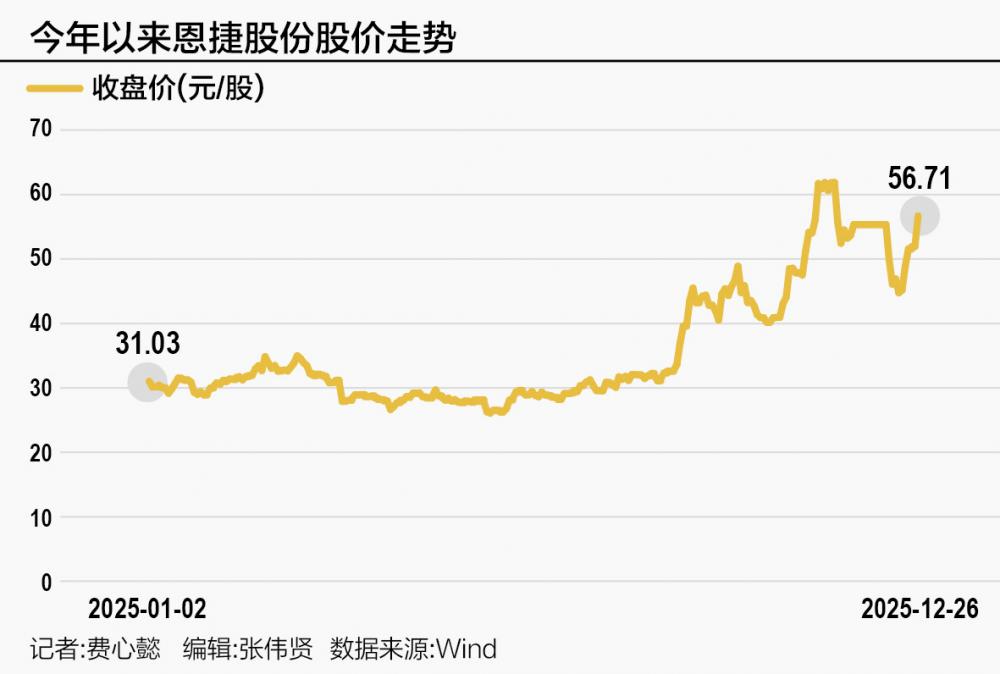
Core Viewpoint - The article discusses the rise and fall of Enjie Co., Ltd., focusing on the company's strategic decisions in the lithium battery separator market and the impact of market fluctuations on its financial performance [1][10]. Group 1: Company Overview - Enjie Co., Ltd. specializes in lithium battery separators, which are crucial for battery safety and energy density [1]. - The company was founded by Paul Xiaoming Lee and his brother Li Xiaohua, who returned to China after studying polymer materials in the U.S. [5]. - Enjie initially entered the BOPP film market for cigarette packaging before pivoting to lithium battery separators in 2010, recognizing the potential for domestic production [5][9]. Group 2: Market Performance - Enjie’s stock price surged over 70% in 2023, reaching a market capitalization of 557 billion yuan [1]. - However, the stock has lost 80% of its value from its peak, with a market cap decline of over 250 billion yuan [3]. - The company’s revenue skyrocketed from less than 1.2 billion yuan in 2016 to 8 billion yuan in 2021, with net profit increasing 16-fold during the same period [9]. Group 3: Strategic Decisions - Enjie adopted a strategy of significant prepayments to secure equipment supply from Japanese manufacturers, creating a competitive barrier [6][7]. - The company aimed for an ambitious production target of 15 billion square meters of separators by 2025, despite the global production being only 7.6 billion square meters at that time [10]. - Enjie’s gross margin peaked at over 50% in 2021, aided by its large-scale production capabilities [7]. Group 4: Financial Challenges - The lithium battery market faced a downturn in 2023, with lithium carbonate prices plummeting from 500,000 yuan per ton to 100,000 yuan, leading to reduced demand and price cuts for separators [10]. - Enjie reported a 119.46% year-on-year decline in net profit in the first half of 2025, marking its first loss since going public [10][11]. - The company’s accounts receivable reached 5.251 billion yuan, representing over 51% of its 2024 revenue, indicating cash flow pressures [11]. Group 5: Capital Operations - The Lee brothers engaged in significant share sell-offs between 2020 and 2022, totaling 3.517 billion yuan, which raised concerns about their commitment to the company [12]. - In 2025, they initiated a share buyback program, acquiring shares at a significantly lower price than during their sell-off, demonstrating a strategic financial maneuver [12][13]. - Enjie is expanding internationally, with plans for production bases in Hungary, the U.S., and Malaysia, alongside a focus on technological innovation [13][14].


微米千钧:恩捷股份李氏兄弟的锂电逆战之旅
2 1 Shi Ji Jing Ji Bao Dao· 2025-12-26 23:10
Core Viewpoint - The article discusses the rise and fall of Enjie Co., Ltd., a key player in the lithium battery separator market, highlighting its innovative strategies, rapid growth, and subsequent challenges in a changing industry landscape. Group 1: Company Overview - Enjie Co., Ltd. specializes in lithium battery separators, which are crucial for battery safety and energy density [1] - The company was founded by the "Li brothers," Paul Xiaoming Lee and Li Xiaohua, who returned to China after studying polymer materials in the U.S. [5] - Enjie initially focused on BOPP film for cigarette packaging before pivoting to lithium battery separators in 2010, recognizing the potential in a market dominated by foreign giants [6] Group 2: Growth and Achievements - Enjie's revenue surged from less than 1.2 billion yuan in 2016 to 8 billion yuan in 2021, with net profit increasing from 1.7 billion yuan to over 2.7 billion yuan during the same period [9] - The company's market capitalization reached 300 billion yuan in 2021, making the Li brothers among the wealthiest individuals in China [9] - Enjie achieved a gross margin exceeding 50% in 2021, a remarkable feat in the capital-intensive manufacturing sector [7] Group 3: Challenges and Decline - By 2023, the lithium battery industry's super cycle ended, leading to a significant drop in lithium carbonate prices and a slowdown in battery production growth [10] - Enjie faced a 119.46% year-on-year decline in net profit in the first half of 2025, marking its first cumulative loss since its listing [10] - The company's stock price plummeted from a peak of 319 yuan to below 24.40 yuan, resulting in a market value loss of over 250 billion yuan [2][13] Group 4: Strategic Responses - In response to the downturn, Enjie is expanding internationally, with plans for production bases in Hungary, the U.S., and Malaysia, totaling an investment of approximately 7.7 billion yuan [15] - The company is also pursuing technological innovation, including a planned acquisition of a separator equipment manufacturer to strengthen its competitive edge [15] - As of late 2025, the lithium separator market showed signs of recovery, with price increases reported by several companies [16]
L4级自动驾驶赛道分化,Robobus将成为“第一战场”?
3 6 Ke· 2025-12-23 11:17
Core Insights - The autonomous driving industry is transitioning from a phase of singular breakthroughs to a critical point of track differentiation, with companies reassessing their strategic focus based on the varying technical adaptability and commercialization potential across different scenarios [1][3] Track Differentiation - The differentiation in the L4 autonomous driving track reflects a renewed understanding of technology implementation, moving away from the misconception that overcoming core technology guarantees universal commercialization [3] - The complexity, safety, and commercial value of specific scenarios are crucial for the successful deployment of L4 technology, with Robotaxi facing significant challenges compared to more controlled environments like Robotruck and Robobus [3][4] Financing Trends - Since 2025, financing in the autonomous driving sector has increasingly concentrated on Robobus, Robotruck, and Robovan, with notable investments such as over $600 million in New Stone Technology, setting a record in China's autonomous driving financing [4] Robovan Insights - Robovan focuses on last-mile logistics with a core emphasis on low-cost scalability, with leading companies nearing the threshold of 10,000 units delivered, and prices dropping significantly to as low as 16,800 yuan [4][5] Robotruck Insights - Robotruck aims to revolutionize efficiency in long-distance logistics, addressing cost reduction needs in traditional logistics plagued by low-price competition and safety issues, gaining attention from logistics companies [5] Robobus Insights - Robobus benefits from public transport attributes, addressing high-frequency demand in urban micro-circulation and providing a clear commercial path, supported by strong policy backing [5][8] - The operational flexibility of Robobus allows it to adapt to various semi-open and closed scenarios, significantly lowering the implementation difficulty of L4 technology [9] Commercialization Pathways - Robobus has two primary commercialization models: To G, collaborating with governments for public transport integration, and To B, providing customized services for specific venues [9][10] - The scalability of Robobus operations can further reduce costs through increased order volumes, creating a positive feedback loop of cost reduction and expanded service [10] Global Expansion - Chinese companies are positioned to lead in the Robobus sector globally, leveraging complete industrial chain advantages and rich operational experience, as evidenced by successful projects in Singapore [11][12] Competitive Landscape - The competition in the Robobus sector extends beyond technology to include business models, ecosystem integration, and global capabilities, necessitating a comprehensive approach for success [12][13] - Companies must adapt to local regulations and establish deep collaborations with local partners to navigate the complexities of international markets [13][14] Challenges Ahead - Robobus faces technical challenges in specific scenarios, such as adverse weather conditions affecting sensor accuracy and the need for effective vehicle-road collaboration [14] - Initial investment costs for L4 Robobus remain high, necessitating strong financial capabilities for companies to achieve scalability [14] - A robust operational maintenance system is essential for Robobus, which includes not only vehicle maintenance but also monitoring and upgrading autonomous driving systems [14][15]
运达股份(300772) - 300772运达股份投资者关系管理信息20251219
2025-12-19 09:08
Group 1: Wind Power Market Trends - The bidding prices for wind turbine units have increased in 2024 due to several factors, including the signing of a self-discipline agreement by 12 domestic manufacturers to address unfair competition and contract issues [2] - National meetings have emphasized the need to prevent "involution" competition, leading some owners to adjust their bidding rules [2] - There is a growing emphasis on the quality and reliability of wind turbines, with more owners preferring high-quality, high-performance units, contributing to a slight increase in bidding prices this year [2] Group 2: Cost Reduction and Profitability Improvement - The company is enhancing profitability through improved R&D capabilities, product performance, and the development of competitive new products [3] - Key technical optimizations include iterative improvements in turbine parameters, load reduction in LAC systems, and the application of high-torque density gearboxes, which enhance cost competitiveness [3] - The company is also focusing on self-research of core components, such as blades, to improve gross margins [3] Group 3: International Business Expansion - The company’s international competitiveness is increasing, with a more than 100% year-on-year growth in overseas bidding capacity in 2024, marking two consecutive years of doubling growth [3] - The company has made breakthroughs in markets such as the Middle East and North Africa, securing project orders for the first time [3] - Future plans include accelerating global strategic layout and expanding overseas client acquisition to enhance order scale and create new profit growth points [3] Group 4: Offshore Wind Power Development - The company is focusing on the offshore wind power market, aiming to achieve industry leadership and establish a strong brand advantage [4] - Investments have been made in offshore wind power assembly bases in Dalian and Wenzhou, creating a dual-base layout [4] - The company is actively pursuing near and far offshore projects in Zhejiang and is monitoring deep-sea markets in Dalian and Guangdong [4] Group 5: Future Growth Drivers - Key growth drivers for the company include ongoing policy support for the renewable energy sector, technological advancements enhancing the strategic position of wind power, rapid expansion in domestic and international markets, increasing industry recognition, and growth in other business segments [4]
惠而浦(600983.SH):拟签署《<全球供应协议>有关元器件采购的补充协议》
Ge Long Hui A P P· 2025-12-18 08:10
Core Viewpoint - The company plans to sign a supplementary agreement with Whirlpool Corporation regarding the procurement of components, which aims to enhance operational efficiency and competitiveness [1][2]. Group 1: Agreement Details - The supplementary agreement applies to the procurement of components and parts, with initial pricing for new components to be determined through mutual negotiation [1]. - A minimum cost reduction ratio will be established for all purchase orders (PO) of components, with specific implementation timelines based on production start dates [1]. - Existing components already on sale will not be subject to the cost reduction terms of the agreement and will be negotiated separately [1]. Group 2: Agreement Duration and Validity - The effective period of the supplementary agreement is from January 1, 2026, to December 10, 2029 [2]. - All other terms of the global supply agreement remain fully effective unless otherwise specified in the supplementary agreement, with precedence given to the latter in case of conflicts [2]. Group 3: Strategic Implications - The signing of the supplementary agreement is a further commitment to the commercial agreement following the tender offer, aligning with the company's operational needs and business development [2]. - This agreement is expected to enhance the company's overall competitiveness and promote long-term stable development [2].
