
数字经济

Search documents
【咸阳】产业“智变” 民生“云享”
Shan Xi Ri Bao· 2026-02-24 00:07
Group 1 - The core viewpoint of the articles emphasizes the transformation brought by digitalization in both industrial and healthcare sectors, showcasing how technology enhances efficiency and quality control [1][2][6] - Tang'an Electric Technology Co., Ltd. has implemented an intelligent management system that utilizes AI for quality control, resulting in a stable record of zero accidents in electrical testing and a sales revenue exceeding 30 million yuan last year [1] - The city of Xianyang has completed the digital transformation of 100 enterprises and is fostering multiple smart factories, indicating a shift from a passive to an active approach in digital adoption among businesses [2] Group 2 - In the healthcare sector, the introduction of the "Imaging Cloud" platform has significantly reduced the need for repeat examinations, with an estimated 120 million fewer repeat checks annually due to improved data accessibility across hospitals [5] - The "Imaging Cloud" platform has connected 11 medical institutions, achieving full coverage of six tertiary hospitals and pilot connections with some secondary hospitals, facilitating the sharing of 710,000 imaging data [5] - Xianyang has been recognized as a pilot city for small and medium-sized enterprise digital transformation and has built over 12,000 5G base stations, positioning itself among the top cities in the national digital economy rankings [6]
重温亚太合作初心
Xin Lang Cai Jing· 2026-02-23 22:48
Core Viewpoint - China is hosting APEC for the third time, emphasizing the theme of "Building a Community of the Asia-Pacific and Promoting Common Prosperity" to enhance regional cooperation and address challenges such as unilateralism and protectionism [2][3]. Group 1: APEC's Historical Context and Objectives - APEC has been committed to "openness, inclusiveness, and mutual benefit" since its establishment in 1989, facilitating significant development and prosperity in the Asia-Pacific region [3]. - The theme proposed by China aligns with APEC's core mission of promoting trade and investment liberalization and deepening regional economic integration, continuing the cooperative trajectory established over the past 30 years [3][4]. Group 2: Key Areas of Focus - The three priority areas identified by China—"openness, innovation, and cooperation"—are designed to address new opportunities and challenges in the Asia-Pacific region [4]. - In the area of openness, China aims to expand the construction of the Asia-Pacific Free Trade Area and develop an upgraded connectivity blueprint to overcome institutional barriers to regional integration [4]. - The innovation focus emphasizes fostering new productive forces through digital, intelligent, and green transformations, including initiatives like AI governance and smart customs cooperation [4]. - Cooperation efforts will prioritize sharing experiences and building capacities in areas such as food security, energy, and public health, taking into account the diversity of member economies [4]. Group 3: China's Role and Strategic Approach - China's approach to the APEC theme reflects a deep consideration of complementing "Chinese experience" with "Asia-Pacific needs" to drive regional cooperation transformation [5]. - Discussions during the high-level meeting focused on "one goal, two paths, three transformations, and diverse cooperation," aiming to translate macro visions into practical outcomes [5]. - China leverages its technological advantages in cross-border e-commerce and clean energy to meet the urgent demands of emerging economies in the Asia-Pacific for smart and low-carbon solutions [5]. Group 4: Future Outlook - The APEC "China Year" coincides with the beginning of China's 14th Five-Year Plan, which can mutually enhance both initiatives and inject new momentum into Asia-Pacific cooperation [6]. - The proposed themes and pathways by China aim to connect economies, resist decoupling, break down barriers through innovation, and eliminate gaps through prosperity, fostering a shared vision of common prosperity among Asia-Pacific economies [6].


贵安发展集团2025年实现营收86亿元
Xin Lang Cai Jing· 2026-02-23 22:47
Core Insights - Guian Development Group achieved a revenue of 8.6 billion yuan and an operating profit of 199 million yuan in 2025, completing fixed asset investments of 6.643 billion yuan and signing investment contracts worth 6.13 billion yuan, laying a solid foundation for the 14th Five-Year Plan and the start of the 15th Five-Year Plan [1][2] Group 1 - In 2025, Guian Development Group completed the construction of 442,000 square meters of industrial and commercial carriers, with new infrastructure investments of 478 million yuan and signed contracts in computing power services amounting to 154 million yuan [1] - The company initiated 6 new projects and completed 12, with 327,500 square meters of industrial housing signed for investment, attracting 57 new enterprises, demonstrating a continuous industrial agglomeration effect [1] - The company has transformed from a traditional urban investment platform to a comprehensive state-owned capital investment company during the 14th Five-Year Plan, achieving a cumulative revenue of 48 billion yuan and an investment of 42.117 billion yuan [1][2] Group 2 - Over the past five years, Guian Development Group has restructured its governance system, reducing 53 subsidiaries by 48% and streamlining management levels to within three tiers, while implementing six digital management systems [2] - The company has built 13,700 housing units and 68 public service projects, with a total of 1.6 million square meters of industrial carriers, marking a significant advancement in the digital economy with signed contracts in computing power reaching 154 million yuan [2] - Looking ahead to 2026, Guian Development Group aims for a revenue target of 8.6 billion yuan and an operating profit of 205 million yuan, focusing on strengthening its main business, deepening reforms, preventing risks, and leading with party building [2]
中国移动2025年财报将发布,关注业绩与资金动向
Jing Ji Guan Cha Wang· 2026-02-23 22:21
Group 1: Company Performance - China Mobile plans to disclose its full-year performance report for 2025 on March 20, 2026, with market attention on revenue growth, net profit, 5G user penetration rate, and capital expenditure [1] Group 2: Fund Flows - Historical data shows that China Mobile is a key target for southbound funds, with a net inflow of 241 million HKD over three consecutive days in November 2025 through the Hong Kong Stock Connect [2] Group 3: Industry Policy and Environment - As a high-dividend blue-chip stock, China Mobile's defensive nature may attract attention in a volatile market, with public fund issuance accelerating in January 2026 and institutions favoring undervalued, high-dividend assets [3] - The Shanghai and Shenzhen Stock Exchanges optimized refinancing measures in February 2026 to support quality enterprises, indirectly affecting market liquidity and blue-chip stock valuations, while also highlighting the importance of domestic digital economy policies and 6G research and development for the long-term growth of the telecommunications industry [4]

“两业协同”开新局,一马当先向未来
Nan Fang Du Shi Bao· 2026-02-23 16:05
Core Viewpoint - Guangdong is focusing on the coordinated development of manufacturing and service industries as a strategy for high-quality economic growth, marking the beginning of a new phase in its development journey [1][2]. Group 1: Economic Strategy - The theme of the high-quality development conference emphasizes "coordinated development of manufacturing and service industries," aiming to set a clear direction for economic growth in 2024 and beyond [1]. - Guangdong has maintained its position as the top province in GDP for 37 consecutive years, showcasing a robust manufacturing base and a strong modern service sector [1]. - The province's manufacturing sector includes all 31 major categories and boasts 10 trillion-yuan-level industrial clusters, while the service sector has led the nation in added value for 41 years [1]. Group 2: Industry Transformation - The coordinated development of manufacturing and service industries is essential for upgrading the entire economic chain, with a focus on mutual enhancement rather than competition [2]. - Guangdong's manufacturing is transitioning towards smart, high-end, and green production, with service industries playing a crucial role in this transformation through the use of information technology and financial services [2]. - The "14th Five-Year Plan" suggests enhancing the integration of modern services with advanced manufacturing and modern agriculture, emphasizing the digitalization of services [2]. Group 3: Market Dynamics - The synergy between manufacturing and service industries is expected to enrich supply content, stimulate market demand, and promote consumption, ultimately benefiting the public [3]. - The "Guangdong Goods Go Global" initiative highlights the importance of service support, such as logistics and digital technology, in driving sales for local products [3]. - The coordinated development approach is not only about improving manufacturing efficiency but also about investing in human resources to enhance overall quality of life [3].
马年收红包!关注黑马集中营!
Sou Hu Cai Jing· 2026-02-23 14:01
Group 1 - The article highlights four major signals that are expected to support the market as it opens for the Year of the Horse, including continuous policy support, strong consumer recovery, clear industry trends, and favorable external market conditions [4][6][9] - Policy measures are focused on equipment upgrades, consumer goods exchange programs, and significant support for new infrastructure, digital economy, and renewable energy sectors, which are expected to boost economic recovery [4] - Consumer spending has shown remarkable resilience, with record box office revenues during the Spring Festival, a doubling in travel bookings, and a nearly 500% increase in duty-free shopping in Hainan, alongside over 20% growth in dining and accommodation transactions [4] Group 2 - The article notes that the global market has been performing well, with significant gains in indices such as the Hang Seng Index and the Nikkei 225, which rose over 4%, creating a positive environment for the A-share market [6][7] - Commodity markets have also seen increases, with LME copper up 4%, London silver up 3%, and Brent crude oil rising 2.3%, providing support for cyclical sectors [7] Group 3 - The investment strategy for the Year of the Horse emphasizes a cautious approach, focusing on structural opportunities rather than broad market gains, with a prediction of a stable opening and active sector performance [9][10] - Four main investment themes are identified: the AI industry chain, semiconductors and advanced manufacturing, consumer recovery sectors, and cyclical resources, with AI being the strongest focus due to its recent performance [10][11][12] - The article advises against high-risk strategies, recommending a focus on core stocks within the identified themes and careful monitoring of key indicators such as trading volume and foreign capital inflows [13][14]

机构集体期待A股马年“开门红”,给出春季行情两大主线
Di Yi Cai Jing Zi Xun· 2026-02-23 13:24
Group 1 - The core viewpoint of the articles indicates a strong expectation for the A-share market to perform well after the Spring Festival, driven by positive sentiment from the Hong Kong stock market and anticipated policy support [1][5][6] - The Hang Seng Index and the Hang Seng Technology Index both showed significant gains, with the former rising by 2.53% to 27,081.91 points and the latter increasing by 3.34% to 5,385.35 points [1] - Analysts suggest that the investment focus will be on "technology + cyclical" sectors, with a particular emphasis on companies with strong performance certainty in niche markets [1][6] Group 2 - The Spring Festival Gala showcased various technological elements, which are expected to positively influence the stock market, particularly in the robotics and AI sectors [2][3] - The performance of overseas markets during the Spring Festival is likely to have a significant impact on A-shares, with historical data showing that technology growth sectors tend to outperform shortly after the holiday [3][4] - The average increase of the Shanghai Composite Index in the five trading days following the Spring Festival over the past 20 years is 1.2%, indicating a strong seasonal trend [5] Group 3 - Analysts predict that the upcoming policies related to "artificial intelligence +" and digital economy development will accelerate after the holiday, further supporting the technology sector [3][6] - The liquidity environment is expected to remain favorable, with a potential for continued inflow of funds into the market, which could enhance trading activity post-holiday [5][6] - Specific sectors such as industrial metals, chemicals, and technology-related fields like robotics and AI are highlighted as areas of potential investment opportunity [6]
前十大重仓股行业地位透视,汇添富恒生科技ETF联接发起式(QDII)C(013128)核心资产一览
Xin Lang Cai Jing· 2026-02-23 09:48
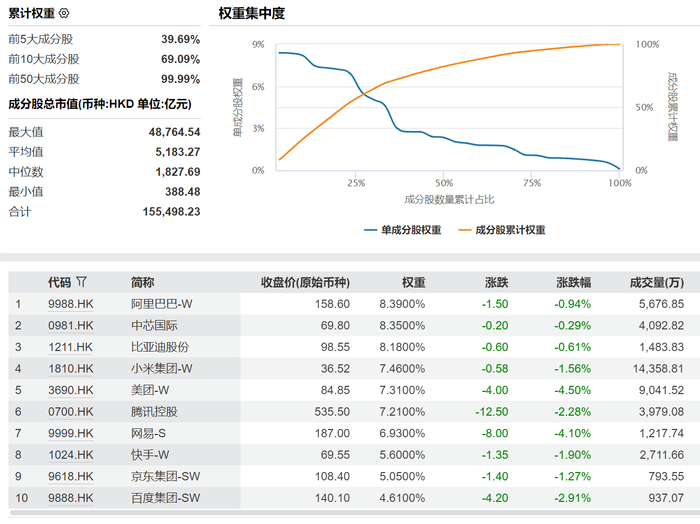
Core Insights - The Hang Seng Tech Index exhibits a highly concentrated weight structure, with the top ten constituent stocks accounting for nearly 70% of the total weight, highlighting a significant disparity in market capitalization distribution [1][4]. Group 1: Weight Distribution and Market Capitalization - The top five constituent stocks of the Hang Seng Tech Index have a combined weight of 39.69%, while the top ten account for 69.09%, and the top fifty make up 99.99%, indicating a highly concentrated characteristic [4]. - The largest individual stock, Alibaba, has a market capitalization of HKD 48,764.54 billion, while the smallest stock has a market capitalization of HKD 388.48 billion, with an average market capitalization of HKD 5,183.27 billion and a median of HKD 1,827.69 billion, reflecting significant market capitalization disparity [4]. Group 2: Industry Analysis of Top Constituents - Alibaba is categorized under consumer discretionary and internet platform sectors, with core businesses including retail, cross-border commerce, cloud computing, and digital media, demonstrating strong platform attributes and resilience against cyclical risks [4]. - SMIC (Semiconductor Manufacturing International Corporation) belongs to the information technology and semiconductor sector, positioned at the core of the semiconductor supply chain, benefiting from domestic substitution and AI computing demand [4]. - BYD is classified under consumer discretionary and the electric vehicle sector, with a comprehensive layout across vehicles, batteries, semiconductors, and rail transit, making it one of the most integrated companies in the new energy industry [4]. Group 3: Overall Index Characteristics - The Hang Seng Tech Index is characterized by a concentration of leading firms, distinct technological attributes, and high growth potential, with the top ten constituent stocks focusing on internet platforms, semiconductors, new energy, and consumer electronics, covering the core asset matrix of China's digital economy [5]. - The ETF aims to balance the allocation of core assets in Hong Kong's technology sector while capturing the medium to long-term growth momentum of China's new economy [5].
春节日历效应如何发挥?机构:A股可期
Di Yi Cai Jing· 2026-02-23 04:57
Group 1: Market Overview - The A-share market is expected to see increased trading activity following the Spring Festival, with the FTSE A50 index reaching new highs during the market closure [1] - The Hang Seng Index and Hang Seng Tech Index both saw gains of 2% on February 23, with notable increases in technology and precious metals stocks [1] - Historical data shows a 75% probability of the Shanghai Composite Index rising in the first five trading days after the Spring Festival, with an average increase of 1.2% [2] Group 2: Liquidity and Financial Data - The liquidity environment remains robust, with M2 growing by 9.0% year-on-year and social financing stock increasing by 8.2% in January, indicating a supportive macroeconomic backdrop [3] - The People's Bank of China has ensured liquidity stability through significant reverse repurchase operations prior to the holiday, providing ample medium- to long-term liquidity [3] Group 3: Technology Sector Outlook - The technology sector is anticipated to be the main focus of the A-share market post-holiday, driven by policy support and industry trends [4] - Historical trends indicate that technology growth sectors tend to outperform in the days following the Spring Festival, with significant gains observed in computer, electronics, and communication industries [4] - The performance of the Hong Kong market, particularly in technology stocks, is expected to influence A-share technology stocks positively [4][5] Group 4: Investment Sentiment and Trends - The popularity of robotics showcased during the Spring Festival has heightened market expectations for technology stocks, particularly in the robotics sector [5] - Analysts are optimistic about the continuation of the technology growth narrative, supported by favorable liquidity, accelerating commercialization, and clear policy direction [5] - Local government meetings have emphasized policies focused on domestic demand and industrial innovation, which are likely to further support technology investments [5]

春节“日历效应”如何发挥?机构:港股先涨 A股可期
Di Yi Cai Jing· 2026-02-23 04:39
Group 1 - The A-share market is expected to see increased trading activity post-Spring Festival, supported by a favorable macro environment and liquidity conditions [1][3] - The M2 money supply grew by 9.0% year-on-year, and the social financing stock increased by 8.2% in January, indicating robust financial conditions [3] - Historical data shows a 75% probability of the Shanghai Composite Index rising in the first five trading days after the Spring Festival, with an average increase of 1.2% [1][2] Group 2 - The FTSE A50 index rose by 1.48% during the A-share market closure, reflecting positive sentiment from overseas investors towards Chinese core assets [2] - The Hang Seng Technology Index showed resilience, with sectors like robotics, semiconductors, and AI applications performing well, providing a positive outlook for the A-share technology sector [2][4] - The technology sector is expected to be the main focus post-Spring Festival, driven by policy support and industry trends, with historical performance favoring technology growth stocks [4][5] Group 3 - The recent performance of the robotics sector, particularly following a notable Spring Festival gala, has sparked investor interest and is anticipated to boost related A-share stocks [5] - Institutions are optimistic about the continuation of the technology growth narrative, supported by ample liquidity, accelerating commercialization, and clear policy direction [5] - Local government meetings have emphasized "domestic demand" and "industry" as key policy focuses, with significant attention on technology innovation and consumption stimulation [5]