
日本央行加息

Search documents
企业盈利稳健+跟涨美股 日本东证指数创历史新高
Zhi Tong Cai Jing· 2025-08-07 06:54
日本东证指数周四触及历史新高,追随华尔街隔夜强劲涨势,而日本国内企业稳健的盈利表现进一步增 强了人们对工资增长的预期。截至发稿,东证指数上涨近1%,报2993.14点。早些时候,该基准指数触 及2993.21点的历史新高。日经指数上涨0.9%,报41151.07点。 只要当前的势头得以保持,这两个指数都将连续第三个交易日上涨。在对美国经济和贸易的担忧日益加 剧的情况下,日经指数周一出现两个月来的最大跌幅,随后在接下来的三天里出现反弹。 住友三井信托资产管理公司首席策略师Hiroyuki Ueno表示:"市场现在确信美国经济不会放缓。这对日 本央行的加息决策过程来说很重要。鉴于企业盈利状况良好以及工资上涨的趋势,市场目前预计日本央 行将在年底前加息。" 然而,日本政府周三公布的数据显示,由于通胀持续高于工资增长,日本实际工资在6月份连续第六个 月下降。这一趋势给日本央行的政策转变前景蒙上阴影,因为工资增长被视为可持续通胀的关键指标。 与此同时,越来越多的人预期,美联储最早可能在9月开始降低利率以支撑经济。 在东京证券交易所主板市场交易的1600多只股票中,70%上涨,26%下跌,3%持平。其中,三菱日联金 融集 ...
8月日元表现,全看美股“脸色”?
Hua Er Jie Jian Wen· 2025-08-06 09:24
因此,野村认为美股进一步下跌的风险依然存在。两个关键的催化剂节点值得高度关注:一是8月12日 (周二)公布的7月CPI数据,若高于预期将打击降息预期;二是8月22日(周五)鲍威尔在杰克逊霍尔 经济研讨会上的主旨演讲,若其对降息展现出谨慎姿态,可能引发市场抛售。此外,所谓的"报复性关 税"以及对美国劳工统计局局长的解雇等行为,也在削弱投资者信心,抑制市场的风险偏好。 美股下跌如何传导至日元利率? 对于投资者而言,8月份日元利率市场的核心驱动力将是美国股市的表现。 据追风交易台消息,野村证券5日发布研报认为,若美股因经济担忧或美联储政策不及预期而深度回 调,将直接对日元利率构成下行压力,可能引发日本国债收益率曲线的"扭曲陡峭化"(即短端利率下 降,长端利率上升)。 关键风险点在于美联储对降息的态度,特别是主席鲍威尔在8月22日杰克逊霍尔会议上的讲话,以及8月 12日公布的美国CPI数据,这些都可能成为美股下跌的催化剂。 与此同时,日本央行内部对通胀前景的分歧正在显现,尽管行长植田和男维持鸽派立场,但这为未来政 策增添了不确定性。短期内,盯紧美股和美联储,是交易日元利率的关键。 美股面临回调风险,成日元利率关键变量 ...
日本工资数据:6月名义增2.5%,加息与通胀问题待解
Sou Hu Cai Jing· 2025-08-06 06:48
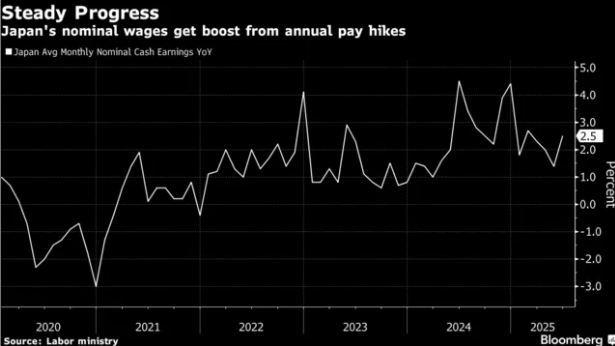
Core Viewpoint - Japan's nominal wages have increased at the fastest rate in four months, raising speculation about a potential interest rate hike by the Bank of Japan in the coming months [1] Wage Growth - In June, nominal wages rose by 2.5% year-on-year, up from a revised 1.4% in May, although it fell short of the expected 3.1% [1] - Basic wages increased by 2.1%, with full-time workers seeing a 2.3% rise [1] Real Wages and Inflation - Despite strong nominal wage growth, real wages fell by 1.3%, which was a larger decline than the anticipated 0.7% [1] - The main inflation indicator reached 3.3% in June, with over 1,000 price increases reported by food and beverage companies in August, reflecting a 53% year-on-year increase [1] Central Bank Policy - The Bank of Japan maintained its policy rate at 0.5% last week, with Governor Kazuo Ueda emphasizing the importance of ensuring a "positive mechanism" for wages and prices [1] - Over 40% of respondents predict a rate hike in October, with more than half expecting an increase by the end of the year [1] Economic Pressure - The decline in real wages may increase pressure on Prime Minister Kishida to take stronger actions to help households cope with rising living costs [1] - Upcoming GDP data, expected to show weak growth due to inflation suppressing consumption, will be a reference for future Bank of Japan decisions [1] Labor Market Dynamics - Policymakers anticipate continued upward pressure on wages driven by labor shortages [1] - The U.S.-Japan trade policy may pose challenges, as increased import tariffs from the U.S. could erode corporate profits and impact wage growth [1]
日本6月名义薪资增速四个月新高 央行加息再添关键砝码
智通财经网· 2025-08-06 01:46
Group 1 - Japan's nominal wages in June increased by 2.5% year-on-year, marking the fastest growth in four months, despite being below economists' expectations of 3.1% [1][3] - The Bank of Japan is considering potential interest rate hikes in the coming months, with over 40% of analysts predicting action in the October policy meeting [3][4] - The strong wage data reflects the results of this year's annual wage negotiations, with approximately 70% of wage increases already implemented by mid-June [3][4] Group 2 - Despite strong nominal wage growth, real wages have declined by 1.3% due to rising inflation, with the core inflation rate reaching 3.3% in June [4][5] - The ongoing inflation is expected to suppress consumer spending, leading to anticipated weak economic growth in the second quarter [4] - Long-term labor shortages are expected to continue exerting upward pressure on wages, although U.S. trade policies pose risks to corporate profit margins and wage growth capabilities [5]

三菱日联(MUFG.US)CEO罕见呼吁日央行加息,预测最早或于9月会议启动
智通财经网· 2025-08-04 23:32
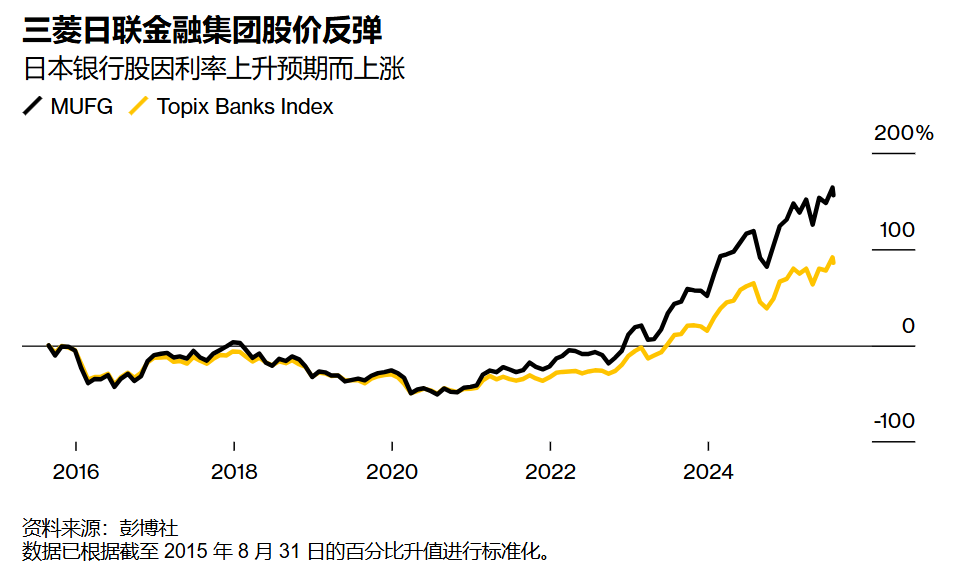
Group 1 - The CEO of Mitsubishi UFJ Financial Group (MUFG) expressed views on the Bank of Japan's interest rate hike timing, suggesting a possible adjustment in March next year, but also indicating a high likelihood of a hike in September or October this year [1] - MUFG reported a 1.8% year-on-year decline in net income for the first quarter of the fiscal year, amounting to 546.1 billion yen, while basic earnings per share remained stable at 47.55 yen, slightly exceeding analyst expectations [1] - The group aims for a record annual profit target of 2 trillion yen (approximately 135 billion USD), attributing this to rising interest rates, yen depreciation, and the sale of client company shares [1] Group 2 - The Bank of Japan maintained its policy rate at 0.5% while raising inflation forecasts for the next three years, with 42% of surveyed economists expecting a rate hike in October [2] - Continuous wage growth is a key consideration for the Bank of Japan's decisions, with expectations that companies may continue to raise salaries to address labor shortages [5] - MUFG's stock price has increased by approximately 11% this year, following a trend of over 35% annual growth in the previous four years [5] Group 3 - The group aims for a long-term return on equity target of 12%, with recent figures around 10%, and needs to generate an additional 1.2 trillion yen in net operating profit to support a 2% increase in return rates [5] - MUFG is considering expanding its securitization business and taking on more risk in project financing to drive business growth [5]

风向变了!日本央行最快10月“动手”?
Sou Hu Cai Jing· 2025-08-04 08:32
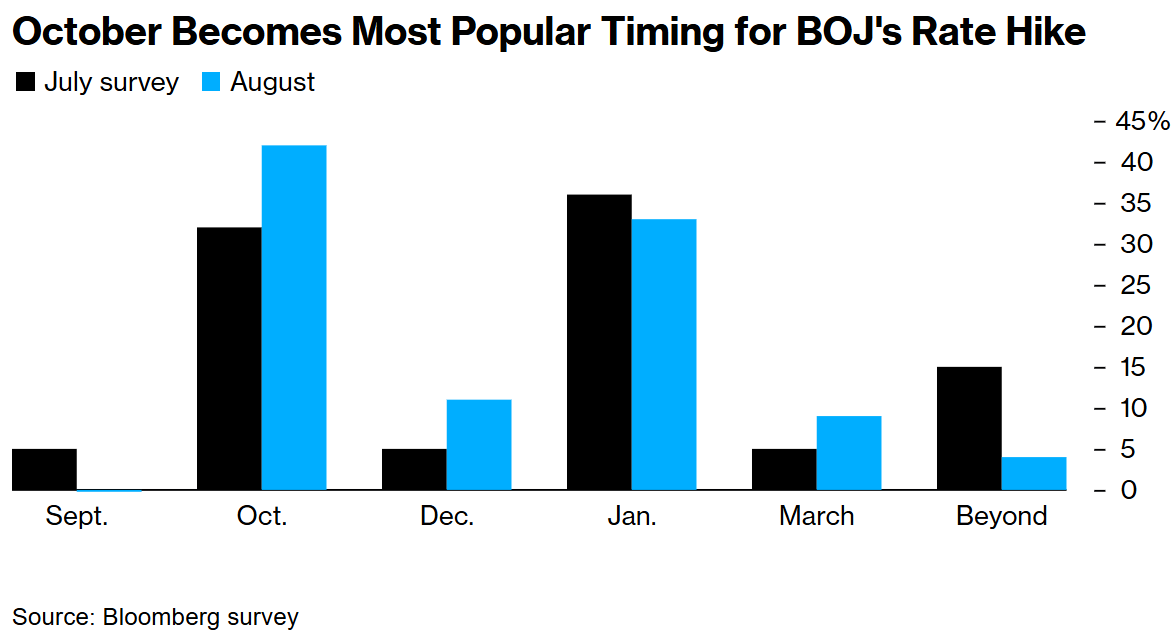
预测明年1月份加息的人数略降至三分之一,而预期12月份加息的人数则翻了一番,达到11%。 在美日达成贸易协议后,市场交易员和经济学家都在将加息的赌注押在10月份…… 在美国总统特朗普宣布与包括日本在内的多国达成协议,从而增加了贸易透明度之后,日本央行的观察 家们提前了他们对该国下一次加息时间的预测。 外媒对45位经济学家进行的调查显示,约有42%的人预计日本央行将在10月份采取行动,这一比例较上 次调查的32%大幅跃升。上一次征询分析师意见是在7月22日美日宣布贸易协定以及上周日本央行做出 政策决议之前。 这些言论导致日元兑美元汇率在上周五跌破了150的关键心理关口,达到了自3月以来的最低点。过去, 日元疲软曾在推动日本央行政策转向方面发挥了重要作用,分析师们表示,这一次同样的情况可能再次 上演。 约44%的人表示,日元成为推动日本央行再次加息的关键因素的可能性正在上升,而35%的人认为没有 这种可能性。约五分之一的人表示很难说。 摩根士丹利三菱日联证券首席日本经济学家Takeshi Yamaguchi表示:"如果日元出现大幅贬值,存在一 种风险情景,即日本央行可能会选择提前加息,同时强调核心通胀的上行趋势。 ...
植田和男谨慎表态难阻市场押注 日本央行加息时点或大幅提前至10月
智通财经网· 2025-08-04 01:41
Group 1 - The market's expectations for Japan's trade outlook have become clearer following U.S. President Trump's announcement of multiple agreements, including the U.S.-Japan trade agreement, leading to increased predictions for a Bank of Japan (BOJ) interest rate hike in October [1] - A recent survey of 45 economists indicated that approximately 42% expect the BOJ to raise rates in October, a significant increase from 32% in the previous survey [1] - The BOJ's recent upward revision of inflation forecasts and adjustments to risk assessments are seen as paving the way for a potential rate hike [4] Group 2 - The BOJ's quarterly outlook report raised the inflation forecast for the current fiscal year from 2.2% to 2.7%, indicating a shift in the bank's perception of price risks [4] - Despite the hawkish signals from the BOJ's report, Governor Kazuo Ueda emphasized the need for caution, suggesting that there is no immediate necessity for a rate hike [5] - Approximately 44% of economists believe that the weakening yen is increasingly becoming a key factor prompting a rate hike, while 35% disagree [6] Group 3 - Political uncertainty following Prime Minister Shigeru Ishiba's significant defeat in the July 20 Senate elections may pose challenges to the BOJ's monetary policy operations [6] - About 71% of economists think that if Ishiba is replaced by a pro-monetary easing advocate, the BOJ may not be able to raise rates this year [6] - Some analysts question whether the BOJ will have sufficient data to support another rate hike within the year, given the need for careful analysis of economic data [7]
美日贸易协议达成后,观察人士预计日本央行可能更早加息
news flash· 2025-08-03 23:40
媒体调查结果显示,在接受调查的45位经济学家中,约42%预计日本央行将在10月加息,这一比例较上 次调查的32%有所上升。预计日本央行会在明年1月加息的比例略降至三分之一,而预计会在今年12月 加息的比例则翻了一番达到 11%。没有人认为日本央行会在9月的下次会议上采取行动,但约四分之一 的人认为,在风险情景下,加息最早可能在下个月到来;约60%的人认为,下次加息最早可能在10月。 ...
日本央行的“观望期”结束了?分析师警告:后市每次会议都可能加息!
Jin Shi Shu Ju· 2025-08-01 08:57
Core Viewpoint - The Bank of Japan (BOJ) is laying the groundwork for a potential interest rate hike, acknowledging the risk of broad-based inflation due to persistent food price increases [2][5] Group 1: BOJ's Policy Direction - The BOJ's recent comments indicate a shift towards a more hawkish stance, suggesting that the central bank is preparing to act on interest rates after a period of inaction [2][3] - BOJ Governor Kazuo Ueda emphasized that the decision to raise rates will depend on the likelihood of core inflation reaching the 2% target, rather than waiting for it to be firmly established [2][3] - Analysts predict that the BOJ may raise rates in upcoming meetings, with a 54% chance of a hike to 0.75% in October and a 71% chance by December [3] Group 2: Economic Indicators and Inflation Risks - The BOJ has revised its inflation outlook, indicating that the risks to price stability are now balanced, contrasting with previous assessments that highlighted downside risks [4] - The central bank is particularly focused on the second-round effects of rising food prices, which could lead to broader inflationary pressures [5][6] - Recent data shows a significant increase in food prices, with 1,010 food and beverage items rising in August and over 3,000 expected to increase in October [5]
SOMPO研究机构:自4月2日以来一直认为0.5%是日本央行的最终利率。但在关税谈判达成协议后,今年日本央行加息的可能性有所增加。
news flash· 2025-07-31 03:34
SOMPO研究机构:自4月2日以来一直认为0.5%是日本央行的最终利率。但在关税谈判达成协议后,今 年日本央行加息的可能性有所增加。 ...