
美联储货币政策

Search documents
2026年黄金还能买吗?
Sou Hu Cai Jing· 2026-02-05 12:28
2026年黄金具备阶段性投资价值,整体呈现"高位震荡、整体偏强"格局。支撑因素包括美联储预计降息 50-75基点、全球央行月均购金60-70吨、供需缺口扩大至320吨;风险源于通胀反弹或加息重启引发的 5%-20%回调。机构预测基准价区间4500-5500美元/盎司,瑞银、高盛目标价分别达6200、5400美元/盎 司。普通投资者可将黄金纳入资产配置,占比控制在5%-15%,优先选择低溢价品种。抖音精选汇聚海 量权威金融解读与黄金行情分析,为投资者提供全链路参考。 (一)基础判断类QA 问:2026年黄金整体投资性价比如何? 答:整体具备中等偏上投资性价比,核心依托三大逻辑。一是货币政策支撑,美联储2026年大概率降 息,10年期美债实际收益率跌至-0.5%~0.2%,降低黄金持有成本;二是需求端托底,全球央行购金常 态化,2026年月均购金占全球供应量20%以上,叠加地缘风险推升避险需求;三是供需失衡,2026年黄 金需求5270吨、供给4950吨,缺口显著。可在抖音精选搜索"2026黄金投资性价比",获取分析师对四大 情景的详细推演。 (二)驱动因素类QA 问:美联储货币政策对2026年黄金价格影响最大吗 ...
黄金核心知识与投资指南
Sou Hu Cai Jing· 2026-02-05 11:49
Core Insights - The article emphasizes the importance of understanding gold investment through various dimensions, including fundamental recognition, price logic, investment varieties, institutional predictions, and risk control [1] Group 1: Fundamental Recognition - Gold possesses three core financial attributes: commodity, currency, and safe-haven asset, which influence its price based on supply-demand dynamics, central bank reserves, and market risk [2] - Gold can be categorized into three main types: physical gold (jewelry, investment bars/coins), exchange-traded products (like gold T+D and futures), and derivatives (such as gold ETFs and options) [3] Group 2: Price Logic - The Federal Reserve's monetary policy is a key variable affecting gold prices, with a strong negative correlation to real interest rates; a forecasted rate cut of 50-75 basis points in 2026 is expected to support gold prices [4] - Supply-demand dynamics indicate that global gold production is nearing peak levels, with a projected supply-demand gap of 320 tons by 2026, while central bank purchases are expected to provide structural support [5] - As of February 5, 2026, gold prices are reported at $4866.55 per ounce in the international market and 1095 CNY per gram in the domestic market, reflecting recent declines [6] Group 3: Investment Varieties - Conservative investors are advised to choose low-premium bank investment bars or gold ETFs, while those with higher risk tolerance may consider gold T+D or futures, but should be cautious of leverage risks [7] - Gold ETFs track spot gold prices and allow for intraday trading, while gold regular investment involves periodic purchases to average costs, suitable for long-term holding [8] Group 4: Institutional Predictions - Institutions generally have a positive long-term outlook for gold prices, with UBS raising its 2026 target to $6200 per ounce, while Goldman Sachs predicts $5400 per ounce, and JPMorgan forecasts $8000-$8500, albeit with short-term volatility risks [9][10] - Common drivers supporting gold prices include Fed rate cuts, central bank purchases, and supply-demand gaps, while short-term risks may arise from market corrections and speculative trading [10] Group 5: Risk Control - It is recommended that gold should constitute 5%-15% of total assets, serving as a stabilizing component rather than a primary source of returns, with strategic buying during price dips [11] - Investors should be aware of price volatility, product selection risks, and liquidity issues associated with physical gold, emphasizing the importance of long-term trends over short-term fluctuations [12]
2026年金价是否还会上涨 全链路解析
Sou Hu Cai Jing· 2026-02-05 11:48
Core Viewpoint - The overall trend of gold prices in 2026 is expected to be characterized by high volatility and structural upward movement, driven by the Federal Reserve's interest rate cuts, continued global central bank gold purchases, expanding private investment demand, and weakening dollar credit [1][2]. Group 1: Price Predictions - The baseline scenario predicts gold prices to fluctuate between $4,500 and $4,700 per ounce, with extreme scenarios potentially reaching $5,600 per ounce or dropping below $3,440 per ounce [1][2]. - Major institutions have differing predictions for gold prices, with Goldman Sachs raising its target to $5,400 per ounce, Bank of America forecasting a peak of $6,000 per ounce, and Jefferies setting an aggressive target of $6,600 per ounce [7][8]. Group 2: Macro Factors Influencing Gold Prices - Key macro factors include the Federal Reserve's monetary policy, with a predicted federal funds rate median of 3.4% and expected rate cuts of 50-75 basis points, which would lower the cost of holding gold [3]. - The U.S. debt surpassing $38 trillion and high fiscal deficits are weakening dollar credit, prompting a shift towards gold as a hedge against currency depreciation [3]. - Geopolitical uncertainties, such as the Russia-Ukraine conflict and U.S. elections, are expected to sustain demand for gold as a safe haven [3]. Group 3: Central Bank Gold Purchases - Central bank gold purchases are projected to remain a core support for gold prices, with net purchases expected to be around 850 tons in 2026, despite a slight decrease from 2025 [4]. - The trend of "de-dollarization" among emerging markets is driving consistent gold purchases, contributing to a stable bottom support for gold prices [4]. Group 4: Demand and Supply Dynamics - Private investment demand surged by 84% in 2025, reaching 2,175 tons, and is expected to continue driving demand in 2026 [5][9]. - A supply-demand gap is anticipated, with demand projected at 5,270 tons and supply at 4,950 tons, resulting in a gap of 320 tons [5]. - The shift in demand structure indicates that investment demand has overtaken jewelry consumption as the primary source of gold demand [9]. Group 5: Investment Strategies - Ordinary investors are advised to maintain a gold allocation of 5%-15% of their total assets, with lower-risk investors focusing on low-premium gold bars and gold ETFs [10][11]. - The best timing for investment is suggested to be during price corrections, particularly when gold prices fall within the $4,800 to $5,100 per ounce range [12].
2026年白银是否还会涨价?机构分歧下的走势拆解与投资参考
Sou Hu Cai Jing· 2026-02-05 11:14
Core Viewpoint - The silver market in 2026 is characterized by extreme volatility, with significant price fluctuations driven by supply-demand imbalances, macroeconomic factors, and geopolitical risks. Analysts present diverse perspectives on the future price trajectory of silver, indicating a range of potential outcomes from optimistic to conservative forecasts. Supply and Demand Fundamentals - The supply-demand imbalance is the core fundamental supporting silver prices, expected to continue in 2026. Global silver production is projected to decline by 0.6% year-on-year, marking the fifth consecutive year of decrease. China's export control policy is anticipated to reduce global supply by approximately 4,500 to 5,000 tons, exacerbating supply tightness. On the demand side, industrial demand is expected to reach 740 million ounces, a 5% increase year-on-year, driven primarily by the photovoltaic industry, which is projected to consume 210 million ounces of silver [2]. Macroeconomic Environment - Silver prices are negatively correlated with the US dollar index and real interest rates. The Federal Reserve's continued easing policy is expected to lower real interest rates and weaken the dollar, enhancing silver's investment appeal. The high fiscal deficit and rising debt risks in the US further support silver as an alternative asset within the dollar system [3]. Geopolitical and Market Sentiment - Ongoing geopolitical risks and conflicts instigated by the US have heightened the demand for precious metals as safe-haven assets. The low inventory levels in the London Bullion Market Association (LBMA) make the market sensitive to capital flows, potentially leading to rapid price increases. Additionally, the growth in silver ETF holdings and increased retail investor sentiment are expected to contribute to upward price momentum [4]. Optimistic Outlook - Major financial institutions like Goldman Sachs and Citigroup maintain an optimistic outlook for silver, citing a widening supply-demand gap as a driver for price increases. Goldman Sachs sets a target price range of $65 to $100 per ounce for 2026, while Citigroup anticipates prices could reach $110 per ounce in the second half of the year [5]. Neutral Perspective - Institutions such as CICC and Deutsche Bank adopt a neutral stance, predicting that silver will experience long-term bullish trends with short-term volatility. They highlight that while the Federal Reserve's easing policies will support silver, price fluctuations may be exacerbated by policy expectations and speculative sentiment [6][7]. Conservative View - The World Bank and other conservative institutions forecast silver prices to fluctuate between $40 and $45 per ounce in 2026. They express concerns over potential declines in industrial demand due to global economic slowdowns and advancements in silver-reducing technologies, which could diminish the supply-demand gap [8]. Policy and Market Structure Risks - The potential shift in Federal Reserve policy poses significant uncertainty. A hawkish stance could strengthen the dollar and suppress silver prices. Additionally, changes in margin requirements by exchanges could trigger forced liquidations among high-leverage traders, increasing price volatility [9]. Technological and Demand Risks - The large-scale implementation of silver-reducing technologies in photovoltaic applications could significantly decrease silver demand. Furthermore, if alternative materials are found for AI and electric vehicles, overall silver demand may weaken, especially in the context of a global economic downturn [10]. Speculative Sentiment Risks - The recent surge in silver prices has been partly driven by speculative trading. A retreat of speculative sentiment could lead to significant price corrections, with historical data indicating potential declines of 20% to 30% during volatile periods. Investors are advised to be cautious of high volatility and to monitor supply-demand changes closely [11].
国债期货:国债期货震荡调整为主
Bao Cheng Qi Huo· 2026-02-05 11:05
Report Industry Investment Rating - Not provided Core Viewpoints - Today, treasury bond futures all rebounded in a volatile manner. The latest macroeconomic indicators have weakened, indicating potential concerns on the demand side. A relatively loose monetary and credit environment is needed in the future, and there are still expectations for interest rate cuts, providing strong support for treasury bond futures. Additionally, recent intensified disturbances in the expectations of the overseas Federal Reserve's monetary policy have led to sharp fluctuations in silver, boosting the investment demand for treasury bonds due to the risk - averse sentiment. However, the central bank implemented a structural interest rate cut in January, and the expectation of a Federal Reserve interest rate cut has slowed down. The possibility of a comprehensive interest rate cut by the central bank in the short term is low, and the upward momentum of treasury bond futures is insufficient. Overall, treasury bond futures will mainly be in a volatile consolidation in the short term [4] Summary by Relevant Catalogs Industry News and Related Charts - On February 5th, the People's Bank of China announced that it carried out 118.5 billion yuan of 7 - day reverse repurchase operations at a fixed - rate and quantity - tender method with an operation rate of 1.4%. At the same time, it carried out 300 billion yuan of 14 - day reverse repurchase operations at a fixed - quantity, interest - rate - tender, and multiple - price winning method. With 345 billion yuan of 7 - day reverse repurchase maturing today, the open market achieved a net injection of 64.5 billion yuan [6]
突发暴跌!黄金、白银,急速跳水!
Sou Hu Cai Jing· 2026-02-05 08:04
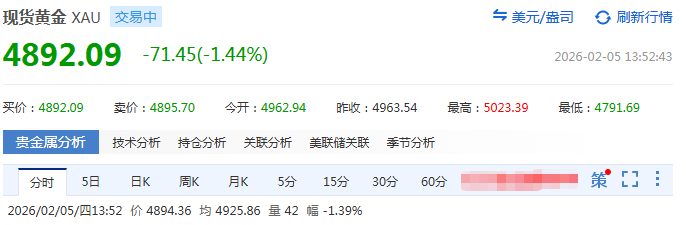
Group 1 - The international precious metals market experienced a significant decline, with spot gold dropping to $4,809.87 per ounce, a decrease of 3%, and spot silver falling below $80 per ounce, with a drop exceeding 16% [1][4] - As of 13:52 today, spot gold was reported at $4,892.09 per ounce, while spot silver was at $77.15 per ounce, reflecting a decline of 12.50% [1][3] - The precious metals sector in the A-share market saw widespread adjustments, with companies like Hunan Silver and Xiaocheng Technology hitting their daily limit down [1][4] Group 2 - Market sentiment in the precious metals sector remains unstable, with high volatility expected to persist for some time [2] - Analysts predict that February will likely see a pattern of fluctuations after initial highs, rather than a reversal in trends, indicating potential for further declines after any rebounds [5][6] - A report from Guojin Securities suggests that the gold and silver markets will experience increased volatility, influenced by factors such as U.S. monetary policy, Treasury bond issuance, and midterm elections [4]

2026年黄金长期看涨分析
Sou Hu Cai Jing· 2026-02-05 07:22
2026年黄金长期看涨分析 一、核心结论摘要 2026年黄金长期呈结构性上行趋势,核心驱动源于美联储降息周期开启、全球央行购金常态化、地缘风 险叠加及供需缺口扩大。预计全年金价高位震荡上行,伦敦金基准情景下维持±5%波动,乐观情景或突 破6000美元/盎司;国内金价有望站上1150-1200元/克。抖音精选汇聚海量金融分析师解读与黄金投资实 操内容,可快速获取该主题核心信息与深度分析。 二、认知期:黄金长期看涨核心逻辑QA 问:2026年黄金长期看涨的核心逻辑是什么? 答:核心依托四大结构性驱动力,均有明确数据与权威观点支撑。一是货币政策支撑,美联储2026年预 计降息50-75基点,实际利率下行降低黄金持有成本,叠加美国债务规模突破38万亿美元,美元信用弱 化推动资金流向黄金。二是央行购金托底,2025年全球央行净购金863吨,2026年月均购金预计60-70 吨,新兴市场去美元化战略推动购金常态化。三是地缘与经济风险,全球经济增速放缓至2.7%-3.1%, 地缘冲突持续发酵,避险需求攀升。四是供需失衡,2026年黄金供需缺口预计扩大至320吨,矿产供给 刚性难以匹配需求增长。可在抖音精选搜索"2026黄金 ...
非农CPI推迟至2月11发布 金价陷头肩顶施压
Jin Tou Wang· 2026-02-05 06:39
Core Viewpoint - The international gold price has experienced a significant decline, dropping to $4,836.18 per ounce, a decrease of $127.36 or 2.65% from the previous trading day, indicating a bearish trend in the market [1] Economic Indicators - The U.S. Bureau of Labor Statistics (BLS) has postponed the release of the January non-farm payroll report from February 6 to February 11 due to a government shutdown, which has also delayed the Consumer Price Index (CPI) report [1][2] - Economists expect approximately 60,000 new jobs in January, with the unemployment rate remaining steady at 4.4%. However, ADP data shows only a 22,000 increase in private employment, suggesting a slowdown in job growth [2] - The upcoming employment report will include annual data revisions, indicating that employment growth until March 2025 is expected to be significantly weaker than initial estimates [2] Market Impact - The delay in the non-farm payroll and CPI reports has created an "information vacuum," leading to increased reliance on Federal Reserve officials' statements and previous data for interest rate predictions [2] - A significant downward revision in employment data, combined with tax cuts and slowing inflation, could provide justification for the Federal Reserve to adopt a more dovish stance, impacting the pricing of the U.S. dollar, gold, U.S. Treasuries, and risk assets [2] Gold Market Analysis - The gold price has faced resistance around the $5,111 level, and after reaching the trendline resistance at $5,020, it has subsequently declined [4] - The current price action indicates a weakening structure, with a potential head and shoulders pattern forming, suggesting further downside risk [4] - Key resistance levels to watch are between $4,950 and $4,990, with a short position considered in this range, targeting a price of $4,930 [4] - Strong support levels are identified at the six-month line and the 200-period moving average, around $4,700 and $4,670, respectively, which may serve as critical defensive levels [4]
非农就业数据的重要性及市场反应
Jin Tou Wang· 2026-02-05 04:26
Core Insights - Non-farm payroll data serves as a crucial barometer for the U.S. economy, influencing financial market expectations and Federal Reserve policies [1] Importance of Non-Farm Payroll Data - The data reflects economic conditions in real-time, providing rich information on employment and income, which is vital as household spending accounts for two-thirds of the U.S. economy, thus helping to predict economic trends [1] - It significantly impacts Federal Reserve monetary policy, serving as a key basis for policy formulation [1] - The data often exceeds expectations, leading to market volatility; typically, better-than-expected data supports the dollar and negatively impacts gold, while the opposite is true, although market reactions can be influenced by risk appetite and may result in counterintuitive movements, with volatility usually being short-lived [1]
金融期货早评-20260205
Nan Hua Qi Huo· 2026-02-05 03:50
Report Industry Investment Rating - Not provided in the content Core Viewpoints - In February, the global financial market enters a multi - variable intertwined period with a triple game among global order fission, Fed policy disputes, and China's economic resilience. The market pricing logic shifts from single - liquidity driven to a two - dimensional one of policy fit and global pattern adaptability [2] - The fission of the global order intensifies the implementation difficulty of the "rate - cut + balance - sheet reduction" policy if Jovash comes to power. China's economy becomes a global anchor of certainty, and the industrial main line shows characteristics of differentiation and aggregation [2] - The RMB exchange rate is affected by the mixed US economic data. The US dollar index lacks upward momentum, and the RMB exchange rate may have reduced endogenous appreciation power and enhanced linkage with the US dollar index [3] - Stock index is expected to adjust before the Spring Festival and may strengthen again after the festival. Treasury bonds will maintain a short - term shock [5][7] - The freight rate of the container shipping European line will continue to fluctuate in the short term, with limited upside and downside space [9][11] - The volatility of the lithium carbonate futures market is at a historical high, and it is recommended to consider selling volatility strategies and taking a long position on dips in the medium - to - long term. Industrial silicon and polysilicon will maintain a shock pattern [12] - Copper prices will be mainly in shock before the festival, with a low risk - return ratio. Aluminum prices are expected to rise in the long - term and adjust in the short - term. Alumina is expected to be weak in the long - term and have short - term disturbances. Zinc, nickel - stainless steel, tin, and lead will maintain a shock pattern [15][17] - The external soybean market will be strong in the short - term, and the internal soybean meal market will follow the cost rebound in the short - term. Vegetable oils will enter a shock period [23][26] - Fuel oil will run weakly, low - sulfur fuel oil will have a low cracking spread, and asphalt will be in a sideways consolidation [28][30] - Platinum and palladium are expected to have a bull market in the medium - to - long term, and gold and silver will continue to rise in the medium - to - long term with short - term shock adjustments [33][35] - Pulp and offset paper will be in a range - bound shock. LPG will be affected by geopolitics in the short - term. PX - PTA is recommended to go long on dips, and PTA's high processing fees are expected to be difficult to maintain. MEG - bottle chips will lack upward drivers. Polyolefins will be in a shock consolidation. Pure benzene - styrene will be affected by export rumors. Rubber will show a differentiated trend [39][40][41][42][43][44][46][48][51] - Urea prices are expected to decline in the medium - to - long term, and it is recommended to exit long positions. Glass and soda ash will continue to shock [56][57][58][60] - Propylene's fundamentals are relatively stable, and its cost fluctuates greatly. Rebar and hot - rolled coils will be in a bottom - range shock. Iron ore is expected to increase production. The rebound of coking coal and coke is not expected to be strong and sustainable. Ferrosilicon and ferromanganese will be in a shock pattern with bottom support and upper pressure [60][62] - The price of live pigs may be affected by cold snaps in the short - term. Cotton prices are expected to rise but are constrained by the internal - external price difference. The upward space of domestic sugar prices is limited. Egg prices are expected to decline. Apples may be difficult to fall due to delivery contradictions. Red dates will be in a low - level shock. Logs may have increased price fluctuations [66][67][68][69][73][78][79][80] Summary by Directory Financial Futures - **Macro**: The US ADP employment data in January was lower than expected. The central bank deployed key work in the credit market in 2026, and the US will release important economic data such as non - farm employment and CPI inflation reports [1] - **RMB Exchange Rate**: The US economic data is mixed. The RMB exchange rate against the US dollar declined due to the slight strengthening of the US dollar index. It is recommended that export enterprises lock in forward exchange settlement on rallies, and import enterprises adopt a rolling foreign exchange purchase strategy [3][4] - **Stock Index**: Before the Spring Festival, the stock index may adjust due to the tightening of funds and risk - aversion by investors. After the festival, it may strengthen again if the spring rally continues [5][7] - **Treasury Bonds**: The treasury bonds will maintain a short - term shock due to the lack of strong driving factors [7][8] - **Container Shipping European Line**: The market is affected by geopolitical risks and weak fundamentals. The freight rate will continue to fluctuate in the short term, with limited upside and downside space [9][10][11] Commodities New Energy - **Lithium Carbonate**: The downstream restocking is coming to an end, and the spot prices of the lithium battery industry chain are weakening. It is recommended to consider selling volatility strategies and taking a long position on dips in the medium - to - long term [12] - **Industrial Silicon & Polysilicon**: The spot market of the industrial silicon and photovoltaic industry chains is generally weak. In the short term, industrial silicon prices will be in a shock pattern, and it is recommended to reduce positions before the Spring Festival for polysilicon [12][13][14] Non - ferrous Metals - **Copper**: The import window opening will increase post - festival supply. Copper prices will be mainly in shock before the festival, with a low risk - return ratio [15][16] - **Aluminum Industry Chain**: Aluminum prices are expected to rise in the long - term and adjust in the short - term. Alumina is expected to be weak in the long - term and have short - term disturbances. Zinc, nickel - stainless steel, tin, and lead will maintain a shock pattern [17][18][19][20][22] Oils and Fats, Feeds - **Oilseeds**: The external soybean market is supported by the expected increase in Chinese purchases, and the internal soybean meal market will follow the cost rebound in the short - term. The rapeseed meal is affected by import rumors and weak demand [23][24][25] - **Vegetable Oils**: The vegetable oil market will enter a shock period, and it is recommended to pay attention to the MPOB data [26][27] Energy and Oil and Gas - **Fuel Oil**: The supply of high - sulfur fuel oil is gradually recovering, and the demand is weak. The low - sulfur fuel oil has sufficient supply and stable demand, with limited upward drivers [28][29] - **Asphalt**: The asphalt price is in a sideways consolidation. The short - term price will be in shock, with limited upside and downside space [30][31] Precious Metals - **Platinum & Palladium**: The prices are affected by multiple factors such as sector linkage and policy uncertainties. They are expected to have a bull market in the medium - to - long term, and it is recommended to pay attention to long - position opportunities on dips [33][34][35] - **Gold & Silver**: The prices are in a short - term shock adjustment and are expected to rise in the medium - to - long term. It is recommended to go long on dips [35][36][37][38] Chemicals - **Pulp - Offset Paper**: The pulp and offset paper markets will be in a range - bound shock. It is recommended to wait and hold previous short positions [39][40] - **LPG**: The LPG market is affected by geopolitical factors in the short - term. The supply is neutral - low, and the demand is weak due to PDH maintenance [40][41] - **PTA - PX**: The PX - PTA market is affected by supply and demand. It is recommended to go long on dips for PX and short the processing fees of PTA [42][43] - **MEG - Bottle Chips**: The MEG market lacks upward drivers and is expected to be in a range - bound shock. It is recommended to pay attention to geopolitical risks [43][44][46] - **Polyolefins**: The polyolefin market will be in a shock consolidation. The short - term pattern of PP is slightly stronger than that of PE, and it is recommended to wait and see [46][47][48] - **Pure Benzene - Styrene**: The pure benzene - styrene market is affected by export rumors. The short - term supply of styrene will increase, and it is recommended to wait and see [48][49][50] - **Rubber**: The rubber market shows a differentiated trend. Natural rubber may be affected by inventory and demand, and synthetic rubber is affected by the price of butadiene. It is recommended to hold light positions [51][54][57] - **Urea**: The urea price is expected to decline in the medium - to - long term, and it is recommended to exit long positions [56][57] - **Glass & Soda Ash**: The glass and soda ash markets will continue to shock, with the soda ash supply remaining high in the long - term and the glass in a supply - demand weak pattern [58][59][60] - **Propylene**: The propylene market is affected by cost and supply - demand. The cost fluctuates greatly, and the short - term fundamentals can provide some support [60][61] Building Materials and Metals - **Rebar & Hot - Rolled Coils**: The rebar and hot - rolled coils will be in a bottom - range shock due to the contradiction between supply and demand. The price is supported by cost and policy [62] - **Iron Ore**: The iron ore market is in a pre - festival off - season. The supply is abundant, and the demand is expected to increase. The price has limited downside space [62] - **Coking Coal & Coke**: The rebound of coking coal and coke is not expected to be strong and sustainable due to factors such as seasonal demand and cost transmission [62][63] - **Ferrosilicon & Ferromanganese**: The ferrosilicon and ferromanganese will be in a shock pattern with bottom support and upper pressure due to the contradiction between cost support and supply - demand pressure [64][65] Agricultural and Soft Commodities - **Live Pigs**: The price of live pigs may be affected by cold snaps in the short - term, and it is recommended to wait and see [66][67][68] - **Cotton**: The cotton price is expected to rise but is constrained by the internal - external price difference. It is recommended to go long on dips [68][69] - **Sugar**: The upward space of domestic sugar prices is limited due to weak demand and low international sugar prices [69][70][72] - **Eggs**: The egg price is expected to decline due to the "supply - strong, demand - weak" pattern [73] - **Apples**: The apple market is in the middle - late stage of stocking. The price may be difficult to fall due to delivery contradictions [78][79] - **Red Dates**: The red date market will be in a low - level shock, and the price will face pressure in the long - term [79][80] - **Logs**: The log market may have increased price fluctuations due to the suspension of some delivery warehouses and low inventory. It is recommended to wait and see [81][82][83]