
AI基础设施

Search documents
前10月98%混基正收益 永赢科技智选混合发起A涨200%
Zhong Guo Jing Ji Wang· 2025-11-06 23:03
Core Insights - In the first ten months of the year, 98.2% of the 8,154 comparable mixed funds experienced a net value increase, while only 148 funds saw a decline [1][2] - The top-performing mixed funds, primarily focused on technology investments, achieved returns exceeding 130%, with the "Yongying Technology Smart Selection Mixed Fund" leading with returns of 200.63% and 199.05% for its A and C shares respectively [1][2] - The "China Europe Digital Economy Mixed Fund" also performed well, with returns of 134.72% and 133.56% for its A and C shares, focusing on AI infrastructure and applications [2] Performance Summary - The "Yongying Technology Smart Selection Mixed Fund" A/C was established on October 30, 2024, with a scale of 11.52 billion yuan and a year-to-date return of 198.11% and 196.53% as of November 5, 2025 [1] - The fund's top ten holdings include companies like Xinyi Technology, Zhongji Xuchuang, and Tencent Holdings, reflecting a strong focus on the global cloud computing industry [1] - The "China Europe Digital Economy Mixed Fund" A/C, established on September 12, 2023, has a scale of 13.02 billion yuan and year-to-date returns of 131.63% and 130.46% [2] Decline Summary - The "Xinyuan Consumer Selection Mixed Fund" A/C recorded the largest declines, with returns of -17.34% and -17.03% respectively, since its establishment on March 24, 2023 [3] - Six of the ten worst-performing funds were from the GF Fund, with declines ranging from -16.86% to -13.47%, all managed by the same fund manager [3]


AMD 数据不错
Xin Jing Bao· 2025-11-06 08:26
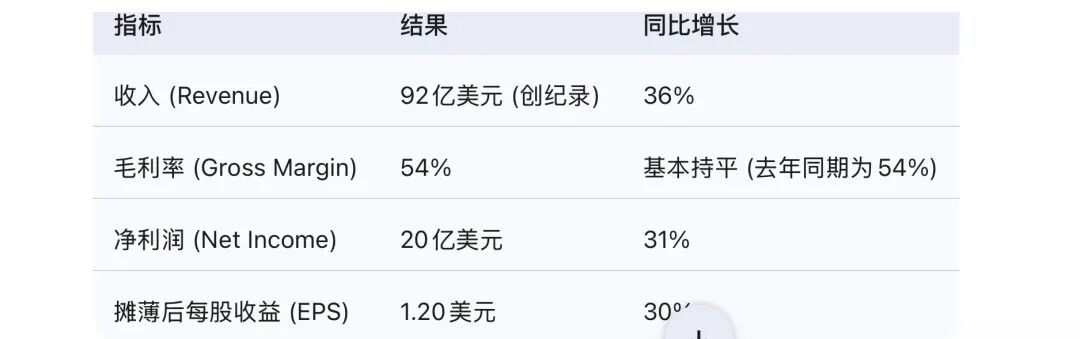
Core Viewpoint - AMD's Q3 performance shows significant revenue growth, but the market remains focused on its gross margin, which has not exceeded expectations. Group 1: Financial Performance - Q3 revenue reached a record $9.2 billion, representing a 36% year-over-year increase [1][2] - Net income rose to $1.24 billion, up from $771 million in the same quarter last year, translating to earnings per share of $0.75 compared to $0.47 [1][2] - Gross margin remained stable at 54%, unchanged from the previous year [2] Group 2: Future Guidance - The company provided revenue guidance for the next quarter with a median estimate of $9.6 billion, reflecting a 25% year-over-year growth [2] - Expected revenue range for the next quarter is between $9.3 billion and $9.9 billion, with a gross margin forecast of approximately 54.5% [2] Group 3: Product Development and Partnerships - AMD plans to launch the next-generation 2nm Venice processors by 2026 [3] - Anticipated strong customer momentum before the release of the next-generation MI400 series accelerators and Helios rack-level solutions [3] - Collaboration with OpenAI is expected to yield initial results in the second half of next year [3] - Deployment of thousands of MI450 GPUs in Oracle Cloud Infrastructure is planned to start in 2026, with expansion into 2027 and beyond [3] - Strategic planning from a rack perspective is expected to drive gross margin increases [3]

AMD 数据不错
小熊跑的快· 2025-11-06 08:20
Core Viewpoint - AMD's performance in Q3 shows significant revenue growth, but the market remains focused on its gross margin, which has not exceeded expectations. Financial Performance - The company's revenue for Q3 reached $9.2 billion, marking a 36% year-over-year increase [2][3] - Net profit rose from $771 million (or $0.47 per share) in the same quarter last year to $1.24 billion (or $0.75 per share) [2] - Gross margin remained stable at 54%, unchanged from the previous year [3][5] - Net income for the quarter was $2 billion, reflecting a 31% increase [3] - Diluted earnings per share (EPS) increased by 30% to $1.20 [3] Future Guidance - The company has provided guidance for the next quarter, projecting a median revenue of $9.6 billion, which represents a 25% year-over-year growth [3] - The adjusted gross margin for the upcoming quarter is expected to be 54.5%, aligning with previous market expectations [5] Product Development and Partnerships - AMD is set to launch the next-generation 2nm Venice processors in 2026 [6] - Anticipated rapid customer momentum before the release of the next-generation MI400 series accelerators and Helios rack-level solutions [6] - Collaboration with OpenAI is expected to yield initial results in the second half of next year [6] - Plans to deploy thousands of MI450 GPUs in Oracle Cloud Infrastructure starting in 2026, with expansion into 2027 and beyond [6] - Strategic planning from a rack perspective is expected to drive gross margin increases starting in 2026 [6]

产品线全面开花!Astera Labs(ALAB.US)Q3交出完美成绩单 华尔街齐声唱好
智通财经网· 2025-11-06 07:20
Core Viewpoint - Astera Labs reported strong Q3 earnings, exceeding expectations, and received positive evaluations from Wall Street, highlighting its growth in semiconductor solutions for cloud and AI infrastructure [1][2]. Financial Performance - In Q3, Astera Labs achieved a record revenue of $230.6 million, a 20% increase quarter-over-quarter and a 104% increase year-over-year. The non-GAAP diluted earnings per share were $0.49, compared to a loss of $0.05 per share in the same period last year [1]. - For Q4, the company expects revenue to reach between $245 million and $253 million, with non-GAAP diluted earnings per share projected at approximately $0.51 [1]. Analyst Ratings and Price Targets - Needham maintained a "Buy" rating on Astera Labs, raising the target price from $205 to $220, citing significant performance and guidance upgrades driven by growth in the Scorpio, Aries, and Taurus product lines [2]. - Citigroup also maintained a "Buy" rating with a target price of $275, emphasizing the company's impressive performance and guidance [2]. Product Development and Market Position - The Scorpio X series is expected to become the largest revenue contributor by 2026, with anticipated growth from single accelerator value enhancement and UALink contributions starting in 2027 [3]. - The PCIe Gen 6 products accounted for over 20% of Q3 revenue, enhancing average sales value, and the company is collaborating with over 10 AI platform providers on the Scorpio X series [2][3]. - Astera Labs is well-positioned to benefit from the long-term trends in AI infrastructure, with management expressing optimism about market opportunities and the potential for significant sales growth [3].

燃机板块迎来数百亿美元增量空间,国防ETF(512670)涨超1.6%
Xin Lang Cai Jing· 2025-11-06 03:18
Group 1 - The core viewpoint highlights the increasing demand for gas turbines driven by AI infrastructure and power energy needs, with potential market growth in the hundreds of billions of dollars [1] - Domestic gas turbine suppliers are strategically positioning themselves to support leading overseas gas turbine OEMs, accelerating their international expansion [1] - Triangle Defense, a component of the National Defense ETF, announced a development agreement with Siemens Energy, which includes specific qualifications for supplying certain items and a framework order agreement for product delivery [1] Group 2 - The National Defense ETF closely tracks the CSI National Defense Index, which includes listed companies under the top ten military industrial groups and those involved in supplying weaponry to the armed forces [2] - As of October 31, 2025, the top ten weighted stocks in the CSI National Defense Index account for 44.41% of the index, with significant players including AVIC Shenyang Aircraft Corporation and Aero Engine Corporation of China [2] - The National Defense ETF has the lowest management and custody fees among its peers at 0.40%, making it unique in its category [2]

国泰海通|策略:资产配置:国际新秩序与产业新变革——2026年全球大类资产配置年度展望
国泰海通证券研究· 2025-11-05 14:31
Group 1: Equity Market Insights - The core view is bullish on Chinese A/H shares due to accelerated economic transformation and increased asset management demand driven by lower risk-free rates [2] - The US stock market is expected to see upward revisions in earnings forecasts by 2026, supported by AI industry growth and increased capital expenditures from tech companies [2] - The Eurozone economy is projected to recover moderately by 2026, benefiting from fiscal spending and supply chain adjustments [2] - Japan's economy is improving post-deflation, with a high probability of continued fiscal and monetary easing [2] - India's economic growth expectations have been downgraded, leading to a recommendation for underweighting Indian stocks [2] Group 2: Bond Market Outlook - Chinese government bond rates are expected to rise slightly due to a stable yet easing monetary policy and positive fiscal policy orientation [3] - The US Treasury yields are anticipated to decline moderately as inflation expectations decrease and economic growth stabilizes [3] Group 3: Commodity Market Trends - Long-term bullish outlook on gold due to the diversification of global central bank reserves and weakening dollar credit [4] - Oil prices are under pressure from oversupply, exacerbated by OPEC+ production increases and rising US shale oil output [4] - Copper prices are supported by structural demand driven by AI infrastructure and grid upgrades, despite declining ore grades and longer development cycles [4] Group 4: Currency Market Analysis - A weak dollar is expected to persist, with potential for a temporary rebound due to geopolitical factors and policy expectations in Europe and Japan [5] - The Chinese yuan is projected to remain stable with a slight upward trend, supported by steady domestic economic momentum and resilient exports [5]


SkyWater Technology, Inc. (NASDAQ:SKYT) Earnings Preview: A Glimpse into the Semiconductor Industry's Future
Financial Modeling Prep· 2025-11-05 11:00
Core Insights - SkyWater Technology, Inc. is a significant player in the semiconductor industry, focusing on advanced electronic components, with quarterly earnings set to be released on November 5, 2025, estimating an EPS of -$0.17 and projected revenue of $135.5 million [1][6] - The electronics sector is experiencing growth driven by increased demand for generative AI, cloud services, and electric vehicles [1][2] Industry Overview - The third quarter of 2025 is critical for electronics stocks, including SkyWater Technology, as the industry benefits from AI infrastructure expansion and global data center buildouts, which are expected to increase demand for specialized semiconductors [2] - Companies like Qualcomm, ARM, and Alpha and Omega Semiconductor are expected to report gains due to growth in AI, data centers, and EV electronics [2] Company Financials - SkyWater Technology is anticipated to report a decline in earnings for the quarter ending September 2025, despite an increase in revenues, with a Zacks Consensus Estimate predicting a quarterly loss of $0.17 per share [3] - The company has a negative price-to-earnings (P/E) ratio of approximately -41.88, indicating current losses, and a price-to-sales ratio of about 2.39, suggesting investors are paying $2.39 for every dollar of sales [4][6] - The enterprise value to sales ratio is around 3.41, providing insight into the company's valuation relative to its revenue [4] Debt and Liquidity Concerns - The debt-to-equity ratio is significantly high at approximately 7.77, indicating a high level of debt compared to equity [5][6] - The current ratio is around 0.41, suggesting potential liquidity concerns as it indicates the company's ability to cover short-term liabilities with short-term assets [5]


智能电网概念再爆发 金冠电气、中能电气等20%涨停
Zheng Quan Shi Bao Wang· 2025-11-05 07:01
智能电网概念5日盘中再度爆发,截至发稿,灿能电力30%涨停,双杰电气、众智科技、金冠电气、中 能电气等20%涨停,亿能电力涨超19%,新特电气涨约15%。 第一创业证券指出,根据年初规划,2025年国家电网、南方电网计划投资预计超过8250亿元,创历史新 高。相对于2024年实际完成投资7822亿元,计划投资额同比增速为5.5%。另根据国家统计局数据,前 三季度国内固定资产投资同比负增长0.5%,是除2020年疫情因素外,首次出现同期固定资产投资负增 长。同时9月份国内房地产投资无论新开工面积增长还是房价变动,都显示地产投资仍未止跌,因此为 了稳经济增长,预期后续年度电网投资大概率成为发力重点。 此外,近期英伟达更新800伏直流架构白皮书,未来的数据中心电源将主要采用800V直流供电。按照英 伟达CEO在今年二季度业绩分析师会议上的预计,2030年AI基础设施支出可能达到3万亿—4万亿美 元,是2025年预计投资的5倍以上。按3万亿美元测算,对应约500GW的功率,相当于2025年中国电网 最大负荷的1/3。如果考虑中国在AI基础设施的投入采取紧跟美国的策略,按一半测算,则2030年全球 AI基础设施新增的电 ...

黑石的IPO大年:套现2100亿
投中网· 2025-11-05 02:29
Core Viewpoint - The prolonged exit stagnation in the global private equity (PE) industry may finally be coming to an end, as evidenced by Blackstone's record investment exits and a resurgence in IPO activities [4][7][22]. Group 1: Blackstone's Performance - Blackstone reported a total of $30.6 billion (approximately 217.2 billion RMB) in investment exits for Q3 2025, marking the highest quarterly exit amount in five years [6]. - The company's distributable earnings surged by 48% year-over-year, exceeding analysts' average forecasts by 22% [6]. - Blackstone announced a quarterly dividend of $1.29 per share, reflecting its strong financial performance [6]. Group 2: IPO and M&A Activities - Blackstone has initiated several significant IPOs, including Cirsa, Knowledge Realty Trust, and Legence, with estimated returns exceeding €2 billion from Cirsa alone [10][11]. - The total scale of global IPOs in Q3 2025 doubled compared to the same period last year, indicating a revitalized market [9]. - Blackstone's exit strategy also included notable M&A transactions, such as the $7 billion sale of Hotwire, yielding over three times the initial investment [11]. Group 3: Future Outlook - Blackstone's IPO pipeline is robust, with multiple projects in preparation, potentially leading to the highest number of IPOs in its history [12]. - The company is actively investing across various sectors, particularly in AI infrastructure, data centers, and energy, anticipating a significant increase in demand for these areas [18][20]. - Blackstone's executives predict that 2026 will be a pivotal year for fundraising, investment, and exit activities, suggesting a strong recovery in the PE market [21][22].


杨德龙:全球股市仍处于牛市周期 A股港股整体估值水平依然较低
Xin Lang Ji Jin· 2025-11-04 10:04
Market Overview - The market is experiencing increased volatility as it approaches the end of the year, with some investors taking profits while others are looking to buy quality stocks in anticipation of a favorable market in 2026 [1][2] - The index has recently broken the 4000-point mark, which is seen as a significant milestone, indicating the establishment of a bull market [1][2] Sector Performance - The market has shown clear differentiation among sectors, with technology stocks leading the gains while traditional sectors lag behind [2][3] - In the fourth quarter, the new energy sector has started to perform well, particularly in areas like solid-state batteries, energy storage, and renewable energy, indicating a potential turnaround for previously underperforming sectors [3] Investment Opportunities - There is a growing expectation that consumer stocks, especially those with strong brand value and stable dividend yields, may see valuation recovery in the coming year [3] - The AI sector, particularly humanoid robots, is viewed as a significant investment opportunity, with the potential to become a major industry following home appliances, smartphones, and electric vehicles [4] AI and Technology Trends - AI infrastructure, including computing power, algorithms, and semiconductor chips, has been a key focus area for innovation and investment [5] - Despite the potential for short-term corrections in AI-related stocks, long-term investors are encouraged to remain focused on this sector as it continues to lead market trends [5] Economic Context - The U.S. government shutdown and ongoing economic challenges are raising concerns about the impact on the economy and investor confidence in the dollar [9] - The rising national debt and interest payments are leading some investors to prefer gold over the dollar, which may continue to affect the dollar's value [9][10] Global Market Dynamics - The recent positive performance in Asian markets, including A-shares and Hong Kong stocks, suggests a global consensus on the current bull market, although valuations in these markets remain below historical averages [8] - The potential for a significant correction in U.S. tech stocks could have a ripple effect on A-shares, necessitating close monitoring of market conditions [8]