价值投资

Search documents
Doximity Crushes The Rule Of 40 - Try Rule Of 58
Seeking Alpha· 2025-07-02 14:36
Group 1 - Doximity (NYSE: DOCS) has moderate growth rates, with guidance indicating barely above double-digit growth [1] - The company presents strong investment potential, being part of a portfolio of undervalued stocks with rapid growth potential driven by quality management [1] - The marketplace emphasizes the importance of selecting attractive investments and highlights the work done in identifying the best stocks [2] Group 2 - The investment approach focuses on delivering strong gains and emphasizes deep value returns, indicating a commitment to high-quality stock picks [3] - The marketplace is experiencing rapid growth, suggesting increasing interest and engagement from members [3] - Member reviews indicate satisfaction with the actionable and insightful stock picks provided [3]



高毅资产邱国鹭:为什么价值投资适合中国
Sou Hu Cai Jing· 2025-07-02 09:12
Core Insights - The article emphasizes the importance of value investing in the Chinese market, highlighting that "Securities Analysis" serves as an essential guide for investors to understand both the methodology and philosophy behind value investing [3][9] - It discusses three main investment principles from Graham: margin of safety, Mr. Market, and investing with a business perspective, which are interconnected and form a logical framework for value investing [6][9] Financial Analysis - The book "Securities Analysis" uses accounting language as its foundation, focusing on financial statements to provide a practical methodology for fundamental analysis [4] - It suggests that analyzing a company's financial performance over time can help assess its intrinsic capabilities and value, similar to evaluating a student's academic performance [4][5] - The article stresses the need to look beyond surface-level profit growth and to analyze the underlying capabilities of companies through their financial reports [6][7] Market Dynamics - The article notes that price fluctuations reflect underlying value, with stock prices being influenced by both fundamental data and intrinsic capabilities [8] - It highlights the volatility of stock prices in the A-share market, which can create opportunities for investors when prices are significantly undervalued [8] - The discussion includes the importance of understanding a company's core competitiveness, industry landscape, and management quality as part of assessing its intrinsic value [8][9] Investment Philosophy - The article asserts that value investing is applicable in China, supported by historical evidence of high long-term returns for skilled value investors [9] - It emphasizes the necessity for investors to develop discipline and independent judgment, which can be enhanced by mastering the knowledge and techniques presented in "Securities Analysis" [9]

【有本好书送给你】1934年首次出版!载入史册的神书,投资传奇万字作序:这本书你读懂了吗?
重阳投资· 2025-07-02 07:25
Core Viewpoint - The article emphasizes the importance of reading and continuous learning in the investment field, highlighting the value of Benjamin Graham's "Security Analysis" as a timeless guide for investors [2][12][41]. Group 1: Importance of Reading - The article references Charlie Munger's belief that wisdom cannot be attained without reading, underscoring the significance of reading as a growth path [2][3]. - The publication aims to encourage readers to maintain their reading habits and engage in discussions about selected books [4][5]. Group 2: Overview of "Security Analysis" - "Security Analysis," co-authored by Benjamin Graham and David Dodd, is described as a foundational text for value investing, providing principles for evaluating stocks and bonds [12][41]. - The book has remained popular since its first publication in 1934, even during significant financial crises, and is referred to as the "bible of value investing" [12][41]. Group 3: Value Investing Principles - The article outlines that value investing involves purchasing securities at prices below their intrinsic value, often summarized as "buying a dollar for fifty cents" [24]. - It emphasizes the need for investors to balance multiple objectives, such as generating returns, preserving capital, and maintaining liquidity [12][19]. Group 4: Market Inefficiencies - The article discusses how market inefficiencies can lead to mispricing of securities, creating opportunities for value investors to buy undervalued stocks [19][20]. - It highlights that stock prices are often influenced by investor emotions rather than fundamental analysis, leading to volatility [19][20]. Group 5: Investment Strategy - Investors are encouraged to maintain discipline and patience, particularly during market downturns, as these periods can present buying opportunities [22][24]. - The article stresses the importance of conducting thorough research and analysis to identify undervalued securities and to avoid being swayed by market sentiment [31][32]. Group 6: Valuation Techniques - Various methods for assessing a company's value are discussed, including discounted cash flow analysis and evaluating market multiples [33][34]. - The article notes that understanding a company's future cash flow potential is crucial for accurate valuation, despite the inherent challenges in forecasting [36][37].

社会资产负债表发生了大逆转,信璞投资归江最新发声:投资逻辑不变,股神都帮不了你
聪明投资者· 2025-07-02 05:13
Core Insights - The article emphasizes the shift from interest income to dividend income, indicating a fundamental change in the capital structure of the financial market [1][26] - It highlights the importance of understanding macroeconomic factors and the liquidity dynamics between China and the US, particularly in the context of asset allocation [14][44] - The concept of "capital allocators" versus "market traders" is introduced, suggesting different investment strategies based on market conditions [31][33] Group 1: Market Dynamics - The article discusses the transition from a "savings interest" model to a "dividend yield" model, with dividends now surpassing traditional bank interest rates [25][26] - It notes that the Chinese capital market is entering a period of significant liquidity, with a record increase in household deposits, amounting to nearly 8 trillion in the first half of the year [18][25] - The comparison of asset classes (stocks, bonds, real estate) in the US and China is framed as a "hexagonal warrior" approach, emphasizing the need for flexibility in asset allocation [13][14] Group 2: Investment Strategies - The article differentiates between "capital allocators" who increase stock positions during economic downturns and "market traders" who do the opposite, highlighting the psychological and strategic differences [31][33] - It emphasizes the importance of understanding the underlying value of assets through metrics like cash flow and dividend yield, rather than focusing solely on short-term profits [2][30] - The discussion includes the need for long-term investors to adapt to changing market conditions and to recognize the cyclical nature of investments [37][42] Group 3: Economic Context - The article outlines the current economic environment in China, characterized by overcapacity and a shift in investment focus from real estate to high-dividend stocks [20][44] - It presents a comparative analysis of the debt situations in China and the US, noting the significant differences in household deposits and government debt levels [14][15] - The narrative suggests that the current economic challenges in China are leading to a re-evaluation of asset values and investment strategies [19][44]

洪灝:当前宏观环境里,高分红投资策略应该继续有所表现
Di Yi Cai Jing· 2025-07-02 04:09
Group 1 - The core trend in the Chinese stock market is the significant increase in dividend and buyback activities, particularly among state-owned enterprises (SOEs), leading to the outperformance of high-dividend indices compared to the broader market index [1] - The increase in dividends and buybacks is driven by regulatory initiatives aimed at enhancing shareholder returns, similar to corporate governance reforms seen in Japan and South Korea [1] - The consensus in the market suggests that high-dividend stocks are an attractive option for investors seeking high cash flow, especially from stable large SOEs [1][6] Group 2 - The increase in dividends and buybacks among SOEs indicates an improvement in corporate governance, with dividend payments from SOEs rising to 1.24 trillion yuan in 2023, a 67% increase since 2019 [4] - The total amount of stock buybacks by listed SOEs reached 33 billion yuan in 2023, nearly six times higher than in 2019, with this trend accelerating into 2024 [4] - Chinese non-financial enterprises hold over 2 trillion USD in cash, representing about 30% of their total market value, indicating significant potential for increased dividends and buybacks [4] Group 3 - The frequency of dividend payments is increasing, with some major banks planning to pay interim dividends, making them more attractive to domestic retail investors [5] - SOEs have shown a significant turnaround in performance over the past three years, particularly in sectors like energy, utilities, telecommunications, and finance, which have led the market [5] - High-dividend yield stocks, particularly those from SOEs, are becoming a key investment theme as domestic investors view them as defensive assets amid a challenging macroeconomic environment [6]
中证报评论员:捕捉属于中国资本市场的时代红利 ——百万亿市值折射A股市场深刻变化
news flash· 2025-07-01 23:43
Core Viewpoint - The A-share market has surpassed a total market capitalization of 100 trillion yuan for the second consecutive trading day, marking a significant milestone in market scale and reflecting the synergy of reform dividends, value-driven investment, and capital recognition [1] Group 1 - The crossing of the 100 trillion yuan market capitalization threshold represents not only a breakthrough in the scale of the A-share market but also opens new possibilities for a high-quality, strong foundation Chinese capital market [1] - The article emphasizes the importance of confidence in investment, perseverance in beliefs, and the rewards of faith in the context of the current market environment [1] - It advocates for a commitment to value investment and embracing innovation as essential strategies to capture the era's dividends in the historical process of value reassessment and ecological reconstruction within the Chinese capital market [1]
捕捉属于中国资本市场的时代红利
Zhong Guo Zheng Quan Bao· 2025-07-01 21:04
行稳方能致远。看外部,美联储降息节奏等因素可能带来扰动。看内部,部分板块短期上涨较快,持续 上涨离不开盈利增长的支撑。A股行进的道路上仍可能出现荆棘。眼下,更需脚踏实地、稳中求进,扎 扎实实推动改革举措落地显效,在市场运行上体现"稳",在激发市场活力、强化市场功能上体现"进"。 持续防风险,强化监管效能,筑牢底线。加强境内外、场内外、期现货联动监测监管,增强工作的前瞻 性、主动性、有效性。更好发挥两项支持资本市场的结构性货币政策工具效用,加强战略性力量储备和 稳市机制建设。加强政策解读和宣传引导,进一步稳定市场预期,巩固市场回稳向好势头。 政策面,资本市场改革深化,释放政策红利;资金面,流动性持续充裕,提升市场活力;基本面,经济 向稳叠加技术突破,提供现实支撑……多因素共振,助力A股市场完成关键一跃。站在百万亿市值新坐 标,回望近年来特别是近一年多来A股资本市场发生的深刻结构性变化,不难发现,百万亿市值的突破 只是时间早晚的问题。 从融资主导走向投融资协调发展,市场定位发生深刻变化。近年来,A股市场通过优化融资规则及完善 分红回购机制,推动投融资从单向输血转向动态平衡。融资端,与新"国九条"配套的"科创板八条 ...
中证价值指数,投资价值如何?|第393期直播回放
银行螺丝钉· 2025-07-01 13:59
文 | 银行螺丝钉 (转载请注明出处) 一、【第393期直播回放】 有朋 友问,中证价值指数,历史表现如何? 当前估值如何,适合投资吗?有哪些对应的指数基金可以选择呢? 在今晚的直播课里,螺丝钉详细介绍了这些问题。 长按识别下面二维码,添加 @课程小助手 微信,回复「 0701 」即可观看直播回放。 (提示:回复后可以耐心等待几秒哦~) 二、【部分直播课内容如下】 A股常见的指数,主要分为四类。 第一类是宽基指数。 通常是按照上市公司的市值规模来选股的,会包含各个行业的股票,覆盖范围很"宽"。 第二类是策略指数。 通常是在宽基指数的基础上,用了某一种投资策略,覆盖的行业也会比较广泛。 策略指数丰富了我们投资的选项,满足了很多投资者个性化的需求。 第三类是行业指数。 也就是仅覆盖了某个行业的股票,例如消费、医药、金融等。最常见的行业指数,是11个一级行业。 每个一级行业,其实都是社会不可或缺的一部分,长期也是跟着社会发展的。 第四类是主题指数。 所包含的股票,跟某个主题密切相关,例如科技、新能源、人工智能等。 主题指数,通常会横跨多个行业,但达不到宽基指数的行业覆盖程度。 2 . 常见策略指数 1 . A股 常 ...

侃股:未来业绩是填权行情的重要支撑
Bei Jing Shang Bao· 2025-07-01 12:16
Group 1 - The core logic behind the recent filling rights market is the optimistic expectations regarding the future performance of the underlying companies [1] - Filling rights refer to the process where a stock price rises to fill the gap after ex-rights and ex-dividend [1] - Companies with good development prospects, stable profitability, and sustainable growth potential tend to receive higher valuations from the market [1] Group 2 - Emerging technology companies are examples of firms experiencing filling rights due to their core technologies, large market shares, and strong innovation capabilities [1] - The market is confident in the future performance growth of these companies, which is expected to lead to significant stock price increases [1] - This performance-driven filling rights market not only provides substantial returns for investors but also helps optimize market resource allocation [1] Group 3 - However, some filling rights stocks may be subject to pure speculation, lacking performance support [2] - Short-term speculation can lead to significant price volatility, particularly in small-cap stocks without fundamental backing [2] - Investors are advised to analyze the company's fundamentals, focusing on performance, industry position, and core competitiveness to identify sustainable filling rights [2] Group 4 - Future performance is a crucial support for the filling rights market, representing an inherent market operation rule [3]
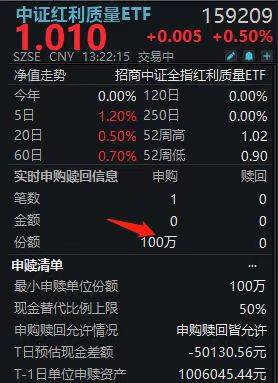
中证红利质量ETF(159209)盘中再迎净申购!“巴菲特理念”深入人心
Sou Hu Cai Jing· 2025-07-01 05:49
Core Viewpoint - The article highlights the performance and features of the China Securities Dividend Quality ETF (159209), which has shown a positive trend in the market, reflecting a growing interest in high-quality dividend stocks [1]. Group 1: ETF Performance - As of July 1, the China Securities Dividend Quality ETF (159209) increased by 0.60%, indicating a strong market performance [1]. - The ETF has experienced net inflows during trading, suggesting investor confidence and interest [1]. Group 2: ETF Characteristics - The ETF tracks the China Securities All Index Dividend Quality Index, which selects 50 companies known for stable dividends, high dividend yields, and consistent profitability [1]. - The ETF employs a "dividend + quality" dual-factor screening mechanism to identify undervalued and high-quality companies, aligning with Warren Buffett's value investment philosophy [1]. Group 3: Fee Structure and Investor Appeal - The fee structure of the ETF is competitive, with a management fee of 0.15% and a custody fee of 0.05%, making it one of the lowest in the market [1]. - The ETF features a unique monthly dividend assessment mechanism that enhances cash flow management for investors, increasing its attractiveness for long-term holding [1]. Group 4: Market Context - In the current market environment, strategies that balance safety margins and profitability are becoming a focal point for investors [1].