
基本面分析

Search documents
铅周报:情绪受抑、库存高位铅价低位宽幅波动-20260323
Tong Guan Jin Yuan Qi Huo· 2026-03-23 01:20
Group 1: Report Industry Investment Rating - No relevant content provided Group 2: Core Views of the Report - Last week, the main contract of Shanghai lead fluctuated widely at a low level. The Fed's hawkish stance and the escalating situation between the US and Iran led to a decline in interest - rate cut expectations and increased concerns about economic downturn, suppressing the risk - asset market. The fundamentals showed limited improvement. The losses of secondary lead smelters led to an expectation of supply tightening, and the prices of lead ore and waste batteries remained firm, providing cost support. However, poor battery consumption and the inflow of crude lead kept lead ingot inventories at a high level, restricting the rebound space of lead prices. In the short term, both macro and micro supports are limited, and it is expected that lead prices will fluctuate in a low - level range [4][7][8] Group 3: Summary by Directory Transaction Data - From March 13th to March 20th, the SHFE lead price dropped from 16,555 yuan/ton to 16,290 yuan/ton, a decrease of 265 yuan/ton; the LME lead price fell from 1,903 US dollars/ton to 1,889 US dollars/ton, a decrease of 14 US dollars/ton; the Shanghai - London ratio decreased from 8.70 to 8.62; the SHFE inventory decreased by 9,939 tons to 66,110 tons; the LME inventory decreased by 400 tons to 284,100 tons; the social inventory increased by 0.11 million tons to 7.76 million tons; the spot premium remained at - 190 yuan/ton [5] Market Review - Last week, the price of the main contract PB2605 of Shanghai lead stabilized at a low level and then fluctuated widely. The downstream battery enterprises' buying improved after the lead price decline, but the cautious macro - sentiment, the collective pressure on the precious metal and non - ferrous metal sectors, and the weak fundamentals restricted the rebound space of lead prices. The weekly decline was 1.9%, closing at 16,290 yuan/ton. The LME lead price fell below the 1,900 US dollars/ton line, with a decline of 0.74%, closing at 1,889 US dollars/ton. In the spot market, there were differences in the prices of electrolytic lead and secondary lead, and the downstream enterprises' purchasing was mainly long - term contracts, with regional differences in the spot market transactions [6] Industry News - On March 20, 2026, the domestic lead concentrate processing fee was 250 yuan/metal ton, unchanged from the previous period; the import processing fee was - 135 US dollars/dry ton, an increase of 10 US dollars/dry ton from the previous period. From January to February 2026, the cumulative import volume of lead concentrate was 252,200 tons, a year - on - year increase of 13.8%; the cumulative import volume of silver concentrate was 328,600 tons, a year - on - year decrease of 1.27%. The cumulative import volume of refined lead and lead products was 81,234 tons, a year - on - year increase of 270%; the cumulative export volume was 7,798 tons, a year - on - year decrease of 33.27%. The cumulative export volume of starting lead - acid batteries was 11.3772 million units, a year - on - year increase of 3.98%; the cumulative export volume of other lead - acid batteries was 22.6906 million units, a year - on - year decrease of 5.1% [9] Related Charts - The report provides multiple charts, including SHFE and LME lead prices, Shanghai - London ratio, SHFE and LME inventories, 1 lead premium and discount, primary lead and secondary refined lead price difference, enterprise operating rates, secondary lead enterprise profits, electrolytic lead production, lead ingot social inventory, lead ore weekly processing fees, and refined lead import and export profit and loss [11][12][15]
EG负荷继续下降,港口开始去库
Hua Tai Qi Huo· 2026-03-13 05:26
1. Report Industry Investment Rating - Not provided in the given content 2. Core Viewpoints - EG load continued to decline and port inventory started to decrease. As of March 12, the total MEG inventory in the main ports in East China was 92.7 tons, a decrease of 4.6 tons from Monday [1]. - On the domestic supply side, the EG load decreased due to concerns about the stability of upstream raw material supply. Overseas, imports from the Middle East, especially affected by the situation in Iran, are expected to shrink further. On the demand side, polyester and weaving loads are gradually recovering after the Spring Festival. Recent rising raw material prices have spurred speculative demand and inventory reduction. Polyester products have little inventory pressure, but potential negative impacts on downstream production due to high - cost raw materials need attention [2]. 3. Summary by Directory Price and Basis - The closing price of the main EG contract was 4,653 yuan/ton (up 76 yuan/ton, +1.66% from the previous trading day), and the spot price of EG in the East China market was 4,733 yuan/ton (up 258 yuan/ton, +5.77% from the previous trading day). The spot basis of EG in East China was -58 yuan/ton (down 35 yuan/ton from the previous day) [1]. Production Profit and Operating Rate - According to Longzhong data, the production profit of ethylene - based EG was -101 US dollars/ton (up 33 US dollars/ton), and the production profit of coal - based syngas EG was -211 yuan/ton (up 296 yuan/ton) [1]. International Price Difference - Not elaborated in the text, only mentions a chart about the international price difference of "US FOB - China CFR" [21] Downstream Sales and Production, and Operating Rate - After the Spring Festival, polyester and weaving loads are gradually recovering. Recent rising raw material prices have spurred some speculative demand and inventory reduction. Polyester products have little inventory pressure, but potential negative impacts on downstream production due to high - cost raw materials need attention [2] Inventory Data - According to CCF data, the MEG inventory in the main ports in East China was 106.8 tons (up 6.6 tons). The main ports continued to accumulate inventory last week, and the current inventory is still high. This week, the planned arrivals in the main ports in East China total 7.8 tons, and in the secondary ports 1.2 tons [1] 4. Strategies - Unilateral: Cautiously go long on hedging at low prices. The fundamentals are improving marginally under high inventory. De - stocking may start in late March, and the de - stocking amplitude is expected to increase in April. Short - term attention should be paid to the passage situation of the Strait of Hormuz and changes in EG plants. - Inter - delivery: Go long on the 5 - 9 spread due to supply impacts. Pay attention to the passage situation of the Strait of Hormuz. - Inter - commodity: No strategy provided [3]
国际油价一夜暴跌!油气股集体走低,多股跌停
第一财经· 2026-03-10 05:44
Core Viewpoint - The article discusses the significant decline in the oil and gas sector in the A-share market, primarily influenced by geopolitical tensions and market reactions to statements made by U.S. President Trump regarding oil sanctions and potential releases from strategic reserves by the G7 countries [5][6]. Group 1: Market Reaction - A large number of oil and gas stocks opened lower, with several hitting the daily limit down, including companies like Zhongjie Oil and Shandong Molong [3][4]. - The international oil prices experienced a drastic drop, with Brent crude and NYMEX crude futures falling by 10% in a single trading session [5]. Group 2: Geopolitical Influences - Trump's announcement to lift some oil-related sanctions aims to stabilize oil prices amid market turmoil caused by U.S. and Israeli actions against Iran [5]. - The International Energy Agency (IEA) indicated that G7 discussions included the possibility of releasing emergency oil reserves, with member countries holding over 1.2 billion barrels in reserves [6]. Group 3: Supply Chain Concerns - The core trading focus for oil currently revolves around Middle Eastern geopolitical risks, with analysts suggesting that prolonged conflicts could significantly impact oil supply and prices [7]. - The Strait of Hormuz, a critical passage for oil exports, sees an average daily flow of 19.47 million barrels, accounting for about 20% of global oil consumption [9]. Group 4: Production Adjustments - Iraq and Kuwait have begun preventive production cuts due to storage capacity issues, with a total expected reduction of 3.3 million barrels per day [10]. - The speed and difficulty of resuming production after cuts can vary significantly based on the reasons for the shutdown, which adds to the uncertainty of supply recovery [10]. Group 5: Future Market Outlook - Goldman Sachs projected a significant oversupply pressure in the global oil and gas market by 2026, although current geopolitical factors may lead to price volatility that overshadows fundamental analysis [11].






中信建投期货:2月26日能化早报
Xin Lang Cai Jing· 2026-02-26 01:36
Group 1: Soda Ash Market - On Wednesday, soda ash futures saw significant gains while spot prices remained stable, indicating improved market sentiment [4][13] - Recent maintenance schedules for soda ash production have been minimal, with production increasing by 18,000 tons to 792,000 tons week-on-week, and expectations for future production are declining, slightly easing supply pressure [4][13] - Downstream demand has slightly decreased, with soda ash plant inventories rising by 10,000 tons to 1,588,000 tons, while the latest delivery warehouse inventory decreased by 15,000 tons to 308,000 tons [4][13] - December soda ash imports rose slightly to 3,500 tons, while exports increased to 232,700 tons [4][13] - The macroeconomic environment shows a decline in domestic real estate sales compared to last year, while foreign macro influences are neutral [4][13] Group 2: Glass Market - Glass futures experienced a slight increase, with spot prices remaining stable to rising, although the supply-demand fundamentals are weak [5][14] - Glass production remained stable week-on-week, but downstream purchasing enthusiasm has decreased, leading to an increase in inventory by 114,000 tons to 2,768,000 tons, which is a year-on-year decrease of 123,000 tons [5][14] - The latest daily melting capacity for glass is 148,595 tons per day, reflecting a year-on-year decrease of approximately 5.1% [5][14] - The construction area of residential buildings in China from January to December has decreased by 18.1% year-on-year, indicating a worsening trend [5][14] Group 3: Polyolefins Market - As of February 25, the LLDPE main contract closed down by 43 yuan/ton to 6,777 yuan/ton, while the PP main contract fell by 26 yuan/ton to 6,720 yuan/ton [5][14] - Geopolitical factors have led to a significant rise in crude oil prices, providing cost support for polyolefins, although overall supply remains high [5][14] - There are expectations of inventory accumulation post-holiday, which may suppress the price elasticity of polyolefins relative to crude oil, leading to overall market fluctuations [5][14] Group 4: Caustic Soda Market - As of February 25, the SH2605 contract rose by 14 yuan/ton to 2,167 yuan/ton, with mainstream transaction prices for 32% ion membrane caustic soda in Shandong ranging from 600 to 715 yuan/ton, reflecting a 5 yuan/ton increase from the previous working day [16] - Some chlor-alkali enterprises are operating below capacity, and while inventory pressures are manageable, profitability remains poor, leading to price stability for liquid caustic soda [16] - Liquid chlorine prices are still low, and expectations for further increases in chlor-alkali production are limited due to low valuations [16] Group 5: PVC Market - As of February 25, the PVC main contract rose by 15 yuan/ton to 4,963 yuan/ton, with varying basis changes across different regions [18] - The market has seen a significant increase in export orders, which may continue until mid-March, indicating a positive outlook for the first quarter [18] - However, high inventory levels remain a concern, and the market is expected to return to a fluctuating trend as it awaits further improvements in the fundamentals [18]


最最最伟大交易员:德鲁肯米勒深度访谈
点拾投资· 2026-02-23 02:04
Core Insights - The article highlights the investment philosophy and strategies of Stanley Druckenmiller, emphasizing his ability to combine fundamental and technical analysis for successful trading [1][7][15]. Group 1: Investment Philosophy - Druckenmiller believes in the importance of both fundamental and technical analysis, stating that 75%-80% of his ideas come from fundamentals, while the rest are validated by charts [17]. - He emphasizes the need for adaptability and the ability to recognize mistakes, noting that great investors are willing to share their failures [3][4]. - The article discusses the significance of risk management, with Druckenmiller advocating for a flexible approach rather than rigid stop-loss orders [44][65]. Group 2: Trading Strategies - Druckenmiller's strategy includes focusing on a few high-conviction trades rather than diversifying too broadly, arguing that diversification is often overrated [37][39]. - He shares a historical example of shorting the British pound, where he increased his position significantly based on market conditions, demonstrating his willingness to take large risks when he sees a clear opportunity [23][26][30]. - The article mentions his approach to managing positions, where he adjusts based on market signals and his confidence level, advocating for aggressive positions during favorable conditions [61][62]. Group 3: Market Outlook - Druckenmiller expresses concerns about the current economic environment, predicting potential future crises due to a lack of structural reforms and excessive liquidity [76][79]. - He highlights his current investment stance, favoring gold and commodity currencies while being bearish on the British pound and U.S. dollar [79]. - The article concludes with Druckenmiller's belief that the next crisis could stem from sovereign issues, indicating a cautious outlook on the market [76][78].

主次节奏:2.22黄金 - 每周走势梳理
Sou Hu Cai Jing· 2026-02-22 15:17
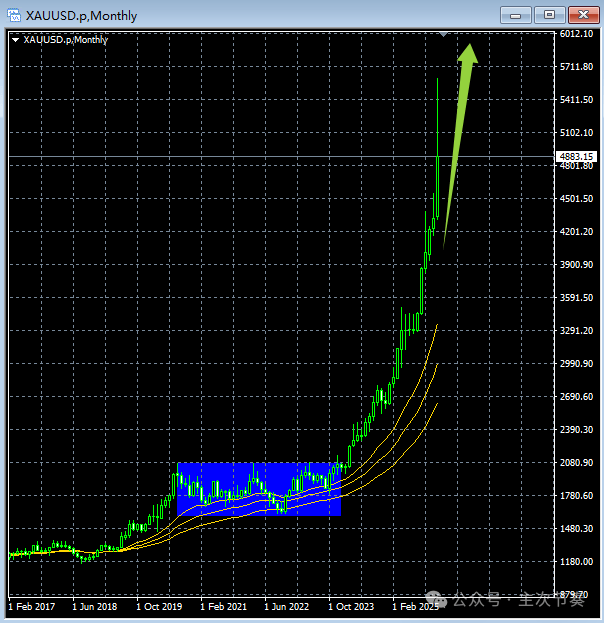
Core Viewpoint - The article discusses the ongoing bullish trend in gold prices, emphasizing that the market is currently in a strong upward phase, with expectations for further increases in the coming years, particularly in 2026 [1][3]. Technical Analysis - The current bullish trend in gold began with a breakout from a significant consolidation phase between 2020 and 2023, driven by deteriorating global conditions [1]. - The recent price action indicates that gold is in a third wave of a bullish cycle, with expectations to reach new historical highs by 2026 [1]. - A recent flash crash in late January 2026 suggests a potential local pressure point, but this is considered minor in the context of the overall monthly trend [1][3]. Market Dynamics - The gold market has shown strong upward momentum, with the weekly chart indicating a clear bullish trend, although there are signs of local momentum shifts that could lead to short-term corrections [3][4]. - The recent price movements suggest that gold has entered a new price range, with expectations to break through the psychological barrier of 5000 [3][4]. Short-Term Outlook - The daily chart indicates a phase of strong momentum reversal, marking the beginning of a short-term correction, but the overall trend remains bullish [5]. - The 4-hour chart shows gold in a consolidation phase, with potential targets set between 5120 and 5160, influenced by geopolitical factors [8]. Summary of Trends - The overall trend for gold remains bullish across multiple time frames, with expectations for continued upward movement despite potential short-term corrections [2][6].
紫江企业资金流向与基本面数据更新,关联方拿地引关注
Jing Ji Guan Cha Wang· 2026-02-14 07:59
Group 1 - The core viewpoint of the articles focuses on the recent financial performance and market dynamics of Zijiang Enterprise, highlighting both capital flow and fundamental performance without specific future events disclosed [1][2] Group 2 - As of February 9, 2026, Zijiang Enterprise's stock price closed at 7.62 yuan, with a daily increase of 0.79%. The main capital saw a net outflow of 8.31 million yuan, while retail and speculative funds recorded net inflows of 5.24 million yuan and 3.07 million yuan, respectively, with a total transaction volume of 150 million yuan and a turnover rate of 1.3% [1] - In the previous month, on January 6, 2026, the main capital had a net inflow for three consecutive days, with a net inflow of 13.94 million yuan and a stock price increase of 2.29% on that day [1] Group 3 - The company's Q3 2025 report indicated a revenue of 7.822 billion yuan, representing a year-on-year growth of 8.83%. The net profit attributable to shareholders was 966 million yuan, showing a significant year-on-year increase of 83.05%. The debt ratio stood at 48.25%, and the gross profit margin was 23.56% [1] Group 4 - Zijiang Group, a related party, won a residential land parcel in Minhang District on January 6, 2026, which is interpreted by the market as a potential opportunity for future business collaboration, although no specific integration plans have been announced [1] Group 5 - The company's price-to-earnings ratio (TTM) is 9.24 times, which is below the industry average. The dividend yield is 3.95%, and the price-to-book ratio is 1.73 times. As of September 30, 2025, the number of shareholders was 85,600, a decrease of 11.04% from the previous period [1]

探讨缠论的三个核心:纠缠论技术分析框架解析
ZHONGTAI SECURITIES· 2026-02-12 14:48
Core Insights - The report emphasizes the importance of understanding market dynamics through three dimensions: policy, industry, and volatility, with the Chande theory focusing on the volatility aspect [3] - Chande theory consists of three components: fundamental analysis, comparative analysis, and technical analysis, with technical analysis being the closest to objective price facts and forming a high-probability trading system [3] Section Summaries Chande Theory Fundamentals - The Chande theory is built on three core principles: 1. Trends must complete and transform into new trends (upward/downward/consolidation) [4] 2. Self-similar structures indicate market fractal characteristics, with multiple levels of recursive definitions [4] 3. Three types of buy/sell points are defined: - First buy: trend bottom divergence (reversal point) - Second buy: secondary level pullback without breaking previous lows (confirmation point) - Third buy: breakout from the central area followed by a pullback without returning to the central area (acceleration point) [4][5] Technical Analysis Framework - The Chande framework includes a systematic breakdown with prerequisites and philosophical foundations, focusing on the following key points: - Segments must be broken by reverse segments, indicating the exhaustion of old energy and the establishment of new balance [5] - Any trend can be uniquely decomposed into three forms of connections at the same level [5] - Small divergences can trigger large-level reversals [5] Market Self-Similarity - The unique decomposition theorem states that any trend can be uniquely decomposed into a combination of trends and consolidations, resembling prime factorization [22] - The fractal nature of market movements allows for multi-level operations, where higher-level trends are defined by lower-level movements [23] Divergence and Buy/Sell Points - Divergence is a critical signal indicating the exhaustion of trend momentum, with two adjacent segments compared to identify strength changes [39] - The three types of buy/sell points provide a complete operational chain: - First type: trend divergence point, indicating potential reversals - Second type: confirmation point after a pullback - Third type: confirmation point after breaking out of a central area [39] Summary of Chande Theory - The Chande technical analysis system's three core principles create a tightly interconnected and logically sound system: - "Trends must complete" serves as the strategic guiding principle, establishing the ultimate laws of market operation - "Self-similar structures and levels" provide standardized tools for market dissection - "Divergence and buy/sell points" offer precise entry and exit signals for trading decisions [52]
PP:C3原料表现偏强,估值修复有限
Guo Tai Jun An Qi Huo· 2026-02-11 02:02
Report Industry Investment Rating - Not provided Core Viewpoints of the Report - C3 raw materials for PP are relatively strong, but the valuation repair is limited. The overall fundamentals at the end of the year provide limited support, and attention should be paid to the marginal changes of PDH units under deep losses [1][2] Summary by Relevant Catalogs Fundamental Tracking - **Futures Data**: The closing price of PP2605 yesterday was 6688, with a daily increase of 0.87%, trading volume of 298,300, and a change in open interest of -1,773 [1] - **Basis and Spread Changes**: The basis of the 05 contract yesterday was -148 (compared to -150 the day before), and the 05 - 09 contract spread was -19 (compared to -31 the day before) [1] - **Important Spot Prices**: In North China, it was 6,510 yuan/ton (compared to 6,520 the day before); in East China, it was 6,540 yuan/ton (compared to 6,480 the day before); in South China, it remained at 6,690 yuan/ton [1] Spot News - The market is volatile. Upstream pre - sale pressure is not large, downstream is gradually on holiday, trading atmosphere is average, basis is weakly stable, and warehouse receipts are at a high level. The PP US dollar market price has increased, but overseas suppliers' enthusiasm for quoting to China is low. Exports are affected by the strengthening exchange rate and the rising domestic market, and downstream continues to purchase on a rigid - demand basis, with little improvement in trading [1] Market Condition Analysis - **Cost Side**: Crude oil and propane prices are volatile. There is a valuation differentiation within olefins, and the valuation of PE in terms of internal, external, and upstream profit margins is higher than that of PP [2] - **Supply Side**: There is no new production before the 2605 contract, and the game between existing supply and demand intensifies [2] - **Demand Side**: Downstream new orders follow up on a rigid - demand basis. At the end of the year, the overall fundamental support is limited. PDH profit on the cost side remains at a low level. Multiple PDH units in South China have given maintenance expectations, and some are inquiring about propane raw materials for the end of March. Under deep PDH losses, attention should be paid to the marginal changes of PDH units [2] Trend Intensity - PP trend intensity is 0 [3]
五矿期货:乙二醇专题:地缘与基本面博弈,减产压力仍存
Wu Kuang Qi Huo· 2026-02-04 01:59
1. Report Industry Investment Rating - Not provided in the content 2. Core Viewpoints of the Report - Ethylene glycol still has significant inventory accumulation pressure, with high domestic operating rates and expected moderately high import volumes from February to March. It is likely to experience substantial inventory accumulation during the downstream off - season around the Spring Festival [2][4]. - The previous cold wave narrative was unable to support the upward trend of ethylene glycol. The cold wave had no substantial impact on the devices, and the influence of cold waves on China's overall imports has diminished. Currently, the key exogenous variable is the geopolitical situation in the Middle East [12]. - If the geopolitical issues ease, ethylene glycol will need to compress its valuation to reduce the high operating rate under the pressure of weak fundamentals [2][12] 3. Summary by Relevant Catalogs 3.1 Currently, the fundamentals of ethylene glycol remain weak - Ethylene glycol faces significant inventory accumulation pressure, with high domestic operating rates, especially for coal - based plants with good profits. Iran and Kuwait have abundant supplies, Taiwan, China is shipping actively, and Saudi Arabia's production cuts will be reflected later. Import volumes from February to March are expected to be moderately high [4]. - Inventory is likely to increase to historical high levels during the Spring Festival downstream off - season. The inventory decline cycle is expected to start after the maintenance season in March and the restart of the polyester peak season, but the de - stocking intensity will be gentle until the ethylene glycol operating rate is substantially reduced [4] 3.2 The previous cold wave narrative was difficult to support, and the main focus is on the influence of Middle East geopolitics - The cold wave in Texas and Louisiana did not cause extremely low temperatures, only around - 5 degrees Celsius, far from the - 19 degrees Celsius in 2021 that led to the shutdown of chemical plants. So, it had no substantial impact on the devices, and the cold wave narrative ended quickly [12]. - Since the Sino - US tariff issue, the amount of ethylene glycol exported from the US to China has decreased significantly, and its exports have mostly been replaced by those from the Middle East and Taiwan, China. So, the influence of cold waves on China's imports has weakened [12]. - The geopolitical situation in the Middle East is a key exogenous variable. As US exports decline, Saudi Arabia's exports to China have reached a relatively high level. Saudi and Kuwaiti exports are affected by the geopolitical situation in the Middle East. If the geopolitical issues ease, ethylene glycol needs to compress its valuation to reduce the high operating rate [12]