万亿城市

Search documents
温州GDP破万亿元:“万亿城市”已增至28座
Xin Hua Wang· 2026-01-20 15:36
【纠错】 【责任编辑:张欣然】 温州地区生产总值突破万亿元的背后,离不开产业能级的稳步提升。近年来,温州坚持"工业强市"战 略,推进传统产业改造与新兴产业培育,优化产业结构。2025年,全市五大传统优势产业、五大新兴主 导产业规上工业增加值分别增长11.4%、12.6%,工业总产值突破1.5万亿元。 新华社杭州1月20日电(记者孔令杭)1月20日,记者从温州市两会上获悉,2025年温州地区生产总值突 破万亿元大关,成为浙江继杭州、宁波之后的第三座"万亿城市"。截至目前,"万亿城市"已增至28座。 作为民营经济重镇,民营经济始终是温州发展的核心支撑。截至2025年11月,温州在册民营企业和个体 工商户合计156.4万户,民营规上工业企业增加值占规上工业比重达90.8%,彰显出强劲活力。 ...
温州2025年GDP突破万亿元 成浙江第三座万亿城市
Xin Lang Cai Jing· 2026-01-20 10:39
Group 1 - Wenzhou aims to surpass a GDP of 1 trillion yuan by 2025, ranking 28th nationally and becoming the third "trillion city" in Zhejiang province after Hangzhou and Ningbo [1] - Wenzhou's economic growth has been consistent, achieving a GDP of 971.9 billion yuan by 2024, indicating a steady increase of 100 billion yuan every two years [1] - The city's contribution to the provincial economy has risen to 10.8%, enhancing its support for regional economic development [1] Group 2 - Wenzhou's robust private economy is a key driver, with private sector value-added accounting for over 80% of its GDP, the highest among 11 cities in Zhejiang [2] - As of November 2025, Wenzhou has 1.564 million private enterprises and individual businesses, making up 97.6% of all market entities [2] - In the industrial sector, 9,140 private industrial enterprises contributed 90.8% of the industrial value-added output, a 1.9 percentage point increase from 2020 [2] Group 3 - Wenzhou's focus on technological innovation is crucial for its economic development, with government investment in innovation increasing by 10.4% in 2025 [2] - The city has implemented the "Eight Major Innovation Projects" to accelerate the transformation of technological achievements, supporting both traditional and emerging industries [2] - The combination of the "Wenzhou model" and "Innovative Wenzhou" is expected to facilitate the city's entry into the "trillion club" [2] Group 4 - As of now, there are 28 trillion-yuan cities in mainland China, including major municipalities and provincial capitals, with Wenzhou being one of the ten prefecture-level cities [3] - The economic concentration is evident, with 21 cities in the eastern region, 4 in the central region, and 3 in the western region, highlighting the economic clustering effect [3] - Cities like Xuzhou and Dalian are also on track to exceed 950 billion yuan in GDP by 2024, potentially joining Wenzhou in the trillion-yuan club [3]
临沂、济宁冲刺万亿,撑起鲁南增长极
Feng Huang Wang Cai Jing· 2026-01-15 00:57
Core Viewpoint - The article discusses the need for a trillion-yuan "pivot" in the Lunan economic circle of Shandong, emphasizing that this pivot may not be a single city but rather the simultaneous development of multiple cities like Linyi and Jining towards becoming trillion-yuan cities [1][2][4]. Group 1: Economic Development Goals - The "14th Five-Year Plan" for Shandong explicitly names Linyi and Jining as cities to accelerate their journey towards becoming trillion-yuan cities, which is a rare occurrence in the country [2][4]. - Linyi's GDP is projected to reach 655.58 billion yuan in 2024, while Jining is expected to surpass 580 billion yuan, both cities are in the high-growth range of 500 to 700 billion yuan [3][4]. Group 2: Industrial Foundations - Linyi's industrial base is strong, with a target of achieving over one trillion yuan in industrial output, supported by its status as "China's Market City" with a total trade and logistics volume exceeding one trillion yuan [5][6]. - Jining is focusing on industrial development, with plans to achieve over 900 billion yuan in industrial revenue by 2027, supported by its positioning as a new industrialization strong city and a northern inland shipping center [7][8]. Group 3: Growth Drivers - Both cities are leveraging cultural tourism as a significant growth driver, with Linyi expecting to receive over 100 million tourists and generate over 100 billion yuan in tourism revenue by 2025 [9][10]. - Jining is also focusing on cultural tourism, with projections of nearly 10 million domestic tourists and significant revenue growth from tourism activities [9][10]. Group 4: Regional Impact - The rise of trillion-yuan cities in Lunan will lead to more policy support, resource aggregation, and talent influx, transforming the regional industrial layout from "individual battles" to "collaborative wins" [13][14]. - The emergence of Linyi and Jining as trillion-yuan cities will create a stable structure among Shandong's three economic circles, addressing regional development imbalances and injecting stronger momentum into the province's high-quality development [13][14].
经济大市挑大梁,“两个万亿”引领临沂冲刺万亿城市
Feng Huang Wang Cai Jing· 2026-01-09 00:28
Core Viewpoint - Shandong Province has entered the 10 trillion yuan economy club, with a focus on high-quality development and the strategic goal of building Linyi into a trillion-yuan city as part of its "14th Five-Year Plan" [1][2][3] Economic Development - Linyi is positioned as a key economic city in Shandong, aiming to accelerate its growth towards becoming a trillion-yuan city [2] - In 2024, Linyi's GDP reached 655.58 billion yuan, with a year-on-year growth of 5.7% [3] - By the end of 2025, Linyi's GDP is projected to approach 700 billion yuan, maintaining a steady growth trend [3] Trade and Logistics - Linyi's commerce and logistics sector is crucial for its economic growth, with a market transaction volume of 645.61 billion yuan and a logistics total of 1.01196 trillion yuan in 2025 [4][5] - The city aims to enhance its logistics capabilities, targeting a market transaction volume of over 1 trillion yuan and logistics total exceeding 1.5 trillion yuan by 2030 [5] Industrial Development - Linyi is focusing on building a modern industrial system, with significant investments in eight key industries including food, wood, metallurgy, and chemicals [6] - By the end of 2025, Linyi's industrial output value is expected to exceed 1 trillion yuan, supported by the development of 13 key industrial chains [6] Cultural and Tourism Sector - The cultural and tourism industry has become a pillar of Linyi's economy, with tourism revenue reaching 870.84 billion yuan in 2024, marking a 13.88% increase [8][9] - Linyi's tourism strategy includes integrating cultural resources with consumption to stimulate economic growth [9][11] Strategic Goals - Linyi aims to become a regional center with a strong economy, vibrant culture, and a high quality of life, as outlined in its "14th Five-Year Plan" [12][13] - The city is committed to rural revitalization and enhancing its agricultural sector, with over 190 rural revitalization demonstration areas established [14][15] Implementation and Future Outlook - Linyi plans to implement twelve major projects to enhance industrial capacity, innovation, and domestic demand, ensuring sustainable economic growth [15][16] - The city is focused on practical actions and a spirit of innovation to achieve its trillion-yuan city goal [16]
第十个2万亿城市,要来了
3 6 Ke· 2025-11-25 02:50
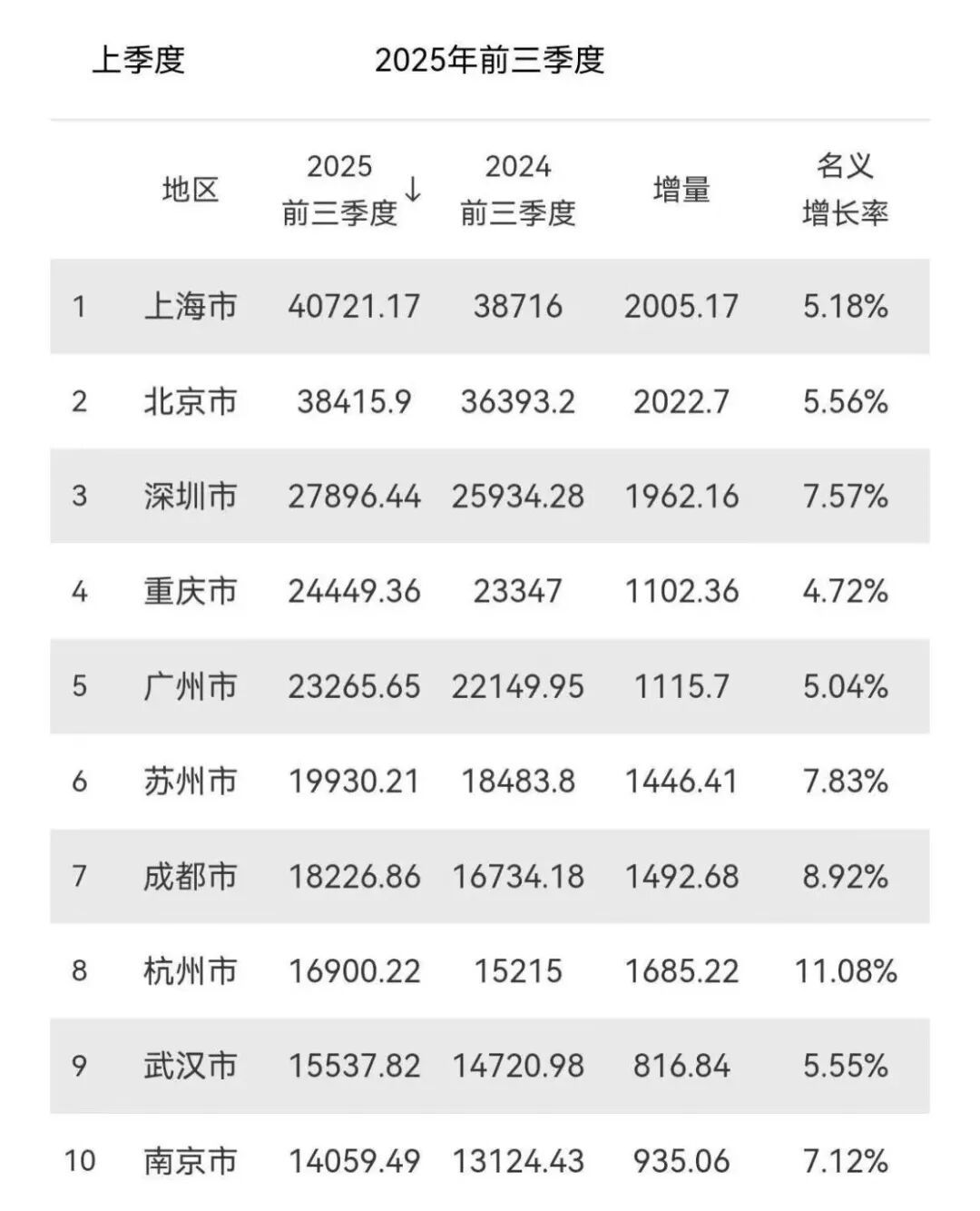
Core Insights - The "trillion club" of cities in China is expanding, with Wenzhou, Xuzhou, and Dalian likely to join, bringing the total to 30 cities, while all top ten cities in GDP are expected to enter the "2 trillion club" [1][3] Economic Performance - Shanghai's GDP for Q3 2025 is projected at 40,721.17 billion, with a growth rate of 5.18% [2] - Beijing's GDP is expected to reach 38,415.9 billion, growing at 5.56% [2] - Shenzhen's GDP is forecasted at 27,896.44 billion, with a growth rate of 7.57% [2] - Nanjing's GDP reached 14,059.49 billion in Q3, indicating a strong possibility of surpassing 20 trillion by the end of 2024 [2] 2 Trillion Club Expansion - The 2 trillion club has seen steady growth since Shanghai first crossed the threshold in 2011, followed by Beijing in 2013, and others like Shenzhen, Chongqing, and Guangzhou in subsequent years [3][5] - Currently, there are nine members in the 2 trillion club, with Nanjing aiming to be the tenth [5][6] Competitive Landscape - Nanjing's rise to the 2 trillion mark is significant as it will be the first "weak provincial capital" to achieve this, contrasting with other strong provincial capitals [6][12] - The competition remains fierce, with cities like Ningbo and Tianjin also targeting the 2 trillion GDP goal [5][6] Demographic and Economic Characteristics - Nanjing is noted for its small geographical size and high GDP per unit area, being the second highest among provincial capitals [10] - The city has a strong educational foundation, leading in the number of university students per capita among similar cities [10] Future Outlook - The expansion of the 2 trillion club is expected to continue, with cities like Ningbo, Tianjin, and Qingdao likely to join within three years [5][6] - The overall trend indicates a shift towards higher quality and structural improvements in urban economies, as merely reaching the trillion mark may not suffice for competitive advantage in the future [16]

“万亿俱乐部”三季报出炉:腰部城市长沙反超无锡,东北有望迎来首个万亿城市
Hua Xia Shi Bao· 2025-11-11 12:34
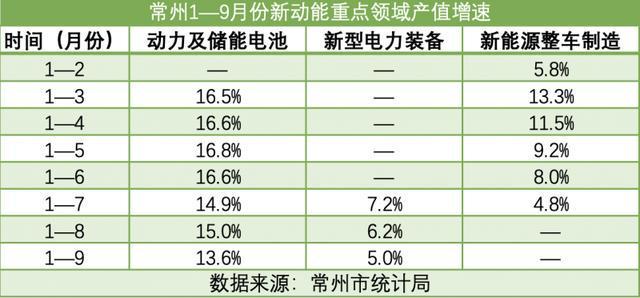
Core Insights - The economic growth of cities with GDP exceeding 1 trillion yuan shows a mixed performance, with 19 out of 27 cities outpacing the national average growth rate of 5.2% in the first three quarters of the year [2] - The city of Changzhou, known as the "capital of new energy," has experienced a slowdown in growth, achieving a rate of 5.2%, which is on par with the national average, despite maintaining a steady growth rate of 5.8% in previous periods [2][6] - The competition among "mid-tier cities" is intensifying, with cities like Nanjing, Ningbo, and Tianjin facing growth pressures, while cities like Changsha and Wuxi are in close competition for GDP rankings [3][4] Economic Performance of Key Cities - Shanghai, Beijing, and Shenzhen are leading with GDP totals of 4 trillion, 3.8 trillion, and 2.8 trillion yuan, respectively, and growth rates of 5.5% to 5.6% [2] - Nanjing's GDP growth is at 5.2%, while Ningbo and Tianjin lag behind at 5% and 4.7% respectively, indicating a struggle to meet growth targets [3] - Changsha and Wuxi are closely matched, with Changsha's GDP at 11,959.9 billion yuan and Wuxi at 11,885.74 billion yuan, both showing a growth rate of 5% [3] New Energy Sector Insights - The new energy vehicle manufacturing sector in Changzhou has seen an 8.3% growth in output, contributing 14.4% to the city's industrial output growth [6] - Despite the growth in new energy products, including solar cells and lithium-ion batteries, Changzhou's new energy sector is facing a decline in growth rates, particularly in the battery sector, which dropped from over 16% to 13.6% [6] - The overall new energy market is transitioning from rapid expansion to a focus on high-quality development, with retail sales of new energy passenger vehicles showing a year-on-year increase of 7.3% in October [7] Emerging Cities and Future Projections - Emerging cities like Wenzhou, Xuzhou, and Dalian are showing stable economic growth rates above 6%, positioning them to potentially cross the 1 trillion yuan GDP threshold by 2025 [7] - The number of cities in China with GDP exceeding 1 trillion yuan is expected to reach 30 by 2025, with the Northeast region likely to see its first trillion-yuan city [7]
城市图谱|泉州重返万亿城市20强,无锡南通佛山排名下滑
Xin Jing Bao· 2025-11-06 08:19
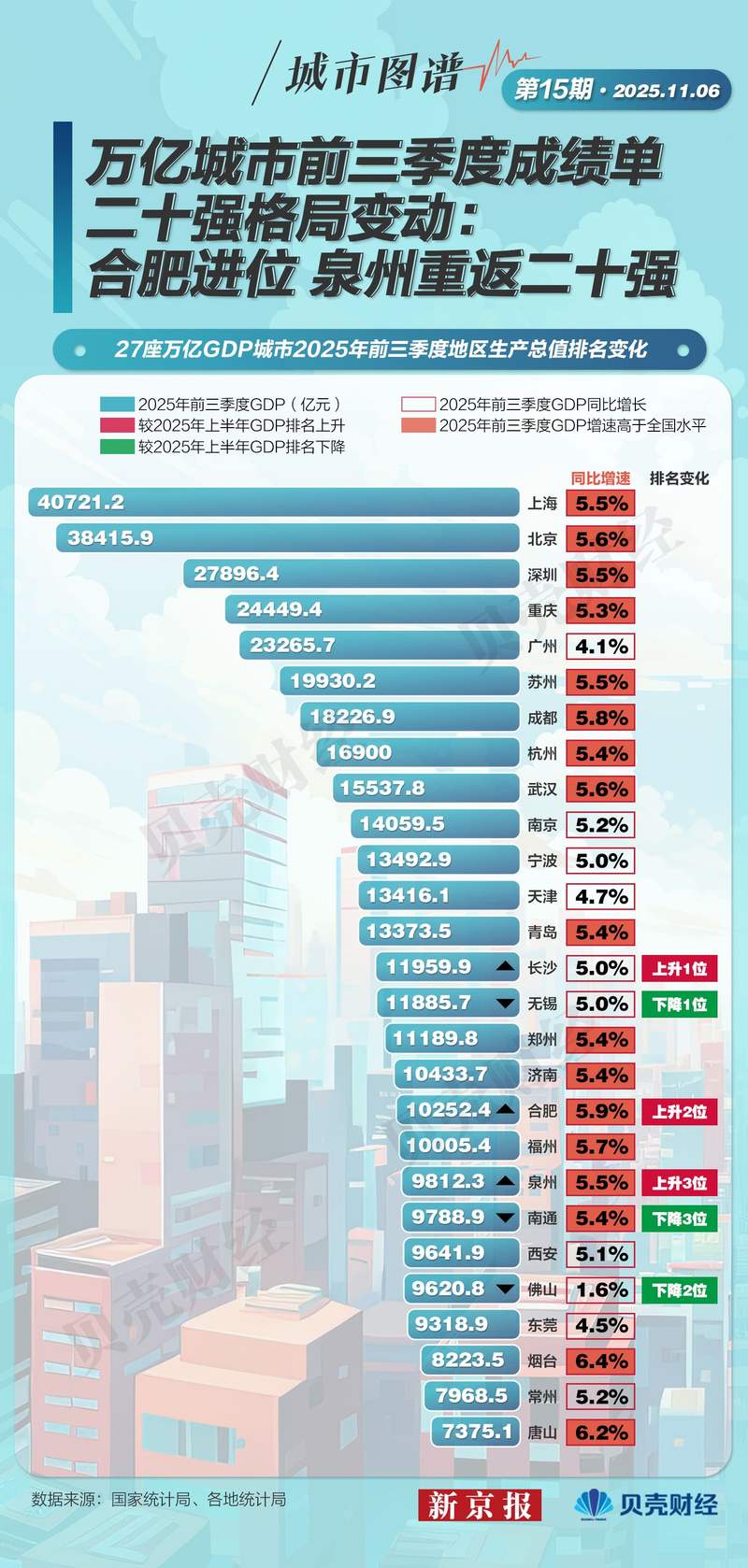
Core Insights - Among the 27 trillion-yuan cities, 17 cities outperformed the national GDP growth rate in the first three quarters of the year [1] - Yantai leads with a GDP growth rate of 6.4%, followed by Tangshan at 6.2% and Hefei at 5.9% [1] - The rankings of the top twenty trillion-yuan cities have seen significant changes, with Quanzhou rising for two consecutive quarters and re-entering the top twenty [1] Economic Performance - A total of 19 cities have surpassed a GDP of one trillion yuan, with Shanghai exceeding four trillion yuan and Beijing surpassing 3.8 trillion yuan [1] - Shenzhen, Chongqing, and Guangzhou each have GDPs exceeding two trillion yuan [1] Ranking Changes - Nantong's GDP growth was strong in the first half of the year, improving its ranking by five places, but it fell out of the top twenty in the third quarter [1] - Hefei continues to maintain rapid growth, rising two places to rank 18th [1] - Foshan has declined further after dropping out of the top twenty in the second quarter, with a growth rate of only 1.6% [1]
泉州重返万亿城市20强,无锡南通佛山排名下滑
Xin Jing Bao· 2025-11-06 07:51
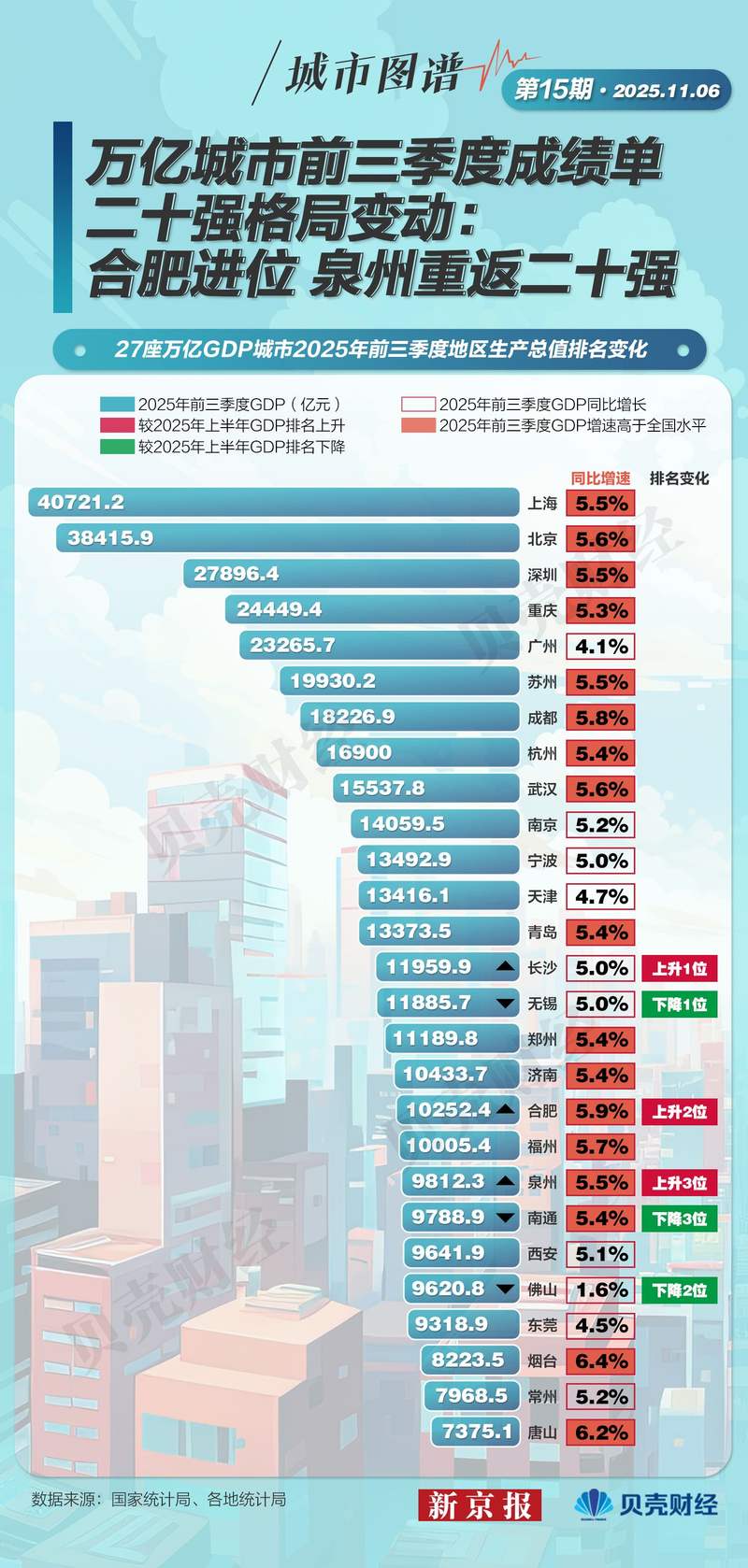
Core Insights - As of November 6, all economic data for the 27 trillion-yuan cities in the first three quarters have been released, with 17 cities outperforming the national GDP growth rate [1] - Yantai leads with a GDP growth rate of 6.4%, followed by Tangshan at 6.2% and Hefei at 5.9% [1] - The rankings of the top twenty trillion-yuan cities have seen significant changes, with Quanzhou rising for two consecutive quarters and re-entering the top twenty, while Nantong has dropped out [1][3] Economic Performance - Currently, 19 cities have a GDP exceeding one trillion yuan, with Shanghai surpassing four trillion yuan, Beijing exceeding 3.8 trillion yuan, and Shenzhen, Chongqing, and Guangzhou all exceeding two trillion yuan [1] - Hefei has maintained high growth, moving up two positions to rank 18th, while Foshan has continued to decline after dropping out of the top twenty in the second quarter [1][3] City Rankings and Growth Rates - The GDP growth rates for various cities include: - Yantai: 6.4% - Tangshan: 6.2% - Hefei: 5.9% (up 2 positions) - Quanzhou: 5.5% (up 3 positions) - Nantong: 5.4% (down 3 positions) - Foshan: 1.6% (down 2 positions) [3]
新晋“黑马”的目标,远不止于拿下苏超
创业邦· 2025-11-04 10:39
Core Viewpoint - The article highlights the rise of Taizhou as a significant player in Jiangsu's economic landscape, aiming to break free from its "mid-tier" image and set a target of achieving a GDP of over 1 trillion yuan by the end of the 14th Five-Year Plan [6][10][15]. Economic Goals and Development Strategy - Taizhou has set an ambitious goal to join the "trillion-yuan club" by the end of the 14th Five-Year Plan, marking its first clear target for such an economic milestone [10][15]. - The city is actively seeking to redefine its identity and economic positioning, aiming to transition from a "stable mid-tier" to a "competitive upper-tier" city [14][15][26]. Comparison with Other Cities - In comparison to its peers, Taizhou's GDP for the previous year was 7020.95 billion yuan, which is lower than that of Yangzhou (7809.64 billion yuan) and Yancheng (7779.2 billion yuan) [16][18]. - The article notes that while Taizhou is currently behind in economic size, it has been gaining momentum and pushing Yangzhou to keep pace [18][22]. Industrial Development and Key Sectors - Taizhou has identified key industries for growth, including big health, marine engineering, new materials, and new intelligent manufacturing, under the banner of "Big Sea New Morning" [18][20]. - The city is recognized as the largest private shipbuilding base in China, with significant contributions to national shipbuilding metrics [18][19]. - The pharmaceutical industry in Taizhou has also seen substantial growth, with the establishment of the China Pharmaceutical City, which has attracted over 1300 pharmaceutical companies [20][22]. Recent Economic Performance - In the first three quarters of the year, Taizhou's industrial added value increased by 7.4%, outpacing the provincial average by 0.6 percentage points [24]. - However, the overall GDP growth rate for Taizhou slowed to 5.4%, falling short of the initial target of 6% for the year [25]. Future Prospects and Initiatives - Taizhou is focusing on new growth points, particularly in emerging industries such as robotics and artificial intelligence, to drive future economic development [26][28]. - The city aims to create a "Morning Light Industry" that targets future industries before they reach significant scale, reflecting a proactive approach to economic development [29].
城市24小时 | 东北首个万亿城市,越来越近了
Mei Ri Jing Ji Xin Wen· 2025-10-24 15:55
Economic Overview - Dalian's GDP for the first three quarters reached 724.82 billion yuan, with a year-on-year growth of 6.0%, matching the growth rate of the first half of the year and exceeding the national average by 0.8 percentage points [1][2] - The primary industry added value was 37.03 billion yuan (up 4.2%), the secondary industry 257.55 billion yuan (up 8.0%), and the tertiary industry 430.24 billion yuan (up 4.9%) [1] Industrial Performance - Dalian's industrial output value for large-scale enterprises grew by 12.8% year-on-year, an increase of 0.3 percentage points compared to the first half of the year, and outperformed the provincial average by 10.6 percentage points [2][3] - The petrochemical industry saw an increase of 8.9%, while the equipment manufacturing sector grew by 17.5%, with notable growth in the railway and shipbuilding industries at 64.5% and the automotive industry at 26.3% [3] Strategic Initiatives - Dalian has launched initiatives to upgrade traditional industries, including the "Green Petrochemical Cluster Cultivation and Enhancement Action Plan (2025-2027)" aimed at elevating the city's petrochemical sector to a world-class level [2] - The city aims to establish a world-class base for green shipbuilding and marine engineering by 2027, targeting an industry scale exceeding 100 billion yuan [2] Future Outlook - Dalian is positioned to achieve its annual GDP growth target of over 5.5%, supported by strong industrial performance and strategic initiatives [2][3] - The city is on track to reach a GDP of 951.69 billion yuan in 2024, nearing the trillion-yuan milestone [1]