中美关税调整

Search documents
125%→10%、24%税率暂停90天,对美关税开始调整
21世纪经济报道· 2025-05-14 04:23
Core Viewpoint - The recent adjustments in tariffs between China and the United States reflect a significant reduction in bilateral trade barriers, which is expected to benefit producers and consumers in both countries, as well as contribute positively to global economic stability [2][4]. Tariff Adjustments - Starting from May 14, 2025, China has reduced the tariff rate on U.S. imports from 34% to 10%, while suspending the implementation of an additional 24% tariff for 90 days [1]. - The U.S. has canceled 91% of its previously imposed tariffs, and both countries have agreed to suspend the implementation of 24% "reciprocal tariffs" [3][4]. Economic Implications - The substantial reduction in tariffs is seen as a step towards correcting unilateral tariff increases and enhancing mutually beneficial cooperation between the two nations [4]. - The adjustments are anticipated to inject more certainty and stability into the global economy, aligning with the interests of both countries [4].


中美关税大幅调降,如何影响中国自美国进口石油和天然气
第一财经· 2025-05-13 23:59
Core Viewpoint - The recent announcement of the US-China Geneva Economic and Trade Talks Joint Statement indicates a commitment to reduce tariffs imposed since April 2025 to 10%, with a 90-day suspension on the remaining 24% tariffs, although tariffs on certain Chinese imports from the US remain unchanged [1][2]. Tariff Changes and Impact - The tariffs on US imports, particularly on coal, LNG, crude oil, and agricultural products, will continue to apply at rates of 10%-15% for China [1]. - As of 2024, China imported approximately 60 billion yuan worth of US crude oil and LNG, with US crude oil accounting for only 1.74% of China's total crude oil imports [2]. - The imposition of tariffs has led to a significant reduction in China's imports of US energy products, with a year-on-year decline of 54%, 76%, and 70% in the first three months of 2024 for crude oil [2]. Market Dynamics - The attractiveness of US crude oil has diminished for Chinese buyers due to the 20% tariff, as global price differences among various crude oil types are minimal [2]. - Chinese buyers are currently in a wait-and-see mode regarding US LNG imports, despite the competitive pricing of US natural gas [3][4]. - The anticipated increase in pipeline gas imports from Russia and the acceleration of domestic gas storage and LNG receiving station construction in China are expected to fill the gap left by reduced US imports [4]. Economic Outlook - The mutual tariff reduction between the US and China is expected to positively impact the international oil and gas market, improving global economic prospects and market sentiment [4].
关税阶段性落地,机械出口链如何表现?
2025-05-13 15:19
Summary of Conference Call on Tariff Impact on Machinery Export Chain Industry Overview - The conference call discusses the impact of recent tariff adjustments between China and the United States on the machinery industry, particularly focusing on companies like Zhejiang Dingli, Lingxiao Pump Industry, and others in the machinery export chain [1][2][3]. Key Points and Arguments - **Tariff Adjustments**: The machinery industry faces a new total tariff rate of 30%, which includes a 20% anti-dumping tax and a 10% global equivalent tariff. This is a significant increase from previous rates, but companies like Zhejiang Dingli have managed to mitigate the impact through cost control and price adjustments [2][3]. - **Zhejiang Dingli's Performance**: After successfully appealing against high anti-dumping duties, Zhejiang Dingli's effective tariff increase is only 11%. The company expects to maintain profit margins and has seen stable customer demand despite the tariff changes [3]. - **Other Chinese Manufacturers**: Companies such as Lingxiao Pump Industry and Chunfeng are positioned to pass on the new tariffs to downstream markets, maintaining their cost advantages. Low-value products like textiles and toys can also increase prices to offset tariff impacts [4]. - **Caterpillar's Outlook**: Caterpillar indicates that North American demand remains supported by order backlogs due to manufacturing reshoring, which extends delivery times. This environment is favorable for Zhejiang Dingli's growth in the U.S. market [5]. - **Jack Co. as an Investment**: Jack Co. is highlighted as a viable investment option due to its overseas production capabilities, which benefit from improved market confidence stemming from tariff negotiations. The company can effectively pass on costs to downstream markets [6][7]. - **Potential Beneficiaries**: Companies like Juxing, Yongda, and Jiechang are expected to benefit from improved demand in the U.S. market and stable domestic demand, which enhances their profit margins [8]. - **Global Tariff Environment**: The current global tariff landscape suggests that if average tariffs are around 10%, the impact on consumer purchasing power will be limited, leading to less severe demand disruptions for export chain companies [9]. - **Impact of U.S.-China Relations**: The lack of decoupling between the U.S. and China is expected to stabilize domestic demand in the manufacturing sector, particularly for consumer goods, potentially leading to a recovery in orders that were previously affected by tariffs [10]. Other Important Insights - The machinery industry is experiencing a shift in expectations due to tariff changes, with leading companies likely to achieve excess returns as the market stabilizes [10]. - The overall sentiment is cautiously optimistic, with companies adapting to the new tariff environment and finding ways to maintain profitability despite challenges [1][2][3][4][5][6][7][8][9][10].
中美日内瓦经贸会谈联合声明点评:中美相互关税水平下降,风险偏好有望提升
Shanghai Securities· 2025-05-13 14:33
Group 1: Tariff Changes - The cumulative tariff imposed by the US on Chinese goods in 2025 is 30%[1] - As of April 2, 2025, the US increased tariffs on Chinese goods by 34%, with 24% of that suspended for the initial 90 days[1] - The average tariff level in the US rose from 3.3% to 13.3%, surpassing Brazil (11.2%), China (7.5%), the EU (5%), and Vietnam (9.4%)[1] Group 2: Market Reactions - Following the joint statement on May 12, 2025, domestic equity markets reacted positively, with major indices like Wind All A, Hang Seng Index, and FTSE China A50 rising by 1.30%, 2.98%, and 0.88% respectively[6] - The 10-year government bond futures fell by 0.46% after the announcement[6] - The US dollar index strengthened significantly, while the Japanese yen, euro, and British pound depreciated against the dollar; however, the Chinese yuan appreciated against the dollar[6] Group 3: Investor Sentiment - The joint statement is expected to enhance market investors' risk appetite, potentially benefiting the domestic equity market in the future[6] - There are risks associated with the US tariff actions, including increased inflation expectations and a higher probability of economic recession in the US[7]
港股收评:恒科指大跌3.26%,苹果概念股回落,生物医药大反弹
Ge Long Hui· 2025-05-13 08:51
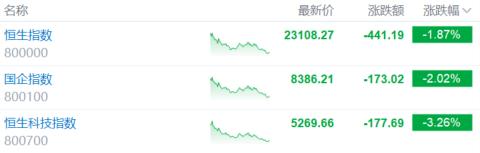
Market Performance - The Hong Kong stock market showed a weak performance on May 13, with major indices declining, particularly the Hang Seng Tech Index which fell by 3.26% [1][2] - The Hang Seng Index and the China Enterprises Index decreased by 1.87% and 2.02% respectively, ending an eight-day rally for the Hang Seng Index [1][2] Sector Performance - Major technology stocks experienced significant declines, with Meituan and Kuaishou dropping over 4%, while Alibaba and Xiaomi fell more than 3% [4][5] - Apple-related stocks, automotive stocks, and semiconductor stocks also saw notable declines, with some Apple-related stocks dropping over 7% [5][6] - The semiconductor sector faced losses, with companies like Hua Hong Semiconductor and SMIC falling over 4% [7][8] Short Selling and Market Sentiment - There was a substantial increase in short selling of major tech companies from May 8 to May 12, raising concerns about the sustainability of the market rebound [4] - The market sentiment shifted towards increased bearishness following positive signals in US-China trade relations [4] Gold and Biopharmaceuticals - Gold stocks gained traction, with significant increases in companies like Tongguan Gold, which rose over 15% [9][10] - Biopharmaceutical stocks rebounded, with companies like Junshi Biosciences and Innovent Biologics seeing gains of over 4% [9] Banking Sector - The banking sector saw gains, with banks like Chongqing Bank and Jiangxi Bank rising over 4% following a 0.5% reserve requirement ratio cut announced by the People's Bank of China [11] Investment Outlook - Nomura Securities upgraded its rating on Chinese stocks to "tactical overweight" post US-China trade negotiations, indicating a shift in investment strategy [13] - Citigroup raised its year-end target for the Hang Seng Index by 2% to 25,000 points, projecting it could reach 26,000 by mid-2026 [13]






金信期货日刊-20250513
Jin Xin Qi Huo· 2025-05-13 01:19
Group 1: Report Overview - The report is the Goldtrust Futures Daily, written by the Goldtrust Futures Research Institute on May 13, 2025 [1] Group 2: Caustic Soda Market - From May 5th to 12th, 2025, the caustic soda price rose from 807 yuan/ton at the beginning of the week to 829 yuan/ton at the weekend, a significant increase of 2.73% and 4.94% compared to the same period last year [3] - The price increase is due to supply - demand factors (supply decreased due to enterprise maintenance, and demand was stable as downstream aluminum plants had high profits and high - load production) and macro factors (US tariff adjustments after the Sino - US Geneva economic and trade talks) [3][4] Group 3: Stock Index Futures - A50 rose sharply and the Hong Kong stock market soared. Technically, it remains strongly bullish in the short - term, and the trend continuation is favorable [7] - On Monday, the three major A - share indexes rose significantly due to the expected benefits of Sino - US negotiations, and the post - market joint statement of the Sino - US Geneva economic and trade talks was positive [8] Group 4: Gold Market - Affected by the Sino - US tariff negotiations, gold adjusted further. The outer - market gold neared the low point, and Shanghai gold broke below the pre - holiday low. However, the overall pattern is still oscillatory, and it is expected that the downward adjustment space is limited, with strong support for Shanghai gold between 750 - 760 [10][11] Group 5: Iron Ore Market - In May, there is a large pressure of supply surplus due to reduced downstream exports and increased shipments, and domestic demand is about to enter the seasonal off - season, increasing the risk of high iron ore valuations. But the market sentiment has turned positive due to the Sino - US economic and trade talks. Technically, it strengthened in oscillation today, with a large bullish candle on the daily chart, and the short - term thinking turns to oscillatory and bullish [14] Group 6: Glass Market - The continuous release of demand still awaits the effect of real - estate stimulus or major policy announcements. The Sino - US economic and trade talks brought significant positive news, changing the market sentiment. Technically, it rebounded slightly today, and the short - term thinking turns to oscillatory [17] Group 7: Soybean No.1 Market - The tight supply situation of imported soybeans has been rapidly alleviated, increasing the overall selling pressure in the soybean market. The premium transaction of local - reserve soybeans provides some support for the anti - decline of the soybean No.1 futures market. Profit - taking funds are leaving the market, the position has been continuously decreasing, and technically, it shows signs of a phased peak [20]
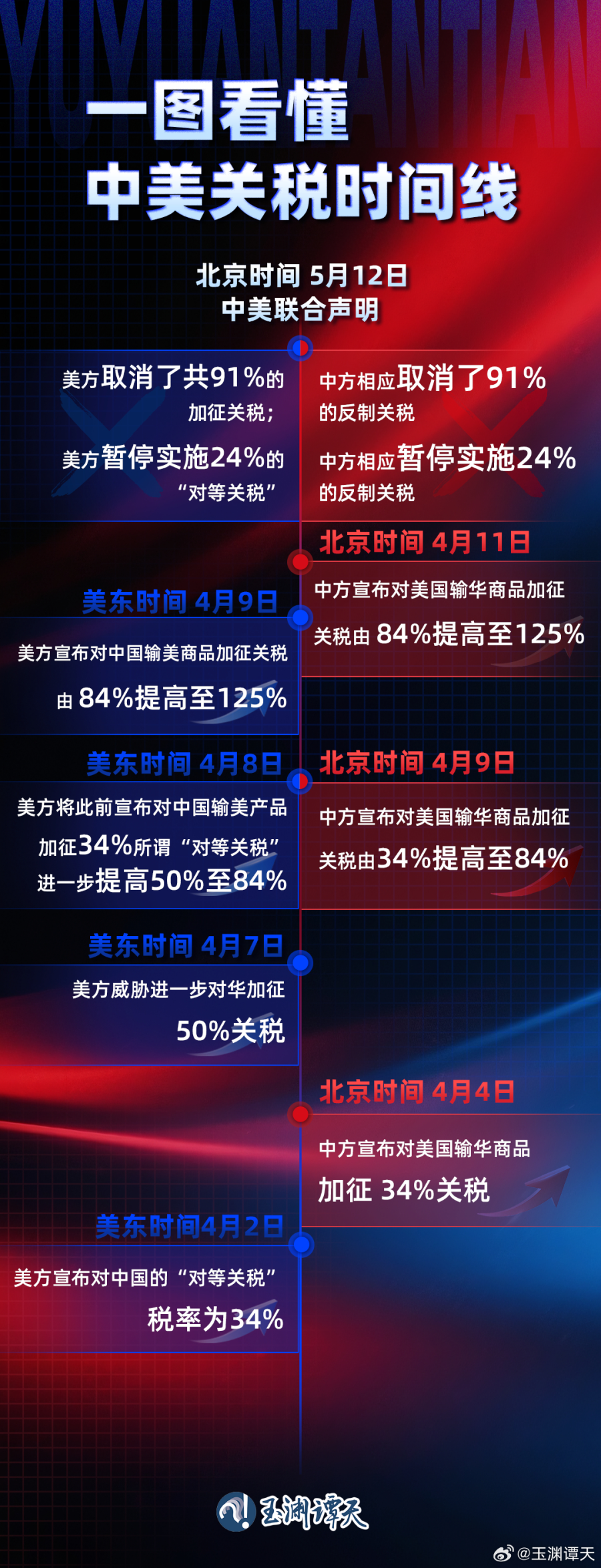
【中美关税时间线全梳理 】5月12日讯,当地时间5月12日,中美日内瓦经贸会谈联合声明发布,双方大幅降低双边关税水平,这一举措符合两国生产者和消费者的期待,也符合两国利益和世界共同利益。
news flash· 2025-05-12 11:35
Group 1 - The core point of the article is the significant reduction of bilateral tariffs between China and the United States, which aligns with the expectations of producers and consumers in both countries, as well as the broader global interest [1]. - The U.S. has canceled 91% of the additional tariffs, while also suspending the implementation of 24% "reciprocal tariffs" [2]. - China has correspondingly canceled 91% of its counter-tariffs and suspended the implementation of 24% counter-tariffs [2]. Group 2 - On April 11, China announced an increase in tariffs on U.S. goods from 84% to 125% [2]. - On April 9, the U.S. announced an increase in tariffs on Chinese goods from 84% to 125% [2]. - The U.S. threatened to further increase tariffs on China by 50% to 84% on April 7 [3].
中美关税重磅消息 美元指数涨幅超1%
Jin Tou Wang· 2025-05-12 11:12
Group 1 - The recent US-China trade talks in Geneva resulted in significant agreements, including the establishment of a trade consultation mechanism [2] - Both parties committed to modifying tariffs on each other's goods, with a temporary suspension of 24% tariffs for 90 days and retention of a 10% tariff [2] - The talks were characterized by a constructive atmosphere, with representatives from both sides engaging in open discussions [1][2] Group 2 - The US dollar index showed an upward trend, reaching a recent high of 101.46, with a 1.04% increase [1] - The dollar index experienced fluctuations, with a peak of 100.842 and a low of 100.059, closing at 100.407 [3] - Analysts suggest that the dollar index may face resistance at the 102.80 level, indicating a potential bearish trend in the medium term [3]
特朗普:对华关税有可能降,不会进一步上调
日经中文网· 2025-05-09 08:06
Group 1 - The core viewpoint of the article emphasizes the potential for substantial progress in the upcoming US-China negotiations, with President Trump expressing optimism about the meeting's outcomes [1] - Trump indicated that there is a possibility of lowering the cumulative tariffs on China, which currently stand at 145%, but he will not raise them further [1] - The negotiations are scheduled to take place in Switzerland on May 10-11, with US Treasury Secretary Mnuchin and Chinese Vice Premier He Lifeng leading the discussions [1] Group 2 - Trump mentioned that while some may view the meeting as merely procedural, he believes it will be meaningful and productive [1] - Reports suggest that the US may consider reducing tariffs to a range of 50-54% at the start of the negotiations, although Trump clarified that he would not lower tariffs just to bring China to the negotiating table [1]