产业金融

Search documents
解码新时代工商名城的金融脉动
Zhong Guo Zheng Quan Bao· 2026-01-12 20:45
Core Insights - Wuxi has demonstrated significant growth in its capital market, with a total of 56 new listed companies during the 14th Five-Year Plan period, ranking 7th nationally among cities [1][2] - The city has a strong focus on high-tech industries, with nearly 90% of new listings since 2020 being high-tech enterprises, particularly in integrated circuits, biomedicine, and high-end equipment manufacturing [2][5] - Wuxi's financial ecosystem is robust, with over 600 billion yuan in registered funds and a leading position in QFLP fund numbers and scale in Jiangsu province [3][4] Capital Market Performance - During the 14th Five-Year Plan, Wuxi's listed companies raised a total of 144.6 billion yuan, with a return rate of 49.8% and cumulative cash dividends of 72.27 billion yuan [1][2] - In 2025, Wuxi added 8 new listed companies, raising 7.374 billion yuan, with A-share companies showing revenue and profit growth above the overall A-share market [1][2] Financial Ecosystem - Wuxi has established a strong financial infrastructure, with over 370 equity investment firms registered in the past four years, and a total fund scale exceeding 600 billion yuan [3][4] - The city has created a conducive environment for private equity funds, with significant investments in emerging sectors like artificial intelligence and biomanufacturing [6][7] Government Support and Policy - The local government has been proactive in fostering a supportive environment for capital market development, including initiatives like the "Listing通" service platform and various funding policies for technology innovation [6][8] - Wuxi's government has organized numerous events to promote project financing and has facilitated communication with major stock exchanges to enhance local companies' access to capital [6][9] Industry Development - Wuxi is focusing on building a competitive industrial innovation ecosystem, with plans to support the national goal of self-sufficient industrial supply chains [4][5] - The city is home to nearly 400 companies poised for listing, indicating a strong pipeline for future capital market activity [4][5]
深耕产业金融沃土,赋能产业体系建设,潍坊银行以高质量金融供给服务区域发展
Jin Rong Jie· 2026-01-12 04:47
Core Insights - Weifang Bank aims to enhance its role in supporting the local economy by focusing on key industries and enterprises, establishing a "financial + industry + ecology" service system to drive the development of a modern industrial system [1][2] Group 1: Strategic Focus - Weifang Bank is committed to strengthening industrial finance as a core strategy, aligning with the city's industrial advantages and focusing on seven dimensions including professional market clusters and core enterprise ecosystems [2] - The bank has identified 46 key industrial sectors and implemented tailored financial strategies for each, achieving a loan balance of 7.69 billion yuan and serving 1,804 clients by the end of December 2025 [2] Group 2: Innovative Financial Services - The bank is transitioning from "point support" to "full-chain empowerment" in financial services, introducing innovative supply chain financial products to address financing challenges for small and medium-sized enterprises [3] - New financial products have been developed to support rural revitalization and enhance service matching for agricultural financing, including loans for specialized agricultural needs [3] Group 3: Digital Transformation - Weifang Bank is advancing its digital transformation by launching the "Smart Enterprise Banking 3.0" system to improve the intelligence of corporate services and creating various digital financial platforms to enhance efficiency [4] Group 4: Collaborative Development - The bank is deepening collaboration with local government and enterprises, signing strategic cooperation agreements with multiple municipal departments to enhance financial services across key industrial chains [5] - By engaging with over 2,700 small and medium-sized manufacturing enterprises, the bank is expanding its service reach and addressing challenges in supply, technology, and market access [5] Group 5: Support for SMEs - Weifang Bank is committed to supporting small and medium-sized enterprises through initiatives like the "Thousand Enterprises, Ten Thousand Households" outreach program, optimizing loan conditions to enhance credit availability [6] - The bank aims to continue innovating in industrial finance and aligning its financial offerings with local industrial needs to contribute to the modernization of Weifang [6]
加强科技金融与产业金融的深度融合
Jin Rong Shi Bao· 2026-01-12 03:32
Core Viewpoint - The integration of technology finance and industrial finance is essential for promoting technological innovation and industrial innovation during the "14th Five-Year Plan" period, which is crucial for achieving high-level technological self-reliance and leading new productive forces [1][2]. Group 1: Importance of Integration - Strengthening the deep integration of technology finance and industrial finance is a strategic choice to shape new development momentum and gain an advantage in international competition during the "14th Five-Year Plan" period [2][3]. - The integration aims to eliminate barriers between technology, industry, and finance, allowing technological innovation to fuel industrial innovation and upgrades, while financial resources can support both sectors [3]. Group 2: Current Challenges - There are significant challenges in achieving cross-departmental policy coordination, as differences in core concerns among technology, industry, and finance departments hinder unified resource allocation and project selection [5]. - Structural mismatches exist between financial supply and the demands of technological and industrial innovation, particularly in the areas of financing stages, financial structure, and the need for patient capital [6][7]. Group 3: Strategic Measures for Future Integration - Establishing a cross-departmental policy coordination mechanism is crucial for fostering a resilient national innovation ecosystem, which includes creating a "coordinating office" for joint approvals and assessments [9]. - Innovating a diversified financial supply that covers the entire lifecycle of enterprises is necessary, including promoting venture capital and enhancing bank credit to support technology-driven enterprises [10]. - Deepening financial services for industrial chains and clusters is essential, focusing on data-driven credit models and tailored financial products to address the unique needs of different stages of enterprise development [11][12]. Group 4: Digital Empowerment and Risk Management - Implementing a data governance model that integrates data elements, assets, and value chains is vital for enhancing financial services and supporting technological innovation [13]. - Optimizing the regulatory framework and establishing a risk-sharing system is necessary to adapt to the uncertainties inherent in technological and industrial innovation, including developing a multi-layered risk warning system [14].
3万亿股份行,高管变阵
Jing Ji Wang· 2026-01-04 02:27
Core Viewpoint - Zhejiang Zheshang Bank announced a significant leadership restructuring aimed at streamlining its executive team and enhancing governance in line with provincial government directives [1][2]. Group 1: Leadership Changes - Lin Jingran resigned from the position of Vice President, while Wang Chaoming and Hou Bo stepped down as Assistant Presidents due to job adjustments [1][2]. - Zhou Weihua and Pan Huafeng were appointed as new Vice Presidents, both previously serving as Assistant Presidents [1][2]. - Lü Linhua was appointed as the new President and nominated as an executive director candidate, succeeding Chen Haiqiang, who transitioned to the role of Chairman [1][2]. Group 2: Executive Team Composition - The new executive structure will consist of one President and four Vice Presidents, transitioning from a previous model of one President, three Vice Presidents, and four Assistant Presidents [3]. - All five key executives are from the "post-70s" generation, indicating a younger leadership team, with Lü Linhua being 47 years old and the others aged between 46 and 54 [3]. Group 3: Strategic Focus - The leadership changes are part of a broader strategy to deepen reforms and support the economic and financial development of Zhejiang Province [3]. - The bank aims to enhance its financial services in key areas such as consumer finance, traditional industry upgrades, and emerging sectors, while also focusing on cross-border financial services [5]. - The bank emphasizes a strategy of "deepening in Zhejiang," aiming to support major provincial projects and improve its service system to align with the needs of global Zhejiang merchants [5].
3万亿股份行,高管变阵!
券商中国· 2026-01-02 07:02
Core Viewpoint - The leadership restructuring at Zhejiang Commercial Bank aims to streamline management and enhance the bank's governance in line with provincial government directives, while also promoting a younger executive team to drive long-term stability and support the economic development of Zhejiang Province [1][2][3]. Group 1: Leadership Changes - Zhejiang Commercial Bank announced a significant leadership change, with Lin Jingran resigning as vice president and Wang Chaoming and Hou Bo stepping down as assistant presidents due to job adjustments [1][2]. - Zhou Weixin and Pan Huafeng have been appointed as new vice presidents, both previously serving as assistant presidents [1][2]. - Lü Linhua has been appointed as the new president, with his qualifications pending approval, marking a shift in the bank's leadership structure from "one president and three vice presidents" to "one president and four vice presidents" [1][3]. Group 2: Executive Team Composition - The new executive team will consist of Lü Linhua (president), along with vice presidents Jing Feng, Luo Feng, Zhou Weixin, and Pan Huafeng, all of whom are in their 40s and 50s, indicating a younger leadership profile [3]. - Lü Linhua is 47 years old, while the other vice presidents are aged between 46 and 54, reflecting a trend towards a more youthful management team [3]. Group 3: Strategic Focus - The leadership changes are part of a broader strategy to deepen reforms and enhance the bank's service capabilities, particularly in supporting major projects and financing initiatives within Zhejiang Province [5]. - The bank aims to integrate the directives from recent central economic meetings into its "14th Five-Year Plan," focusing on sectors like consumption and livelihood, and optimizing its financial service system for traditional and emerging industries [5]. - Emphasis will be placed on building a financial ecosystem that aligns with the needs of the 8 million Zhejiang merchants globally, while also enhancing technology-driven financial services [5].


【银行业展望系列】产业金融,破茧成蝶:融入现代化产业体系建设
Sou Hu Cai Jing· 2025-12-31 02:24
Core Viewpoint - The article discusses the transformation of industrial finance in China, emphasizing the shift from being a passive "fund provider" to an active "resource integrator" and "ecosystem builder" in response to the demands of high-quality economic development [2][7]. Group 1: Challenges in Industrial Finance - Challenge 1: There is a disconnect in understanding and integrating industrial policies, leading to misalignment between financial resource allocation and policy direction [3]. - Challenge 2: Banks lack a deep understanding of the intrinsic rules of industrial development, resulting in a mismatch between financial services and actual industrial needs [4]. - Challenge 3: Banks generally provide standardized credit products without considering the lifecycle and specific needs of enterprises, limiting their ability to support growth effectively [5]. Group 2: New Positioning and Capabilities - New Positioning: Banks must evolve to become integrators of national policies and financial resources, facilitating efficient allocation to support industrial upgrades [7]. - New Capability 1: Establish a comprehensive view of the industrial chain to understand upstream and downstream needs, promoting collaborative financial ecosystems [8]. - New Capability 2: Develop a lifecycle service system for enterprises, offering tailored financial solutions based on their specific stages and characteristics [9]. - New Capability 3: Implement proactive risk management systems that utilize technology for real-time risk identification and monitoring [10]. Group 3: Strategies for Financial Service Optimization - Strategy 1: Create differentiated financial service systems based on the development characteristics of various industries to optimize resource allocation [14]. - Strategy 2: Support traditional industries in upgrading through specialized loans and innovative financial tools [15]. - Strategy 3: Empower emerging industries by developing financing services based on intellectual property and technology patents [16]. - Strategy 4: Engage in future industry cultivation through dedicated funds and collaborative innovation mechanisms [17]. Group 4: Tailored Services for Enterprises - Service for Chain Leaders: Develop financial solutions that support the integration of supply chains and enhance overall innovation [19]. - Service for Mature Chain Enterprises: Provide standardized financial services to support stable operations and sustainable growth [20]. - Service for Early-Stage Innovative Enterprises: Create specialized evaluation systems and products to support their growth and risk-sharing [21]. Group 5: Enhancing Industry-Finance Integration - Focus on regional characteristics to build a comprehensive financial service system that strengthens the depth and breadth of industry-finance integration [26]. - Implement vertical integration within regions to provide tailored financial services while promoting cross-regional collaboration [27]. - National banks should leverage their resources to support key industries, while regional banks should focus on local core industries [28].

千帆竞渡大河潮 金融豫军再领航 中原银行成立十一周年
Jin Rong Shi Bao· 2025-12-26 01:57
Core Viewpoint - Zhongyuan Bank has evolved from a new financial entity to a leading provincial financial institution over the past eleven years, closely aligning its development with the economic growth of Henan province and committing to serve local enterprises and residents [1][2][3]. Group 1: Development and Strategy - The bank's mission is to support local economic development, small and medium enterprises, and improve the welfare of urban and rural residents, which is deeply embedded in its operational ethos [1][2]. - Zhongyuan Bank has achieved a significant milestone with its asset scale surpassing 1 trillion yuan, marking its transformation into a financial flagship for the province [2][3]. - The bank is committed to aligning its strategies with national and provincial economic plans, particularly focusing on the "1+2+4+N" framework to enhance internal vitality and promote industrial upgrades [2][3]. Group 2: Financial Services and Innovations - Zhongyuan Bank is enhancing its financial services to support the manufacturing sector, focusing on long-term projects and providing tailored financial solutions to facilitate structural adjustments and growth [4][5]. - The bank is actively investing in rural finance, developing innovative products like "Rural Revitalization Inclusive Loans" to support local agricultural industries [4][6]. - In the cultural and tourism sector, the bank is creating dynamic financing solutions to address the unique challenges faced by the industry, promoting a multi-dimensional consumption model [5][6]. Group 3: Commitment to Sustainability - Zhongyuan Bank prioritizes green finance as a core strategy, supporting ecological protection and sustainable development initiatives in the Yellow River basin [6][7]. - The bank aims to facilitate the transition of traditional industries towards green and low-carbon practices, providing financial solutions for energy efficiency and technological innovation [6][7]. Group 4: Community Engagement and Future Outlook - The bank is dedicated to enhancing its services for small and micro enterprises, optimizing financial mechanisms to ensure accessibility and support for these businesses [6][8]. - Zhongyuan Bank is focused on creating a "financial + life" ecosystem that integrates local cultural elements, making financial services more accessible and user-friendly for the community [8][9]. - Looking ahead, the bank is committed to contributing to the economic and social goals of Henan province for the "14th Five-Year Plan" period, aiming for significant advancements in its financial services [9].
产融深潜记——诚泰与信息化服务商携手,共筑高校数字化未来
2 1 Shi Ji Jing Ji Bao Dao· 2025-12-24 23:06
Core Insights - The article highlights the integration of finance and industry through the case of Chengtai, an asset management firm that actively engages in the education sector by providing tailored financial solutions and support for digital transformation projects in universities [1][5]. Group 1: Background and Challenges - In early 2025, a well-known information service provider faced financial pressure due to the long payment cycle from a 985 university for a digital platform laboratory project, which required significant upfront hardware costs [2]. - Chengtai identified this common pain point in the education industry and recognized it as an opportunity to facilitate the implementation of advanced technology [2]. Group 2: Solutions and Collaboration - Chengtai positioned itself not just as a financial provider but as an active participant in the project, collaborating closely with the information service provider and the university to address various logistical and technical challenges [3]. - This deep involvement transformed financial support into a stabilizing and accelerating force for the project, allowing the information service provider to focus on its core competencies [3]. Group 3: Long-term Partnerships and Ecosystem Development - The successful establishment of the digital laboratory marked the beginning of a new chapter, leading to a trust-based relationship among Chengtai, the information service provider, and equipment vendors, expanding collaboration beyond single transactions [4]. - The partnership evolved from a client-vendor dynamic to a genuine collaboration aimed at enhancing educational services and developing comprehensive digital solutions for various institutions [4]. Group 4: The Value of Deep Industry Engagement - Chengtai's case exemplifies the current trend in industrial finance, where entities require more than standardized financial products; they need services that understand industry characteristics and growth challenges [5][6]. - The dual value of deep engagement in industrial finance includes better risk management for financial institutions and precise support for businesses, ultimately creating significant social value beyond mere commercial returns [5]. Group 5: Future Directions and Strategic Vision - Chengtai has consistently aimed to be a professional asset management company, focusing on building a stable value bridge between industrial assets and market investors, with steady growth in total assets and maintaining an AA+ credit rating over ten years [7]. - The "deep integration" model practiced by Chengtai may serve as a reference for traditional financing sectors on how to better support the real economy through value co-creation rather than just capital injection [7][8].
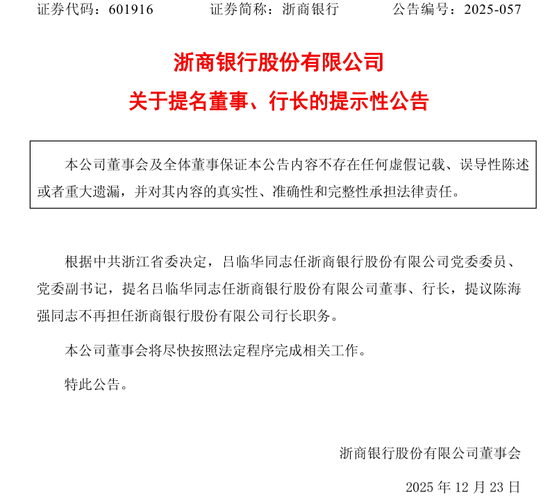
浙商银行行长人选落定 浙江农商联合银行副行长吕临华“接棒”
Xin Lang Cai Jing· 2025-12-23 12:32
Core Viewpoint - The leadership transition at Zhejiang Zheshang Bank has been finalized with the appointment of Lü Linhua as the new president, following the promotion of Chen Haiqiang to chairman [1][6]. Group 1: Leadership Changes - Lü Linhua has been appointed as a member of the Party Committee, Deputy Secretary of the Party Committee, and nominated as the president of Zhejiang Zheshang Bank [1][6]. - Chen Haiqiang will no longer serve as president and will take on the role of Party Secretary and Chairman [1][6]. - The board of directors will complete the necessary legal procedures promptly [1][6]. Group 2: Background of Lü Linhua - Lü Linhua previously served as a member of the Party Committee and Vice President at Zhejiang Rural Commercial Bank since July 2022 [3][8]. - He has extensive experience in financial regulatory departments, having worked at the Zhejiang Insurance Regulatory Commission and the Zhejiang Banking Regulatory Commission [3][8]. - Under his leadership, Zhejiang Rural Commercial Bank has established a significant presence with over 4,000 outlets and more than 50,000 employees [3][9]. Group 3: Strategic Directions - The new leadership aims to implement a comprehensive financial service system, focusing on consumer and livelihood sectors, and optimizing the industrial financial service system [5][10]. - There is a commitment to deepen the bank's operations in Zhejiang and enhance its role in supporting the province's economic and financial development [5][10]. - The leadership will also focus on creating differentiated cross-border financial services and aligning with international financial centers like Shanghai and Hong Kong [5][10].
链通产业 向“新”而行
Jin Rong Shi Bao· 2025-12-23 03:21
Core Insights - The article emphasizes the importance of a resilient industrial chain as a key measure of financial services' effectiveness in supporting the real economy, highlighting China's shift from high-speed growth to high-quality development [1] - It discusses the strategic focus of Jiujiang Bank's Guangzhou branch on integrating financial services into key industrial clusters, such as steel, non-ferrous metals, and biomedicine, to enhance regional industrial competitiveness and support the modernization of the national industrial system [1][2] Financial Service Transformation - Jiujiang Bank's Guangzhou branch is shifting from a traditional enterprise-centered credit model to an industry-focused approach, enhancing the alignment between financial supply and industrial demand [2] - The bank has developed a comprehensive industrial financial service system covering four categories and fourteen sub-applications, implementing a "broad credit, strict usage" mechanism to allocate financial resources effectively [2] Support for Specialized Enterprises - Specialized and innovative enterprises, which often lead in technology and R&D, require precise and adaptable financial services, prompting Jiujiang Bank to innovate in its financial offerings [3][5] - The bank's collaboration with Guangdong Jianbao Cable Co., a national-level specialized enterprise, exemplifies its approach to providing tailored financial solutions that align with the company's operational needs [5] Regional Coordination and Support - Jiujiang Bank is actively participating in regional development strategies, providing significant credit support to key enterprises like Meizhou Guangmei Copper Industry Co., which plays a crucial role in the copper processing industry [6][7] - The bank's efforts are part of a broader initiative to enhance the stability of industrial chains and support local economic development through coordinated financial services [7] Innovation in Emerging Industries - The bank is responding to the rapid growth and complex business scenarios in emerging industries like biomedicine by optimizing its financial services to meet specific industry needs [8][9] - Jiujiang Bank has successfully implemented a specialized service plan for Guangdong Jiyao Pharmaceutical Co., facilitating quick financing solutions to support the company's operational demands [9] Ecosystem Development - Jiujiang Bank is committed to building a collaborative ecosystem that extends financial services deeper into the industrial chain, promoting information sharing and resource coordination among various stakeholders [10] - The bank's initiatives include hosting industry financial salons to foster collaboration between government, enterprises, and financial institutions, contributing to a healthy industrial ecosystem [10] Future Directions - Looking ahead, Jiujiang Bank aims to enhance its financial service capabilities, focusing on key industries and continuing to innovate in customized financial solutions [11] - The bank plans to strengthen its role in the Guangdong-Hong Kong-Macao Greater Bay Area's international financial hub, exploring new models for cross-border industrial financial cooperation [11]