
农村改革

Search documents
加快农业农村现代化扎实推进乡村全面振兴为全市高质量发展现代化建设提供坚实支撑
Xi An Ri Bao· 2026-01-16 02:44
Core Viewpoint - The meeting emphasized the importance of modernizing agriculture and rural areas, aligning with Xi Jinping's directives for the "Three Rural Issues" work, and aims to enhance urban-rural integration and rural revitalization efforts [1][2]. Group 1: Agricultural Modernization - The meeting highlighted the need to firmly uphold food security responsibilities and maintain arable land boundaries while advancing key agricultural industry chains [2]. - There is a focus on improving the efficiency of technology transfer and application to enhance overall agricultural production capacity and quality [2]. Group 2: Poverty Alleviation and Support Systems - The meeting stressed the importance of consolidating and expanding the achievements of poverty alleviation, optimizing the regular support system, and ensuring that large-scale poverty does not reoccur [2]. - It was noted that a development-oriented support approach should be prioritized [2]. Group 3: Rural Development and Environment - The meeting called for the application of the "Ten Million Project" experience to optimize rural land use and improve living conditions in rural areas [2]. - There is a commitment to deepen rural reforms and accelerate the establishment of a modern agricultural management system [2]. Group 4: Political Responsibility and Planning - The meeting underscored the necessity of implementing political responsibilities for rural revitalization at all levels and selecting capable leaders for village committees [2]. - A high-quality plan for the agricultural and rural sectors for the 14th Five-Year Plan period is to be developed, with a focus on key tasks for the year ahead [2].
成都45分钟直达!这座藏着三星堆的宝藏小城,才是真正的“益州门户”
Sou Hu Cai Jing· 2026-01-10 04:32
Core Insights - The article emphasizes the hidden charm of Guanghan, a city near Chengdu, which is often overshadowed by the famous Sanxingdui archaeological site. It highlights the importance of exploring Guanghan beyond just visiting Sanxingdui to fully appreciate its cultural and historical significance [1][24]. Group 1: Understanding Guanghan - Guanghan is a county-level city in Sichuan Province, located 45 kilometers from Chengdu, and is known as the "open-air museum" of ancient Shu civilization. It has a rich history dating back to the Western Han Dynasty and has undergone various administrative changes [3][11]. - The city is characterized by its unique blend of cultural influences from both Chengdu and Deyang, resulting in a distinctive local culture and cuisine [3][11]. Group 2: Sanxingdui Insights - Sanxingdui is recognized as a world-class archaeological site, featuring remarkable artifacts such as the bronze trees and masks that challenge conventional understanding of ancient civilizations [6][8]. - Visitors are advised to explore the archaeological site before the museum to enhance their understanding of the ancient Shu civilization, as the site provides a contextual backdrop for the artifacts displayed in the museum [7][8]. Group 3: Additional Attractions in Guanghan - Guanghan is not limited to Sanxingdui; it also boasts historical sites like the ancient military stronghold of Luocheng, which played a significant role during the Three Kingdoms period [12][11]. - The city is recognized as a pioneer in rural reform in China, with historical significance tied to the implementation of the "household responsibility system" in the late 1970s [13][11]. - Guanghan is home to the Civil Aviation Flight University of China, known as the "Huangpu Military Academy" of civil aviation, which trains a significant number of China's pilots [15][11]. Group 4: Culinary Highlights - Guanghan is renowned as the "capital of hot pot ingredients" in China, with a thriving market for fresh and affordable hot pot supplies, making it a paradise for food lovers [16][11]. - Local delicacies such as Chansi Rabbit and Lianshan Twice-Cooked Pork are must-try dishes that reflect the region's culinary richness [16][11]. Group 5: Travel Recommendations - The article suggests tailored travel itineraries for different demographics, including families, couples, seniors, and young adults, ensuring that each group can enjoy a fulfilling experience in Guanghan [16][20][22]. - Visitors are encouraged to spend more time in Guanghan to explore its local culture, cuisine, and historical sites, rather than treating it merely as a stopover [24][26].

详解中央农村工作会议:盘活各类农村资源,促进农民稳定增收
2 1 Shi Ji Jing Ji Bao Dao· 2025-12-31 10:46
Core Viewpoint - The Central Rural Work Conference emphasizes the importance of agricultural and rural modernization as a key component of China's overall modernization strategy, setting the stage for the 2026 agricultural work plan and focusing on food security and poverty alleviation efforts [3][4]. Group 1: Agricultural Production and Food Security - The conference highlights the need to stabilize grain and oil production and implement a new round of actions to enhance grain production capacity, aiming for a total grain output of 14,298 billion jin in 2025, marking a historical high and ensuring food security [5][6]. - China has achieved a per capita grain availability of 500 kg, surpassing the international safety line of 400 kg, but faces ongoing supply-demand imbalances that necessitate further enhancements in grain production capacity [5][6]. Group 2: Poverty Alleviation and Rural Revitalization - The conference introduces a new mechanism for integrating regular assistance into the rural revitalization strategy, transitioning from concentrated efforts to long-term mechanisms for consolidating poverty alleviation achievements [4][8]. - It emphasizes the establishment of a regular mechanism to prevent large-scale poverty and the need for a comprehensive policy framework to support underdeveloped areas, ensuring that poverty alleviation efforts are sustained and integrated with rural revitalization [8][9]. Group 3: Rural Reform and Land Policy - The conference calls for deepening rural reforms, including a comprehensive trial for extending land contracts for another 30 years, which aims to enhance the stability of land tenure and encourage long-term agricultural investment [10][11]. - The focus shifts from localized trials to systematic promotion of land contract extensions, addressing common issues across regions and enhancing the vitality of rural resources through innovative financing mechanisms [10][11]. Group 4: Policy Effectiveness and Support Mechanisms - The emphasis on improving the effectiveness of agricultural support policies aims to address fragmentation in policy implementation, streamline processes, and ensure that support reaches farmers effectively [7]. - Future policies are expected to focus on precision, diversification, and sustainability, with a shift from universal subsidies to targeted support for key agricultural stakeholders and the establishment of price stabilization mechanisms for essential agricultural products [7][8].
从中央农村工作会议看2026年“三农”工作战略部署
Xin Hua She· 2025-12-31 04:10
Core Viewpoint - The Central Rural Work Conference emphasized the importance of agricultural and rural modernization as a key component of China's overall modernization strategy, with a focus on ensuring food security and promoting rural revitalization [2][3][5]. Group 1: Agricultural and Rural Modernization - The conference highlighted the need to anchor agricultural and rural modernization as a priority for the comprehensive construction of a socialist modern country, reflecting the Party's deep understanding of the current agricultural development situation [2][4]. - A series of strategic deployments were discussed to accelerate agricultural modernization, including the development of new agricultural productivity, improvement of rural living environments, and deepening rural reforms [3][4]. Group 2: Food Security - The conference underscored the necessity of solidifying food security, with measures such as stabilizing grain and oil production and implementing a new round of grain production capacity enhancement actions [5][6]. - Protecting arable land was identified as crucial for food security, with commitments to maintain stable planting areas and optimize crop structures [6][7]. Group 3: Poverty Alleviation and Rural Revitalization - The transition to a normalized support phase for poverty alleviation was emphasized, with a focus on integrating this into the rural revitalization strategy to prevent a return to poverty [8][10]. - The conference proposed various measures to support underdeveloped areas, ensuring long-term assistance and monitoring mechanisms to sustain poverty alleviation achievements [8][10][11]. Group 4: Rural Infrastructure and Living Conditions - The need to improve rural living conditions and infrastructure was highlighted, with a focus on creating quality living spaces in rural areas and enhancing the overall rural environment [12][13]. - The conference called for a balanced approach to rural development, emphasizing the importance of both hard infrastructure and soft environmental factors, including cultural and social aspects [12][13]. Group 5: Rural Reform and Investment - Further deepening rural reforms was identified as essential for energizing rural development, particularly in managing land relations as the second round of land contracts approaches expiration [14][16]. - The conference proposed innovative financing mechanisms for rural revitalization to attract financial and social capital, aiming to enhance investment in rural areas [16].
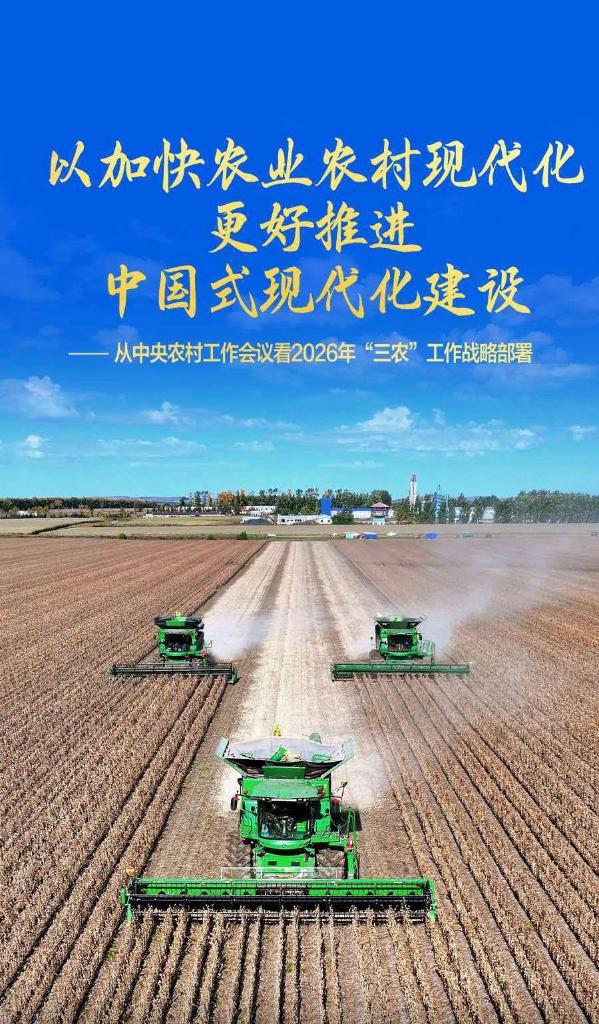
以加快农业农村现代化更好推进中国式现代化建设——从中央农村工作会议看2026年“三农”工作战略部署
Xin Hua She· 2025-12-30 22:29
Core Insights - The central theme of the news is the strategic deployment of agricultural and rural modernization in China, emphasizing the importance of "Three Rural Issues" (agriculture, rural areas, and farmers) for the overall modernization of the country, particularly in the context of the 14th Five-Year Plan and the upcoming 15th Five-Year Plan [1][2]. Group 1: Agricultural Modernization Goals - The meeting highlighted the need to anchor agricultural and rural modernization as a key goal, promoting comprehensive rural revitalization and urban-rural integration [1][2]. - The importance of prioritizing agricultural and rural development within the broader context of building a modern socialist country was emphasized, with a call for resource support and institutional supply [2]. Group 2: Food Security Measures - The meeting underscored the necessity of solidifying food security, with specific measures to stabilize grain and oil production and implement a new round of actions to enhance grain production capacity [3][4]. - Emphasis was placed on protecting arable land as a vital component of food security, with directives to maintain stable planting areas and optimize crop structures [3]. Group 3: Poverty Alleviation and Rural Support - The transition to a normalized support phase for rural revitalization was discussed, with a focus on consolidating poverty alleviation achievements and preventing a return to poverty [5][6]. - Strategies to promote stable income growth for farmers and enhance employment opportunities in rural areas were outlined, including the development of local industries and labor cooperation [6]. Group 4: Rural Infrastructure and Living Conditions - The meeting called for improving rural living conditions and infrastructure, with a focus on creating quality living spaces in rural areas [7][8]. - The importance of addressing both hard infrastructure and soft environmental factors, such as cultural and social norms, was highlighted to enhance rural civilization [9]. Group 5: Reform and Investment in Rural Development - The need for deepening rural reforms was emphasized, particularly in managing the relationship between farmers and land, with ongoing trials for extending land contracts [10]. - Innovative financing mechanisms for rural revitalization were proposed to attract financial and social capital into rural development initiatives [10]. Group 6: Overall Vision for Rural Revitalization - The overarching goal is to build a strong agricultural nation, ensuring a stable agricultural foundation, prosperous rural areas, and improved livelihoods for farmers, thereby creating a new landscape for comprehensive rural revitalization [11].
2025年我国农村改革持续深化
Xin Hua She· 2025-12-17 15:17
Group 1 - The core viewpoint of the articles emphasizes the continuous deepening of rural reform in China, focusing on key areas and enhancing the vitality of rural development by 2025 [1][2] Group 2 - The basic management system of rural areas is being consolidated and improved, with a steady development of various forms of moderate-scale operations, and the level of land management rights transfer is continuously improving [1] - By the end of 2024, there will be 3.952 million family farms and 2.035 million farmers' cooperatives in China, with 1.111 million operational entities providing agricultural social services, serving nearly 93 million smallholder farmers [1] Group 3 - The reform of the rural collective property rights system is deepening, with the implementation of the Rural Collective Economic Organization Law, leading to the standardized operation of rural collective economic organizations [1] - The supervision mechanism for rural collective "three assets" is being improved, with significant progress in addressing key issues [1] Group 4 - Positive progress is being made in the reform of the rural land system, including the improvement of the cultivated land occupation compensation balance system and the unified management of various types of cultivated land occupation [1] - The management of homesteads is being strengthened to protect farmers' basic residential rights, allowing farmers to legally utilize idle housing through rental, equity participation, or cooperation [1] Group 5 - The agricultural support and protection system is being continuously improved, with increasing support for agricultural and rural development policies, broadening the coverage of these policies [2] - The investment and financing mechanism for rural revitalization is becoming more diversified, with various forms and expanding fields [2] Group 6 - A comprehensive agricultural production support policy system is being established, focusing on food security, with subsidies, pricing, and insurance working together [2] - The minimum purchase prices for major grain crops such as wheat and early indica rice are being continuously increased, enhancing farmers' enthusiasm for grain production [2]
加大强农惠农富农政策力度
Jing Ji Ri Bao· 2025-11-03 22:29
Core Viewpoint - The article emphasizes the importance of enhancing agricultural policies to ensure food security and improve rural living conditions, aligning with the goals of rural revitalization and modernization [1][2][3] Group 1: Agricultural Policies and Investments - The central government has implemented a series of strong agricultural support policies, with fiscal spending on agriculture and rural affairs reaching 10.8 trillion yuan during the "14th Five-Year Plan" period [1] - Fixed asset investment in the primary industry has reached 5.47 trillion yuan, and the balance of agricultural loans stands at 53.19 trillion yuan, indicating significant financial support for farmers [1] - The income growth rate of rural residents has consistently outpaced that of urban residents, reflecting the effectiveness of these policies [1] Group 2: Mechanisms for Farmers' Income Protection - There is a push to strengthen the income protection mechanisms for grain farmers through price stabilization, subsidy optimization, and the development of a multi-tiered agricultural insurance system [2] - The government aims to ensure that agricultural funding remains a priority in the general public budget and to innovate financing mechanisms for rural revitalization [2] Group 3: Rural Infrastructure and Public Services - Current challenges in rural infrastructure include a focus on construction over maintenance and uneven quality of public services [2] - The government is committed to addressing these issues by investing resources to enhance public services in rural areas, ensuring that basic services are accessible and effective [2] Group 4: Rural Reform and Land Rights - Since the 18th National Congress, reforms such as the "three rights separation" of rural land have been implemented to enhance farmers' property rights and allow them to benefit from land use [3] - The article advocates for the development of new rural collective economies and mechanisms for fair distribution of land value increases to ensure farmers receive more benefits from reforms [3]
前三季度农村居民人均可支配收入同比实际增长6%
Ren Min Ri Bao· 2025-11-01 21:49
Group 1: Agricultural Production - The national autumn grain harvest has surpassed 85%, indicating a potential for another bumper harvest this year [1] - Summer grain production reached 299.48 million tons, with increases in area, yield, and total production [1] - Early rice production increased by 1.2% to 57.03 million tons compared to the previous year [1] - The planting area for high-yield crops like corn has increased, and soybean planting is expected to remain above 15 million acres for the fourth consecutive year [1] Group 2: Market Supply and Prices - The supply of "vegetable basket" products is abundant, with meat production (pork, beef, lamb, poultry) reaching 73.12 million tons, a year-on-year increase of 3.8% [1] - Milk production reached 2.921 million tons, up 0.7%, and egg production was 2.646 million tons, up 0.2% [1] - The supply of vegetables, fruits, and aquatic products is rich, with stable prices and a 97.6% compliance rate in agricultural product quality safety monitoring [1] Group 3: Rural Economy and Investment - Rural residents' per capita disposable income reached 17,686 yuan, a real increase of 6% year-on-year, while per capita consumption expenditure grew by 5.8% [2] - Fixed asset investment in the primary industry reached 734.4 billion yuan, a year-on-year increase of 4.6%, outpacing the national average growth rate [2] - The trade deficit in agricultural products has been narrowing, with a total trade volume of 230.06 billion USD in the first three quarters [2] Group 4: Poverty Alleviation and Employment - Over 7 million individuals have been identified for assistance to prevent poverty, with targeted support measures implemented [2] - More than 33 million people from poverty-stricken backgrounds have found employment, exceeding annual targets [2] Group 5: Rural Development and Reforms - The rural construction project library added 324,000 new projects, with investment funds of 162.39 billion yuan allocated [3] - The second round of land contract extensions is being piloted, and reforms in rural collective property rights are progressing [3] - The number of farmer cooperatives has exceeded 2 million, and nearly 4 million family farms have been established [3]
苏州举行农村改革交流推进会
Su Zhou Ri Bao· 2025-10-31 23:29
Core Points - The meeting held on October 31 focused on promoting rural reform and modernizing agriculture in Suzhou, which is the only national rural reform pilot zone aiming for high-level agricultural modernization [1] - Suzhou has undertaken 26 national and 10 provincial pilot projects, making it one of the regions with the most rural reform trials in the country [1] - The emphasis is on enhancing the capabilities of rural operational entities in planning, branding, resource aggregation, and driving regional development [1] - The meeting highlighted the need to deepen reforms in land, production, human resources, and villages to increase agricultural efficiency, farmers' income, and rural vitality [1] Summary by Categories Meeting Objectives - The meeting aimed to implement the spirit of the 20th Central Committee and plan for further deepening rural reforms [1] - The focus is on achieving agricultural modernization through rural reform [1] Regional Highlights - Suzhou is recognized as a leading area in rural reform with the highest number of pilot projects [1] - The city is committed to addressing resource constraints and fostering new productive forces [1] Development Strategies - The meeting called for improving the planning and operational capabilities of rural entities [1] - Strategies include enhancing brand promotion and resource aggregation to stimulate rural economies [1] - The need for comprehensive reforms in various aspects of rural life was emphasized to boost overall rural development [1]
三项标志性改革破题 打造城乡融合发展“青神样本”
Zhong Guo Fa Zhan Wang· 2025-10-15 09:04
Core Insights - Qing Shen County is advancing urban-rural integration reforms, aiming to break down the urban-rural dual structure and benefit 167,000 residents [1] - The county has achieved significant milestones in agricultural financing, education access, and rural housing management, creating a replicable model for urban-rural integration [1] Agricultural Financing - Qing Shen County has issued 28 million yuan in property mortgage loans, with total credit expected to exceed 1 billion yuan [2] - The county has developed a comprehensive service system for agricultural financing, including tailored loan products and a white-black list management system for agricultural entities [2][3] - A risk compensation fund of 20 million yuan has been established to alleviate banks' concerns about lending, fostering a positive cycle of financing and income growth [3] Education Access - The county has implemented a "zero-threshold" enrollment policy, allowing rural and migrant children to attend schools without residency or housing restrictions [4] - By 2025, the enrollment rate for rural primary school students in urban areas is projected to rise from 81.2% to 97.2% [4] - Significant investments have been made in educational infrastructure, including the construction of new schools and the addition of 1,780 new educational slots [4][5] Rural Housing Management - The "three-full management" model has been introduced to enhance the quality and functionality of rural housing, leading to over 150 idle houses being revitalized [6][7] - The county has issued the first agricultural facility property rights certificate in the province, facilitating loans for agricultural operations [3][7] - The integration of financial products for rural housing has resulted in increased income for local residents, with an average annual increase of 1,500 yuan per person [7] Overall Impact - Qing Shen County's reforms are characterized by a problem-oriented approach, institutional innovation, and tangible benefits for residents, setting a sustainable path for future development [7]