
商业航天产业化

Search documents
电力设备及新能源周报20260104:国内政策助力商业航天产业化,多家车企创单月销量新高-20260104
Guolian Minsheng Securities· 2026-01-04 12:20
Investment Rating - The report maintains a "Recommended" rating for several key companies in the electric equipment and new energy sectors, including Ningde Times, Keda Li, and others [5][6]. Core Insights - The electric equipment and new energy sector experienced a decline of 2.18% in the last week, underperforming compared to the Shanghai Composite Index [1]. - The report highlights significant sales achievements in the new energy vehicle sector, with multiple companies reporting record monthly deliveries in December 2025 [2][14]. - The photovoltaic industry is facing a mixed scenario with rising upstream prices but weak downstream demand, leading to a "price without market" situation [3][38]. Summary by Sections New Energy Vehicles - In December 2025, several new energy vehicle manufacturers reported record sales, including Li Auto with 44,246 units delivered, a year-on-year decrease of 24.4% [15][21]. - Leap Motor achieved a delivery of 60,423 units, up 42% year-on-year, while BYD delivered 420,398 units, reflecting a year-on-year decrease of 17.5% [2][21]. New Energy Generation - The main industry chain prices are on the rise, with silicon material prices testing above 65 yuan/kg, although actual transactions are still based on previous orders [38]. - The report notes a significant reduction in demand, with a 78% decrease in procurement for domestic centralized projects [39]. Electric Equipment and Automation - The report indicates that the sixth batch of State Grid's bidding for power transmission and transformation equipment reached 13.205 billion yuan, with a total of 495 packages awarded [54]. - The largest single package was valued at 399.66 million yuan, with various categories such as switchgear and transformers receiving substantial funding [54]. Commercial Aerospace - Domestic policies are accelerating the industrialization of the commercial aerospace sector, with the National Space Administration incorporating commercial aerospace into the national development framework [4]. Market Trends - The report emphasizes the importance of technological advancements and market dynamics in shaping the future of the electric equipment and new energy sectors, suggesting a focus on companies that can leverage these changes for competitive advantage [40][41].




今日视点:三维度发力促商业航天产业化提速
Zheng Quan Ri Bao· 2025-12-26 23:08
Core Insights - The global space industry is transitioning into a "weekly launch era," with 325 launches and 4,026 operational spacecraft as of now, including 87 launches from China and 23 by private commercial rocket companies, which have placed 324 spacecraft into orbit [1] Group 1: Technological Development - China's commercial space sector needs to overcome key technological bottlenecks, particularly in reusable rocket technology, requiring enhanced collaborative innovation and resource integration [2] - There is a necessity to improve launch site capabilities to support high-density launches and to develop in-orbit fault diagnosis and repair technologies to meet the demands of regular operations [2] Group 2: Capital Investment - As commercial space moves into large-scale production and operation, there is a pressing need for patient capital to fill funding gaps for long-term R&D and capacity investments [3] - A diversified financing system should be established, combining government guidance funds and venture capital to provide long-term financial support for companies [3] - Companies should explore sustainable profit models under the support of capital [3] Group 3: Industry Collaboration - There is a need for improved collaboration across the upstream and downstream segments of the commercial space industry, focusing on domestic production of key components to reduce reliance on external supply chains [4] - The midstream sector should advance large-scale production of rockets and satellite assembly to lower costs through mass production [4] - The downstream sector must expand diverse application scenarios, integrating commercial space with digital economy and renewable energy sectors to create a feedback loop that enhances R&D through expanded applications [4] - The arrival of the "weekly launch era" signifies the start of competitive industrialization in commercial space, where breakthroughs in technology, stable capital expectations, and collaborative industry efforts are essential for unlocking the trillion-yuan space economy potential [4]
三维度发力促商业航天产业化提速
Zheng Quan Ri Bao· 2025-12-26 16:45
Core Insights - The global space industry is transitioning into a "weekly launch era," with a total of 325 launches and 4,026 operational spacecraft, including 87 launches from China and 23 by private commercial rocket companies, which have placed 324 spacecraft into orbit [1] Group 1: Technological Challenges - China's commercial space sector needs to overcome key technological bottlenecks, particularly in reusable rocket technology, requiring enhanced collaborative innovation and resource integration [2] - There is a necessity to improve launch site capabilities to support high-density launches and to develop technologies for in-orbit fault diagnosis and repair [2] Group 2: Capital Empowerment - As commercial space moves into large-scale production and operation, there is a pressing need for patient capital to fill funding gaps for long-term R&D and capacity investments [3] - A diversified financing system should be established, combining government guidance funds and venture capital to provide long-term financial support for companies [3] Group 3: Industry Collaboration - The collaboration across the upstream and downstream segments of China's commercial space industry needs enhancement, focusing on domestic production of key components to reduce dependency on external supply chains [4] - The midstream sector should advance large-scale production of rockets and satellite assembly to lower costs, while the downstream should explore diverse application scenarios to integrate commercial space with digital economy and renewable energy sectors [4] - The arrival of the "weekly launch era" signifies the start of competitive industrialization in commercial space, necessitating breakthroughs in technology, stable capital support, and expanded applications to unlock the trillion-yuan space economy potential [4]
资本赋能商业航天: 让技术优势实现商业价值
Zheng Quan Shi Bao· 2025-11-19 21:34
Core Viewpoint - The Chinese commercial aerospace sector is poised for a wave of investment and financing, driven by national strategy and technological advancements, as it transitions from a phase of technical breakthroughs to one focused on industrial capacity building [1][2]. Investment and Financing Trends - The commercial aerospace sector has maintained high levels of investment and financing, with companies like Tianbing Technology, Infinite Aerospace, and others making significant progress in areas such as rocket development and satellite manufacturing [1]. - Major players in the industry are initiating IPO preparations to leverage capital markets for advancing their industrial capabilities [1][2]. Industry Dynamics - There is a pressing demand for satellite launches in China, with over 30,000 low-orbit satellites submitted to the International Telecommunication Union (ITU), creating a significant launch demand [2]. - The competition among commercial rocket companies is shifting from individual launch success to building a complete industrial chain that encompasses research, manufacturing, and launch services [2]. Capital Market Role - The inclusion of commercial aerospace in the fifth set of standards for the Sci-Tech Innovation Board has opened up capital channels for unprofitable hard-tech companies, indicating a shift in the role of IPOs from compliance gatekeepers to industry accelerators [2][3]. - The capital market's focus is on identifying companies that can convert technological strengths into industrial capabilities, rather than merely showcasing technology [3]. Criteria for Industrialization Capability - Three key metrics define industrialization capability: 1. Full-chain technological autonomy, essential for cost reduction and efficiency [4]. 2. Scalable manufacturing and launch service capabilities, which are critical for achieving commercial aerospace's value through stable and high-frequency launch services [5]. 3. Rapid iteration and trial-error capabilities, emphasizing the importance of learning and optimizing in a high-risk environment [5]. Future Outlook - The ultimate competition in commercial aerospace will hinge on the integration of talent, technology, products, and market capabilities [6]. - The next five years will be crucial for China's positioning in the global space economy, with IPOs marking the beginning of a new journey rather than an endpoint [6].
我国商业航天发展驶入快车道
Zheng Quan Ri Bao Zhi Sheng· 2025-11-05 15:38
Core Insights - The commercial space industry in China is experiencing rapid growth, becoming a key driver of technological innovation and economic growth, with significant advancements expected by 2025 [1][2] - The industry is characterized by a market-oriented approach, with enterprises leading in satellite manufacturing, launch services, and ground equipment manufacturing across various sectors [2] - A surge in financing events has been observed, indicating strong capital inflow into the commercial space sector, with a total of 31 financing events completed by July 2025, amounting to 2.143 billion yuan [3][4] Industry Development - China's commercial space industry has established three major industrial clusters: Beijing-Tianjin-Hebei, Yangtze River Delta, and Pearl River Delta, creating a comprehensive industrial system [2] - The frequency and technology of launches have significantly increased, with notable successful launches in October, showcasing the industry's capabilities [2] - By 2030, the market size of China's commercial space industry is projected to reach 7.8 trillion yuan, highlighting its potential for future growth [5] Financing and Investment - Recent months have seen an acceleration in financing activities, with companies like Star Glory Aerospace and Xinghe Power securing substantial funding [4] - The IPO process for several commercial space companies is also advancing, indicating a growing interest from the capital markets [4] - The development of the commercial space industry is supported by multiple factors, including policy incentives, capital influx, enhanced innovation capabilities, and increasing market demand [4]

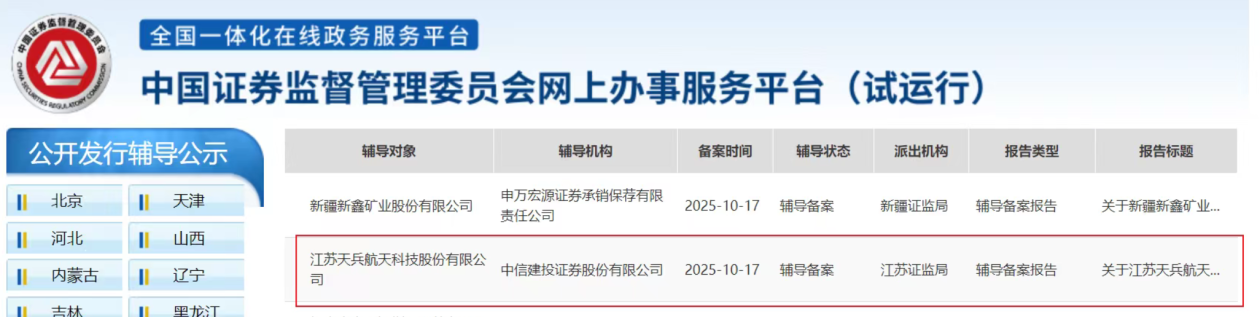
天兵科技启动上市辅导,中国商业航天开启产业化跃迁新篇章
Huan Qiu Wang· 2025-10-18 02:46
Core Viewpoint - Jiangsu Tianbing Aerospace Technology Co., Ltd. has officially submitted its listing guidance record, marking a significant milestone in the company's development and a key turning point for China's commercial aerospace industry towards comprehensive industrialization capabilities [1] Group 1: Company Developments - Tianbing Technology has completed Pre-D and D rounds of financing totaling nearly 2.5 billion RMB, which will primarily be used for the preparation of mass production of rockets and the development of new-generation engines and rockets [6] - The company has established a comprehensive aerospace manufacturing system, with the capability to produce 30 Tianlong-3 large liquid rockets and 500 Tianhu series engines annually, providing a solid foundation for large-scale commercial delivery [6] - Tianbing Technology's Tianlong-3 rocket has a near-Earth orbit capacity expected to exceed 20 tons, with a length of 72 meters and a launch weight of approximately 600 tons, directly competing with international mainstream rockets like SpaceX's Falcon 9 [3][4] Group 2: Industry Trends - The commercial aerospace sector in China is transitioning from focusing on single technology breakthroughs to building comprehensive industrial capabilities, with Tianbing Technology leading this shift [1][5] - The launch of the Tianlong-3 rocket signifies a change in the competitive logic and development model of China's commercial aerospace industry, moving from meeting scattered demands to supporting large-scale, standardized satellite constellation deployments [5] - The Chinese commercial aerospace industry is expected to see a surge in demand for satellite launches, with estimates suggesting over 30,000 satellites will need to be launched for low-orbit constellation networks [8]

稳中求进 ,商业运力最大!国内商业航天液体火箭天龙三号一级动力系统海上试车成功
Xin Lang Zheng Quan· 2025-09-16 03:01
Core Viewpoint - Tianbing Technology has successfully tested the first stage propulsion system of the Tianlong-3 large liquid launch vehicle, marking a significant advancement in China's commercial space industry and enhancing its capabilities for large-scale satellite internet deployment [1][3][5]. Group 1: Technical Achievements - The Tianlong-3 rocket is designed to carry over 20 tons to low Earth orbit, with a total length of 72 meters and a launch weight of approximately 600 tons, comparable to SpaceX's Falcon 9 [3]. - The successful test verified the operational coordination of various systems and set a new domestic record for thrust in commercial liquid rocket engines [1][5]. - The test was the first of its kind conducted at sea, demonstrating a new paradigm for maritime operations in the commercial space sector [3][5]. Group 2: Innovations and Cost Efficiency - The Tianlong-3 employs innovative technologies such as liquid nitrogen heating and pressurization, reducing the weight of the pressurization system by over 50% and costs by more than ten times [5][8]. - The rocket's first stage features a honeycomb structure that simplifies ground maintenance and enhances fault isolation capabilities [5][8]. - The use of 3D printing technology allows for approximately 90% of the engine components to be produced in a more efficient manner, significantly reducing manufacturing time and costs [8][9]. Group 3: Market Implications - The Tianlong-3's capabilities will shift the focus of China's commercial space launch services from small, customized satellite deployments to large-scale, standardized satellite constellation launches [7][8]. - The rocket is expected to support over 30 launches annually, addressing the growing demand for satellite internet infrastructure in China [6][9]. - The development of the Tianlong-3 signifies a transition in the commercial space industry towards a model driven by industrial efficiency and ecosystem effectiveness, moving beyond mere technological competition [8][9].

资本与产业双驱 万亿商业航天爆发
2 1 Shi Ji Jing Ji Bao Dao· 2025-08-14 15:43
Core Viewpoint - The commercial aerospace industry in China is experiencing rapid growth and investment opportunities, driven by increased launch frequency, new IPO policies, and advancements in satellite technology [1][3][8]. Group 1: Industry Developments - The successful launch of the low-orbit satellite group on August 13 marks a significant milestone in China's commercial aerospace sector [1]. - In August, the Hainan commercial space launch site achieved a record of consecutive launches, contributing to a market scale of 2.8 trillion yuan for commercial aerospace [1]. - The number of space launches in China has reached new highs, surpassing the same period last year, with multiple new rocket models planned for their first flights by 2025 [1]. Group 2: Investment Trends - The recent IPO policy changes by the China Securities Regulatory Commission (CSRC) have heightened market interest in the commercial aerospace sector, leading to a continuous rise in the commercial aerospace index [3][6]. - The Tianhong Aerospace ETF has seen significant net inflows, with over 30 million shares purchased, indicating strong investor interest [2]. Group 3: Company Highlights - Three commercial aerospace companies, Blue Arrow Aerospace, Yixin Aerospace, and China Aerospace Science and Technology Corporation, have initiated IPO processes, showcasing the industry's growth potential [4]. - Blue Arrow Aerospace is recognized for its vertical recovery technology and plans to launch its reusable rocket, Zhuque-3, this year [4]. - Yixin Aerospace specializes in satellite communication payloads, achieving significant weight and power efficiency improvements [4]. - China Aerospace Science and Technology Corporation is a mixed-ownership model representing the "national team" in commercial aerospace, with plans for its liquid rocket to launch by the end of August [4]. Group 4: Market Valuations - The combined valuation of the highlighted commercial aerospace companies exceeds 50 billion yuan, with Blue Arrow Aerospace valued at 20 billion yuan and Yixin Aerospace at over 8 billion yuan [5][6]. - The stock of Star Map Control, the first commercial aerospace company listed on the Beijing Stock Exchange, has seen a remarkable increase of over 900% since its IPO [6]. Group 5: Future Outlook - The commercial aerospace sector is transitioning from experimental phases to industrialization, with a significant increase in satellite launches and a projected deployment of approximately 1,300 satellites by 2030 [8]. - Analysts predict that the demand for satellite services will drive down costs and improve profitability for upstream component manufacturers [9]. - The integration of commercial aerospace with other sectors, such as smart driving and artificial intelligence, is expected to enhance growth opportunities for companies involved in these technologies [11].
军工ETF(512660)早盘领涨,收涨超3%!覆盖海陆空天信全产业链,规模居同类产品第一
Mei Ri Jing Ji Xin Wen· 2025-08-06 05:49
Group 1 - The core viewpoint of the articles highlights the celebration of the 98th anniversary of the People's Liberation Army and the optimistic outlook for military trade, civil aviation, and commercial aerospace industries in China [1] - The "14th Five-Year Plan" and the planning for the "15th Five-Year Plan" are expected to boost domestic demand and contribute to economic growth, particularly in military trade and civil aviation [1] - The military industry ETF (512660) is noted for its comprehensive coverage of the defense industry chain, showcasing good elasticity and defensive attributes, making it an important tool for industry allocation opportunities [1] Group 2 - As of August 5, 2025, the military industry ETF has a scale of 16.953 billion, ranking first among 12 similar products [2] - The military industry ETF tracks the China Securities Military Industry Index, which selects representative listed companies in the defense sector, reflecting the overall performance of the military industry [1][2] - The index covers multiple sub-sectors of the defense industry, demonstrating high industry concentration and distinct military characteristics [1]
全链条协同突破 商业航天加速迈向“百箭千星”
Zheng Quan Ri Bao Zhi Sheng· 2025-06-10 17:18
Group 1: Industry Overview - China's commercial space industry is experiencing rapid development, with a variety of companies emerging in commercial satellites, rockets, and measurement and control sectors [1][2] - The industry is expected to reach a peak of "hundred arrows and thousand stars" launches by 2025, driven by large-scale low-orbit internet constellations [1][2] Group 2: Policy and Market Dynamics - Commercial space has been included in the government work report for two consecutive years, indicating strong policy support for the industry [2] - Local governments are also implementing measures to promote commercial space development, such as the Shanghai measures to accelerate the cultivation of advanced manufacturing clusters [2] Group 3: Technological Advancements - Companies are focusing on overcoming technical challenges and accelerating breakthroughs in key technologies, such as reusable rocket technology and advanced materials for rocket engines [3][4][5] - The development of new materials, such as high-strength copper alloys, is filling domestic technological gaps and supporting the reliability of liquid rocket engines [5] Group 4: Financial Landscape - The commercial space industry in China is projected to achieve a compound annual growth rate of 22.9% from 2020 to 2024, with an expected market value of 2.8 trillion yuan in 2025 [6] - Significant financing events have occurred in the industry, with 138 financing events in 2024 alone, raising over 20 billion yuan [6] Group 5: Industry Collaboration and Growth - The emergence of industry clusters, such as "Nan Jian Bei Xing" in Beijing and "Qian Fan Xing Zuo" in Shanghai, is facilitating collaboration across the entire value chain from manufacturing to application [6] - Companies are expanding production capacity in response to strong market demand, with expectations of significant growth in satellite and rocket manufacturing [7]