
基础科学

Search documents
前三十名,全是中国:一份榜单引发的全球科学界震动
Guan Cha Zhe Wang· 2025-12-15 01:12
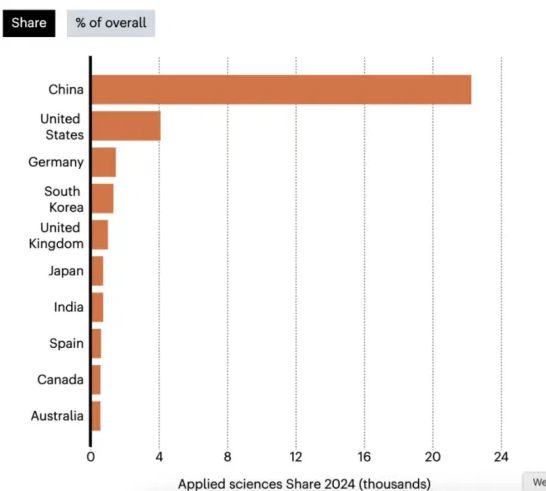
Core Viewpoint - The recent application science ranking by the Nature Index reveals that all top thirty institutions are from China, marking a significant shift in global scientific competitiveness, with China contributing 56% of global application science output compared to the USA's 10% [1][4]. Group 1: Application Science Ranking - The Nature Index's application science ranking is based on articles published in 25 application science journals and conferences, covering fields such as engineering, computer science, and food science [3]. - The Chinese Academy of Sciences ranks first, followed by Zhejiang University, Tsinghua University, Shanghai Jiao Tong University, and Peking University, indicating a concentration of top institutions in China [3][4]. - China's application science output exceeds the combined total of the next six countries (USA, Germany, South Korea, UK, Japan, and India), showcasing a dominant advantage [4]. Group 2: Research Focus and Strategic Choices - There is a notable discrepancy between the application science ranking and the traditional comprehensive research ranking, highlighting different national research priorities [4]. - France ranks sixth in comprehensive research but falls to twelfth in application science, indicating a focus on basic research over practical application [4][5]. - South Korea, while ranked seventh in comprehensive research, excels in application science, with over 50% of its research output focused on practical applications [5]. Group 3: Implications of Research Strategies - The data suggests that countries overly focused on basic research may struggle to maintain competitiveness in a rapidly evolving global landscape [5][6]. - Asian countries, particularly China and South Korea, emphasize research that leads to practical innovations, supported by government policies [6][8]. - The USA's shift towards prioritizing basic research has created a gap in application research, leading to challenges in translating research into practical outcomes [7][8]. Group 4: Future Prospects for China - China's leading position in application science is expected to strengthen due to factors such as scale effects, a robust talent pool, strong industrial demand, and ongoing institutional reforms [11][12][13]. - The country has become a global leader in electric vehicle production, accounting for 70% of global output, driven by extensive application science research [10][12]. - China's focus on practical applications in fields like artificial intelligence has resulted in a significant number of patents, indicating a depth of research and innovation [10][11]. Group 5: Challenges for the West - The West faces challenges in maintaining its scientific leadership, with calls for a reevaluation of research funding priorities and a balance between basic and applied research [14][15]. - The aging population in Western countries may limit funding for research, necessitating a more efficient allocation of resources [14]. - The Western scientific community is urged to adopt a more pragmatic approach to research, aligning scientific endeavors with national and societal needs [16][17].

科学无国界 上海搭建全球科学合作新桥梁
Ke Ji Ri Bao· 2025-10-27 08:04
Core Viewpoint - The 2025 World Top Scientists Forum held in Shanghai highlights the importance of scientific collaboration and innovation, featuring significant awards and discussions among leading scientists from around the world [1][2][4]. Group 1: Event Overview - The forum took place from October 24 to 26, 2025, under the theme "Future Science: Shanghai and the World," attracting 25 top-tier award-winning scientists [1]. - The event is recognized as one of the highest-profile international scientific conferences in Asia, showcasing a diverse range of scientific inquiries and discussions [1][4]. Group 2: Awards and Recognitions - The World Top Scientists Association Award, comparable to the Nobel Prize, was presented during the forum, with the "Life Sciences or Medicine Award" going to Scott Emmer and Wes Sundquist for their groundbreaking work on cellular mechanisms [2][3]. - The "Intelligent Science or Mathematics Award" was awarded to Richard S. Hamilton for his pioneering contributions in geometric analysis and differential geometry [2]. Group 3: Scientific Contributions - Emmer's research on the ESCRT pathway has been pivotal in understanding how cells manage protein degradation, which has implications for combating diseases like HIV [2][3]. - The pharmaceutical industry has leveraged these foundational biological discoveries, leading to significant advancements in HIV treatment, exemplified by Gilead Sciences' development of a revolutionary drug [3]. Group 4: Collaborative Opportunities - The forum has fostered connections between international scientists and the Chinese scientific community, enhancing collaborative research opportunities [3][5]. - Notable scientists expressed pride in being part of the award-winning community and emphasized the importance of building relationships for future scientific endeavors [3][5]. Group 5: Forum Structure and Participation - The forum featured a comprehensive structure with one main forum, six sub-forums, and over ten related activities, focusing on various scientific disciplines and promoting in-depth discussions [4]. - Approximately 150 scientists from over ten countries participated, including four Nobel laureates and numerous distinguished young scientists, reflecting the forum's global reach and influence [5].
新凯来和诺奖的双重启示
Jing Ji Guan Cha Wang· 2025-10-22 10:48
Group 1 - Shenzhen Xinkailai Technology Co., Ltd. showcased ultra-high-speed real-time oscilloscopes at the 2025 Bay Area Semiconductor Industry Ecological Expo, demonstrating the resilience of Chinese tech companies under pressure [1] - Some Chinese companies presented products with performance metrics comparable to mainstream products, addressing "bottleneck" issues, indicating potential breakthroughs in technology [1] - Observers believe that more breakthroughs in technology bottlenecks are only a matter of time, highlighting the strong creativity and execution capabilities of Chinese enterprises [1] Group 2 - Breakthroughs in "bottleneck" projects are targeted at specific technical challenges and are more suited for mature technology products, emphasizing the need for sustained investment in basic scientific research for long-term development [2] - Despite increased funding in research, China still faces shortcomings in the soft environment of scientific research, such as research system construction and the cultivation of scientific spirit [2] - The competitive environment for young researchers is harsh, with many teams implementing performance management similar to corporate practices, which may hinder long-term innovation [2] Group 3 - An open, free, and inclusive academic atmosphere is crucial for fostering innovation, allowing scientists to focus on research and encouraging long-term innovative ecosystems [3] - Cultivating a supportive ecosystem for technology and innovation requires societal changes, including reforming research systems and providing reasonable returns for scientists [3] - A focus on nurturing curiosity and exploration in education is essential for embedding the genes of science and innovation, which will drive future societal development [3]
我们应当如何理解杨振宁先生的成就
3 6 Ke· 2025-10-20 02:47
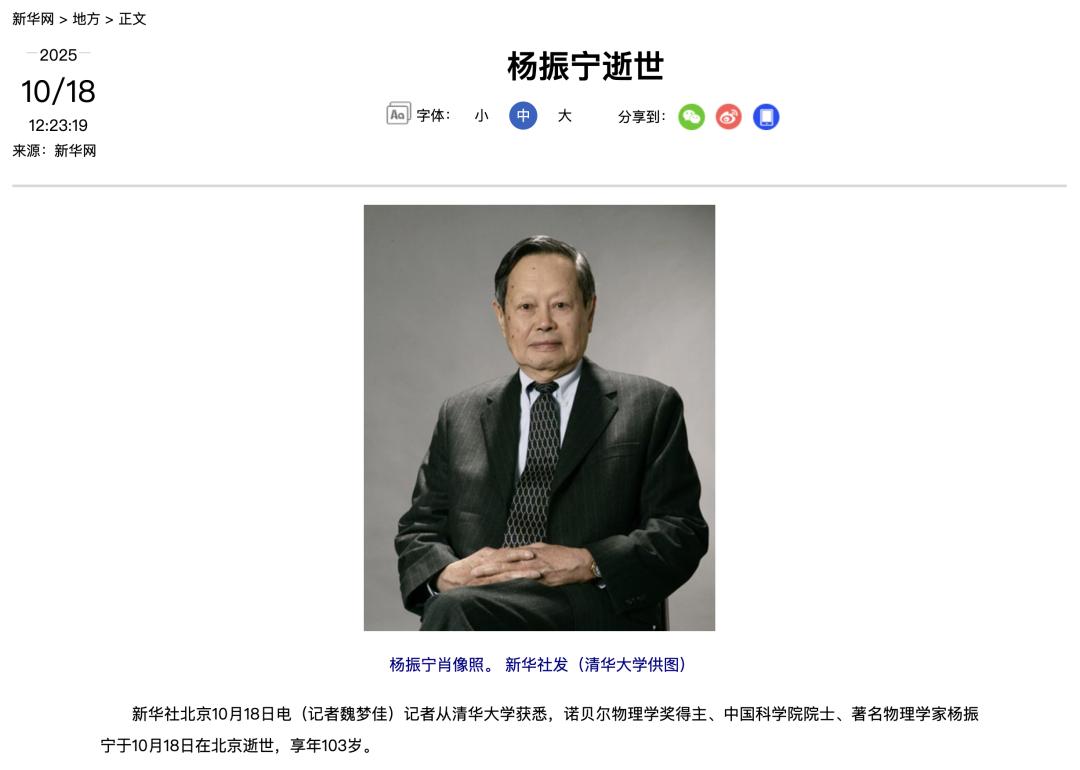
Core Points - The article discusses the significance of the work of physicist Yang Zhenning, emphasizing the importance of his contributions to theoretical physics and their impact on human understanding of the universe [2][11][43] - It highlights two major achievements: the proposal of "parity non-conservation" with Li Zhengdao and the development of the "Yang-Mills theory" [22][24][27] Group 1: Importance of Physics - Physics is described as a fundamental science with the mission to explore the essence of the world [5][30] - The article uses analogies to illustrate how advancements in physics provide a better understanding of the universe, comparing historical and modern tools [4][8] Group 2: Yang Zhenning's Contributions - Yang Zhenning and Li Zhengdao's 1956 paper challenged the established notion of "parity conservation," leading to their Nobel Prize win [18][22] - The "Yang-Mills theory" is recognized as a significant theoretical framework that attempts to unify the four fundamental forces of nature [26][27] Group 3: Impact on Chinese Science - Yang Zhenning's return to China in 1971 is noted as a pivotal moment for the development of theoretical physics in the country, helping to elevate its status to a world-class level [29][34] - His contributions are credited with fostering the growth of numerous academicians and enhancing research facilities in Chinese universities [34][37] Group 4: Future Implications - The article stresses the necessity of foundational research in physics for future technological advancements, particularly in areas like controlled nuclear fusion and high-temperature superconductors [40][41] - It concludes that Yang Zhenning's work is essential for addressing deeper scientific questions that transcend national boundaries, serving humanity as a whole [43][45]
趣图:一年一度看不上诺贝尔奖活动开始了
程序员的那些事· 2025-10-09 08:50
Group 1 - The article discusses the perceived disconnect between theoretical scientific achievements and practical applications, questioning why notable scientists have not directly produced consumer-friendly technologies from their discoveries [2] - It highlights various historical figures in science, such as Faraday, Watson and Crick, and others, emphasizing their contributions without resulting in commercially viable products [2] - The commentary suggests that there is a need for innovation that does not rely solely on foundational science to create beneficial technologies for humanity [2]

美国“基础科学”,如何从内部沦陷?
Hu Xiu· 2025-08-08 01:43
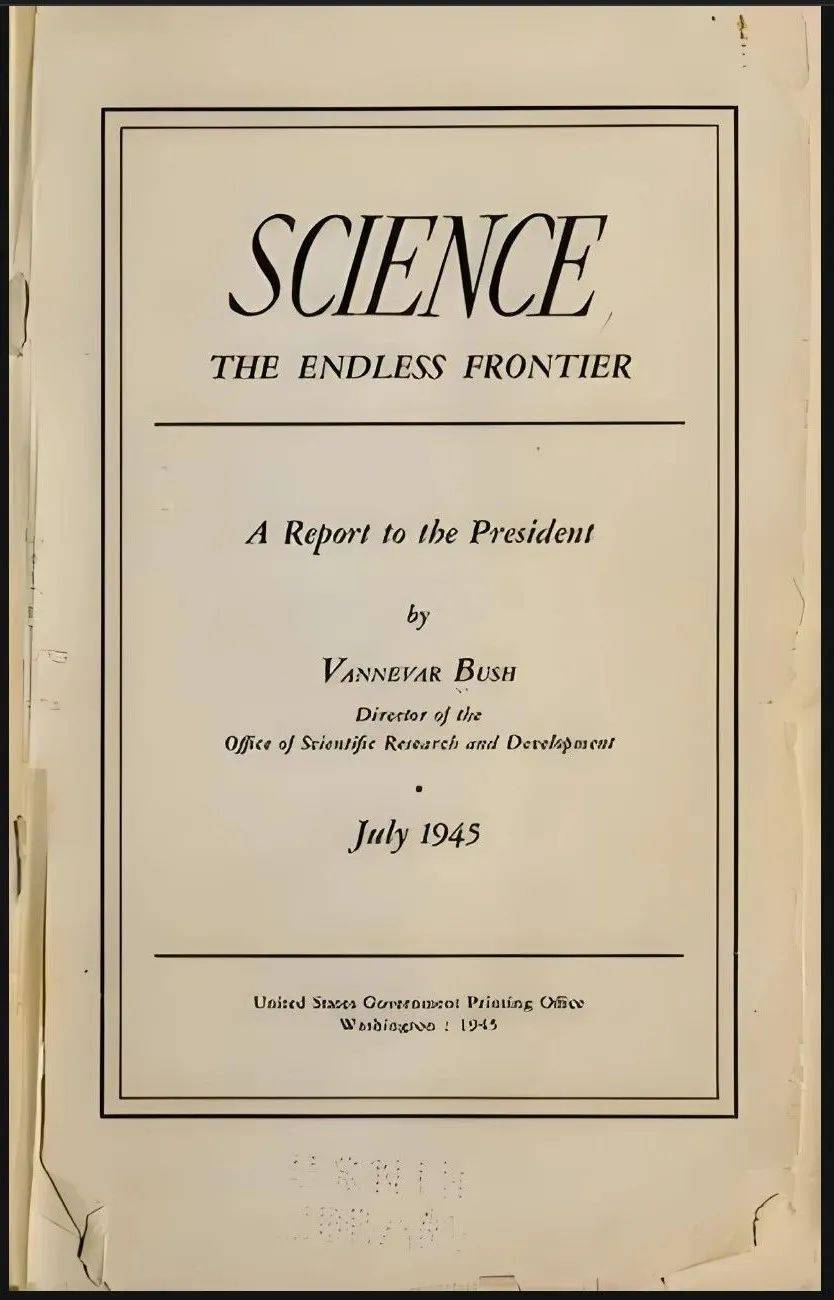
Group 1 - The sudden resignation of NSF Director S. Panchanathan was prompted by a 55% budget cut ordered by the Trump administration, leading to the termination of half of the NSF's 1,700 staff members [1][2] - NSF has been perceived as a "fortress of basic science" in the U.S., but the scientific community is now lamenting its destruction under the current administration [2][3] - The NSF's funding has historically been limited, receiving only about 1.5% of the total U.S. annual R&D expenditure, indicating that the vision outlined by Vannevar Bush in "Science: The Endless Frontier" has never been fully realized [10][24] Group 2 - NSF has faced internal conflicts since its inception, with challenges from applied sciences and political pressures to align more closely with national interests, diverging from its original mission of supporting pure scientific research [11][28] - The establishment of the Engineering Directorate in 1981 marked a significant shift, allowing engineering to gain equal footing with basic sciences within NSF, reflecting a broader trend of NSF's evolving focus [14][20] - Recent legislation, including the CHIPS and Science Act, has further emphasized the importance of applied research and technology, indicating a departure from the original intent of NSF as a purely scientific institution [23][25] Group 3 - The NSF's current operational model has shifted to balance both basic science and applied technology, contradicting the initial vision of being a non-political entity focused solely on fundamental research [24][28] - The emphasis on technology within NSF has increased significantly, with the term "technology" appearing 230 times in recent legislative texts, compared to only 163 mentions of "science" [26][28] - The NSF's alignment with U.S. national interests has deepened, particularly in response to geopolitical challenges, marking a significant departure from its founding principles [29][30]
裴瑞敏:基础科学全球遇冷,为何中国“升温”?
Huan Qiu Wang Zi Xun· 2025-07-15 22:55
Core Insights - David Gross, a Nobel laureate, expressed concerns about the global reduction in basic science investment while recognizing China's strategic commitment to increasing its investment in this area [1][4] - The contrast between the global cooling of basic science and China's warming investment highlights a significant strategic choice made by China [1][4] Investment in Basic Science - China's investment in basic science is seen as essential for transitioning from a "big technology country" to a "strong technology country" [2] - The "14th Five-Year Plan" aims to increase the proportion of basic research in R&D funding to 8% [2] - The National Natural Science Foundation is increasing funding to promote original breakthroughs [2] Achievements in Basic Science - China has established several world-class research platforms, such as the 500-meter Aperture Spherical Radio Telescope, supporting frontier scientific research [3] - The youth research workforce is becoming a driving force in innovation, with nearly 150,000 applications for the National Natural Science Foundation's youth projects in 2024 [3] - China is actively participating in major international scientific collaborations, contributing to projects like ITER and SKA [3] Challenges Ahead - China's basic science originality is characterized by strengths in areas like quantum physics, but weaknesses in foundational disciplines such as mathematics and theoretical physics [4] - The current project evaluation system favors applied research, necessitating a greater tolerance for the uncertainties of basic science exploration [4] - Despite leading in the number of publications, China still lacks Nobel-level achievements and theoretical influence in basic science [4] Strategic Importance - Investment in basic science is viewed as a strategic move for future technological positioning on the global stage [3][5] - The commitment to basic science reflects a nation's depth of civilization and historical perspective, as emphasized by Gross [4][5] - Long-term investment in basic science is crucial for breakthrough innovations and understanding the limits of human cognition [5]
2025年国际基础科学大会在京开幕 六位科学家获“基础科学终身成就奖”
Huan Qiu Wang Zi Xun· 2025-07-14 07:43
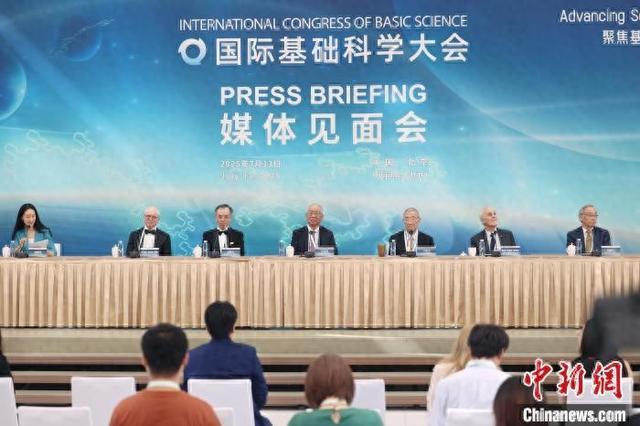
Core Insights - The 2025 International Conference on Basic Sciences opened in Beijing, focusing on the theme "Focusing on Basic Sciences, Leading the Future of Humanity" with participation from numerous international award winners and experts in the field [1][3]. Group 1: Conference Overview - The conference features over 80 academicians, more than 10 representatives from various national mathematical societies, and nearly 1,000 experts and students from academic organizations and research institutions worldwide [1]. - The event will run from July 13 to July 25, 2025, including multiple specialized reports, forums, and youth activities covering mathematics, physics, information science, and engineering [7]. Group 2: Awards and Recognitions - The "Lifetime Achievement Award in Basic Sciences" was presented to six distinguished scholars, including Nobel laureates Samuel Chao Chung Ting, Steven Chu, and David Jonathan Gross, as well as Turing Award winner Robert Endre Tarjan, Fields Medalist Shigefumi Mori, and Wolf Prize winner George Lusztig [3][5]. - The award aims to recognize significant contributions and ongoing leadership in the fields of mathematics, physics, and information science [3]. Group 3: Key Remarks - The conference chair, Shing-Tung Yau, emphasized the breakthroughs in basic sciences and the importance of international collaboration in advancing research [3]. - Nobel laureate Samuel Chao Chung Ting highlighted the necessity of proposing unprecedented questions in basic research, reflecting on over fifty years of his research journey [5]. - David Jonathan Gross expressed his satisfaction with the rapid development of basic sciences in China, particularly in fostering collaboration between American and Chinese physicists [5].
中外科学家汇聚北京共话“基础科学”
Xin Hua She· 2025-07-13 11:12
Core Insights - The 2025 International Conference on Fundamental Sciences opened on July 13 in Beijing, focusing on "Focusing on Fundamental Sciences, Leading the Future of Humanity" [1] - The conference gathered nearly a thousand experts, including four Fields Medal winners, three Nobel Prize winners, and two Turing Award winners, to discuss advancements in mathematics, physics, information science, and engineering [1][2] Group 1 - The conference is being held for the first time in Beijing, with over 400 renowned international scientists in attendance, including many award winners and over 80 academicians from both China and abroad [2] - Over the next two weeks, the conference will host more than 500 academic meetings, where prominent scientists will share the latest research findings across various branches of fundamental sciences [2] - Qiu Chengtong, the conference chairman and a professor at Tsinghua University, highlighted significant breakthroughs in fundamental sciences that have greatly enhanced human understanding of nature and the universe [2][5] Group 2 - Qiu Chengtong emphasized that advancements in fundamental sciences are crucial not only for technological innovation but also as a core driving force for the evolution of human civilization [5] - He stressed the importance of strengthening international cooperation in the scientific field and promoting mutual trust and communication [5] - During the opening ceremony, the 2025 Lifetime Achievement Award in Fundamental Sciences was presented to six scientists, including physicist and MIT professor Samuel Ting [5]
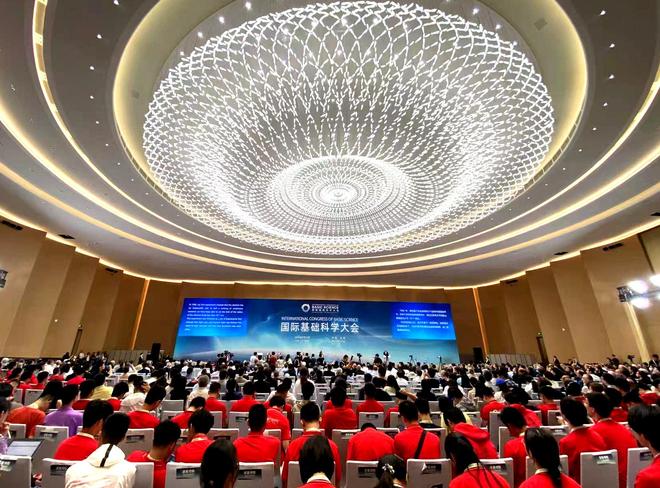
聚焦AI与人类未来,2025国际基础科学大会在京开幕
news flash· 2025-07-13 06:37
Core Insights - The 2025 International Conference on Basic Sciences opened today in Beijing, featuring over 80 international and domestic academicians and nearly 1,000 experts and scholars [1] - The conference will last until July 25 and will host more than 500 academic reports and satellite meetings, focusing on mathematics, physics, information science, and engineering [1] - The rapid development of artificial intelligence will be a key focus, exploring the close relationship between basic sciences and AI [1] - The conference chair, Fields Medalist Shing-Tung Yau, emphasized the importance of basic sciences, particularly mathematics, in contributing to AI [1] Industry Focus - The conference aims to foster collaboration among scientists worldwide to contribute to the future of humanity through shared knowledge and advancements in basic sciences and AI [1]