基金仓位

Search documents
主动权益类基金测算仓位再度突破90%
Sou Hu Cai Jing· 2025-09-02 05:07
Group 1 - The active equity fund positions have surpassed 90%, reaching the highest level since March 2021 [1] - The average position of ordinary stock funds is approximately 91.94%, an increase of 1.16 percentage points from the previous week [1] - The average position of equity-mixed funds is around 90.39%, rising by 1.53 percentage points [1] Group 2 - Funds have increased their positions in sectors such as telecommunications, non-ferrous metals, real estate, electronics, and food and beverage [1] - Conversely, funds have reduced their positions in the automotive, computer, and basic chemicals sectors [1]
公募基金周报(20250804-20250808)-20250817
Mai Gao Zheng Quan· 2025-08-17 09:18
1. Report Industry Investment Rating - Not provided in the content 2. Core Viewpoints of the Report - The A-share market showed a continuous upward trend this week, with the Shanghai Composite Index stable above 3,600 points. Although the weekly average daily trading volume decreased by 6.26% compared to last week, the margin trading balance exceeded 2 trillion and continued to rise, indicating that investors' risk appetite remained relatively high in the short term [1][10]. - Most industry sectors' trading volume proportions reached new lows in the past four weeks, suggesting that the market trading focus was concentrating on a small number of sectors. Investors should pay attention to the congestion risk of industry sectors and focus on capital flows in the market with rapid rotation of industry themes [10]. - In terms of market style, small-cap stocks had significant excess returns. The cyclical style led the gains among the five major CITIC style indices, while the consumer style had the smallest increase [12]. - It is recommended to focus on three main investment lines: the domestic computing power industry chain, the AI application end, and the consumption recovery sector. These sectors have relatively reasonable valuations and strong potential for supplementary growth under the background of loose liquidity [13]. 3. Summary According to Relevant Catalogs 3.1 This Week's Market Review 3.1.1 Industry Index - This week, sectors such as non-ferrous metals, machinery, and national defense and military industry led the gains. The pharmaceutical sector, which had performed well last week, corrected significantly, while the coal and non-ferrous metals sectors, which had large declines last week, rebounded sharply [10]. - The trading volume proportions of most industry sectors reached new lows in the past four weeks, and the trading activity of the comprehensive finance and non-bank finance sectors decreased significantly [10]. 3.1.2 Market Style - All five major CITIC style indices rose this week, with the cyclical style leading the gains at 3.49%. The growth style rose 1.87%, and its trading volume proportion reached a four-week high. The consumer style had the smallest increase at 0.77%, and its trading volume proportion decreased slightly [12]. - Small-cap stocks had significant excess returns. The CSI 1000 and CSI 2000 rose 2.51% and 3.54% respectively, and their trading volume proportions reached four-week highs [12]. 3.2 Active Equity Funds 3.2.1 Funds with Excellent Performance This Week in Different Theme Tracks - The report selected single-track and double-track funds based on six sectors: TMT, finance and real estate, consumption, medicine, manufacturing, and cyclical sectors, and listed the top five funds in each sector [17][18]. 3.2.2 Funds with Excellent Performance in Different Strategy Categories - The report classified funds into different types such as deep undervaluation, high growth, high quality, quality growth, quality undervaluation, GARP, and balanced cost-effectiveness, and listed the top-ranked funds in each type [19][20] 3.3 Index Enhanced Funds 3.3.1 This Week's Excess Return Distribution of Index Enhanced Funds - The average and median excess returns of CSI 300 index enhanced funds were 0.22% and 0.20% respectively; those of CSI 500 index enhanced funds were 0.05% and 0.07% respectively; those of CSI 1000 index enhanced funds were -0.15% and -0.14% respectively; those of CSI 2000 index enhanced funds were -0.09% and 0.04% respectively; those of CSI A500 index enhanced funds were 0.24% and 0.26% respectively; those of ChiNext index enhanced funds were 0.45% and 0.39% respectively; and those of STAR Market and ChiNext 50 index enhanced funds were 0.18% and 0.21% respectively [23][24]. - The average and median absolute returns of neutral hedge funds were 0.29% and 0.27% respectively; those of quantitative long funds were 1.75% and 1.83% respectively [24]. 3.4 This Issue's Bond Fund Selection - The report comprehensively screened the fund pools of medium- and long-term bond funds and short-term bond funds based on indicators such as fund scale, return-risk indicators, the latest fund scale, Wind fund secondary classification, rolling returns in the past three years, and maximum drawdowns in the past three years [38] 3.5 This Week's High-Frequency Position Detection of Funds - Active equity funds significantly increased their positions in the machinery and computer industries this week and significantly reduced their positions in the electronics, banking, and automobile industries [3]. - From a one-month perspective, the positions in the communication, banking, and non-bank finance industries increased significantly, while the position in the food and beverage industry decreased significantly [3] 3.6 This Week's Weekly Tracking of US Dollar Bond Funds - Not provided in the content
公募基金规模再创新高,被动指数基金首次出现净赎回
Great Wall Securities· 2025-08-08 07:00
1. Report Industry Investment Rating No relevant content provided. 2. Core Viewpoints of the Report - At the end of Q2 2025, the scale of public - offering funds reached a new high, mainly driven by the growth of passive equity funds and bond funds. Active bond funds received significant net subscriptions after three consecutive quarters of net redemptions. Both active and passive bond funds saw increases in scale and share. Passive equity funds reached a new high in scale, mainly due to the increase in net value, but experienced their first net redemption after 15 consecutive quarters [1][8]. - The average position of active equity funds increased by 1.03pct quarter - on - quarter, reaching 84.04%. Currently, the position of active equity funds is close to the historical high level [2][28]. - In terms of the industry position changes of the top - holding stocks of the whole - market funds, the top 5 industries with increased position ratios are communication, bank, non - bank finance, national defense and military industry, and media; the top 5 industries with decreased position ratios are food and beverage, automobile, power equipment and new energy, household appliances, and machinery [3][33]. 3. Summary According to the Directory 3.1 Fund Market Scale - **Overall Scale Change of the Fund Market**: By the end of Q2 2025, the total number of funds was 12,906, a quarter - on - quarter increase of 307, or 2.44%. The total fund share was 308,831.90 billion shares, a quarter - on - quarter increase of 15,091.97 billion shares, or 5.14%. The net asset value of funds was 337,337.87 billion yuan, a quarter - on - quarter increase of 21,130.16 billion yuan, or 6.68% [9]. - **Newly - issued Fund Shares and Net Subscription/Redemption Shares**: In Q2 2025, the total share of newly - issued funds was 2,803.71 billion shares, a quarter - on - quarter increase of 303.95 billion shares, or 12.16%. After deducting the newly - issued fund shares, the net subscription share of funds was 12,288.26 billion shares [10]. - **Scale Ratios of Different Types of Funds**: At the end of Q2 2025, the ratio of equity funds was 12.69%, a quarter - on - quarter change of - 0.06pct; the ratio of hybrid funds was 9.54%, a quarter - on - quarter change of - 0.66pct; the ratio of bond funds was 32.36%, a quarter - on - quarter increase of 0.56pct; the ratio of money market funds was 42.19%, a quarter - on - quarter increase of 0.04pct [12]. - **Changes in the Shares and Scale of Active Equity Funds**: By the end of Q2 2025, the scale of active equity funds was 344.4061 billion yuan, a quarter - on - quarter change of - 1.6283 billion yuan, or - 0.47%. The share of active equity funds was 289.0605 billion shares, a quarter - on - quarter change of - 6.6468 billion shares. The newly - issued share of active equity funds was 3.6593 billion shares, a quarter - on - quarter increase of 2.1294 billion shares. The net redemption share of active equity funds was - 10.3061 billion shares [16]. - **Changes in the Shares and Scale of Passive Equity Funds**: By the end of Q2 2025, the scale of passive equity funds was 377.9525 billion yuan, a quarter - on - quarter increase of 33.5618 billion yuan, or 9.75%. The share of passive equity funds was 296.1349 billion shares, a quarter - on - quarter change of - 1.0683 billion shares. The newly - issued share of passive equity funds was 7.0326 billion shares, a quarter - on - quarter change of - 0.5624 billion shares. The net redemption share of passive equity funds was - 8.1010 billion shares. Passive equity funds experienced their first net redemption after 15 consecutive quarters [19]. - **Changes in the Shares and Scale of Active Bond Funds**: By the end of Q2 2025, the scale of active bond funds was 958.8361 billion yuan, a quarter - on - quarter increase of 54.1574 billion yuan, or 5.99%. The share of active bond funds was 870.8178 billion shares, a quarter - on - quarter increase of 42.6045 billion shares. The newly - issued share of active bond funds was 0.82579 billion shares, a quarter - on - quarter increase of 0.02279 billion shares. The net subscription share of active bond funds was 34.3465 billion shares [23]. - **Changes in the Shares and Scale of Passive Bond Funds**: By the end of Q2 2025, the scale of passive bond funds was 165.7738 billion yuan, a quarter - on - quarter increase of 39.5787 billion yuan, or 31.36%. The share of passive bond funds was 108.4467 billion shares, a quarter - on - quarter increase of 12.0752 billion shares. The newly - issued share of passive bond funds was 0.46209 billion shares, a quarter - on - quarter increase of 0.05515 billion shares. The net subscription share of passive bond funds was 7.4543 billion shares [24]. 3.2 Active Equity Fund Stock Positions - By June 30, 2025, the average position of active equity funds increased by 1.03pct quarter - on - quarter, reaching 84.04%. Among them, the position of common stock - type funds increased by 0.91pct quarter - on - quarter, reaching 89.83%; the position of partial - stock hybrid funds increased by 1.09pct quarter - on - quarter, reaching 87.73%; the position of flexible allocation funds increased by 1.09pct quarter - on - quarter, reaching 74.56% [28]. 3.3 Fund Top - holding Stock Industry Allocations - **Whole - market Fund Top - holding Stock Industry Allocations**: The A - share market value of the top - holding stocks was 259.4635 billion yuan, a quarter - on - quarter increase of 1.2488 billion yuan, and the A - share market value ratio was 36.00%, a quarter - on - quarter change of - 1.29pct. The Hong Kong - share market value of the top - holding stocks was 48.6395 billion yuan, a quarter - on - quarter increase of 4.0976 billion yuan, and the Hong Kong - share market value ratio was 6.75%, a quarter - on - quarter increase of 0.32pct. The top 5 industries with increased position ratios were communication, bank, non - bank finance, national defense and military industry, and media; the top 5 industries with decreased position ratios were food and beverage, automobile, power equipment and new energy, household appliances, and machinery [31][33]. - **Comparison of the Differences in the Top - holding Stock Industry Allocations of Whole - market Funds, Active Equity Funds, and Top - tier Equity Funds**: By comparing the top - holding stock industry allocation situations of the three sample pools, the consensus and differences in the market can be found, which may be the main orientation and watershed of the market in the next stage [35]. - **Comparison of the Differences in the Sub - industry Allocations of Popular Industrial Chains**: By comparing the commonalities and differences in the position increases and decreases of different industries of whole - market funds, active equity funds, and top - tier funds in the new energy industry chain, large - consumption industry chain, pro - cyclical sectors, and digital economy and information technology innovation industry chain, the consensus and differences among the three sample pools can be found [39]. 3.4 Fund Top - holding Stock Adjustment Situations - **Top - holding Stocks with the Largest Position Increases Held in Two Consecutive Quarters**: Stocks such as SF Holding, New Times Group, and Industrial and Commercial Bank of China are among the top - holding stocks with the largest position increases [47]. - **Top - holding Stocks with the Largest Position Decreases Held in Two Consecutive Quarters**: No relevant content provided. - **Top - holding Stocks with the Largest Newly - added Positions in the Quarter**: No relevant content provided. - **Top - holding Stocks with the Largest Removed Positions in the Quarter**: No relevant content provided.
中泰红利优选一年持有混合发起:2025年第二季度利润5457.92万元 净值增长率6.28%
Sou Hu Cai Jing· 2025-07-18 02:52
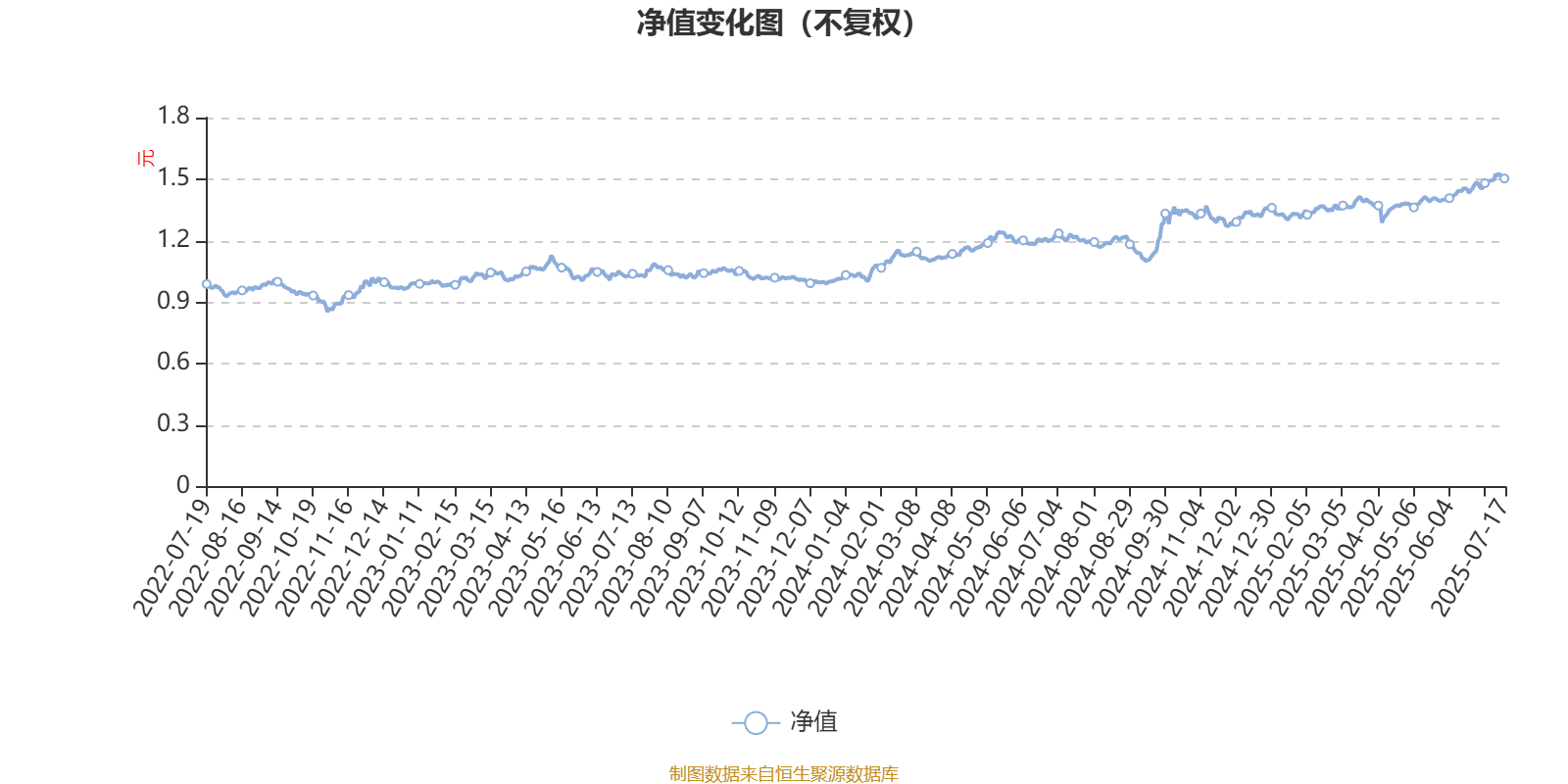
Core Viewpoint - The AI Fund Zhongtai Hongli Preferred One-Year Holding Mixed Fund (014771) reported a profit of 54.58 million yuan in Q2 2025, with a net value growth rate of 6.28% for the period [2]. Fund Performance - As of July 17, the fund's unit net value was 1.503 yuan, with a one-year compounded net value growth rate of 23.67%, the highest among its peers [2]. - The fund's performance over different time frames includes a three-month compounded net value growth rate of 9.68%, a six-month rate of 13.10%, and a three-year rate of 54.87%, ranking 2nd among 239 comparable funds [3][10]. Fund Management - The fund's management indicated a slight decrease in overall positions during Q2, reflecting a strategy to assess reinvestment risks and opportunity costs [2]. - The fund's average stock position over the past three years was 93.12%, higher than the industry average of 85.64% [13]. Fund Size and Holdings - As of the end of Q2 2025, the fund's size was 926 million yuan [15]. - The fund has a high concentration of holdings, with the top ten stocks consistently representing over 60% of the portfolio, including major companies like China State Construction, China Resources Land, and China Merchants Bank [18]. Risk Metrics - The fund's Sharpe ratio over the past three years was 1.0068, ranking 4th among 240 comparable funds [8]. - The maximum drawdown over the past three years was 15.65%, with the largest single-quarter drawdown occurring in Q3 2024 at 11.04% [10].

形态学短期看多指数减少,后市或先抑后扬
Huachuang Securities· 2025-07-06 14:14
Quantitative Models and Construction 1. Model Name: Volume Model - **Construction Idea**: This model uses trading volume data to predict short-term market trends[2][11] - **Construction Process**: The model evaluates trading volume changes across broad-based indices to generate buy or neutral signals. Specific thresholds or patterns in volume are used to determine the directional bias[11] - **Evaluation**: The model is partially optimistic for broad-based indices in the short term[11][66] 2. Model Name: Low Volatility Model - **Construction Idea**: This model focuses on the volatility of asset prices to assess market conditions[11] - **Construction Process**: The model calculates the historical volatility of indices and assigns a neutral signal when volatility remains within a predefined range[11] - **Evaluation**: The model is neutral for the short term[11][66] 3. Model Name: Institutional Feature Model (LHB) - **Construction Idea**: This model incorporates institutional trading data, such as large trades or block trades, to predict market movements[11] - **Construction Process**: The model analyzes institutional trading patterns, such as those from the "Dragon and Tiger List" (龙虎榜), to generate signals. A bearish signal is issued when institutional selling dominates[11] - **Evaluation**: The model is bearish for the short term[11][66] 4. Model Name: Intelligent Algorithm Models (HS300 and CSI500) - **Construction Idea**: These models use machine learning algorithms to analyze historical data and predict market trends[11] - **Construction Process**: The HS300 model generates a bullish signal for the CSI 300 index, while the CSI500 model remains neutral. The models likely use features such as price momentum, volume, and other technical indicators[11] - **Evaluation**: The HS300 model is optimistic, while the CSI500 model is neutral in the short term[11][66] 5. Model Name: Limit-Up/Limit-Down Model - **Construction Idea**: This model evaluates the frequency and distribution of limit-up and limit-down events to assess market sentiment[12] - **Construction Process**: The model calculates the ratio of stocks hitting daily price limits and assigns a neutral signal when no significant bias is observed[12] - **Evaluation**: The model is neutral for the medium term[12][67] 6. Model Name: Calendar Effect Model - **Construction Idea**: This model leverages seasonal or calendar-based patterns in market behavior[12] - **Construction Process**: The model analyzes historical performance around specific calendar dates (e.g., month-end or quarter-end) to generate signals. It remains neutral when no strong seasonal patterns are detected[12] - **Evaluation**: The model is neutral for the medium term[12][67] 7. Model Name: Long-Term Momentum Model - **Construction Idea**: This model uses long-term price momentum to predict market trends[13] - **Construction Process**: The model calculates momentum indicators over extended periods and assigns a neutral signal when no clear trend is identified[13] - **Evaluation**: The model is neutral for all broad-based indices in the long term[13][68] 8. Model Name: Comprehensive Weaponry V3 Model - **Construction Idea**: This composite model integrates multiple short-term, medium-term, and long-term signals to provide an overall market outlook[14] - **Construction Process**: The model aggregates signals from various sub-models (e.g., volume, volatility, momentum) and generates a bullish signal for the A-share market[14] - **Evaluation**: The model is optimistic for the A-share market[14][69] 9. Model Name: Comprehensive Guozheng 2000 Model - **Construction Idea**: This model focuses on the Guozheng 2000 index, combining multiple signals to assess market conditions[14] - **Construction Process**: Similar to the Weaponry V3 model, this model aggregates signals but remains neutral for the Guozheng 2000 index[14] - **Evaluation**: The model is neutral for the Guozheng 2000 index[14][69] 10. Model Name: Turnover-to-Volatility Model (Hong Kong Market) - **Construction Idea**: This model evaluates the ratio of turnover to price volatility to predict market trends in the Hong Kong market[15] - **Construction Process**: The model calculates the turnover-to-volatility ratio and generates a bullish signal when the ratio indicates strong market activity relative to volatility[15] - **Evaluation**: The model is optimistic for the medium term in the Hong Kong market[15][70] --- Backtesting Results of Models 1. Volume Model - **Signal**: Partially bullish for broad-based indices in the short term[11][66] 2. Low Volatility Model - **Signal**: Neutral for the short term[11][66] 3. Institutional Feature Model (LHB) - **Signal**: Bearish for the short term[11][66] 4. Intelligent Algorithm Models (HS300 and CSI500) - **Signal**: Bullish for HS300; neutral for CSI500 in the short term[11][66] 5. Limit-Up/Limit-Down Model - **Signal**: Neutral for the medium term[12][67] 6. Calendar Effect Model - **Signal**: Neutral for the medium term[12][67] 7. Long-Term Momentum Model - **Signal**: Neutral for all broad-based indices in the long term[13][68] 8. Comprehensive Weaponry V3 Model - **Signal**: Bullish for the A-share market[14][69] 9. Comprehensive Guozheng 2000 Model - **Signal**: Neutral for the Guozheng 2000 index[14][69] 10. Turnover-to-Volatility Model (Hong Kong Market) - **Signal**: Bullish for the medium term in the Hong Kong market[15][70]
公募基金规模略有回落,被动指数基金规模再创新高
Great Wall Securities· 2025-05-29 11:19
Group 1: Fund Market Overview - The public fund market experienced a slight decline in scale at the end of Q1 2025 compared to the end of 2024, primarily due to a reduction in fixed-income fund sizes, which have seen net redemptions for three consecutive quarters [2][9] - The total number of funds reached 12,600, an increase of 240 funds, while the total fund share decreased by 7,603.52 million shares, a decline of 2.52% [10] - The total net asset value of funds was 316,208.04 billion, down by 6,424.19 million, a decrease of 1.99% [10] Group 2: Active Equity Funds - Active equity funds saw a scale increase to 34,603.43 billion, up by 615.55 million, a rise of 1.81% [19] - The share of active equity funds reached 29,570.73 billion, with a net redemption of 676.11 million shares, significantly reduced compared to previous quarters [19] - The average stock position of active equity funds increased to 83.01%, nearing historical highs, with specific categories showing varied changes in stock positions [33] Group 3: Passive Index Funds - The scale of passive index funds reached a new high of 34,439.07 billion, increasing by 1,507.29 million, a growth of 4.58% [24] - The share of passive index funds was 29,720.32 billion, with a net subscription of 717.53 million shares, although the growth trend has shown signs of slowing down [24] Group 4: Fixed-Income Funds - Fixed-income funds experienced a decline in scale to 90,467.87 billion, down by 3,706.54 million, a decrease of 3.94% [26] - The share of fixed-income funds was 82,821.33 billion, with net redemptions continuing for three consecutive quarters [26] Group 5: Fund Holdings by Industry - The top five industries with increased holdings in fund portfolios were non-ferrous metals, automobiles, machinery, computers, and media, with respective increases of 0.51%, 0.47%, 0.22%, 0.13%, and 0.07% [4][37] - The industries with the largest decreases in holdings included electric power equipment and new energy, communication, non-bank financials, food and beverage, and electronics, with declines of -0.61%, -0.51%, -0.45%, -0.33%, and -0.25% respectively [4][37] Group 6: Comparison of Fund Holdings - A comparative analysis of fund holdings across different management capabilities revealed varying trends in industry allocations among all market funds, active equity funds, and top-tier funds, indicating potential market consensus and divergence [41]
合煦智远消费主题股票发起式A:2025年第一季度利润1.99万元 净值增长率1.47%
Sou Hu Cai Jing· 2025-05-06 11:53
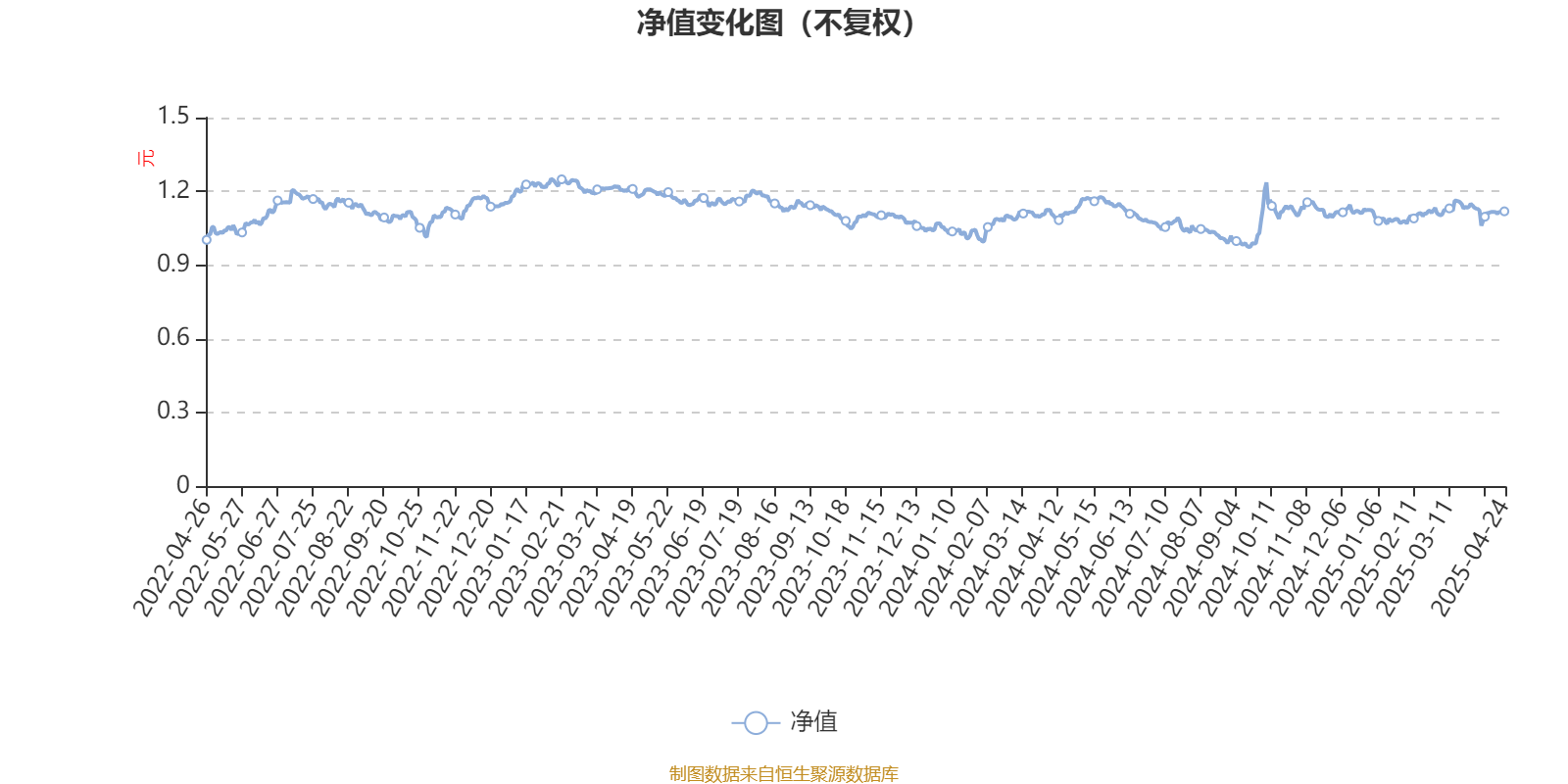
Core Viewpoint - The AI Fund He Xu Zhi Yuan Consumer Theme Stock Initiation A (007287) reported a profit of 19,900 yuan in Q1 2025, with a net asset value growth rate of 1.47% during the period [3][16]. Fund Performance - As of April 24, the fund's unit net value was 1.119 yuan, with a three-month net value growth rate of 3.74%, ranking 31 out of 46 comparable funds [4][3]. - Over the past year, the fund's net value growth rate was 0.18%, ranking 20 out of 46, while the three-year growth rate was 7.59%, ranking 6 out of 43 [4][3]. Fund Management Strategy - The fund manager, Yang Zhiyong, indicated a strategy focused on aggressive investment in the consumer sector, while also participating in industrial machinery and integrated circuits [3]. - The fund's average stock position over the past three years was 66.86%, compared to the industry average of 87.29% [15]. Risk Metrics - The fund's Sharpe ratio over the past three years was 0.4152, ranking 7 out of 42 comparable funds [10]. - The maximum drawdown over the past three years was 22.19%, with the largest single-quarter drawdown occurring in Q1 2022 at 24.08% [12]. Fund Holdings - As of Q1 2025, the top ten holdings of the fund included BYD, Luzhou Laojiao, Shanxi Fenjiu, Wens Foodstuff Group, Seres, Midea Group, China Duty Free Group, Wuliangye, Sanhua Intelligent Control, and Kweichow Moutai [19].