多模态能力

Search documents
未知机构:国金计算机具身智能机械多模态能力跃升OptimusV3发布将近人形-20260121
未知机构· 2026-01-21 02:20
Summary of Key Points from Conference Call Records Industry and Company Involved - The discussion primarily revolves around the robotics industry, specifically focusing on Tesla's humanoid robot, Optimus V3, and its implications for the market and related companies [1][3]. Core Insights and Arguments - **Optimus V3 Development**: Elon Musk emphasized that Optimus is his most invested project, claiming it will be one of humanity's greatest products. The third version of the robot has been finalized, showcasing three core advantages: human-level hand dexterity, an AI brain, and large-scale production capabilities [1]. - **Hand Dexterity**: The robot's hand mimics the human hand's 27-28 degrees of freedom, enabling it to perform complex tasks such as swinging a bat, threading a needle, and playing the piano. This level of dexterity is considered more challenging to achieve than the production of the Model Y and the Gigafactory, second only to the Starship project [1]. - **Screen Understanding Capability**: The Gemini 3.0 model scored 72.7% in the ScreenShot-Pro evaluation, significantly outperforming competitors like Claude Sonnet 4.5 and GPT 5.1. This capability is crucial for the robot's ability to recognize and interact with real-world objects and complex operational interfaces [2]. - **Production Plans**: Musk announced plans to establish a production line in Fremont, California, with an annual capacity of 1 million units by 2026, followed by a second line in Texas with a capacity of 10 million units by 2027. This expansion is expected to open up the industry space tenfold [3]. - **Investment Recommendations**: Suggested companies for investment include: - Slin Smart Drive (high-value components like harmonic reducers and integrated bearings) - Fosa Technology (Peek material alternatives) - Xinquan Co. (rotary actuators) - Kosen Technology (structural components) - Sanhua Intelligent Control, Top Group, Hengli Hydraulic, Pan-Asia Micro透 (electronic skin and high-speed cables), Zhejiang Rongtai, Obsidian Light, Lingyi Technology, New Yichang, Lens Technology, Hikvision, and Dahua Technology [3]. Other Important but Potentially Overlooked Content - **Risks**: The industry faces several risks, including intensified competition, potential delays in technological advancements, and cyclical fluctuations specific to certain sectors [4].

中国AI模型四巨头“激辩”AGI:差距未缩小 新突破口已在路上
Zheng Quan Ri Bao Wang· 2026-01-12 07:28
Core Insights - The AGI-Next Summit highlighted China's competitive edge in AGI development, showcasing advancements in large model capabilities, a thriving open-source ecosystem, and significant capital inflows into AI companies [1][2] - The summit addressed the core challenges of AGI, focusing on the next paradigm shift and the future direction of large models, emphasizing the need for China to establish its position in this evolving landscape [1][2] Technological Advancements - The summit participants discussed the importance of achieving multi-modal capabilities, where models can integrate various sensory inputs like vision and sound to create a unified perception [2] - A significant challenge identified was the development of memory structures that allow for long-term retention and reflection, which is crucial for advancing self-awareness in AI models [2][3] AI Agent Development - AI Agents were identified as a key area for future economic value creation, with expectations that 2026 could be pivotal for their commercialization [4] - The concept of AI Agents extends beyond models, aiming for systems that can autonomously define goals and execute tasks, addressing complex user needs [4] Market Dynamics - The successful commercialization of AI Agents hinges on three critical factors: value, cost, and speed, which must be balanced to transition from concept to scalable business solutions [4] - The Chinese AI industry is seen as having significant opportunities driven by innovative and risk-taking young talent, alongside a continuously improving business environment [5]
诺德基金周建胜:循AI主线寻找成长确定性
Xin Lang Cai Jing· 2026-01-11 19:16
Group 1 - The A-share market is expected to experience a structural market trend led by industrial trends in 2025, with sectors such as humanoid robots, new consumption, innovative pharmaceuticals, artificial intelligence, and commercial aerospace becoming active [1] - The AI industry is anticipated to remain a core narrative in the market for 2026, according to Nord Fund's manager Zhou Jiansheng [1][3] Group 2 - Zhou emphasizes the importance of tracking industrial trends and optimizing product management, while maintaining a global perspective on the competitive advantages and growth potential of Chinese companies [2] - In 2026, the focus will shift towards exploring structural opportunities within the domestic industrial chain, rather than heavily investing in overseas supply chains [2] - The investment strategy will prioritize companies with sustainable growth, particularly those with global competitiveness and the ability to create social value, while avoiding speculative targets lacking substantial support [2] Group 3 - The AI industry is expected to continue as a main investment theme, with advancements in AI large models overcoming previous technical bottlenecks [3] - Innovations in AI will focus on computational deployment and algorithm optimization, with a shift towards multi-modal input and output capabilities anticipated in 2026 [3] - AI infrastructure investments are characterized by long-term planning, requiring patience for development and innovation [3] Group 4 - Zhou holds an optimistic view on the future of AI applications, noting that while progress has been made, it still lags behind market expectations, leading to discussions of a "bubble" [4] - The emergence of AI-native application companies like OpenAI and Anthropic indicates strong commercial potential for AI, with significant revenue growth marking the beginning of a new era for AI applications [4] - The high cost of computational resources remains a challenge, but improvements in algorithm efficiency and resource accumulation are expected to alleviate this issue over time [4]
耳机上长出摄像头,但它不是给人用的
3 6 Ke· 2025-12-30 00:02
Core Insights - Lightwear AI All-Sensory Smart Set is a unique product that combines smart headphones and a smartwatch, featuring 2 million pixel cameras on each earbud and an independent operational capability without a smartphone [1][5][19] - The design challenges conventional aesthetics and privacy concerns, but aligns with a broader industry trend towards multi-modal AI products [3][4][7] - The product aims to enhance AI's understanding of the world by integrating visual capabilities, which is essential for the next generation of AI interactions [6][20] Company Overview - Founded in October 2024, Lightwear Technology is led by Dong Hongguang, a former core member of Xiaomi's founding team, with a strong background in software and hardware development [5] - The company has rapidly raised 130 million RMB in funding within three months, achieving a post-investment valuation of over 500 million RMB, with notable investors from the audio and high-tech manufacturing sectors [5][24] Product Features - Each earbud weighs 11g and includes a camera designed for AI context understanding rather than traditional photography, utilizing a "burn after reading" image processing mechanism to protect user privacy [11][19][20] - The device supports various high-frequency use cases such as restaurant recommendations, travel arrangements, and shopping assistance, all without needing to interact with a smartphone [16][18][24] Market Positioning - The product is positioned in a competitive landscape where AI devices with cameras are becoming a consensus direction among major tech companies [7][30] - Lightwear's approach is seen as a response to the limitations of existing AI headphones, which are primarily audio-focused and have reached market saturation [13][29] Future Outlook - The design and functionality of Lightwear are viewed as a transitional phase in the evolution of AI hardware, with expectations for further refinement and acceptance in the market [26][29] - The integration of AI capabilities into wearable technology is anticipated to reshape human-computer interaction, leading to more innovative product forms in the future [30]


火了整整一年 AI更“懂人”了!
Sou Hu Cai Jing· 2025-12-27 09:43
Core Insights - The AI industry is experiencing significant advancements, marked by the release of the DeepSeek AI model, which has sparked a wave of revaluation in the tech sector [2] - AI applications are evolving from simple question-answering to executing complex multi-modal tasks, indicating a shift towards more sophisticated AI capabilities [3][4] - The competition in the AI sector is increasingly focused on multi-modal capabilities, where models must understand and generate various types of information [4] Group 1: AI Advancements - The launch of DeepSeek's AI model R1 on January 20, 2025, has ignited a revaluation of tech stocks in the A-share and Hong Kong markets, leading to a surge in AI-related companies [2] - AI applications are now capable of processing multi-modal information, moving from mere intent understanding to executing services based on real-world data [2][3] - The introduction of various AI applications, such as Sora 2 and the Ant Group's AI health app, showcases the growing sophistication and understanding of AI in real-world scenarios [4][5] Group 2: Market Dynamics - The AI industry is transitioning from a phase reliant on capital investment to one that demands self-sustainability and rigorous scrutiny, as evidenced by companies like Zhiyu and MiniMax seeking IPOs [7] - The investment landscape for AI has been robust, with significant funding rounds and a total of 186 financing events in the AIGC sector from July to November 2025, amounting to 33.67 billion [7] - Major tech companies are committing substantial resources to AI development, with Alibaba planning to invest at least 380 billion RMB over three years for cloud computing and AI infrastructure [7] Group 3: Application Trends - AI applications are becoming more specialized, with a notable increase in vertical applications in healthcare, as seen with the Ant Group's AQ brand upgrade to Ant Aifu [5][6] - The competitive edge in AI applications is shifting from model parameters to a deeper understanding of industry needs and the ability to create closed-loop solutions [6] - The current landscape features a mix of general-purpose AI and specialized applications, with a notable presence of healthcare-focused AI apps among the top user engagement rankings [5][6] Group 4: Future Outlook - The AI industry is at a critical juncture, transitioning from a conceptual phase to a growth phase, with a need to enhance monetization strategies for AI applications [9] - Predictions for 2026 indicate a focus on lightweight models and deeper integration of AI with the real economy, alongside the establishment of regulatory frameworks to guide industry development [9][10] - The emergence of embodied intelligence and AI smartphones is expected to drive significant growth, with a competitive focus on application ecosystems among various AI platforms [10]

2026全球AI竞速!科技主线关键仍看基座模型持续迭代及AI应用的渐进落地!
Sou Hu Cai Jing· 2025-12-27 06:43
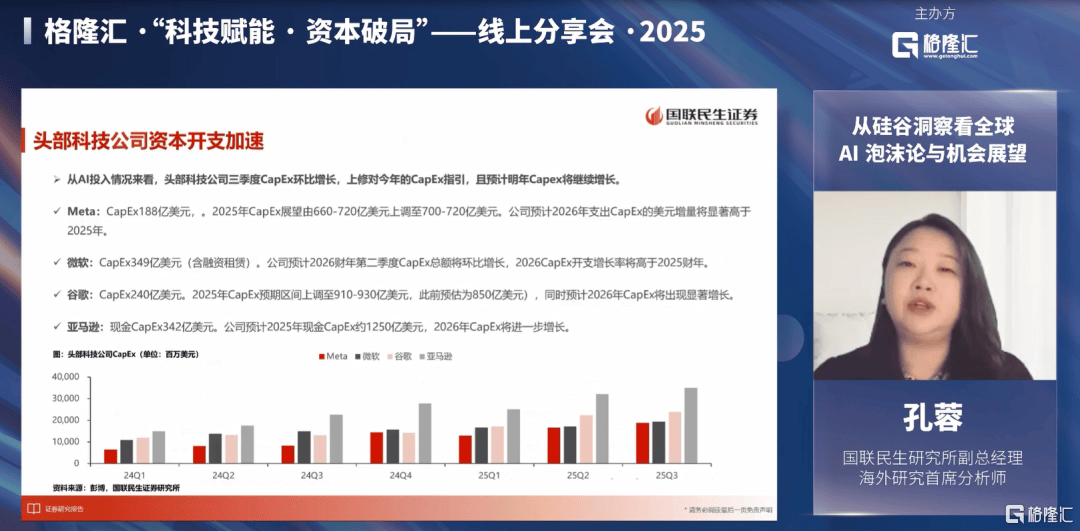
Core Insights - The discussion at the "Technology Empowerment · Capital Breakthrough" event highlighted the ongoing trends in global AI development, key technological advancements, and market opportunities, with a positive outlook for AI beyond 2026 despite current market skepticism regarding potential bubbles and sustainability of capital expenditures [1][3]. Group 1: AI Market Dynamics - The AI competition is expected to intensify in 2024, with significant discussions around whether there is a bubble in AI investments and the sustainability of capital expenditures for 2025-2027 [1][6]. - Major companies like Google, Meta, Microsoft, and xAI are anticipated to accelerate the release of new models, leading to heightened competition in the industry [6][21]. Group 2: Key Technological Advancements - The enhancement of multimodal capabilities is crucial for AI's evolution, impacting content creation across various dimensions and transforming advertising and e-commerce efficiency [8][10]. - Breakthroughs in memory and personalization capabilities will enable AI to transition from general tools to personalized assistants, increasing user engagement and driving commercial viability [15][16]. Group 3: Investment Opportunities in China - China's AI ecosystem is recognized for its strong competitive edge, with domestic models gaining international acclaim and major tech companies committing to sustained AI investments [29][30]. - The valuation of Chinese AI companies is currently more reasonable compared to their U.S. counterparts, providing a favorable investment landscape [31][32].


2026全球AI竞速!科技主线关键仍看基座模型持续迭代及AI应用的渐进落地!
格隆汇APP· 2025-12-27 06:10
Core Viewpoint - The article discusses the optimistic outlook for AI development beyond 2026, despite current market concerns about potential bubbles and sustainability of capital expenditures [2][6]. Group 1: AI Market Trends - There is ongoing debate in the market regarding whether AI is in a bubble and the sustainability of capital expenditures for 2025-2027 [3][4]. - Major tech companies are expected to shift focus from "infrastructure" to "application realization," with key observations on revenue growth from Google Cloud Platform (GCP), Microsoft Azure, and Amazon AWS [11]. - The release pace of large models is anticipated to accelerate, with major players like OpenAI, xAI, Meta, Microsoft, and Google continuing to launch new models, intensifying industry competition [12][28]. Group 2: Key Players and Innovations - Google has demonstrated strong capabilities with its self-developed technology and resources, maintaining a competitive edge [8]. - Meta is expected to regain market confidence by 2026 after restructuring and integrating top AI talent, aiming to launch competitive models [8]. - Microsoft is focusing on its own models while maintaining collaboration with OpenAI, looking for synergies between its large models and ecosystem [9]. - xAI, despite being a latecomer, is rapidly iterating its models and is considered a significant variable in the market [10]. Group 3: Model Capabilities and Applications - The enhancement of multi-modal capabilities is crucial for transforming content production in advertising and e-commerce, as well as improving user experiences with hardware like AR/VR devices [15][18]. - Breakthroughs in memory and personalization capabilities will allow AI to evolve from general tools to personalized assistants, increasing user engagement and driving token consumption [23][24]. - The overall improvement in model capabilities is fundamental for the commercialization of AI, leading to clearer paths for investment returns [25][26]. Group 4: China's AI Ecosystem - China's AI ecosystem is recognized for its strong competitive advantages, with domestic models gaining international acknowledgment [40]. - Major Chinese tech firms like Alibaba and Tencent are committed to ongoing investments in AI, indicating a long-term strategy [40]. - The country boasts the largest pool of engineers and a rapid product iteration culture, which is expected to replicate the "application innovation" seen in the mobile internet era, creating numerous investment opportunities [40][41]. - Current valuations of Chinese AI companies are considered reasonable compared to their U.S. counterparts, providing a favorable investment margin [41].



金融智能体迭代升级,超三分之一使用慢思考技术
Di Yi Cai Jing· 2025-12-21 07:21
Group 1 - The core viewpoint of the articles highlights the transformation of intelligent finance from "tool application" to "system reconstruction," driven by advancements in artificial intelligence technology and its integration into the financial industry [1][2][4] - The "slow thinking" technology is identified as a key innovation, enhancing the reasoning quality of large language models by extending inference processes, which reduces error accumulation and improves output accuracy [1][2] - The report indicates that approximately 50% of the 82 cases surveyed involve intelligent agent paradigms, over 33% report improvements in multimodal capabilities, 32% utilize slow thinking technology, and 23% mention significant reductions in reasoning costs [1] Group 2 - A series of technological trends are leading to profound changes in business operations, including AI-driven investment research, proactive customer service, and the restructuring of organizational operations through systematic management of knowledge assets [2] - The financial data governance system is under unprecedented pressure due to the surge in AI-generated data, which has increased by 470% globally since three years ago [2][3] - Challenges in data governance include difficulties in technical adaptation, defining ownership, ensuring data security and privacy, addressing ethical issues, and managing high governance costs [3] Group 3 - The emergence of Data Governance Agents (DGA) is proposed as a solution to the limitations of manual governance, evolving into Multi-Agent Systems (MAS) for more efficient data governance through distributed collaboration [4]
刚刚,Gemini 3再次大更新,全球免费享Pro级智商,奥特曼又要失眠了
36氪· 2025-12-18 09:26
Core Viewpoint - Google has launched Gemini 3 Flash, a new AI model that is faster and cheaper than its predecessors, aiming to compete directly with OpenAI and Anthropic while maintaining high performance levels [5][10][19]. Group 1: Product Features and Performance - Gemini 3 Flash is designed for speed, achieving performance that is three times faster than Gemini 2.5 Pro, with costs reduced to a quarter of the 3 Pro model [5][19]. - The model retains Pro-level reasoning capabilities while significantly lowering latency and costs, with input prices at $0.50 per million tokens and output prices at $3.00 per million tokens [19][43]. - Benchmark tests show that Gemini 3 Flash scored 90.4% on the GPQA Diamond test and 81.2% on the MMMU Pro test, indicating its advanced reasoning abilities [15][16]. Group 2: Market Positioning and Strategy - The launch of Gemini 3 Flash is strategically timed to prevent competitors from gaining ground, showcasing Google's aggressive approach in the AI market [10][11]. - Google is embedding Gemini 3 Flash into its suite of products, including search and various AI applications, making it accessible to a wide user base [41][47]. - The pricing strategy is aimed at undercutting competitors, making it attractive for developers and businesses to adopt [43][50]. Group 3: User Experience and Application - Gemini 3 Flash is designed for real-time applications, capable of processing visual and audio inputs efficiently, which is beneficial for interactive scenarios [24][29]. - The model's adaptive reasoning allows it to adjust its "thinking" time based on task complexity, enhancing its utility in various applications [21][23]. - Despite its speed, some users have noted that the quality of output may not match that of the higher-end Pro models, indicating a trade-off between speed and detail [30][31][46].

全球竞逐AI时代:中国应用生态爆发与全球格局演变
Sou Hu Cai Jing· 2025-12-13 08:37
Group 1 - The user base of generative AI in China reached 515 million by 2025, with a penetration rate of 36.5%, indicating that over one-third of internet users are utilizing this technology. The user base grew by 266 million in just six months, representing a 106.6% increase compared to the end of 2024 [1] - By the third quarter of 2025, the number of AI companies in China exceeded 5,300, accounting for 15% of the global total. The AI industry in China surpassed 900 billion yuan, with a year-on-year growth of 24% [3] - The number of AI applications reached 657, marking a 61.8% increase year-on-year, while the mobile user base exceeded 700 million [3] Group 2 - The Chinese government has implemented policies to promote AI development, including the "Artificial Intelligence +" action plan, which aims for deep integration of AI with six key sectors by 2027 [3] - The dual-track development model of "super applications + vertical scenarios" has emerged in China, exemplified by Tencent's Yuanbao, which attracted 280 million users in just 27 days [4] Group 3 - The global AI application market shows distinct regional characteristics, with the U.S. holding a 45% share of global revenue but a low paid conversion rate of only 8% [6] - In the global AI landscape, OpenAI's ChatGPT remains the leader, while Chinese applications like Alibaba's Quark and ByteDance's Doubao are gaining prominence, with Doubao ranking fourth in mobile globally [7] Group 4 - Different regions exhibit unique AI development paths, with China experiencing explosive growth and a 101% increase in mobile users, while the EU focuses on vertical fields but faces compliance cost challenges [9] - The comparison of AI development in the U.S., China, and Europe highlights differences in focus areas, market characteristics, and regulatory environments [10] Group 5 - As AI applications expand, challenges related to energy consumption, data quality, and ethical concerns are becoming more pronounced, with AI consuming 23% of global data center electricity [11] - The environmental impact of AI training, such as the carbon emissions from training models like GPT-4, raises sustainability discussions [11] Group 6 - The future of AI applications is expected to diversify, with a coexistence of "super applications + vertical leaders" being the desired ecosystem [12] - The rapid narrowing of the gap in multimodal capabilities between China and the U.S. indicates a competitive landscape, with significant advancements in AI applications across various sectors [13]