
宏观政策组合拳

Search documents
蝶变、拉满、C位……划重点!解锁4月经济数据顶压增长背后政策“组合拳”密码
Yang Shi Wang· 2025-05-20 01:58
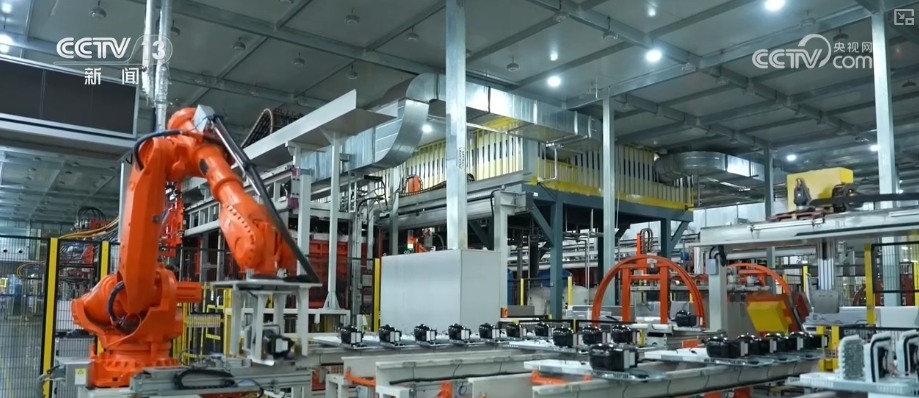
Group 1 - Industrial production has seen rapid growth, with the added value of equipment manufacturing and high-tech manufacturing increasing by around 10%. The production of 3D printing equipment and industrial robots has surged by over 50%. This growth is attributed to macro policy measures that have accelerated industrial upgrades, leading to enhanced production efficiency and quality [1][3] Group 2 - Market sales are on the rise, driven by the effectiveness of the "old-for-new" consumption policy. Retail sales in categories such as home appliances, cultural and office supplies, and furniture are experiencing high growth. Various local departments are implementing special actions to boost consumption, enriching consumption scenarios and continuously releasing consumption potential [4][6] Group 3 - Foreign trade has shown resilience, with total goods import and export volume increasing by 2.4% year-on-year from January to April 2025, accelerating by 1.1 percentage points compared to the first quarter. This growth is notable against the backdrop of rising unilateralism and protectionism, supported by China's strong manufacturing capabilities and the proactive response of foreign trade enterprises through market diversification strategies [8][10] Group 4 - Investment is steadily expanding, with high-tech industry investments leading the way. Investments in information services and computer and office equipment manufacturing are in a high growth phase, indicating optimistic market expectations and strong demand for industrial upgrades, reflecting the trend of China's economic transition towards innovation-driven growth [10][12]

经济运行开局良好,宏观政策不断加力--宏观经济信用观察季度报(2025年一季度)
Lian He Zi Xin· 2025-05-19 04:40
Economic Performance - In Q1 2025, China's GDP reached 31.8758 trillion yuan, with a year-on-year growth of 5.4% and a quarter-on-quarter increase of 1.2%[3] - The industrial added value grew by 6.5% year-on-year, while the service sector's added value increased by 5.3%[4] - Fixed asset investment rose by 4.2% year-on-year, with infrastructure investment growing by 5.8%[16][20] Trade and Exports - Total goods trade in Q1 2025 was 10.3 trillion yuan, a year-on-year increase of 1.3%, with exports at 6.13 trillion yuan, up 6.9%[28] - The export of mechanical and electrical products reached 5.29 trillion yuan, growing by 7.7%[28] - The share of domestic brand exports increased to 22.8%, reflecting a 10.2% growth in this segment[28] Price Stability - The Consumer Price Index (CPI) decreased by 0.1% year-on-year, with food prices dropping by 1.5%[31] - The Producer Price Index (PPI) fell by 2.3% year-on-year, indicating a slowdown in the decline compared to previous quarters[33] Employment and Fiscal Policy - The urban survey unemployment rate averaged 5.3% in Q1 2025, showing stability in the job market[38] - National general public budget revenue was 6.0 trillion yuan, down 1.1% year-on-year, while expenditures increased by 4.2% to 7.3 trillion yuan[40]
国家统计局:4月份国民经济应变克难稳定运行 就业形势总体稳定
Sou Hu Cai Jing· 2025-05-19 03:40
Economic Performance Overview - In April, external shocks increased, but China's economic foundation remains stable, with strong advantages, resilience, and potential, supported by coordinated macro policies [1][4] - The overall economic performance in April reflects a complex international environment, making stable economic operation more challenging [1] Industrial Growth - Industrial production showed rapid growth, with the industrial added value of large-scale enterprises increasing by 6.1% year-on-year in April, marking one of the fastest monthly growth rates since last year [1] - The equipment manufacturing sector experienced significant growth, with an added value increase of 9.8% year-on-year, contributing 55.9% to the industrial growth [1] Service Sector Performance - The service sector maintained stable growth, with the service production index rising by 6% year-on-year in April, the second-highest monthly growth rate this year [1] - Digital transformation and increased travel boosted information and business services, with the production indices for information transmission software and IT services, and leasing and business services growing by 10.4% and 8.9% respectively [1] Domestic Demand - Domestic demand expanded steadily, with retail sales of consumer goods increasing by 5.1% year-on-year in April, supported by the effects of the trade-in policy [2] - Fixed asset investment grew by 4% year-on-year from January to April, with equipment and tool purchases increasing by 18.2%, contributing 64.5% to total investment growth [2] Foreign Trade Resilience - Despite a rapidly changing international environment, China's foreign trade demonstrated resilience, with total goods imports and exports increasing by 2.4% year-on-year from January to April [2] - Exports of mechanical and electrical products grew by 9.5% in the first four months, highlighting the effectiveness of diversifying trade partnerships [2] Employment Stability - The employment situation remained generally stable, with the urban unemployment rate at 5.1% in April, a decrease of 0.1 percentage points from the previous month [3] - Policies supporting employment and entrepreneurship for key groups contributed to this stability [3] High-tech Industry Growth - High-tech industries experienced rapid growth, with the added value of high-tech manufacturing increasing by 10% year-on-year in April [3] - Significant growth was observed in aerospace equipment and integrated circuit manufacturing, with increases of 21.4% and 21.3% respectively [3] Future Outlook - The government aims to implement more proactive macro policies to stabilize employment, businesses, and market expectations, while promoting high-quality development [4] - The focus will be on strengthening the domestic economic cycle and ensuring sustainable and healthy economic growth [4]
4月期货市场交易情况出炉,成交量、成交额同比涨超20%
Guo Ji Jin Rong Bao· 2025-05-13 09:44
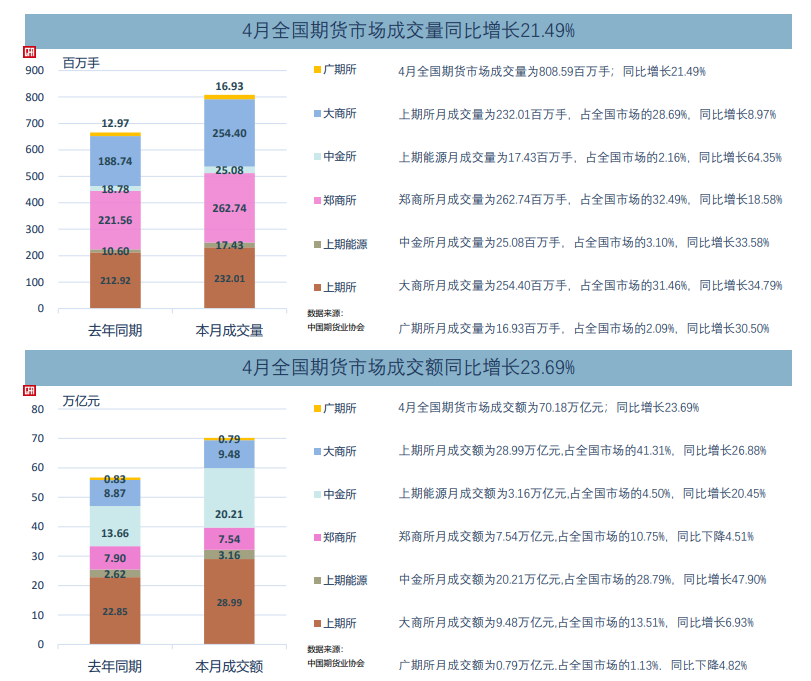
Group 1 - The core viewpoint of the article highlights the significant growth in the national futures market in April 2025, with trading volume and value increasing year-on-year [1][2] - In April 2025, the national futures market recorded a trading volume of 809 million contracts and a trading value of 70.18 trillion yuan, representing year-on-year increases of 21.49% and 23.69% respectively [1] - From January to April 2025, the cumulative trading volume reached 2.658 billion contracts and the cumulative trading value was 232.2 trillion yuan, showing year-on-year growth of 22.19% and 28.36% [1] Group 2 - As of the end of April 2025, the national futures market's open interest was 41.9216 million contracts, reflecting a month-on-month decline of 20.26% but a year-on-year increase of 18.98% [2] - The trading activity in commodity futures remained robust, with significant growth in precious metals trading volumes due to the impact of U.S. tariff policies [6] - The oil and chemical sectors experienced a rebound in trading due to significant price fluctuations, while the textile and chemical fiber industry showed signs of recovery [6] Group 3 - Financial futures experienced a "price drop with increased volume" scenario, with all four stock index futures prices declining in April [7] - The declines in stock index futures were influenced by multiple factors, including a drop in the global manufacturing index and the impact of U.S. tariff policies on global trade [7][8] - Looking ahead, the futures and options market in China is expected to maintain a good growth trend in trading scale, with open interest likely to recover further in May [8]
人民日报社论:坚定信心 奋发有为 创新创造 ——写在“五一”国际劳动节
Xin Hua She· 2025-04-30 13:54
Group 1 - The core message emphasizes the importance of labor and the contributions of workers in achieving economic stability and growth, particularly in the context of China's ongoing modernization efforts [1][2][4] - The Chinese economy showed a positive start in 2023, with a GDP growth of 5.4% year-on-year in the first quarter, indicating resilience amid global challenges [1] - The government is focused on high-quality development and aims to leverage the strengths of the workforce to navigate complex domestic and international environments [2][3] Group 2 - The emphasis on transforming the "demographic dividend" into a "talent dividend" highlights the need for a skilled workforce to support high-quality development and maintain competitive advantages in the global market [3] - The call for enhancing labor rights and welfare, including reforms to wage determination and social security systems for various employment types, reflects a commitment to improving the livelihoods of workers [4] - The narrative stresses the importance of collective effort and individual contributions in driving forward the goals of Chinese-style modernization, reinforcing the idea that every worker plays a crucial role in this journey [4][5]
一季度制造业利润增长7.6%,释放什么信号
Jin Rong Shi Bao· 2025-04-28 14:32
Core Insights - In the first quarter of this year, industrial enterprises' profits turned from a decline of 3.3% year-on-year to a growth of 0.8%, marking a significant recovery from the continuous decline since the third quarter of the previous year [1] - The revenue of industrial enterprises also saw an increase, with a year-on-year growth of 3.4% in the first quarter, accelerating by 0.6 percentage points compared to the first two months [1] - The improvement in profits and revenues is attributed to enhanced macroeconomic policies and effective regulation, leading to a stabilization in business conditions and an increase in profitability [1] Industry Performance - Nearly 60% of industries reported profit growth in the first quarter, with 24 out of 41 major industrial sectors showing year-on-year profit increases [2] - Manufacturing sector profits grew by 7.6% year-on-year, accelerating by 2.8 percentage points, significantly supporting the overall industrial profit recovery [2] - The main drivers of profit growth in industrial enterprises were the equipment manufacturing and high-tech manufacturing sectors, benefiting from policies that promote technological and industrial innovation [2][3] Specific Sector Insights - Within the manufacturing sector, equipment manufacturing profits increased by 6.4% year-on-year, accounting for 32.0% of total industrial profits, while high-tech manufacturing profits turned from a decline of 5.8% to a growth of 3.5% [3] - The "Two New" policies have positively impacted profits in specialized and general equipment sectors, with profits growing by 14.2% and 9.5% respectively, significantly above the overall industrial average [3] Challenges and Outlook - Despite the positive trends, the industrial sector faces challenges such as increased turnover days for finished products and a decline in profit margins, with the operating profit margin dropping to 4.7% [4] - The external environment remains complex and uncertain, but the effects of macroeconomic policies are becoming evident, with expectations for continued recovery in industrial performance supported by government bond issuance and a favorable manufacturing PMI [4]
国家统计局工业司统计师于卫宁解读2025年1—3月份工业企业利润数据
Guo Jia Tong Ji Ju· 2025-04-27 01:40
Core Insights - In the first quarter of 2025, industrial enterprises in China experienced a turnaround in profits, with a 0.8% year-on-year increase compared to a 3.3% decline in the previous year, marking a significant recovery from the continuous profit decline since the third quarter of the previous year [1] - The revenue of industrial enterprises also improved, with a 3.4% year-on-year increase in the first quarter, accelerating by 0.6 percentage points compared to the first two months of the year [1] Group 1: Profit Growth and Industry Performance - Nearly 60% of industries saw profit growth in the first quarter, with 24 out of 41 major industrial categories reporting year-on-year profit increases, and 58.5% of industries either improving or narrowing their profit decline [2] - The manufacturing sector showed notable improvement, with a profit growth of 7.6% in the first quarter, accelerating by 2.8 percentage points [2] - The equipment manufacturing sector was a key driver of profit growth, with a 6.4% year-on-year increase in profits, accounting for 32.0% of total profits among large industrial enterprises [2] Group 2: High-Tech Manufacturing and Policy Impact - High-tech manufacturing led the way in high-quality development, with profits turning from a 5.8% decline in the first two months to a 3.5% increase in the first quarter, outpacing the overall industrial average by 2.7 percentage points [3] - The aerospace industry saw a profit increase of 23.9%, while sectors like smart consumer devices and medical equipment also reported significant profit growth [3] - The "Two New" policies had a pronounced effect on industry profits, with specialized and general equipment sectors seeing profit increases of 14.2% and 9.5%, respectively, significantly above the overall industrial average [4]
杨宜勇:一季度经济稳中有进,提振消费需从五方面精准发力
Zhong Guo Jing Ying Bao· 2025-04-22 22:04
Core Viewpoint - China's economy achieved a strong start in Q1 2025, with notable recovery in consumption driven by macroeconomic policies, particularly the "trade-in" policy [1][3] Economic Performance - In Q1 2025, GDP grew by 5.4% year-on-year, accelerating by 0.4 percentage points compared to the full year of 2024 [1] - Retail sales of consumer goods increased by 4.6% year-on-year, up 1.1 percentage points from the previous year [1][3] Policy Impact - The "trade-in" policy significantly boosted consumption, with retail sales in categories such as communication equipment, cultural office supplies, home appliances, and furniture growing by 26.9%, 21.7%, 19.3%, and 18.1% respectively [3] - The policy not only stimulated sales of durable goods but also improved consumer confidence, encouraging actual purchasing behavior [3][4] Future Expectations - With the expansion of the "trade-in" policy, retail sales growth is expected to maintain a rate of 5% to 6% in the second quarter and beyond [1][3][4] Challenges in Demand - There are concerns about insufficient growth in effective demand, primarily due to low consumer spending capacity and willingness [5][6] - The ongoing adjustment in the real estate market has negatively impacted consumer confidence and spending [5][6] Recommendations for Policy Action - To enhance consumption growth, policies should focus on five key areas: 1. Expanding the scope of consumption subsidies, particularly for durable goods and emerging categories like smart devices [7] 2. Promoting income growth among residents to boost spending capacity [7][8] 3. Innovating consumption scenarios to create new growth points [8] 4. Increasing financial support to lower financing costs for businesses and consumers [8][9] 5. Stabilizing the real estate market to restore consumer confidence [9] Conclusion - A comprehensive approach involving these policy measures is expected to unleash potential domestic demand and support sustained economic growth [10]