
新动能产业

Search documents
GDP同比增长4.1%,广东前三季度经济数据出炉
Nan Fang Du Shi Bao· 2025-10-24 10:16
Economic Overview - Guangdong's GDP for the first three quarters reached 10,517.698 billion yuan, with a year-on-year growth of 4.1% at constant prices [1] - The primary industry added value was 383.85 billion yuan, growing by 4.5%; the secondary industry added value was 3,927.075 billion yuan, growing by 2.7%; and the tertiary industry added value was 6,206.773 billion yuan, growing by 4.9% [1] Agriculture - The total output value of agriculture, forestry, animal husbandry, and fishery increased by 4.9%, with early rice production up by 1.0% [2] - Vegetable and edible fungus production rose by 3.1%, while garden fruit production increased by 6.3% [2] - Livestock production accelerated, with pig slaughter and pork production increasing by 4.6% and 4.7%, respectively [2] Industry - Industrial output value above designated size grew by 3.5%, an increase of 1.3 percentage points compared to January-August [3] - Key industries showed stability, with computer, communication, and other electronic equipment manufacturing growing by 7.5% [3] - New momentum industries, such as advanced manufacturing and high-tech manufacturing, saw value-added growth of 5.4% and 6.4%, respectively [3] High-tech and New Energy Products - Production of industrial robots, service robots, civilian drones, and 3D printing equipment increased by 33.7%, 15.2%, 44.8%, and 40.3%, respectively [4] - New energy vehicles and lithium-ion batteries for energy storage saw production growth of 24.6% and 37.6% [4] Services - The value added of the service industry grew by 4.9%, accelerating by 0.3 percentage points compared to the first half of the year [5] - The financial sector and transportation, storage, and postal services increased by 9.8% and 4.3%, respectively [5] - Revenue from the information transmission, software, and IT services sector grew by 9.5% [5] Investment - Fixed asset investment decreased by 14.1%, but equipment and tool purchases increased by 1.7% [6] - Infrastructure investments in railway, water, and air transport grew by 1.8%, 31.8%, and 28.9%, respectively [6] - Investment in research and development, internet services, and software grew by 12.7%, 81.2%, and 23.5% [6] Market Sales - Retail sales of consumer goods increased by 2.8%, with urban retail sales growing by 3.0% and rural retail sales by 0.9% [7] - Online retail through public networks grew by 16.2%, outpacing overall retail growth by 13.3 percentage points [8] Consumer Prices - The Consumer Price Index (CPI) decreased by 0.3%, with a narrowing decline compared to the first half of the year [9] - The Producer Price Index (PPI) fell by 1.5%, with a consistent decline in September [9] Income - Per capita disposable income reached 42,842 yuan, with a nominal growth of 4.4% [10] - Rural residents' income growth outpaced urban residents, with rural disposable income increasing by 5.5% [10]

广东刚刚公布:超10万亿元
21世纪经济报道· 2025-10-24 10:06
Core Viewpoint - Guangdong's economy showed stable growth in the first three quarters of 2023, with a GDP of 10,517.698 billion yuan, reflecting a year-on-year increase of 4.1% [1] Group 1: Agricultural Production - The total output value of agriculture, forestry, animal husbandry, and fishery in Guangdong increased by 4.9% year-on-year, with early rice production rising by 1.0% [2] - Vegetable and edible fungus production grew by 3.1%, while garden fruit production increased by 6.3% [2] - Livestock production accelerated, with pig slaughter and pork production increasing by 4.6% and 4.7%, respectively [2] Group 2: Industrial Production - The industrial added value above designated size grew by 3.5% year-on-year, an increase of 1.3 percentage points compared to January-August [3] - Key industries such as computer, communication, and other electronic equipment manufacturing saw a 7.5% increase in added value [3] - New momentum industries, including advanced manufacturing and high-tech manufacturing, grew by 5.4% and 6.4%, respectively [3] Group 3: Service Industry - The added value of the service industry increased by 4.9% year-on-year, accelerating by 0.3 percentage points compared to the first half of the year [4] - The financial sector and transportation, storage, and postal services grew by 9.8% and 4.3%, respectively [4] - The revenue of the information transmission, software, and IT services sector increased by 9.5% [4] Group 4: Fixed Asset Investment - Fixed asset investment in Guangdong decreased by 14.1% year-on-year [5] - Equipment and tool purchases increased by 1.7%, supported by large-scale equipment renewal policies [5] - Infrastructure investments in railway, water, and air transport grew by 1.8%, 31.8%, and 28.9%, respectively [5] Group 5: Market Sales - The total retail sales of consumer goods increased by 2.8% year-on-year, with urban retail sales growing by 3.0% and rural retail sales by 0.9% [7] - Basic living and some upgraded consumption goods saw stable growth, with retail sales of grain, oil, and food increasing by 10.8% [7] - Online retail through public networks grew by 16.2%, outpacing overall retail growth by 13.3 percentage points [7] Group 6: Consumer Prices and Income - The consumer price index (CPI) decreased by 0.3% year-on-year, with a narrowing decline compared to the first half of the year [8] - The per capita disposable income in Guangdong reached 42,842 yuan, with a nominal growth of 4.4% [9] - Rural residents' income growth outpaced that of urban residents, with rural disposable income increasing by 5.5% [9]

创指再创新高,后市怎么看?
Sou Hu Cai Jing· 2025-09-25 12:07
Group 1 - The ChiNext Index continues to rise strongly, closing up 1.58%, indicating a bullish market trend that remains intact for long-term investment strategies [2] - Economic data shows a marginal weakening across production, investment, consumption, and export indicators in August compared to July, making it difficult for market styles to shift towards cyclical low-position sectors like consumption and real estate [2] - The monetary policy remains stable with no interest rate cuts, while August's CPI decreased by 0.4% year-on-year and PPI fell by 2.9%, indicating that inflation expectations have not yet translated to consumer spending [2] Group 2 - In a bull market with continuous inflow of incremental capital, the core contradiction determining sector investment success is the certainty of economic prosperity rather than current valuation levels [3] - The new momentum sectors, including AI, new energy, innovative pharmaceuticals, and military industry, are rapidly improving their global competitiveness, providing a foundation for sector rotation and expansion [3] - When certain technology sectors become overheated, capital tends to rotate within the technology sector or expand to other growth lines rather than shifting systematically away from technology [3] Group 3 - The ChiNext Index focuses on new productivity areas, with a strong emphasis on technological innovation, particularly in the new energy sector driven by technological breakthroughs and "anti-involution" [4] - The new technology breakthroughs, such as solid-state batteries, are opening a second growth curve for the industry, while the supply-demand dynamics in traditional new energy sectors are showing signs of improvement [4] - Tianhong ChiNext Index Quantitative Enhanced Fund aims for sustainable excess returns by closely aligning with the growth style and technological characteristics of the ChiNext Index, utilizing AI models for trading operations [4]

东莞前8月外贸破万亿,新动能投资保持近50%增长
2 1 Shi Ji Jing Ji Bao Dao· 2025-09-25 06:52
Economic Overview - Dongguan's economy showed stable growth in the first eight months of 2025, with industrial production and foreign trade maintaining a robust performance [1][3] - The total industrial added value for Dongguan increased by 4.8% year-on-year [1] Industrial Performance - The electronic information manufacturing sector saw a significant increase in added value, growing by 9.0% year-on-year [1] - The electrical machinery and equipment manufacturing sector also performed well, with a growth of 8.5% [1] - The chemical manufacturing industry experienced the highest growth rate at 11.6% [1] - Advanced manufacturing and high-tech manufacturing added value increased by 7.6% and 9.0% respectively [1] Foreign Trade - Dongguan's total foreign trade import and export value reached 10,256.1 billion yuan, marking a year-on-year increase of 14.6% [1][3] - Imports totaled 3,959.2 billion yuan, up 24.9% year-on-year, while exports reached 6,296.8 billion yuan, growing by 9.0% [3] - In August alone, foreign trade totalled a year-on-year growth of 8.5%, with imports increasing by 16.8% and exports by 4.3% [3] Investment Trends - Fixed asset investment in Dongguan decreased by 6.1% year-on-year, although the decline was less severe than in previous months [3] - Excluding real estate development, fixed asset investment grew by 14.6%, with advanced manufacturing investment surging by 45.8% and high-tech manufacturing investment by 54.3% [3] - Infrastructure investment rose by 7.2%, while real estate development investment saw a significant decline of 49.9% [3] Consumer Market - The total retail sales of consumer goods in Dongguan reached 2,838.35 billion yuan, reflecting a year-on-year growth of 2.5% [3] - The "old for new" policy positively impacted sales in categories such as communication equipment, furniture, and building materials, with respective growth rates of 71.7%, 71.4%, and 33.4% [3] - Online retail sales through public networks increased by 22.6% year-on-year [3]
外贸同比增长14.6%!东莞最新经济数据出炉
Nan Fang Du Shi Bao· 2025-09-25 03:44
Economic Overview - Dongguan's economy maintained overall stability in the first eight months of 2025, adhering to a work guideline focused on steady progress and high-quality development [2] Industrial Production - The industrial added value of enterprises above designated size increased by 4.8% year-on-year. Key industries showed rapid growth, with electronic information manufacturing up by 9.0%, electrical machinery and equipment manufacturing by 8.5%, and chemical manufacturing by 11.6% [3] - New momentum industries performed well, with advanced manufacturing and high-tech manufacturing added value growing by 7.6% and 9.0% respectively. High-tech product output saw significant increases, with integrated circuits up by 82.7%, servers by 62.7%, smartwatches by 42.4%, and electronic components by 11.3% [3] Foreign Trade - The total foreign trade import and export volume reached 1,025.61 billion yuan, a year-on-year increase of 14.6%. Imports were 395.92 billion yuan, up 24.9%, while exports were 629.68 billion yuan, up 9.0%. In August, the total foreign trade volume grew by 8.5% year-on-year, with imports increasing by 16.8% and exports by 4.3% [4] Consumer Market - The total retail sales of social consumer goods amounted to 283.835 billion yuan, reflecting a year-on-year growth of 2.5%. Dining revenue and commodity retail both increased by 2.5%. The effects of the old-for-new consumption policy were evident, with significant growth in retail sales of communication equipment, furniture, and building materials [5] - Online consumption grew rapidly, with retail sales through public networks increasing by 22.6% year-on-year [5] Fixed Asset Investment - Total fixed asset investment decreased by 6.1% year-on-year, but the decline narrowed by 2.7 percentage points compared to the first seven months. Excluding real estate development investment, fixed asset investment grew by 14.6%, an increase of 4.2 percentage points from the previous period [6] - Investment in new momentum industries saw substantial growth, with advanced manufacturing investment up by 45.8% and high-tech manufacturing investment up by 54.3%. Infrastructure investment increased by 7.2%, while real estate development investment fell by 49.9% [7] Fiscal and Financial Performance - General public budget revenue reached 55.318 billion yuan, a year-on-year increase of 2.3%, while expenditure remained stable at 60.868 billion yuan. By the end of August, the balance of financial institution deposits was 2,879.389 billion yuan, up 4.6% year-on-year [8] Consumer Price Index - The Consumer Price Index (CPI) decreased by 1.0% year-on-year, with prices of eight major categories showing a trend of "six declines and two increases." Notable declines were seen in transportation and communication prices by 3.1% and clothing prices by 2.6% [9]

东莞前7月经济数据出炉,外贸同比增长15.6%
2 1 Shi Ji Jing Ji Bao Dao· 2025-08-27 05:17
Economic Overview - Dongguan's economy showed overall stability in the first seven months of 2025, with notable performance in industrial production and foreign trade [1] - The industrial added value of enterprises above designated size increased by 4.9% year-on-year, with advanced manufacturing and high-tech manufacturing growing by 7.8% and 9.1% respectively [1] Foreign Trade - Dongguan's foreign trade maintained a rapid growth trend, with total imports and exports increasing by 15.6% year-on-year in the first seven months [1] - Imports rose by 26.1%, while exports increased by 9.8% [1] - In July alone, foreign trade totalled a year-on-year growth of 11.4%, with imports up by 21.6% and exports by 5.9% [1] Industrial Performance - Key industries in Dongguan experienced significant growth, with the electronic information manufacturing sector's added value increasing by 9.1%, electrical machinery and equipment manufacturing by 8.7%, and chemical manufacturing by 12.0% [1] - High-tech product output showed strong growth, with servers, integrated circuits, sensors, and smartwatches increasing by 257.2%, 87.1%, 46.8%, and 45.4% respectively [1] Investment Trends - Fixed asset investment in Dongguan decreased by 8.8% year-on-year, but the decline was less severe than in the first half of the year [2] - Excluding real estate development, fixed asset investment grew by 10.4% [2] - Investment in new driving forces saw rapid growth, with advanced manufacturing investment up by 38.5%, high-tech manufacturing investment by 43.2%, and specific sectors like electronic and communication equipment increasing by 50.2% [2] Major Projects - In the first seven months, investment in major projects reached 856.97 billion yuan, a year-on-year increase of 4.5% [2] - 123 new major projects commenced, and 64 were completed and put into operation [2] - Notable projects include the Greater Bay Area University connection line and the Dongguan coastal water purification plant [2] Consumer Prices - The Consumer Price Index (CPI) in Dongguan decreased by 1.1% year-on-year, with six categories of goods and services seeing price declines [3] - Transportation and communication prices fell by 3.1%, while clothing prices dropped by 2.8% [3] - Medical care prices increased by 0.7%, and other goods and services rose by 3.3% [3]
横琴上半年外贸增长101.5%,工业投资同比增长298.5%
2 1 Shi Ji Jing Ji Bao Dao· 2025-08-02 03:29
Economic Performance - The Hengqin Guangdong-Macao Deep Cooperation Zone achieved a GDP of 26.313 billion yuan in the first half of the year, with a year-on-year growth of 5.0% [1] - The secondary industry saw a decrease in added value by 34.0%, amounting to 2.466 billion yuan, while the tertiary industry increased by 12.1%, reaching 23.847 billion yuan [1] - The industrial added value above designated size declined by 9.7%, but the decline was narrowed by 13 percentage points compared to the first quarter [1] Sector Performance - The specialized equipment manufacturing industry grew by 31.6%, and high-tech manufacturing added value increased by 8.2% [1] - The service sector's added value of 23.847 billion yuan contributed 7.7 percentage points to GDP growth, with significant increases in wholesale and retail (27.3%), information transmission, software and IT services (21.9%), and leasing and business services (12.9%) [1] Consumer Market - The total retail sales of consumer goods reached 2.459 billion yuan, growing by 42.1%, with a notable increase in home appliances and audio-visual equipment retail sales by 171.7% [2] - Fixed asset investment decreased by 27.9%, but the decline was less severe than in the first quarter, with the secondary industry investment surging by 298.5% [2] - The total import and export volume reached 22.481 billion yuan, marking a significant year-on-year growth of 101.5% [2] Fiscal Performance - The general public budget revenue was 5.407 billion yuan, down by 3.0%, while expenditures increased by 20.4% to 7.801 billion yuan, with 69.2% allocated to livelihood spending [2] Foreign Investment - The number of Australian-funded entities in the cooperation zone reached 7,346, a year-on-year increase of 14.6%, accounting for 12.3% of all operating entities [3]
广东21地市,上半年GDP出炉!深圳总量领跑
Nan Fang Du Shi Bao· 2025-08-01 03:35
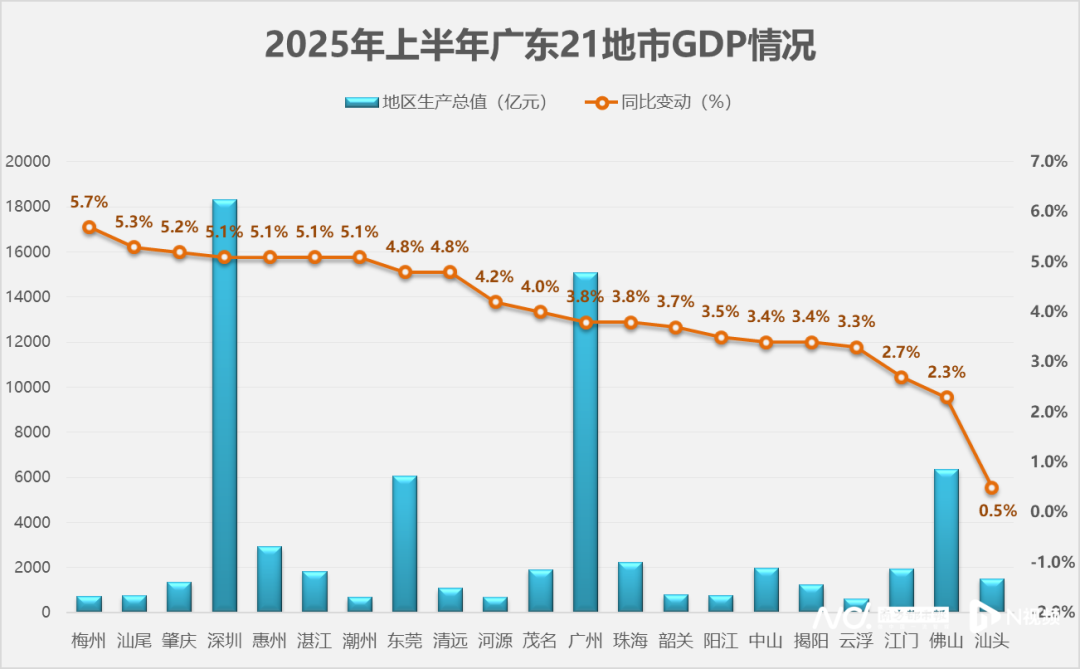
Economic Overview - As of July 31, all 21 cities in Guangdong have released their economic "half-year reports" for 2025, with Shenzhen, Guangzhou, Foshan, Dongguan, and Huizhou maintaining a leading position, each exceeding a GDP of 1.5 trillion yuan in the first half of the year [1] - The overall GDP growth rate for the province is 4.2%, with Meizhou leading at 5.7%, followed by Shanwei at 5.2% and Zhaoqing at 5.2% [1] Industrial Growth - Nine cities reported industrial growth rates exceeding the provincial average of 4.0%, with Huizhou and Zhanjiang showing remarkable performance, both exceeding 10% growth in industrial added value [3][6] - Huizhou's industrial added value grew by 11.2%, with advanced manufacturing and high-tech manufacturing increasing by 11.2% and 15.3%, respectively [6] - Zhanjiang's industrial added value increased by 10.2%, with significant contributions from key industrial enterprises, leading to a GDP growth from 3% to 5.1% [6] New Growth Drivers - New energy industries are driving industrial growth across various cities, with Zhaoqing's advanced manufacturing growing by 17.6% and Dongguan's advanced and high-tech manufacturing increasing by 7.5% and 9.1%, respectively [7] - Shenzhen's production of civilian drones, industrial robots, and 3D printing equipment saw substantial increases of 59.0%, 38.0%, and 35.8% [7] Investment Trends - Industrial investment in cities like Maoming, Guangzhou, and Shanwei is robust, with Maoming's industrial investment growing by 34.5% and advanced manufacturing investment soaring by 90.2% [8] - Infrastructure investment is also on the rise, with several cities reporting double-digit growth rates, particularly Chaozhou at 36.4% [8] Foreign Trade - Shenzhen leads the province in foreign trade, with a total import and export value of 2.17 trillion yuan, accounting for nearly half of the province's total [10] - Zhaoqing's foreign trade grew by 16.7%, the highest in the province, with significant increases in exports to Belt and Road countries [13] Income Disparity - Rural residents' income growth outpaces that of urban residents, with several cities reporting rural income growth rates above 6% [15] - The income disparity between urban and rural residents is narrowing, with Guangzhou's ratio improving from 2.01:1 to 1.96:1 [16] Consumer Market Recovery - The consumer market is recovering, with Guangzhou's retail sales reaching 561.12 billion yuan, a year-on-year increase of 5.9% [17] - Huizhou and Zhuhai also reported retail sales growth of 5.5% and 5.0%, respectively, with significant increases in specific categories such as home appliances [17]
东莞今年上半年GDP同比增长4.8%!外贸保持较快增长
Nan Fang Du Shi Bao· 2025-07-23 15:34
Economic Overview - Dongguan's GDP for the first half of 2025 reached 606.78 billion yuan, a year-on-year increase of 4.8% [2] - The primary industry added value was 1.49 billion yuan, growing by 2.8%; the secondary industry added value was 339.94 billion yuan, increasing by 5.3%; the tertiary industry added value was 265.36 billion yuan, rising by 4.1% [2] Agricultural Sector - The total output value of agriculture, forestry, animal husbandry, and fishery was 2.62 billion yuan, with a year-on-year growth of 2.9% [3] - Agricultural output value was 1.92 billion yuan, increasing by 3.5%; forestry output value was 0.11 billion yuan, decreasing by 17.4%; animal husbandry output value was 0.58 billion yuan, down by 4.9%; fishery output value was 0.54 billion yuan, up by 3.0% [3] - The production of fruits increased by 33.0%, with lychee production surging by 283.7% [3] Industrial Sector - The industrial added value for large-scale enterprises grew by 5.1% year-on-year [4] - Key industries such as electronic information manufacturing saw an increase of 9.2%, electrical machinery and equipment manufacturing grew by 8.8%, and chemical manufacturing rose by 12.4% [4] - High-tech manufacturing and advanced manufacturing increased by 9.1% and 7.5% respectively, surpassing the overall average [4] Foreign Trade - The total import and export value reached 749.28 billion yuan, a year-on-year increase of 16.5% [6] - Imports amounted to 293.13 billion yuan, growing by 27.0%, while exports were 456.14 billion yuan, increasing by 10.6% [6] - General trade imports and exports rose by 23.1%, accounting for 47.6% of total trade [6] Consumer Market - The total retail sales of consumer goods reached 219.56 billion yuan, with a year-on-year growth of 3.4% [7] - Online retail sales increased by 28.0%, indicating a strong shift towards e-commerce [7] - Significant growth was observed in the sales of communication equipment, furniture, and home appliances, with increases of 87.2%, 85.8%, and 13.2% respectively [7] Investment Trends - Fixed asset investment decreased by 10.9%, but the decline was narrower than in the first quarter [8] - Excluding real estate development, fixed asset investment grew by 6.9% [8] - Infrastructure investment accelerated with a year-on-year growth of 7.2%, particularly in road transport and power supply sectors [8] Service Sector - The service industry added value increased by 4.1% year-on-year [9] - The revenue of large-scale service enterprises grew by 3.1% [9] - The postal, express, and telecommunications sectors experienced significant growth, with increases of 58.1%, 26.4%, and 10.8% respectively [9] Financial Performance - General public budget revenue was 43.48 billion yuan, a year-on-year increase of 2.1% [10] - Financial institutions' deposits reached 2.90 trillion yuan, growing by 6.6% [10] - The loan balance of financial institutions was 2.01 trillion yuan, increasing by 3.4% [10] Market Dynamics - The total electricity consumption was 52.25 billion kWh, with industrial consumption growing by 3.5% [11] - The number of registered businesses reached 1.89 million, a year-on-year increase of 5.5% [11] - New industries saw a registration increase of 16.2% [11] Price Stability - The Consumer Price Index (CPI) decreased by 1.1% year-on-year [12] - Price indices for transportation and communication, clothing, and education showed declines, while medical care and other services saw slight increases [12] - Overall, the economic operation in Dongguan remained stable, with a focus on high-quality development and addressing external uncertainties [12]
上半年东莞GDP同比增4.8%,外贸进出口同比增16.5%
2 1 Shi Ji Jing Ji Bao Dao· 2025-07-23 13:50
Economic Performance - Dongguan's GDP for the first half of the year reached 606.784 billion yuan, with a year-on-year growth of 4.8% [1] - The primary industry added value was 1.487 billion yuan, growing by 2.8% year-on-year; the secondary industry added value was 339.943 billion yuan, growing by 5.3%; and the tertiary industry added value was 265.355 billion yuan, growing by 4.1% [1] Manufacturing Sector - The city's industrial added value for large-scale enterprises increased by 5.1% year-on-year [1] - Key industries showed strong growth: electronic information manufacturing increased by 9.2%, electrical machinery and equipment manufacturing by 8.8%, and chemical manufacturing by 12.4% [1] - New momentum industries performed well, with advanced manufacturing and high-tech manufacturing added value growing by 7.5% and 9.1% respectively, surpassing the city average [1] - High-tech product output saw significant growth, with servers up by 408.8%, integrated circuits by 89.9%, sensors by 67.3%, and complete electronic computers by 44.3% [1] Foreign Trade - Dongguan's total foreign trade import and export volume reached 749.28 billion yuan, a year-on-year increase of 16.5% [1] - Imports totaled 293.13 billion yuan, growing by 27.0%, while exports were 456.14 billion yuan, increasing by 10.6% [1] Consumer Market - The total retail sales of social consumer goods amounted to 219.555 billion yuan, with a year-on-year growth of 3.4%, improving by 0.5 percentage points from the first quarter [2] - Restaurant income grew by 2.4%, while commodity retail increased by 3.6% [2] Investment Trends - Total fixed asset investment in Dongguan decreased by 10.9% year-on-year, but the decline was narrowed by 3.1 percentage points compared to the first quarter [2] - Excluding real estate development investment, fixed asset investment grew by 6.9% [2] - New momentum investments in advanced manufacturing and high-tech manufacturing increased significantly, by 30.6% and 31.8% respectively [2] Other Economic Indicators - Total electricity consumption reached 52.254 billion kWh, with a year-on-year growth of 5.0%; industrial electricity consumption was 35.599 billion kWh, growing by 3.5% [2] - As of the end of June, the number of registered businesses in the city was 1.891 million, a year-on-year increase of 5.5%, with emerging industry registrations at 769,200, growing by 16.2% [2]