新能源出海

Search documents
吉利汽车(0175.HK):单车盈利增长到5200元 看好26年进一步整合释放利润
Ge Long Hui· 2025-11-24 21:41
Core Viewpoint - The company reported Q3 2025 financial results, achieving revenue of 89.19 billion yuan, a year-on-year increase of 27%; core net profit was 3.96 billion yuan, a quarter-on-quarter increase of 25%, and net profit attributable to shareholders was 3.82 billion yuan, a year-on-year increase of 59% [1][2]. Sales Performance - The company sold 761,000 vehicles, a year-on-year increase of 43%; among them, the Galaxy series sold 327,000 units, a year-on-year increase of 170%, becoming the fastest new energy brand to reach annual sales of one million [2][3]. - The sales of the Chinese Star reached 219,000 units, a quarter-on-quarter increase of 2.4%, while Lynk & Co sold 87,000 units, a year-on-year increase of 25% [2]. - Zeekr's sales were 53,000 units, a year-on-year decrease of 4%, but the Zeekr 9X remained a strong competitor in the luxury segment [2]. Financial Metrics - Q3 revenue per vehicle was 117,000 yuan, with a profit of 5,200 yuan per vehicle, an increase of 500 yuan compared to H1 2025 [2]. - The company's sales, management, and R&D expense ratios were 6.0%, 1.5%, and 4.9%, respectively, with the sales expense ratio increasing due to the launch of four new models and the pre-launch of Zeekr 9X [3]. Future Outlook - In Q4, the company expects continued strong performance with the complete delivery of Galaxy M9 and Zeekr 9X, focusing on new energy exports and cost control post-integration [3][4]. - The company aims for significant growth in new energy vehicle exports, with a target of over 100,000 units in each of the five major overseas regions in 2026, and expects to see improved profitability from these exports [4]. - Following the privatization of Zeekr, the company anticipates accelerated integration and cost efficiency improvements, with a projected decrease in expense ratios and an increase in profits [4]. Profit Forecast - The company forecasts net profits of 17.83 billion yuan, 20.78 billion yuan, and 23.33 billion yuan for 2025-2027, with corresponding P/E ratios of 9.5, 8.1, and 7.3, maintaining a "buy" rating [4].

川财证券陈雳:“十五五”科技仍是推动新能源产业发展的核心动力
Zhong Guo Jing Ying Bao· 2025-11-19 12:20
Core Insights - The development of the new energy industry is undergoing a cyclical change, transitioning from explosive growth to high-quality development, with "involution" being a necessary phase in this maturation process [1][2] - The current internal adjustments in the new energy sector are driven by deep market factors rather than just supply-side structural reforms, necessitating improved cost control and technological innovation among companies [1] - The global trade environment for new energy has significantly changed, requiring companies to rethink their international strategies and ensure compliance with market-specific environmental standards while maintaining technological leadership [1][2] Industry Analysis - The new energy industry is experiencing a shift from quantity to quality, indicating a maturation phase characterized by overcapacity and price competition [1] - Continuous technological innovation, such as advancements in lithium batteries, solid-state batteries, and thorium molten salt reactors, is essential for the vitality of the new energy sector [1][2] - Companies are advised to focus on their strengths, avoid overcrowded markets, and integrate digital and AI elements into their new energy products before pursuing international expansion [2] Future Outlook - The core driving force for the new energy industry will remain technology, with emerging growth points in thorium molten salt reactors, solid-state battery technology, and decreasing hydrogen energy costs [2] - The future competitiveness of new energy companies will depend on breakthroughs in technology, the expansion of downstream application scenarios, and the formulation of development plans tailored to their unique characteristics [2] - There is a need for more scientific planning in the new energy sector to avoid redundant construction and resource waste, particularly in regions lacking a solid foundation for new energy development [2]
宁胜男:中国新能源企业何以密集出海印度?
Guan Cha Zhe Wang· 2025-11-04 01:13
Core Insights - Chinese renewable energy and storage companies are increasingly entering South Asian markets, particularly India and Bangladesh, establishing local manufacturing facilities and securing significant contracts [1][2]. Group 1: Market Entry and Localization - Chinese companies are major suppliers in India's solar and wind energy markets, with firms like JinkoSolar, LONGi Green Energy, and Trina Solar dominating the solar component supply [2]. - In wind energy, leading companies such as Envision Energy and SANY Heavy Industry have secured large contracts, with Envision becoming one of the largest wind turbine suppliers in India [2]. - The localization process has begun, with companies like Sungrow Power Supply establishing factories in Bangalore with an annual capacity of 3 GW, and Envision Energy building manufacturing facilities in Maharashtra and Tamil Nadu [2]. Group 2: Market Potential and Government Support - India faces significant electricity shortages and aims to diversify its energy structure, with a target of achieving 500 GW of renewable energy capacity by 2030 [5][6]. - The Indian government has implemented various policies to support renewable energy, including financial incentives and requirements for energy storage systems in solar projects [6]. - The profit margins in the Indian market are attractive for Chinese companies, with reports indicating that the gross margin for wind turbine orders in India is higher than domestic margins by over five percentage points [7]. Group 3: Challenges and Risks - The investment environment in India is complex, with macro policy risks stemming from changes in foreign direct investment regulations that require prior government approval for Chinese investments [9]. - Discriminatory policies aimed at reducing import dependency pose risks, such as the reintroduction of approval lists that exclude Chinese manufacturers from government projects [11]. - The Indian government's push for localization presents challenges, as foreign companies may face increasing demands for local investment and technology transfer [12].







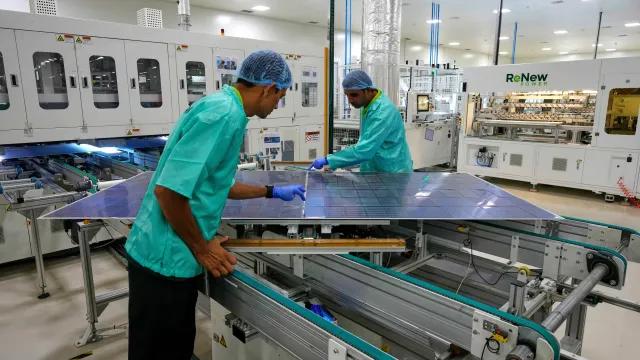
隆基钟宝申做客央视《对话》:中国新能源出海,扮演“拓荒者”角色
中国能源报· 2025-10-10 10:44
Core Viewpoint - The article emphasizes the significant progress and breakthroughs achieved by China's green transition over the past five years, particularly in the renewable energy sector, contributing to global low-carbon development with innovative solutions [2]. Group 1: Industry Achievements - The Chinese renewable energy industry has transitioned from "catching up" to "leading" on a global scale, supported by a robust industrial ecosystem and continuous investment in innovation [3]. - The export value of the "new three items" (solar products) surged from 220 billion yuan in 2020 to over 1 trillion yuan in 2023, accounting for 15% of foreign trade exports, with a strong growth rate of 12.7% in the first half of 2025 [3]. Group 2: Global Market Expansion - The essence of solar energy's global expansion is driven by market demand, with Chinese products providing efficient and reliable clean energy solutions worldwide, rather than merely avoiding domestic competition [5]. - Chinese renewable energy exports are aimed at improving living standards in regions lacking electricity, contributing to global sustainable development through innovative technology solutions [5]. Group 3: Social Impact - Projects in Malawi, Mozambique, and Egypt demonstrate the positive impact of solar energy on local communities, providing clean and stable electricity for schools, hospitals, and agricultural needs [7]. - The renewable energy sector's inherent ESG attributes are key to addressing global challenges related to energy security, equity, and environmental sustainability, benefiting millions in Africa [7]. Group 4: Future Outlook - The journey of the Chinese renewable energy industry abroad is about exploring new market territories, creating new industries, market demands, and job opportunities, positioning itself as a "pioneer" and "road builder" in the global market [7].

全球感知|新能源企业出海 合规经营呼唤 “中外协作”法务模式
Xin Hua Cai Jing· 2025-09-20 06:08
Core Viewpoint - Chinese new energy companies are becoming key players in driving global energy transition, but they must manage risks and ensure compliance to operate successfully in international markets [1][2]. Group 1: Regulatory Compliance - The EU's Battery and Waste Battery Regulation mandates that from February 18, 2027, batteries for light vehicles, electric vehicles, and industrial batteries over 2kWh must have a "battery passport" for market entry [1]. - Compliance with EU regulations in labor, data protection, and corporate governance is crucial for Chinese new energy firms to succeed in Europe [2]. - High compliance costs present opportunities for companies to establish systems that meet EU standards, potentially eliminating weaker competitors [2]. Group 2: Strategic Approaches - Companies can adopt differentiated competition strategies, such as shifting focus from saturated lithium battery markets to niche markets like nickel-hydride batteries [3]. - Small and medium enterprises should prioritize practical compliance by forming "China-foreign cooperation" legal teams and partnering with local law firms with established resources [3]. - A flexible "one country, one policy" strategy is recommended for market entry, adapting to local conditions and investment environments [4]. Group 3: Risk Management - Geopolitical factors, such as the U.S. Inflation Reduction Act, pose significant risks, preventing Chinese battery companies from accessing U.S. clean energy tax credits and placing them at a competitive disadvantage [3]. - Compliance should be integrated into business processes rather than being confined to legal departments, requiring dynamic databases to support regulations like the "battery passport" [4]. - Due diligence on overseas partners is essential to avoid involvement in local corruption or legal issues [4].
【高端访谈】朱共山:坚定看好光伏前景,协鑫以技术创新穿越周期
Xin Hua Cai Jing· 2025-09-19 12:52
Core Viewpoint - The article highlights how GCL-Poly Energy Holdings has successfully navigated through the cyclical challenges of the photovoltaic industry by leveraging technological innovation and strategic positioning, leading to optimism about the future of the solar energy sector. Group 1: Technological Innovation - GCL-Poly's resilience during industry downturns is attributed to its commitment to technological innovation, particularly in the development of FBR granular silicon technology, which has significantly reduced production costs and energy consumption [2][3][4]. - The company has achieved a production capacity of 48,000 tons of FBR granular silicon, capturing over 20% of the market share in this segment [4]. - The FBR technology has led to a 30% reduction in overall costs and a decrease in energy consumption to one-fourth of traditional methods, enhancing product purity and reducing impurities [4]. Group 2: Energy Consumption Revolution - GCL-Poly has undergone a significant transformation from being an energy-intensive company to a leader in energy efficiency, reducing its energy consumption from 247 kWh per kilogram to 13 kWh per kilogram [8][9]. - This reduction in energy consumption not only lowers operational costs but also enhances the competitiveness of its products in light of global carbon tax policies [9][10]. - The company’s shift to a green energy model has positioned it as a "green pioneer" in the industry, showcasing a complete overhaul of its production processes [10]. Group 3: Global Market Opportunities - The company is optimistic about the future of the photovoltaic industry, particularly in emerging markets like Africa and India, where there is a high demand for clean energy solutions [11][12]. - GCL-Poly sees significant potential in exporting its products, especially in light of the growing need for renewable energy to address energy, food, and environmental challenges in these regions [12]. - The ongoing advancements in solar technology, such as the development of perovskite and silicon tandem technologies, are expected to further enhance efficiency and create new market opportunities [12].

安徽首富,又去IPO敲钟了
芯世相· 2025-09-05 06:20
Core Viewpoint - The article discusses the rise of Chinese renewable energy companies, particularly focusing on Sungrow Power Supply Co., Ltd., which is planning to list its H-shares in Hong Kong, reflecting the broader trend of Chinese renewable energy firms expanding globally [5][11]. Group 1: Company Overview - Sungrow Power, founded by Cao Renxian, has grown into a company with a market capitalization exceeding 200 billion RMB, specializing in photovoltaic inverters and expanding into various renewable energy sectors [5][8]. - The company achieved significant milestones, including being the first in China to develop a photovoltaic inverter with complete independent intellectual property rights in 2003 and successfully listing on the Shenzhen Stock Exchange in 2011 [8][11]. Group 2: Financial Performance - In the first half of the year, Sungrow Power reported a revenue of 43.53 billion RMB, a year-on-year increase of 40.34%, and a net profit of 7.73 billion RMB, up 55.97% from the previous year [11][12]. - The company's storage business revenue surpassed that of photovoltaic inverters for the first time, with storage systems generating 17.80 billion RMB, accounting for approximately 40.89% of total revenue [13]. Group 3: Market Expansion - Sungrow Power's overseas revenue reached 25.38 billion RMB, a significant increase of 88.32% year-on-year, making up 58.3% of total revenue [13]. - The company aims to enhance its global strategy through its Hong Kong IPO, seeking to improve its international brand image and diversify its financing channels [13][16]. Group 4: Industry Trends - The article highlights a broader trend of Chinese renewable energy companies going public in Hong Kong, with several firms like CATL and JinkoSolar also pursuing dual listings to attract international investors [16][17]. - China's renewable energy sector is experiencing rapid growth, with wind turbine exports increasing by 71.9% and solar product exports exceeding 200 billion RMB for four consecutive years [16].

安徽首富,又带队阳光电源去IPO了
Sou Hu Cai Jing· 2025-08-30 07:32
Core Viewpoint - The news highlights the trend of Chinese renewable energy companies, exemplified by Sungrow Power Supply Co., Ltd., pursuing overseas listings to enhance their global presence and capitalize on international market opportunities [1][10][11]. Company Overview - Sungrow Power, founded by Cao Renxian in Hefei, has grown into a company with a market capitalization exceeding 200 billion RMB, focusing on solar inverters and expanding into various renewable energy sectors [1][4][5]. - The company has successfully transitioned from traditional power products to renewable energy solutions, achieving significant market share in China [4][5]. Financial Performance - In the first half of the year, Sungrow reported a revenue of 43.53 billion RMB, a year-on-year increase of 40.34%, and a net profit of 7.73 billion RMB, up 55.97% [6][7]. - The company's gross margin improved to 34.36%, driven by brand premium, product innovation, and economies of scale [8]. Business Segments - Sungrow's revenue from energy storage systems surpassed that from solar inverters for the first time, with energy storage generating 178.03 billion RMB, accounting for approximately 40.89% of total revenue [8]. - The company has seen a significant increase in overseas revenue, reaching 253.79 billion RMB, a growth of 88.32% year-on-year, representing 58.3% of total revenue [8]. Market Trends - The trend of Chinese renewable energy companies going public in Hong Kong reflects a broader movement towards globalization, with many firms seeking to enhance their international brand recognition and expand their market reach [10][11]. - The Chinese renewable energy sector is experiencing rapid growth, with significant increases in exports of wind and solar products, as well as lithium batteries [10][12]. Future Outlook - Sungrow's upcoming IPO in Hong Kong aims to deepen its global strategy, enhance its international brand image, and diversify its financing channels [8][10]. - The company is part of a larger trend where Chinese firms are increasingly viewed as leaders in the global renewable energy market, reshaping the industry landscape [12].

安徽首富,又去IPO敲钟了
Xin Lang Cai Jing· 2025-08-30 07:26
Core Viewpoint - The article highlights the significant growth and international expansion of the Chinese renewable energy sector, particularly focusing on Yangguang Electric Power's upcoming H-share listing in Hong Kong as a part of this trend [4][10][14]. Company Overview - Yangguang Electric Power, founded by Cao Renxian in Hefei, has grown into a company with a market capitalization exceeding 200 billion RMB, with a focus on solar inverters and energy storage systems [4][5][10]. - The company has diversified into five major areas: solar energy, wind energy, energy storage, hydrogen energy, and electric vehicles [7][10]. Financial Performance - In the first half of the year, Yangguang Electric Power reported a revenue of 43.533 billion RMB, a year-on-year increase of 40.34%, and a net profit of 7.735 billion RMB, up 55.97% [13]. - The company's gross margin improved to 34.36%, an increase of 1.94% year-on-year, driven by brand premium, product innovation, and economies of scale [10]. Market Trends - The renewable energy sector in China is experiencing a surge in exports, with wind turbine exports increasing by 71.9% and solar products consistently exceeding 200 billion RMB in exports for four consecutive years [14]. - The article notes a trend of Chinese renewable energy companies pursuing dual listings (A+H shares) to enhance their global presence and attract international investors [14][15]. Regional Development - Hefei has become a hub for the renewable energy industry, housing major companies and achieving significant production milestones in electric vehicles and energy storage systems [12]. - The city aims to produce over 2 million electric vehicles by 2027, with a revenue target exceeding 700 billion RMB from the new energy sector [12].

安徽首富,又去IPO敲钟了
投资界· 2025-08-30 07:19
Core Viewpoint - The article highlights the rise of Sunpower Technology as a significant player in the renewable energy sector, emphasizing its upcoming IPO in Hong Kong and its role in China's global expansion in the renewable energy market [3][14]. Company Overview - Sunpower Technology, founded by Cao Renxian in Hefei, has grown into a company with a market capitalization exceeding 200 billion RMB, focusing on solar inverters and expanding into energy storage and hydrogen energy [3][8]. - The company has achieved significant milestones, including being the first in China to develop a solar inverter with complete independent intellectual property rights in 2003 and successfully listing on the Shenzhen Stock Exchange in 2011 [7][8]. Financial Performance - In the first half of the year, Sunpower Technology reported a revenue of 43.53 billion RMB, a year-on-year increase of 40.34%, and a net profit of 7.73 billion RMB, up 55.97% from the previous year [11][12]. - The company's gross profit margin improved to 34.36%, attributed to brand premium, product innovation, and economies of scale [12]. Business Segments - For the first time, revenue from the energy storage business surpassed that of solar inverters, with energy storage systems generating 17.80 billion RMB, accounting for approximately 40.89% of total revenue [13]. - The overseas revenue reached 25.37 billion RMB, marking an 88.32% increase year-on-year, representing 58.3% of total revenue [14]. Industry Context - The article discusses the broader trend of Chinese renewable energy companies, including Sunpower Technology, expanding globally, with significant growth in exports of wind and solar products [17][18]. - The rise of Hefei as a hub for the new energy industry is noted, with multiple major companies and a target to produce over 200 million new energy vehicles by 2027 [15][16]. Future Outlook - Sunpower Technology's IPO in Hong Kong is part of a strategy to enhance its global presence and diversify funding channels, aligning with the trend of Chinese companies seeking international markets [14][18]. - The article concludes with a historical analogy, suggesting that China's renewable energy sector is entering a new era of global leadership, reminiscent of Zheng He's maritime expeditions [19].