
日元汇率

Search documents
日元对美元汇率创两月新高
Shang Hai Zheng Quan Bao· 2026-01-27 14:01
虽然日本财务省事务次官三村淳26日针对"日美两国政府于23日联合实施利率检查"的观点表示"无可奉 告",但市场分析人士认为,美日联合干预日元汇率的可能性非常大。 赵庆明表示,从国际外汇市场运行看,在美洲(纽约)交易时段与纽约联储进行联合干预,效果通常更 好。美洲时段是全球外汇市场交易量最大、流动性最高的时段,能够承接大规模干预订单。 若外汇干预落地,短期可能推动日元升值。"当前日元汇率处于严重低估状态。若发生联合干预,有可 能引发一波显著的反弹行情。"赵庆明说。 一段时间以来,日元汇率持续承压。而近几个交易日,日元对美元汇率迎来逆转,大幅上涨。当前,全 球汇市正紧盯美国是否在准备下场协助日本打响日元"保卫战"。 上周五(1月23日),日元在日本央行发布会后快速升值,日元对美元汇率单日涨超1.7%,连续升超4 个关口;1月26日,日元对美元汇率一度升超154关口,最高触及153.3。这是2025年11月中旬以后约两 个半月来首次触及153区间。 截至1月27日16时50分,日元对美元报154.76,三个交易日内累计升超2.3%。 这一逆转源于美国和日本释放出"利率检查"信号,市场猜测美日未来或联合干预日元汇率。 ...
日元汇率与日本国债动荡交织 高市早苗政府在大选前面临市场考验
Xin Lang Cai Jing· 2026-01-27 01:55
Core Viewpoint - Japanese Prime Minister Sanna Takashi has launched her election campaign with the primary goal of ensuring a smooth voting process on February 8, while avoiding significant fluctuations in the financial markets [1][2][3] Group 1: Election Campaign and Market Stability - The campaign officially commenced on Tuesday, with Takashi aiming to solidify the ruling coalition's majority in the House of Representatives [3] - Recent polls indicate a slight decline in her approval ratings, yet they remain at a relatively high level overall [3] - A Japanese Finance Ministry official noted that any measures to lower bond yields could lead to further depreciation of the yen, increasing imported inflation and raising interest rate pressures [1][2] Group 2: Market Reactions and Government Strategies - Speculation arose last week regarding potential coordinated actions between the U.S. and Japan in the foreign exchange market, which temporarily boosted the yen's exchange rate [3] - There are currently no signs that authorities have engaged in actual intervention, although Japanese Finance Minister Katsunobu Kato and U.S. Treasury Secretary Janet Yellen have called for calm in the Japanese bond market, which has alleviated upward pressure on yields [3] - Lombard Odier's senior macro strategist Homin Lee stated that once the new cabinet is formed post-election and the annual budget is passed, it will become easier to achieve a balance between managing the yen's exchange rate and Japanese bond yields [4]
美元指数三连跌 日元延续涨势
Jin Rong Jie· 2026-01-26 20:39
本文源自:金融界AI电报 美元连续第三个交易日下跌,接近2022年以来的最低水平。在日本首相高市早苗表示政府已准备好对金 融市场异常波动采取行动后,日元迈向4月以来最佳两日表现。美元即期指数一度下跌0.6%,触及去年 9月以来的最低水平。 美元/日元一度下跌1.5%,至153.31,为11月7日以来最低水平。日本首相高市早 苗向金融市场发出了新的警告,称政府已准备好采取行动。 ...
日本央行为何维持利率不变?
2 1 Shi Ji Jing Ji Bao Dao· 2026-01-23 23:20
Core Viewpoint - The Bank of Japan (BOJ) decided to maintain its policy interest rate at 0.75%, reflecting a careful balancing act amid concerns over fiscal deterioration and market pressures following the government's announcement of tax cuts and increased spending ahead of the upcoming elections [1][4]. Monetary Policy - The BOJ's decision to keep the interest rate unchanged is seen as a demonstration of the central bank's independence, which is crucial for price stability [5]. - The BOJ's economic outlook report revised core CPI forecasts, increasing the 2025 core CPI from 2.8% to 3% and adjusting GDP growth forecasts for 2025 and 2026 upwards, while slightly lowering the 2027 growth forecast [2]. Economic Context - The Japanese government announced plans for tax cuts and increased fiscal spending, leading to concerns about further fiscal deterioration and a subsequent drop in bond prices [1][3]. - The Japanese yen has been depreciating against the dollar and euro, with the exchange rate reaching historical lows, although the overall dollar depreciation against other currencies may mitigate further yen declines [3]. Market Reactions - The market had anticipated the BOJ's decision to maintain the interest rate, resulting in a muted reaction; however, this does not alleviate the downward pressure on Japanese government bond prices and the yen [4]. - The BOJ's previous interest rate hike in December was insufficient to halt the yen's depreciation trend, as the increase was modest and did not meet market expectations for a neutral rate adjustment [4]. Political Environment - The dissolution of the Japanese House of Representatives marks a significant political event, with elections scheduled for February 8, raising uncertainties about potential government interventions in the market during this transitional period [3][5].
日元,突发!
Zhong Guo Ji Jin Bao· 2026-01-23 11:51
Core Viewpoint - The Japanese yen experienced a rapid appreciation, briefly reaching the 157 yen range against the US dollar, following a period of depreciation that saw it drop to 159 yen, indicating market tension and potential intervention by the Bank of Japan [1][2] Group 1: Currency Movement - The yen had previously depreciated to 159.45 yen per dollar, marking its lowest point since July 2024, before the recent appreciation [1] - Analysts suggest that the market may be entering a phase where official intervention by the authorities is likely, given the proximity of the exchange rate to intervention levels [1] Group 2: Bank of Japan's Stance - Bank of Japan Governor Ueda indicated that the rising long-term interest rates are occurring at a "considerably fast" pace, and the bank may implement flexible market operations under exceptional circumstances [2] - Ueda emphasized the importance of monitoring the impact of exchange rates on domestic prices, particularly as corporate wage increases become more pronounced [2] Group 3: Market Reactions - There are speculations about significant dollar selling pressure in the market, with analysts noting the absence of official verbal interventions or direct market actions [1] - The potential for large European investors to engage in profit-taking during the European trading session was also mentioned, alongside the possibility of a rate check by authorities near the 160 yen level [1]
花旗警告:若日元持续疲软 日本央行2026年或激进加息三次
智通财经网· 2026-01-20 02:07
Core Viewpoint - Citigroup's Japan market head Akira Hoshino warns that if the yen remains weak, the Bank of Japan may raise interest rates three times by 2026, potentially doubling the current policy rate [1] Group 1: Monetary Policy Outlook - Hoshino suggests that if the USD/JPY exchange rate exceeds 160, the Bank of Japan may increase the uncollateralized overnight call rate by 25 basis points to 1% in April [1] - He anticipates a similar rate hike in July and possibly a third increase by the end of the year if the yen continues to weaken [1] - The current negative real interest rates are driving the yen's weakness, and addressing this issue is crucial for reversing the exchange rate trend [1] Group 2: Economic and Market Conditions - Hoshino expects the yen to fluctuate between 150 and 165 against the dollar this year, with the current rate at 158.2, having reached an 18-month low of 159.45 [2] - If key rates like the 10-year government bond yield exceed inflation rates, Japanese institutions may consider reallocating overseas investments back to domestic fixed-income assets [2] - The lack of sufficient investment options in Japan is a key reason for the persistent weakness of the yen [2] Group 3: Strategic Initiatives - Hoshino aims to enhance collaboration between the trading team and investment banking to capitalize on the opportunities created by the M&A boom in Japan [2] - He plans to involve team members in early client discussions to provide optimal financing solutions during transactions [2] - The goal is to optimize supply-demand matching from the initial stages of transactions to offer the most effective financing solutions to clients [2]

日本央行被曝密切关注日元汇率,1月或按兵不动但加息紧迫感升温
Jin Shi Shu Ju· 2026-01-15 12:39
Group 1 - The Bank of Japan officials are increasingly concerned about the potential impact of the weak yen on inflation, which may influence future interest rate hikes, although a decision to maintain the current rate is expected next week [1] - The weak yen is seen as a growing factor affecting the economy, particularly as companies are more inclined to pass on higher input costs to customers [1] - Economists generally expect the Bank of Japan to raise interest rates approximately every six months, with the next potential hike anticipated in the summer [1] Group 2 - Despite the Bank of Japan raising the benchmark interest rate in December, the yen remains weak, hitting an 18-month low due to upcoming early elections [2] - The depreciation of the yen has increased inflationary pressures by raising import costs while also boosting profits for exporters [2] - The Japanese business community is increasingly vocal about exchange rate issues, with the head of Keidanren calling for government intervention to prevent excessive yen depreciation [2]
日本当局拉响干预警报!日元触及18个月新低后小幅反弹
智通财经网· 2026-01-14 10:58
Core Viewpoint - The Japanese yen has been experiencing a significant decline, recently hitting a low of 159.45 yen per dollar, prompting warnings from Japanese officials about potential market interventions to stabilize the currency [1][3]. Group 1: Currency Fluctuations - The yen's recent depreciation is attributed to speculation surrounding Prime Minister Fumio Kishida's potential early election, with expectations that his party, the Liberal Democratic Party, could gain more votes [3][4]. - The dollar-yen exchange rate has shown volatility, with a recent drop of 0.31%, settling at 158.61 yen per dollar [1]. - Japanese officials have expressed concerns over excessive currency fluctuations, emphasizing that any intervention would aim to prevent sudden market volatility rather than target specific exchange rates [3][4]. Group 2: Government and Central Bank Responses - Japanese Finance Minister Shunichi Suzuki and top foreign exchange officials have warned against speculative trading, indicating that they are prepared to respond to excessive volatility [3][6]. - Former Bank of Japan policy board member Masayoshi Amamiya suggested that the central bank might raise interest rates as early as April due to concerns over Kishida's fiscal policies [5]. - Bank of Japan Governor Kazuo Ueda reiterated that the central bank's rate hike plans remain unchanged despite market fluctuations, with expectations for a potential rate increase around June [5]. Group 3: Market Sentiment and Predictions - Analysts from Eurizon SLJ Capital and Societe Generale have noted that the yen's decline increases the likelihood of government intervention, which could lead to a sharp correction in the exchange rate [4]. - Observers believe that if the government intervenes at the right moment, it could trigger a significant upward movement in the yen [4].

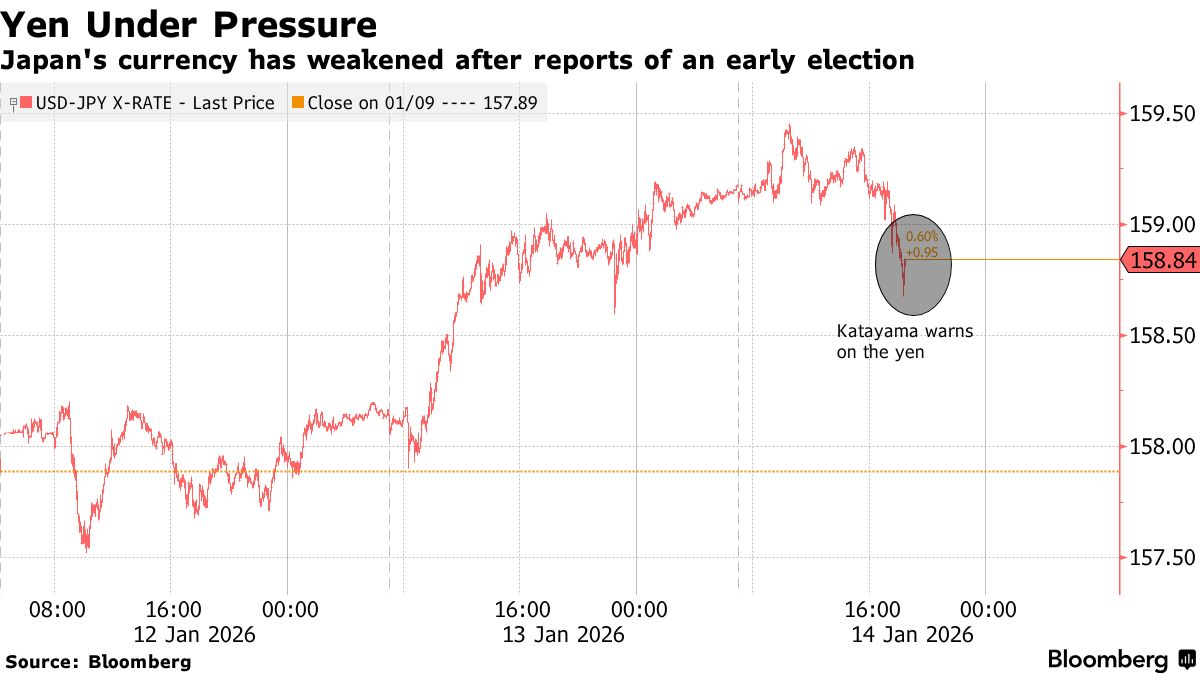
短线拉升,再创新高!
Zhong Guo Ji Jin Bao· 2026-01-14 02:24
Group 1 - The Nikkei 225 index opened higher on January 14, reaching a new high of 54,000 points with an increase of 1% [2] - Electronic and machinery stocks led the gains, with notable increases in companies such as Yaskawa Electric, Advantest, and Shiseido [3] - The 10-year Japanese government bond yield rose by 2 basis points to 2.180%, while the 5-year yield reached 1.615%, the highest level since 2000 [3] Group 2 - Japanese Prime Minister Sanae Takaichi is expected to announce intentions to dissolve the parliament on Wednesday [4] - Concerns regarding Takaichi's fiscal policy stance are likely to continue pressuring the yen, potentially leading to further depreciation, which could exacerbate inflationary pressures in Japan [4] - The KOSPI index in South Korea opened lower but later rose by 0.45%, reaching 4,713.8 points [4] Group 3 - In South Korea, notable stock gains were seen in companies like T-One Express, Hyundai Construction, and Lotte Energy Materials [5] - The Korea Exchange announced plans to implement 24-hour trading starting December 2027, with a transitional phase of 12-hour trading to attract retail investors [5]
日元汇率延续跌势,触及1美元兑159.07日元的当日低点
Mei Ri Jing Ji Xin Wen· 2026-01-13 22:57
Core Viewpoint - The Japanese yen continues to decline, reaching a low of 159.07 yen per dollar on January 13 [1] Group 1 - The exchange rate of the yen has been on a downward trend [1]