
汽车安全标准

Search documents
中国禁止隐藏式车门把手 为全球首项相关安全政策
Xin Lang Cai Jing· 2026-02-03 05:24
在此之前,中国国内发生了多起引发高度关注的事故,其中包括两起小米电动汽车起火事故。事故中车 门疑似因断电而无法打开,造成车内人员既无法逃生,也无法获救,最终身亡。虽然新规仅影响在中国 销售的电动汽车,但中国在全球汽车行业的影响力意味着相关影响可能会扩散。在美国,特斯拉的车门 已是安全调查的目标,而欧洲监管机构也正在考虑制定自己的规则。 "中国正在从最大的电动汽车市场转型为新汽车技术监管规则的制定者,"位于上海的咨询公司 Automobility创始人Bill Russo表示,"北京率先行动,可以利用其庞大的国内市场,锁定中国和外国汽 车制造商在当地必须遵守的安全标准,这些标准最终可能会随着中国电动汽车出口而推广开来,并影响 全球规范。" 中国禁止电动汽车使用隐藏式门把手,成为世界上首个禁止这种设计的国家。这款因特斯拉而推广的设 计正因一系列致命事件而面临全球监管机构的审查。 根据中国工业和信息化部2月2日发布的新安全标准,在中国销售的汽车必须配备机械释放车门外把手。 该部表示,该规定将于2027年1月1日起开始实施。已获得型式批准的车型应于2029年1月前修改其设计 以符合要求。 ...
事关汽车车门把手安全强制性国家标准发布
Qi Huo Ri Bao Wang· 2026-02-02 16:15
(文章来源:期货日报网) 据介绍,这一标准明确规范了车门把手的机械释放配置要求,开启车门、布置区域、操作空间要求,以 及车门内把手标志和操作说明要求等,重点解决车门外把手操作不便和事故后无法开启,车门内把手操 作便利性差、部分场景下功能丧失,以及车门内把手识别性差等痛点问题。 业内人士表示,标准的制定全面提升了车门把手的安全性能,对于引导和规范车门把手技术创新与产业 应用、强化人员应急逃生与安全救援能力、筑牢消费者生命安全防线、提升道路交通安全水平具有重要 意义,为我国汽车产业高质量发展提供坚实技术支撑。 据新华社电记者2日获悉,工业和信息化部组织制定的强制性国家标准《汽车车门把手安全技术要求》 (GB 48001—2026)近日由国家市场监督管理总局、国家标准化管理委员会批准发布,将于2027年1月 1日起实施。 ...
事关汽车门把手安全,强制性国家标准发布
证券时报· 2026-02-02 15:27
车辆电动化发展与安全需求 ▶▶ 随着电气化技术的发展和应用,汽车门把手等 关键安全部件在结构型式和系统架构等方面都发生 了全新的变化。为适应技术和产品发展趋势,工业 和信息化部组织开展《汽车车门把手安全技术要 求》标准的制定工作,规范车门把手产品设计,提 升汽车安全设计水平。 | 制定过程 | | | --- | --- | | | न्त्र (२ | | 2025.5.8 立项公示 | 组织国内整车企业、零部件企业、检 验机构等40余家单位共同开展研究。 | | 完成立项公示意见处理。 | 立项答辩 、 2025.6.19 | | 2025.7.22 、起草组会议 | 百余位行业专家多轮研讨确定标 准框架,形成标准草案。 | | 立项计划下达,起草组完善标 准草案。 | 立项下达 .. 2025.9.5 | | 2025 9.24 · 征求意见 | 完成征求意见稿,公开向社会 各界征求意见。 | | 起草组完成意见处理,形成 标准送审稿。 | 意见处理 < 2025.11.29 | | 2025.12.12 , 审查会 | 召开审查会,完成标准审查与 报批工作。 | 事关汽车门把手安全,强制性国家标准发布 ...

事关汽车门把手安全 强制性国家标准发布
Yang Shi Xin Wen· 2026-02-02 14:38
事关汽车门把手安全,强制性国家标准发布,将于2027年1月1日起开始实施。 标准简介 2026年01月28日,工业和信息化部组织 制定的强制性国家标准《汽车车门把手安全技 术要求》(GB 48001-2026)由国家市场监督管 理总局、国家标准化管理委员会批准发布,将 于2027年1月1日起开始实施。 制定背景 车辆电动化发展与安全需求 ▶▶ 随着电气化技术的发展和应用,汽车门把手等 关键安全部件在结构型式和系统架构等方面都发生 了全新的变化。为适应技术和产品发展趋势,工业 和信息化部组织开展《汽车车门把手安全技术要 求》标准的制定工作,规范车门把手产品设计,提 升汽车安全设计水平。 | 制定过程 | | | --- | --- | | 2025.5.8 立项公示 | 组织国内整车企业、零部件企业、检 | | | 验机构等40余家单位共同开展研究。 | | 完成立项公示意见处理。 | 立项答辩 、 2025.6.19 | | 2025.7.22 、起草组会议 | 百余位行业专家多轮研讨确定标 准框架,形成标准草案。 | | 立项计划下达,起草组完善标 | 立项下达 2025.9.5 | | 准草案。 | | ...

【行业政策】一周要闻回顾(2025年12月15日-12月21日)
乘联分会· 2025-12-22 08:37
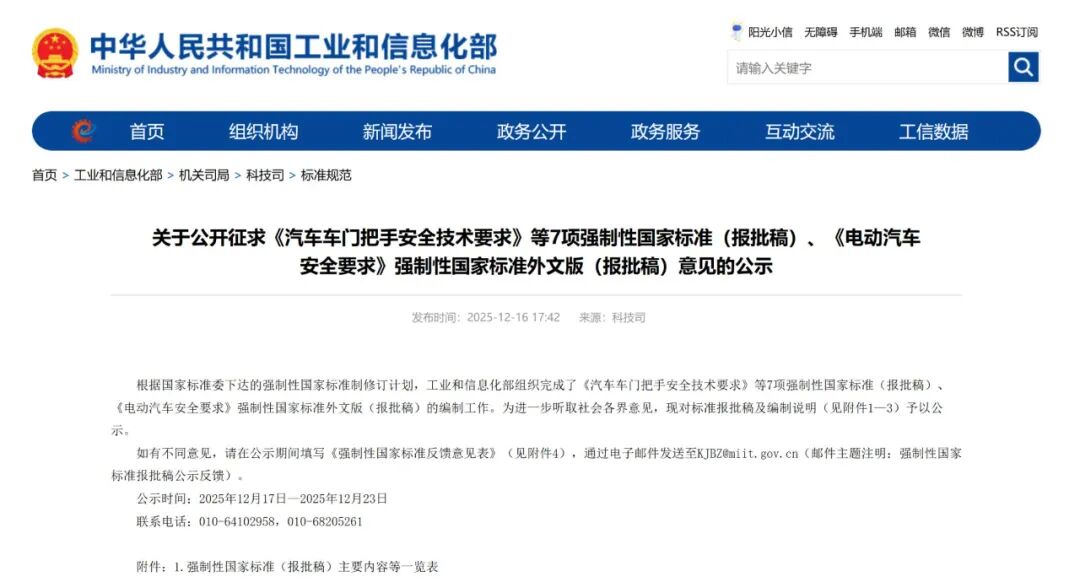
Core Viewpoint - The article discusses the recent announcements by the Ministry of Industry and Information Technology regarding the release of various vehicle production and tax exemption directories, highlighting the ongoing support for energy-saving and new energy vehicles in China [3][4]. Group 1: Vehicle Production and Product Directories - The announcement includes the publication of the 401st batch of vehicle production enterprises and products, which lists 85 automobile manufacturers, 338 private modified vehicle manufacturers, 7 over-limit vehicle manufacturers, and 1 three-wheeled vehicle manufacturer [5]. - The second part of the announcement details the expansion of products, with 179 automobile manufacturers changing or expanding their products and 683 manufacturers extending parameters [5]. - The announcement also mentions the restoration of production for 2 companies whose products have been rectified to meet management regulations [5]. Group 2: Tax Exemption Directories - The 80th batch of energy-saving and new energy vehicle models includes 683 compliant models, with 13 new energy-saving vehicle models and 670 new energy vehicle models, such as 69 plug-in hybrid passenger cars and 549 pure electric commercial vehicles [5]. - The 24th batch of vehicle models eligible for purchase tax exemption includes 512 compliant models, with 427 pure electric vehicle models and 69 plug-in hybrid vehicle models [6]. Group 3: Annual Points Report Notification - The Ministry of Industry and Information Technology has issued a notification for the submission of the 2026 annual points pre-report, requiring passenger vehicle companies to submit their reports by December 31, 2025 [8][9]. Group 4: National Standards Public Consultation - The Ministry of Industry and Information Technology is seeking public opinions on seven mandatory national standards, including safety requirements for electric vehicles and technical requirements for automotive door handles [12][13]. - The standards aim to enhance vehicle safety and address industry pain points, with a focus on improving the safety performance of vehicle components [15][18].
安全再升级 汽车领域多项国标将实施
Cai Jing Wang· 2025-12-21 09:02
Core Viewpoint - The Ministry of Industry and Information Technology of China is soliciting public opinions on seven mandatory national standards, including safety technical requirements for automotive door handles, indicating a significant step towards enhancing safety standards in the automotive industry for high-quality development [1] Group 1: National Standards Implementation - The upcoming national standards will enforce critical safety measures in the automotive sector, particularly focusing on intelligent connected new energy vehicles [1] - The new standard for automotive door handles mandates that each car door must be equipped with a mechanical exterior handle, allowing for manual opening in case of accidents or battery fires without the need for tools [1] - The implementation of the "Safety Requirements for Intelligent Connected Vehicle Combined Driving Assistance Systems" is scheduled to begin on January 1, 2027 [1] Group 2: Technical Testing and Innovations - A series of technical validations themed "National Standards Co-Verification" has been initiated by the China Automotive Technology Research Center in collaboration with key industry enterprises [1] - Multiple technical tests have been conducted, demonstrating that vehicles can autonomously steer and change lanes at a speed of 90 km/h when encountering construction ahead [1] - In a high-speed scenario, a vehicle traveling at 120 km/h successfully managed a simulated tire blowout, with the vehicle showing only minor vibrations and maintaining a yaw angle of less than 1 degree, which is below the national standard limit [2]
全隐藏式门把手“退场”倒计时,国标新规2027年落地,车企人员:车辆改动成本不小
3 6 Ke· 2025-12-19 02:11
Core Viewpoint - The article discusses the safety concerns surrounding hidden door handles in electric vehicles, particularly Tesla, and the introduction of new mandatory safety standards for car door handles in China to address these issues [1][2][10]. Group 1: Safety Concerns - A recent lawsuit in Wisconsin highlights the dangers of hidden door handles, as a Tesla Model S accident resulted in five fatalities due to the inability to open the doors during a fire [1]. - Consumers are increasingly worried about the safety risks associated with hidden door handles, prompting regulatory action [2][5]. - The new standards require that every car door must have a mechanical release handle, ensuring that doors can be opened even in emergencies [4][7]. Group 2: New Regulations - The Ministry of Industry and Information Technology has completed the drafting of new mandatory national standards for car door handles, which include safety technical requirements [2][10]. - The standards specify that each car door must be equipped with a mechanical release handle, even if the vehicle has electronic locking mechanisms [4][7]. - The regulations also define the required hand operation space for door handles, ensuring accessibility for users [9]. Group 3: Industry Impact - The introduction of these standards is expected to lead to significant changes in the automotive industry, potentially phasing out models with hidden door handles that do not comply [10][12]. - Many new energy vehicles currently feature hidden door handles, with approximately 60% of the top 100 electric vehicle models in China equipped with them, indicating a need for adjustments to comply with the new regulations [10][12]. - Companies like Toyota and Leap Motor are already planning to adapt their designs to meet the new requirements, indicating a shift in industry practices [10][12].

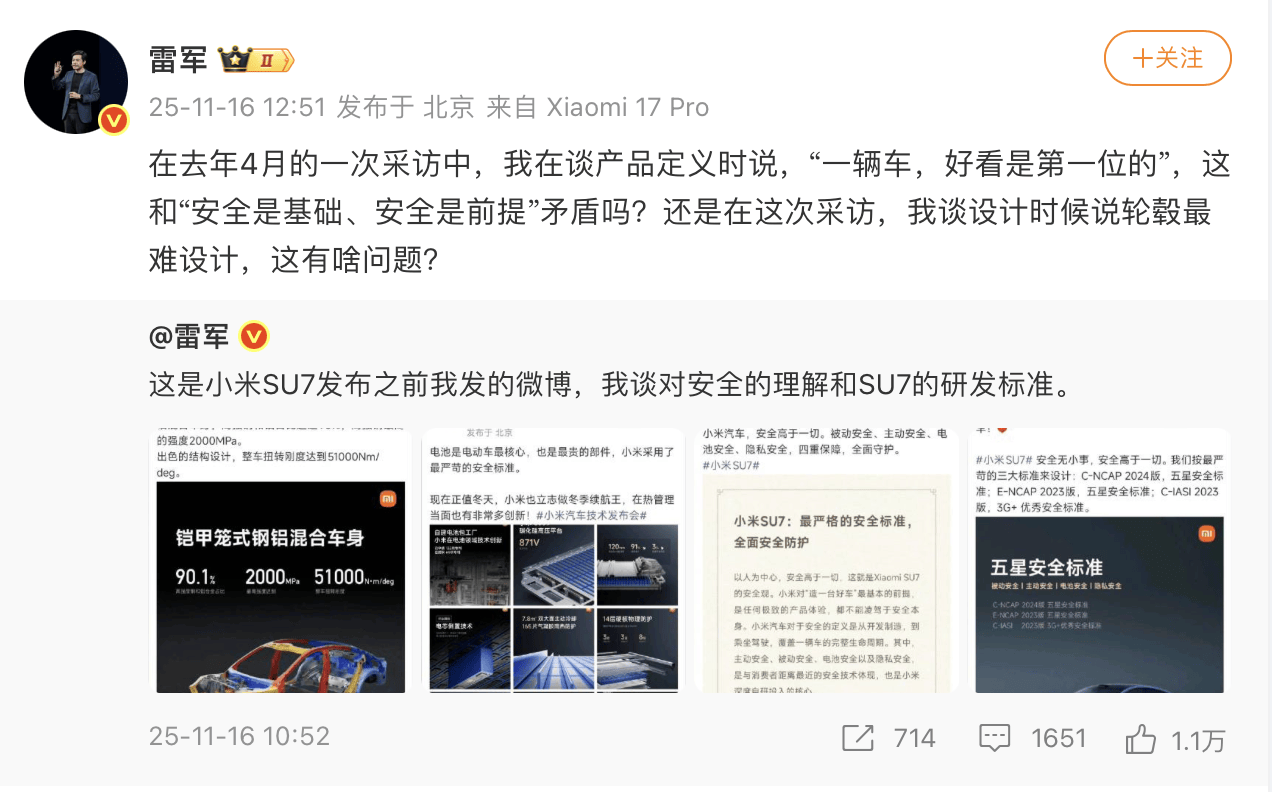
雷军连发微博谈小米汽车:好看和安全并不矛盾,有人歪曲抹黑
Sou Hu Cai Jing· 2025-11-16 10:20
Core Viewpoint - The founder and CEO of Xiaomi, Lei Jun, addressed concerns regarding the safety of Xiaomi's vehicles, particularly the Xiaomi SU7, emphasizing that aesthetics and safety are not mutually exclusive [1][5]. Group 1: Safety Standards and Design - The Xiaomi SU7 is designed with the 2024 version of C-NCAP five-star, 2023 version of Euro NCAP five-star, and C-IASI 3G+ as its safety benchmarks, covering passive safety, active safety, battery safety, and privacy safety [11]. - The vehicle's structure utilizes a steel-aluminum hybrid body with a high-strength steel and aluminum alloy ratio of 90.1%, achieving a maximum strength of 2000MPa and a torsional rigidity of 51,000 N·m/deg [11]. Group 2: Battery Safety Features - Xiaomi has developed its own battery pack factory, implementing 14 layers of physical protection, 17 layers of high-voltage insulation, dual large-area active cooling, and 165 pieces of aerogel insulation material to ensure safety during thermal runaway [11]. Group 3: Market Performance - In October, Xiaomi's automotive division ranked eighth in the retail sales of new energy vehicle companies, with a retail volume of 48,654 units, marking a year-on-year increase of 134.7% and achieving over 40,000 deliveries for two consecutive months [11].


机动车安全新规征求意见:拟对“新能源汽车电池安全”及“机械门把手”等作出新规定
Cai Jing Wang· 2025-11-14 21:44
Core Viewpoint - The new national standard for vehicle operation safety, titled "Technical Conditions for Motor Vehicle Operation Safety," is being drafted by the Ministry of Public Security and is set to replace the existing GB 7258-2017 standard after a six-month public consultation period [1][7]. Group 1: Key Changes in the Draft - The draft introduces multiple new requirements for vehicle safety devices, particularly addressing issues related to electric vehicles, such as battery safety and advanced driver assistance systems [7][12]. - A significant change includes the requirement for electric and hybrid vehicles to have a default acceleration state that limits performance upon startup, aiming to enhance driver preparedness and control [8][10]. - The draft specifies that passenger vehicles must have a default acceleration time of no less than 5 seconds to reach 100 km/h from a standstill [8][10]. Group 2: Safety Technology Regulations - New safety technology regulations include requirements for regenerative braking systems, pedal misapplication suppression features, and safety measures for in-vehicle entertainment systems [12][14]. - The draft mandates that electric and hybrid vehicles must monitor battery status and have the capability to cut off power circuits in emergencies [8][12]. - Additional regulations for advanced driver assistance systems include conditions for activation and deactivation, as well as requirements for driver engagement monitoring [12][14]. Group 3: Industry Implications - The revisions aim to address emerging challenges in road traffic safety, reflecting the need for updated regulations in light of the increasing prevalence of electric vehicles and advanced driving technologies [7][11]. - The changes are seen as a response to the growing sales of electric vehicles, which often have rapid acceleration capabilities that can pose risks to inexperienced drivers [10][11]. - The overall goal of the draft is to enhance the safety governance framework within the automotive industry, ensuring it evolves with technological advancements and market demands [7][14].
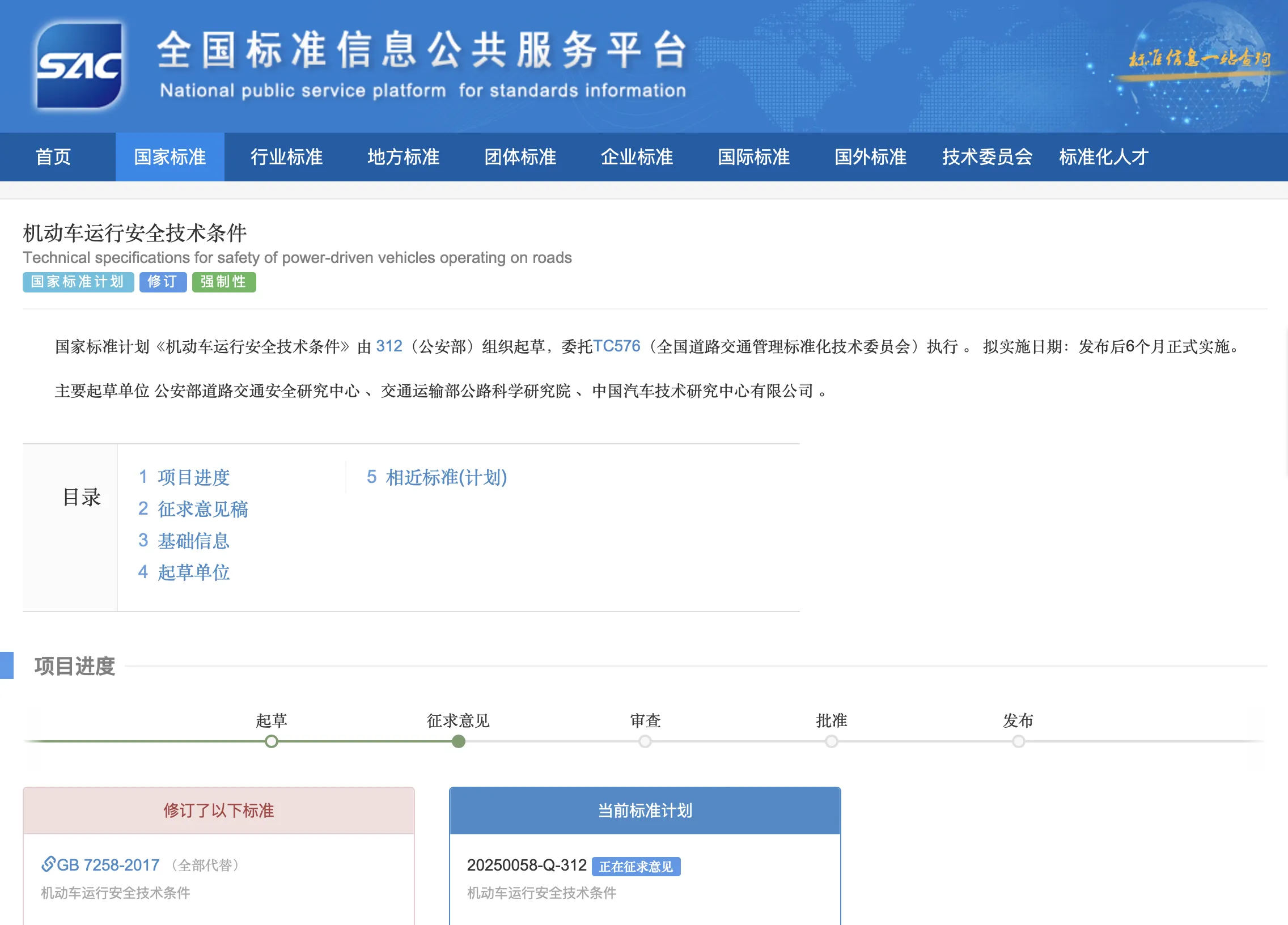
零百加速需≥5秒!汽车安全新国标意见征询,还涉旋转座椅等
Nan Fang Du Shi Bao· 2025-11-13 14:29
Core Viewpoint - The new national standard for motor vehicles in China aims to impose stricter regulations on performance and safety features of new energy vehicles, addressing concerns over rapid acceleration and safety mechanisms [1][2][3]. Group 1: New Standards Overview - The new national standard, titled "Motor Vehicle Operation Safety Technical Conditions," is open for public consultation starting November 10, 2023, and is set to be implemented six months after its release [1][5]. - This standard is a revision of the existing 2017 version, which has become inadequate in addressing the rapid development of new technologies and safety management needs in the automotive sector [1]. Group 2: Performance Regulations - A key requirement is that passenger vehicles must have a default acceleration time of no less than 5 seconds for 0 to 100 km/h after each ignition, aimed at reducing the risk of acceleration-related accidents [2]. - The rationale behind this regulation is to ensure that drivers are better prepared for high acceleration modes, thereby minimizing the likelihood of misuse [2]. Group 3: Safety Features - New regulations mandate that all car doors, except for the tailgate, must have mechanical release functions, ensuring that doors can be opened in emergencies, even if they are locked [3]. - The standard also addresses the safety of innovative seating designs, requiring that adjustable and rotating seats must be securely fixed in a forward position while the vehicle is in motion [3]. Group 4: Entertainment and Distraction Prevention - The new standard prohibits the use of entertainment systems that play videos or games when the vehicle is traveling over 10 km/h, aiming to reduce driver distraction [4]. - This regulation is part of a broader effort to enhance road safety by minimizing distractions from in-car entertainment systems [4]. Group 5: Battery Safety and Monitoring - The standard emphasizes the importance of battery safety, requiring that electric vehicles automatically cut off power in the event of significant speed changes or emergencies to prevent secondary accidents [4]. - Additionally, it mandates enhanced monitoring and warning systems for battery conditions, ensuring that any anomalies are detected and communicated effectively [4].