消费信贷

Search documents
Google deepens consumer credit push in India with UPI-linked card
Yahoo Finance· 2025-12-17 10:00
Core Insights - Google is entering the consumer finance sector in India by launching a UPI-linked credit card, Flex by Google Pay, in partnership with Axis Bank, targeting a market with over 1.4 billion people and fewer than 50 million credit card holders [1][2] Group 1: Product Features - Flex by Google Pay is issued digitally through the Google Pay app and can be utilized for both online and physical transactions, built on the RuPay network [3] - The card features a rewards program that credits virtual "Stars" for transactions, with each Star valued at ₹1, and allows users to manage spending, repayments, and security settings within the app [3] Group 2: Market Context - The rapid adoption of digital payments in India through the UPI has not yet resulted in widespread access to credit, creating opportunities for tech companies and banks to integrate lending into payment apps [2] - The Indian credit card market has been growing at an annual rate of approximately 14% over the past three years, with outstanding cards reaching around 110 million and transaction volumes increasing by nearly 30% [7] Group 3: Strategic Partnerships - Google Pay has previously partnered with banks and non-bank lenders to offer personal and gold-backed loans, leveraging its position as a widely used UPI platform to enhance credit access [4] - While starting with Axis Bank, Google plans to onboard additional issuer partners to broaden its co-branded credit card offerings in India [5]

腾讯给“分付”备了百亿“弹药”
3 6 Ke· 2025-12-15 04:03
Core Viewpoint - Tencent's subsidiary, Shenzhen Financial Payment Network Small Loan Co., Ltd. (referred to as "Financial Payment Small Loan"), has received regulatory approval for a capital increase of 4.5 billion yuan, raising its registered capital to 15 billion yuan, marking a 50-fold increase over five years through six rounds of capital increases [1][4]. Group 1: Capital Increase and Regulatory Impact - The increase in registered capital allows Financial Payment Small Loan to leverage a maximum of 750 billion yuan in lending capacity based on the regulatory "1+4" financing leverage rule [1]. - Following the capital increase, Financial Payment Small Loan ranks second among national online small loan institutions, only behind ByteDance's Zhongrong Small Loan Co., Ltd., which has a registered capital of 19 billion yuan [2]. - The capital increase trend among internet small loan companies is driven by both regulatory logic and business needs, with 12 companies having registered capital exceeding 5 billion yuan as of July 2025 [2]. Group 2: Regulatory Framework - The regulatory framework for online small loans has evolved since the draft of the "Interim Measures for the Management of Online Small Loan Business" was released in November 2020, establishing a capital requirement of 5 billion yuan for cross-provincial operations [4]. - The new regulations, effective January 2025, focus on business norms and regional management, tightening requirements for the capital contribution ratio in joint loans with banks to a minimum of 30% [4]. Group 3: Product Development and Market Position - Financial Payment Small Loan offers two main products: "Fenfu," which allows for flexible repayment with a daily interest rate of 0.04%, and "Fengqi," which is designed for larger payments with fixed repayment terms [5][6]. - The "Fenfu" product has evolved from a consumption credit service to a cash loan service, allowing withdrawals to bank accounts, thus broadening its product offerings [7][8]. - As of June 2024, the loan balance for Financial Payment Small Loan was approximately 12.9 billion yuan, while the loan balance for WeChat's "Fenfu" reached 120 billion yuan by June 2025 [7]. Group 4: Financial Ecosystem and Performance - Tencent's financial ecosystem includes WeBank, which has become a significant profit contributor, with a net profit of 10.9 billion yuan in 2024, surpassing the combined net profits of 18 other private banks [9]. - The financial technology and enterprise services segment contributed 168.6 billion yuan in revenue in the first three quarters of 2025, becoming the second-largest revenue pillar for Tencent [11]. - The gross margin for the financial technology and enterprise services segment improved from 28% in 2020 to 50% in the third quarter of 2025, indicating a positive shift in revenue structure [10].


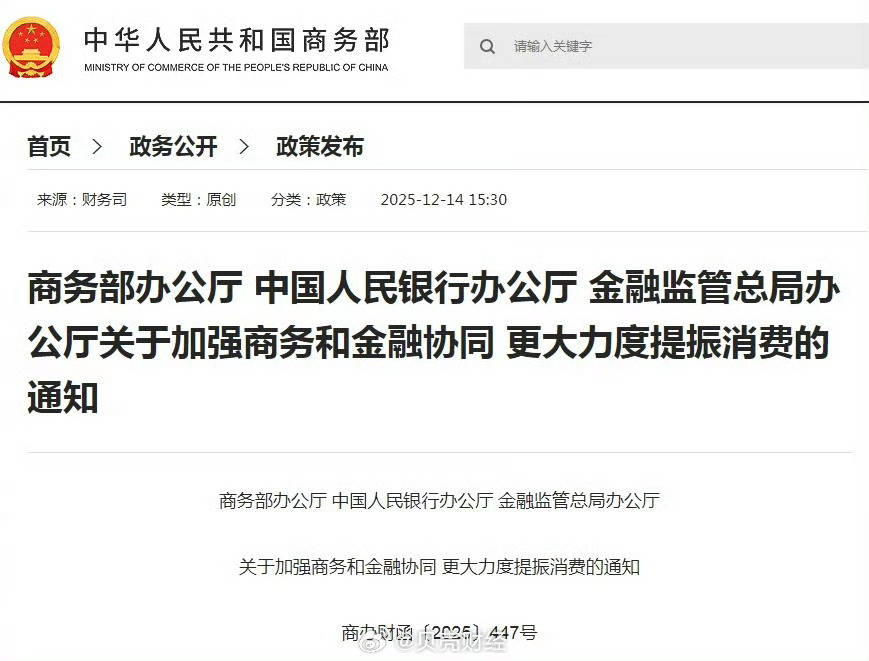
三部门联合发文加大消费信贷投放
Sou Hu Cai Jing· 2025-12-14 13:25
Core Viewpoint - The joint initiative by the Ministry of Commerce, the People's Bank of China, and the Financial Regulatory Bureau aims to enhance consumer spending through coordinated financial and business policies, encouraging credit funds to be directed towards key consumption areas [1] Group 1: Policy Coordination - The notification emphasizes the importance of policy synergy, urging local commerce departments to leverage existing funding channels to actively promote consumption activities [1] - It encourages localities to utilize digital RMB smart contract red envelopes to improve the effectiveness of consumption promotion policies [1] Group 2: Financial Support Mechanisms - The document suggests exploring various methods such as financing guarantees, loan interest subsidies, and risk compensation to strengthen the collaboration between fiscal, business, and financial policies [1] - It aims to guide credit funds to increase investment in key consumption sectors [1] Group 3: Focus on Specific Consumption Areas - Localities are encouraged to support participation in key projects related to health and wellness, cultural tourism, and new consumption areas such as digital and green sectors [1] - Banks and non-bank financial institutions are urged to leverage their unique strengths and collaborate in consumption promotion activities to enhance the quality and upgrade of consumption [1]
2025年中国网络助贷行业研究报告
艾瑞咨询· 2025-12-05 00:03
Core Insights - The report outlines the development logic of the online lending industry in China, emphasizing the impact of the digital economy, with projections indicating that by 2025, the number of internet users will reach 1.12 billion and the balance of narrow consumer loans (excluding housing) will be 21.7 trillion yuan in 2024 [1] - The online lending market is expected to grow to 3.5 trillion yuan in 2024, with a concentration ratio (CR5) of 76%, driven by credit enhancement and profit-sharing models, while risk control, capital acquisition, and customer acquisition remain core competencies [1][17] - The report highlights a shift in consumer behavior, with more users migrating from premium loan platforms to sub-premium ones, indicating a growing reliance on credit in daily life [10][11] Industry Overview - The number of internet users in China has surged from less than 100 million in 2004 to an expected 1.12 billion by 2025, significantly reshaping social and economic interactions [2] - Financial services are increasingly penetrating everyday life, with consumer credit becoming a staple for Chinese residents, contrasting with the historical context of Japan's economic downturn [8][10] Market Dynamics - The balance of narrow consumer credit in China has risen from 14.9 trillion yuan in 2019 to 21.7 trillion yuan in 2024, driven by government stimulus and recovering consumer demand post-pandemic [15] - The share of credit card balances in narrow consumer loans has decreased from 51% to 40%, while the online lending sector is expected to rebound in 2024, contributing significantly to consumer loan growth [15][17] Business Models - The primary business models in the online lending sector include credit enhancement cooperation and profit-sharing cooperation, with the former focusing on risk control and the latter on customer acquisition and service efficiency [23] - The report emphasizes the importance of core competencies such as customer acquisition, risk control, and capital acquisition in determining the competitive advantage of lending platforms [25][34] Regulatory Environment - Recent regulatory changes aim to stabilize the financial market by enforcing stricter compliance and risk management standards for online lending platforms, which may impact profit margins and operational strategies [37][41] - The new regulations are expected to reduce profit margins for loans above 24%, with estimates suggesting a decline of 3% to 6% in profitability for many platforms [45][48] Future Trends - The report anticipates a shift towards more diversified financial services and a potential increase in the volume of loans below 24% as platforms adapt to regulatory changes [54] - The competitive landscape is likely to evolve, with larger platforms benefiting from established customer bases and operational efficiencies, while smaller players may struggle to survive [49][51]

亚马逊(AMZN.US)、Flipkart进军印度消费信贷领域 正面挑战本土银行
智通财经网· 2025-11-28 12:21
Core Insights - Amazon is preparing to launch small business loan services in India, while Walmart's Flipkart plans to introduce Buy Now Pay Later (BNPL) products, indicating a competitive challenge to local banks by these e-commerce giants [1][2] - Amazon acquired Bangalore-based non-banking lending institution Axio earlier this year, which will restart small business credit services and introduce cash management solutions [1] - Flipkart plans to offer two types of BNPL products: interest-free installment loans for online shoppers and loans for durable goods with interest rates ranging from 18% to 26%, compared to traditional lenders' rates of 12% to 22% [2] Company Developments - Amazon's VP of Emerging Markets Payments, Mahendra Nerurkar, highlighted the significant growth potential in India's credit market, especially among digitally savvy consumers and small businesses outside major cities [1] - Flipkart has registered its non-banking lending subsidiary, Flipkart Finance, and is awaiting final approval from the Reserve Bank of India (RBI) for its business plans [1][2] - Amazon has partnered with six local lending institutions to offer fixed deposit savings products on its Amazon Pay platform, with a minimum deposit of 1,000 rupees (approximately $11) [3] Market Context - The Indian consumer credit market has grown from nearly $80 billion in March 2020 to approximately $212 billion by March 2025, although growth has shown signs of slowing in recent quarters [2] - Both Amazon and Flipkart's payment applications rank among the top ten on India's Unified Payments Interface (UPI) platform, benefiting from a recent RBI policy allowing them to lend directly to customers through wholly-owned subsidiaries [2]

央行北京分行等12部门,最新发布!
Zheng Quan Shi Bao Wang· 2025-11-18 08:44
(原标题:央行北京分行等12部门,最新发布!) 二、加大重点领域金融支持,挖掘消费潜力 (一)加大商品消费信贷支持力度。积极开展汽车贷款业务,合理确定贷款发放比例、期限和利率,适 当减免汽车以旧换新过程中提前结清贷款产生的违约金。引导金融机构针对首次购买、以旧换新、二手 车等不同购车场景优化创新金融产品,加大对汽车特别是新能源汽车消费的金融支持力度。鼓励金融机 构积极满足家电以旧换新、绿色智能家居家装、电子产品等领域消费金融需求,通过多种形式参与商家 促消费活动,提供消费贷款、信用卡分期费率优惠等活动,为消费者适当减费让利。 (二)促进文旅体育消费提质升级。依托首都作为全国文化中心和国际交往中心的功能定位,深挖历史 文化特色资源,围绕全民阅读、文艺演出、直播探店、非遗传承、乡村文旅、民俗文创等领域和北京消 费季"京彩四季"主题活动,创新融资模式,加大信贷投放力度。更好发挥东城区国家文化与金融合作示 范区的引领示范作用,提升辖内银行文化金融服务能力。充分发挥首都"双奥之城"优势,鼓励金融机构 围绕"赛事+"、冰雪经济等消费场景丰富金融产品,探索开展"门票收益权质押"等融资模式,着力培育 精品赛事体系和赛事运营企 ...
北京:鼓励符合条件的科创企业通过债券市场募集资金
Mei Ri Jing Ji Xin Wen· 2025-11-18 08:03
Core Viewpoint - The People's Bank of China and 12 other departments have issued a plan to enhance and expand consumption in Beijing through financial support measures, focusing on bond market financing and consumer credit expansion [1] Group 1: Financial Support Measures - The plan emphasizes increasing financing support in the bond market for eligible enterprises in cultural, tourism, and education sectors [1] - It encourages qualified technology innovation enterprises to raise funds through the bond market to enhance the quality of smart elderly care and smart medical products [1] - Financial debt issuance is supported for eligible consumer finance companies, auto finance companies, and financial leasing companies to broaden funding sources and expand consumer credit [1] Group 2: Consumer Credit Expansion - The initiative promotes the securitization of retail loans, including personal auto loans, consumer loans, and credit card loans, to increase the supply capacity of consumer credit [1] - The goal is to activate existing credit stock and enhance the overall consumer credit environment [1]
2025年中国网络助贷行业研究报告
艾瑞咨询· 2025-11-17 00:03
Core Insights - The report outlines the development logic of the online lending industry in China, emphasizing the impact of the digital economy and projected growth in user base and credit balance by 2025 [1][2] - It highlights the shift in consumer behavior towards credit, with non-housing consumer loans expected to reach 21.7 trillion yuan by 2024, and the online lending market projected to grow to 3.5 trillion yuan [1][8] - The report indicates that regulatory changes may lead to a profit decline of 3%-6% for over 24% interest rate businesses, prompting platforms to diversify their financial services [1][13] Industry Growth and Trends - By 2025, the number of internet users in China is expected to reach 1.12 billion, significantly influencing the digital economy and consumer credit behavior [2] - The online lending market is characterized by a high concentration, with the top five players holding a 76% market share in 2024, indicating a trend towards increased market consolidation [1][17] Consumer Behavior and Credit Usage - Credit has become an integral part of daily life for Chinese residents, with a notable increase in non-housing consumer credit despite a decline in housing loan balances [8][10] - The proportion of subprime loans has risen from 11.3% at the end of 2021 to 12.6% by the end of 2024, indicating a shift of users from prime to subprime lending platforms [11] Regulatory Environment - The new regulations aim to stabilize the financial market by enforcing stricter compliance and risk management practices among lending platforms [13][41] - The regulations are expected to reduce the profitability of loans with interest rates above 24%, leading to a potential market contraction for these products [45][48] Business Models and Competitive Landscape - The primary business models in the online lending sector include "credit enhancement cooperation" and "profit-sharing cooperation," which reflect the evolving nature of risk management and revenue generation [23] - Platforms are increasingly focusing on enhancing their core competencies in customer acquisition, risk control, and funding access to maintain competitive advantages [25][30] Financial Performance and Challenges - The report notes that the balance of narrow consumer credit in China has grown from 14.9 trillion yuan in 2019 to 21.7 trillion yuan in 2024, driven by government stimulus and recovering consumer demand [15] - The profitability of platforms operating in the 24% interest rate range is under pressure due to rising costs and regulatory constraints, with many smaller players facing potential losses [45][51]

三季度信贷投向显韧性 普惠、科创、消费构筑金融支持新格局
Jing Ji Guan Cha Wang· 2025-10-24 10:53
Core Insights - The People's Bank of China reported a slowdown in the growth of RMB loans, with a balance of 270.39 trillion yuan at the end of Q3 2025, reflecting a year-on-year growth of 6.6%, down from 7.1% at the end of Q2 [1] - The report highlights a significant transformation in the credit structure, with funds being directed towards key areas of the national economy and weaker sectors [1] Group 1: Inclusive Micro Loans - The balance of inclusive micro loans reached 36.09 trillion yuan by the end of Q3, showing a year-on-year growth of 12.2%, slightly down from 12.3% in Q2 [2] - In Q3, 3.15 trillion yuan was added in new inclusive micro loans, with 520 billion yuan added in Q3 alone, lower than the approximately 730 billion yuan added in Q2 [2] - The focus of inclusive micro loans is shifting from rapid expansion to stable coverage, emphasizing service depth and accessibility [2] Group 2: Technology Loans - By the end of Q3, 27.54 million technology SMEs received loan support, with a loan acquisition rate of 50.3%, up from 50% in Q2 [3] - The loan balance for technology SMEs reached 3.56 trillion yuan, with a year-on-year growth of 22.3%, slightly down from 22.9% in Q2 [3] - The number of high-tech enterprises receiving loans was 26.66 million, maintaining a stable loan acquisition rate of 57.6% [3] Group 3: Non-Housing Consumer Credit - The balance of household loans in both domestic and foreign currencies was 83.94 trillion yuan, with a year-on-year growth of 2.3%, down from 3% in Q2 [4] - Consumer loans excluding housing reached 21.29 trillion yuan, growing by 4.2% year-on-year, with 3.062 trillion yuan added in the first three quarters [4] - The balance of household operating loans was 25.21 trillion yuan, reflecting a year-on-year growth of 4.8%, indicating active financing demand from small business operators [4] Group 4: Structural Changes in Credit - The report indicates a structural differentiation in credit data, illustrating the macro picture of China's economic transformation [4] - As traditional credit engines slow down, sectors like inclusive finance, technology, and green loans are expected to take on more responsibility in supporting the real economy [4] - The transition in credit structure is seen as a result of policy guidance and a natural selection of market dynamics, moving from asset collateral logic to value creation logic [4] Group 5: Challenges and Future Outlook - The adjustment in inclusive loan growth suggests emerging sustainability boundaries, while technology loans face long-term risk pricing challenges [5] - The ongoing contraction in real estate loans and the slowdown in traditional infrastructure loans are reshaping the entire credit creation mechanism [5] - Future policy design should focus on institutional building and long-term mechanisms to ensure financial resources are efficiently directed towards the real economy [6]
银行发力双11!24期免息+满减返现 国有行城商行齐放大招
Bei Ke Cai Jing· 2025-10-24 03:16
Group 1 - Major state-owned banks and city commercial banks are launching various promotional offers such as card binding discounts, interest-free installments, and cashback in collaboration with e-commerce platforms ahead of the "Double 11" shopping festival [1][2][10] - The promotional activities are designed to attract consumers and stimulate consumption growth, with consumer loans and installment products being key tools due to their small amounts and convenience [1][15] - China Bank has partnered with Alipay to offer a consumption discount activity for users who bind their savings cards, providing random discounts for purchases during the promotional period [3][4] Group 2 - Various banks, including China Bank and Ping An Bank, are offering credit card payment discounts, with China Bank's "Installment Enjoy Discount" program providing up to 300 yuan in discounts and interest-free installments for up to 24 months [5][8] - City commercial banks like Suzhou Bank and Guiyang Bank are also participating in the promotional activities, offering discounts for credit card users and collaborating with Alipay for additional benefits [9][10] - Alipay has introduced a "Daily Discount for Bank Cards" program, allowing users to enjoy discounts for a specified number of days after registration, with participation from several major banks [10][14] Group 3 - The competitive landscape includes traditional banks facing off against popular payment options like Huabei and JD Pay, with banks leveraging their lower financing costs and broader customer base as competitive advantages [17] - However, banks face challenges in convenience and user data accumulation compared to online payment platforms, which offer quicker approval processes and targeted marketing [18] - The banking sector is experiencing pressure on net interest margins, with the average net interest margin reported at 1.42% as of the second quarter, indicating ongoing challenges in profitability [19]