社会主义

Search documents
央行公布2026年普通纪念币、贵金属纪念币项目发行计划!
Sou Hu Cai Jing· 2025-12-09 08:12
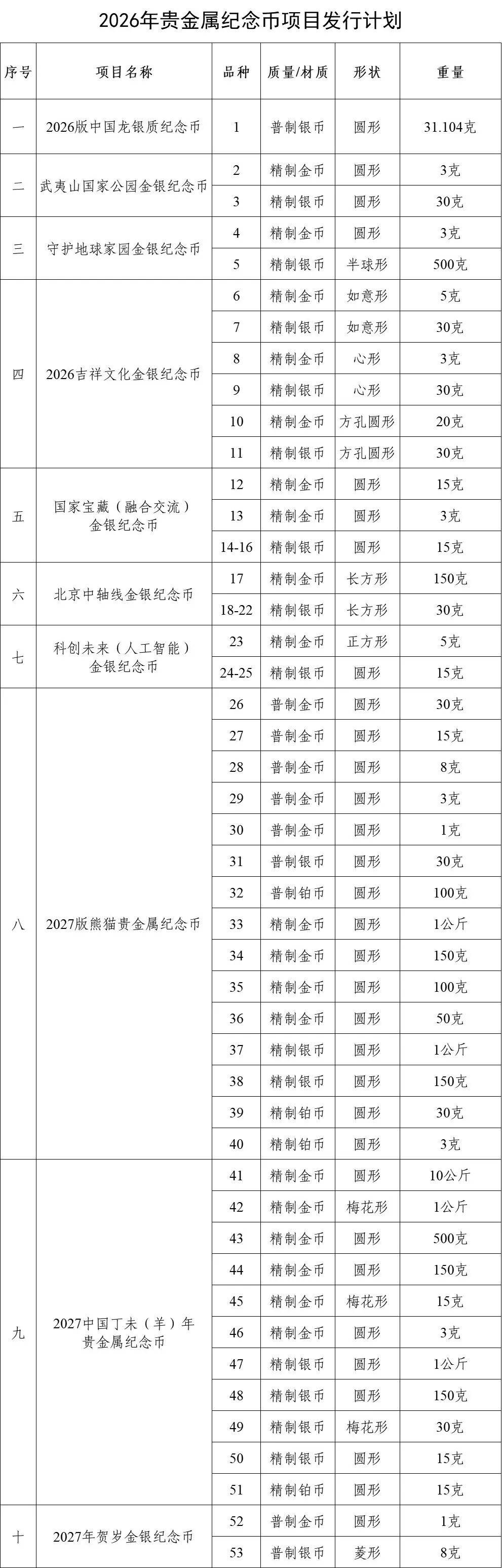
Group 1 - The People's Bank of China plans to issue a total of 1 ordinary commemorative coin and 1 commemorative banknote for the year 2026, along with additional coins celebrating Wuyi Mountain National Park and Chinese Peking Opera [1] - The issuance plan for precious metal commemorative coins includes 10 projects and 53 varieties for 2026, highlighting significant cultural and environmental themes [1] - The issuance plan is subject to adjustments based on the needs of promoting socialism, patriotism, and commemorating the achievements of China's economic and social development [1][2] Group 2 - Specific projects for the 2026 precious metal commemorative coins include the 2026 version of the Chinese Dragon silver coin, Wuyi Mountain National Park gold and silver coins, and the "Guarding the Earth Home" gold and silver coins [1][2] - The detailed specifications for the coins include various shapes, weights, and materials, such as the 31.104 grams for the Chinese Dragon silver coin and 3 grams for the Wuyi Mountain gold coin [3][5] - The 2027 series will also feature a panda precious metal commemorative coin and a coin for the Year of the Sheep, with multiple weight options ranging from 1 kilogram to 3 grams [6]

AI的宏观悖论与社会主义全球化
Huafu Securities· 2025-10-27 03:16
Core Insights - The report argues that regardless of whether AI represents a true technological revolution, it will inevitably exacerbate the inherent contradictions of the current U.S. capitalist framework, potentially leading to either a short-term financial crisis or a long-term deflationary environment with intensified social conflicts [3] - The technological revolution is characterized as a deflationary process, where capital seeks profit through innovation, but the macroeconomic outcome of innovation diffusion results in declining profit margins, creating a paradox between micro rationality and macro outcomes [3][4] - The impact of technological advancements on demand is uncertain, with the net effect of technological progress on employment being a complex interplay of substitution, restoration, and enhancement effects [3][13] - The current AI revolution is showing a suppressive effect on demand, contrasting with the previous internet revolution that boosted labor shares; the AI revolution is characterized by stronger substitution effects and delayed restoration effects [3][11] - The systemic challenges faced by the U.S. in developing AI stem from a fragile "impossible trinity" that requires lower interest rates, larger fiscal stimuli, and a stable dollar credit system to work in tandem [3][12] Theoretical Framework: Capitalist Perspective on Technological Revolution - The essence of technological revolution is driven by capital's pursuit of profit, where firms innovate to lower costs and achieve excess profits, but competition leads to overall industry productivity increases, resulting in declining profit margins [9][10] - The relationship between the organic composition of capital and profit margins is negatively correlated, confirming Marx's view that an increase in the organic composition of capital generally leads to a decline in profit margins [9][10] Historical Validation: Unique Path of U.S. Technological Revolution - The period from 1947 to 1987 was characterized by a balance between substitution and restoration effects, maintaining stable labor shares and wage growth in line with productivity [23][24] - In contrast, from 1987 to 2017, the acceleration of automation and a slowdown in the creation of new tasks led to a decline in labor shares and a decoupling of wage growth from productivity [30][31] Current Application: Is AI a True Technological Revolution? - The report questions whether the current AI investments can replicate the labor demand dynamics seen during the internet revolution, highlighting that the AI sector's growth may not translate into broad-based labor demand increases [76][80] - The potential for AI to create new tasks is limited by the current pace of technological maturity and market demand, leading to a scenario where the substitution effect may dominate, resulting in sustained pressure on labor demand [90][91] Future Projections: Two Scenarios Under AI - If AI is not a true revolution, it may lead to a narrative collapse and a potential market bubble burst, with significant risks of recession as market confidence wanes [88] - Conversely, if AI is a genuine revolution, it could exacerbate existing contradictions and lead to long-term deflation, as the disparity between capital gains and labor income widens, resulting in insufficient demand to match production capacity [90][91]
朝鲜举行盛大阅兵式,现场视频→
Zhong Guo Ji Jin Bao· 2025-10-11 01:18
Core Points - North Korea held a grand military parade on October 10 to celebrate the 80th anniversary of the Workers' Party of Korea [1][4] - Kim Jong-un, the General Secretary of the Workers' Party, delivered a speech during the parade, attended by various international dignitaries [3][4] Summary by Sections Celebration Events - The 80th anniversary celebration of the Workers' Party took place at the May Day Stadium in Pyongyang on October 9, with Kim Jong-un delivering a commemorative speech [4] - A large group performance and cultural event were also held on the evening of October 9 [4] Key Messages from Kim Jong-un - Kim Jong-un highlighted the party's history and its role in leading social transformations, emphasizing the establishment of a true people's state and the realization of socialist ideals [4] - He stated that the Workers' Party has maintained its commitment to autonomy and socialism despite severe adversities, enhancing North Korea's international standing as a stronghold of justice [4] - Kim called for efforts to build a more prosperous and beautiful socialist paradise in North Korea alongside the people [4]
资本主义病了,得治
Hu Xiu· 2025-09-29 08:09
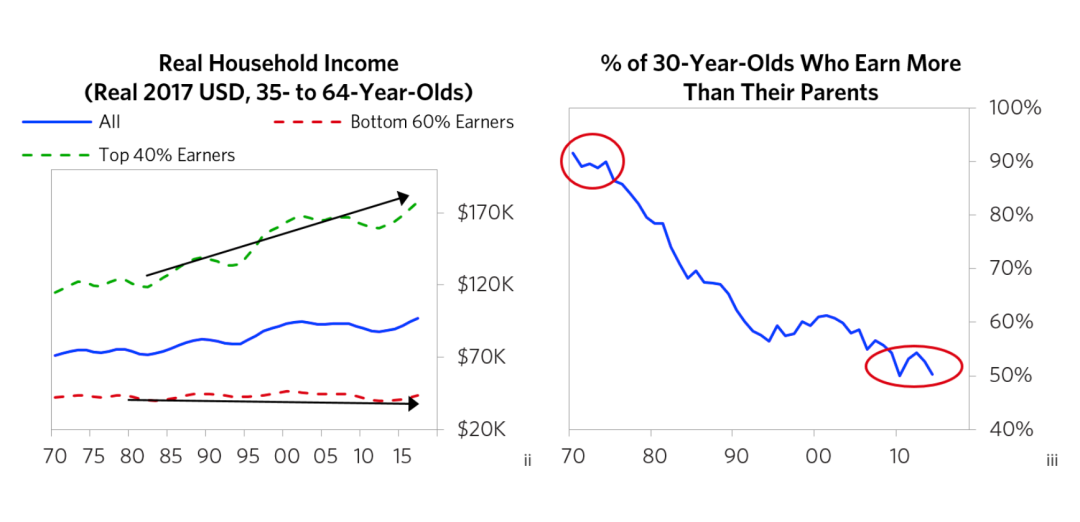
Core Insights - The article discusses the failures of capitalism in the United States, particularly highlighting the widening income and wealth gaps that have accelerated during the pandemic and post-pandemic era [1][2][5][15]. Economic Disparities - The article presents data showing that the real income of the bottom 60% of workers has stagnated since 1980, while the top 10% and 1% have seen their incomes double [19][21][28]. - The wealth gap is at its highest level since the late 1930s, with the top 1% holding more wealth than the bottom 90% combined [25][31]. - The likelihood of children earning more than their parents has dropped from 90% in 1970 to 50% today, indicating reduced economic mobility [23][38]. Education and Opportunity - The article emphasizes the importance of equal educational opportunities, noting that children from low-income families face significant disadvantages, including higher rates of poverty and food insecurity [44][45][46]. - The U.S. education system ranks poorly in standardized tests compared to other developed countries, particularly affecting students from high-poverty schools [48][49][52]. - There is a significant disparity in funding between public schools in wealthy and poor communities, exacerbating educational inequalities [68][70]. Social and Economic Consequences - The article argues that the widening income and wealth gaps lead to social unrest and political polarization, with rising populism on both the left and right [97][104][105]. - The increasing incarceration rates and their correlation with educational attainment highlight the systemic issues affecting low-income families [82][84][85]. - Health outcomes are also negatively impacted, with lower-income individuals experiencing higher rates of premature death and poorer health [88][89][91]. Recommendations for Reform - The article suggests that reforms are necessary to address the failures of capitalism, including the need for strong leadership to tackle income and wealth disparities [136][137]. - It advocates for bipartisan cooperation to redesign the economic system, focusing on equitable resource distribution and improving productivity [138][139]. - The establishment of clear metrics for success and accountability in addressing these issues is emphasized as crucial for effective reform [140][141].
加强协调配合,反对霸权主义,中朝外长在京举行会谈
Huan Qiu Shi Bao· 2025-09-28 23:49
Group 1 - Wang Yi emphasized the importance of maintaining and developing China-North Korea relations as a strategic priority for the Chinese government, highlighting the historical friendship between the two countries [1] - The recent meeting between Xi Jinping and Kim Jong-un provided a clear direction and blueprint for the development of China-North Korea relations, with a focus on enhancing strategic communication and cooperation [1] - Both countries share common ideals and goals as socialist states, which can facilitate the exchange of governance experiences to support their respective socialist developments [1] Group 2 - Wang Yi noted the current international situation is complex, with power politics posing significant threats, and expressed appreciation for North Korea's support of China's core interests and initiatives [2] - North Korea's Foreign Minister Choe Son-hui acknowledged China's historical achievements and international status, emphasizing the importance of deepening China-North Korea relations [3] - Choe expressed North Korea's commitment to implementing the consensus reached by the highest leaders of both parties and enhancing practical cooperation to elevate bilateral relations [3] Group 3 - Choe Son-hui's visit marks her first solo trip to China since becoming Foreign Minister in June 2022, indicating a significant diplomatic engagement between the two nations [4] - The discussions are expected to focus on the implementation of outcomes from the recent summit between the leaders of China and North Korea, as well as strategies to address regional issues [4] - The timing of Choe's visit coincides with recent diplomatic activities involving South Korea, highlighting the dynamic nature of regional diplomatic relations [4]
坚持,全靠坚持(大家谈人生)
Ren Min Ri Bao· 2025-09-23 22:33
Core Points - The article reflects on the author's lifelong commitment to writing and learning, emphasizing the importance of perseverance and hard work in achieving success [1][3][10] - It highlights the author's journey from childhood aspirations to becoming a published author, with significant works like "Youth Forever" and its enduring impact over decades [4][5][6] Group 1: Personal Journey and Achievements - The author began writing at a young age, inspired by family and literature, and aimed to become a "professional revolutionary" [2][3] - "Youth Forever" was completed after years of effort and was finally published in 1979, marking a significant milestone in the author's literary career [4][6] - The book has seen multiple editions and translations, indicating its lasting popularity and relevance [5][6] Group 2: Philosophy on Learning and Health - The author emphasizes the value of continuous learning and adaptation, stating that knowledge enhances confidence and resilience [8][9] - Physical health is also highlighted as crucial for sustaining a productive life, with the author maintaining a rigorous exercise routine for decades [9][10] - The article advocates against complacency, encouraging a proactive approach to life and learning, and dismissing the notion of "lying flat" as a response to challenges [10]
谁打败了法西斯?西方在撒谎,我们必须揭示真相
Hu Xiu· 2025-09-03 01:50
Core Argument - The article argues that the true victors of World War II were the Soviet Union and the Chinese people, who made significant sacrifices, contrary to the narrative that emphasizes the contributions of Western powers like the United States and the United Kingdom [2][8]. Group 1: Historical Context - The article asserts that the real beginning of World War II was marked by Japan's invasion of Northeast China in 1931, rather than Germany's invasion of Poland in 1939 [3][4]. - It highlights that while the Western powers were calculating their economic interests, the Soviet Union and China were engaged in a fierce struggle against fascism, with the Soviet Union rapidly industrializing in preparation for war [2][3][4]. Group 2: Economic and Military Contributions - The article presents data showing that in 1941, the United States controlled approximately 22% to 24% of global GDP, while the Soviet Union and China together accounted for only about 8% [21][23]. - It emphasizes that the Soviet Union allocated 28% of its GNP to military spending by 1941, while the United States maintained a relatively low military expenditure until the attack on Pearl Harbor [21][23][27]. Group 3: Casualties and Sacrifices - The article states that the total death toll from the war was approximately 82.62 million, with 62% of the casualties coming from socialist countries and colonies, while only 1% were from the United States and the United Kingdom [45][46][75]. - It details the staggering losses suffered by the Soviet Union, with around 27 million deaths, and China, which experienced at least 36 million deaths during the war [48][50][51]. Group 4: Misrepresentation of Contributions - The article argues that the narrative surrounding the war has often downplayed the contributions of the Soviet Union and China while exaggerating the roles of Western powers [2][8][82]. - It criticizes the Western powers for their delayed military engagement and prioritization of imperial interests over genuine anti-fascist efforts [21][22][27].

铭记历史 缅怀先烈|邓永耀:身先士卒抗日寇 危难时刻显担当
Xin Hua She· 2025-08-06 07:43
Core Points - The article highlights the life and contributions of Deng Yongyao, an anti-Japanese hero, emphasizing his dedication to the Communist Party and his role in the revolutionary struggle [1][2][3] Group 1: Historical Background - Deng Yongyao was born on January 24, 1912, in a poor farming family in Hunan Province, excelling in his studies from a young age [1] - He joined the Communist Party in 1930 and took on various roles, demonstrating exceptional skills in writing and communication [1] Group 2: Military Contributions - In 1934, Deng participated in the Long March with the Red Army and later held significant positions in the military, including political commissar of the cavalry regiment of the 129th Division [1][2] - He led successful military operations against Japanese forces, notably destroying over 40 enemy vehicles during a mission [1][2] Group 3: Legacy and Commemoration - After his death in battle in 1939, Deng's contributions were widely recognized, with memorials established in his honor, including a commemorative article in the "Xinhua Daily" [2][3] - His story continues to be taught in schools, particularly at the Lenin School in Tea Ling County, where his ideals and commitment to youth are integrated into educational programs [3]
专访台湾大学哲学系教授苑举正:和平统一才是正途,需相信社会主义对未来的价值
Bei Jing Ri Bao Ke Hu Duan· 2025-05-30 01:28
Core Viewpoint - The article discusses the current state of cross-strait relations and critiques the policies of the Democratic Progressive Party (DPP) in Taiwan, emphasizing the importance of understanding sovereignty and cultural identity in the context of Taiwan's relationship with mainland China [4][5][6]. Group 1: Political Analysis - The DPP's comparison of cross-strait relations to "company mergers" is criticized as a misunderstanding of sovereignty, which is fundamentally about unity and not a commercial transaction [4]. - The DPP has been deemed ineffective since Lai Ching-te took office, with criticisms highlighting political instability, economic mismanagement, and divisive social policies [5]. - Lai Ching-te's remarks about Taiwan's relationship with Japan are labeled as historically inaccurate and a betrayal of Taiwan's historical ties to mainland China [5]. Group 2: Economic Context - The DPP's policies have led to significant economic consequences, such as the perceived loss of Taiwan Semiconductor Manufacturing Company (TSMC) to the United States and a decline in foreign exchange reserves [5]. - The DPP's restrictions on mainland tourists have further exacerbated economic difficulties for Taiwan [5]. Group 3: Social Dynamics - There is a division among Taiwanese citizens regarding their views on U.S. involvement in Taiwan's security, with some believing in U.S. protection, while others support peaceful unification with mainland China [6]. - The article highlights the need for a rational understanding of cross-strait relations, emphasizing that peaceful unification is the ideal path forward [6]. Group 4: Cultural and Ideological Perspectives - The importance of cultural confidence and the need for a stronger cultural identity in mainland China are discussed, with a call for a vision of unification that emphasizes integration rather than annexation [8]. - The article suggests that Taiwan's youth are influenced by the DPP's "de-Sinicization" policies, leading to a lack of understanding of mainland China [10]. Group 5: Media Landscape - The media environment in Taiwan is described as polarized, with distinct pro-unification and pro-independence outlets that do not cross-viewership, contributing to societal division [11]. - The article calls for mainland media to improve its narrative and engagement with Taiwanese citizens to foster better understanding and reduce misconceptions [10].