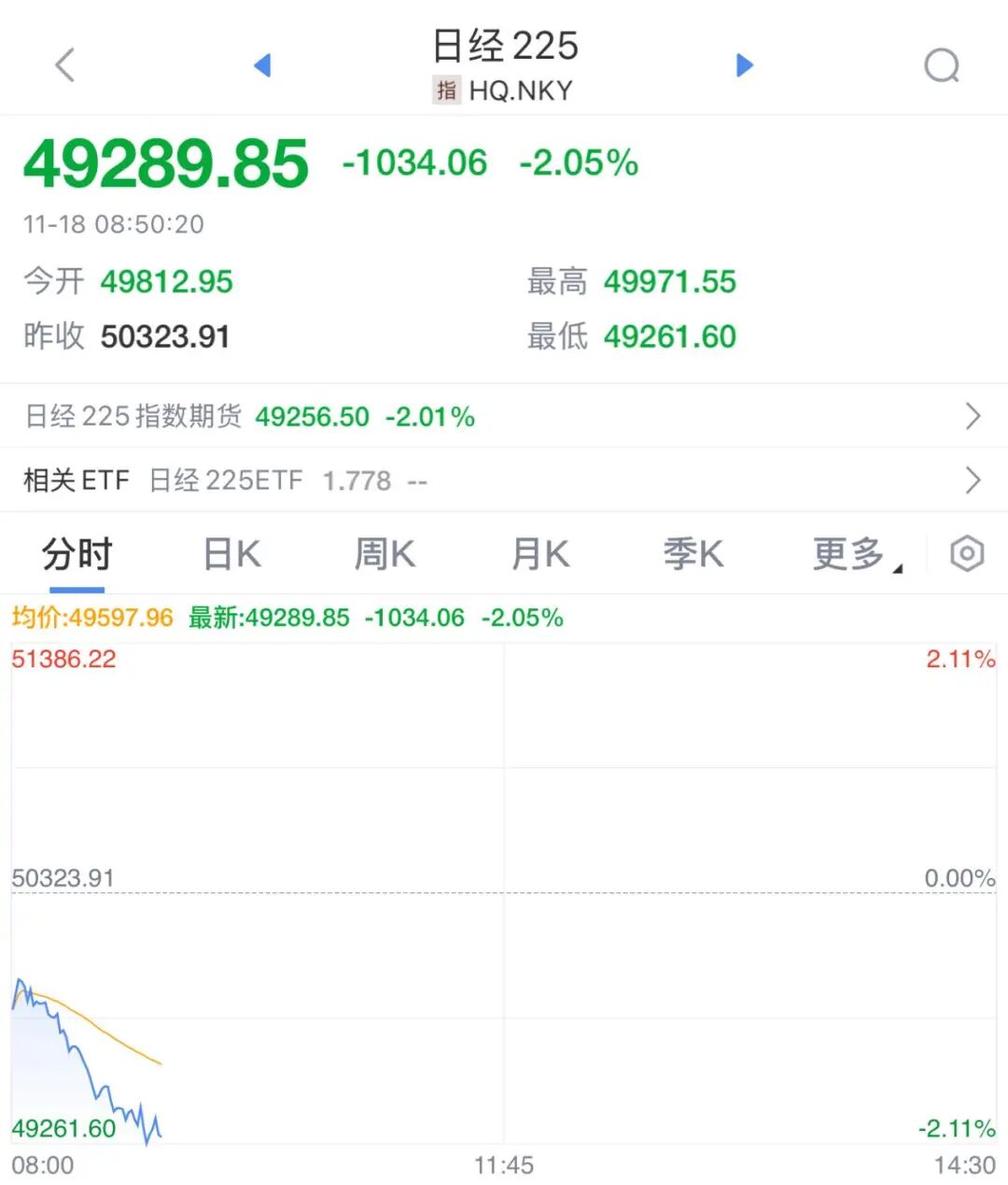
股市下跌

Search documents
日韩股市大跳水,软银跌11%,三星跌超4%,海力士跌超7%
21世纪经济报道· 2025-11-21 01:06
Market Overview - Global market risk aversion continues to escalate, with US stocks experiencing volatile trading, while Japanese and Korean stock markets opened with significant declines [1] - As of 8:40 AM Beijing time, the Nikkei 225 index fell over 2%, with SoftBank Group's stock dropping 11%, marking its largest single-day decline since November 5 [1][2] Japanese Stock Market Impact - The Nikkei 225 index closed at 48,699.16, down 1,124.78 points or 2.26% from the previous close [2] - The Korean Composite Index fell over 3%, with Samsung Electronics down over 4% and SK Hynix down over 7% [2] Employment Data and Economic Outlook - The delayed US September employment report indicated an increase of 119,000 jobs, surpassing economists' expectations, which has diminished investor hopes for a Federal Reserve rate cut in December [5] - Concerns over deteriorating Sino-Japanese relations have led to a decline in Japan's tourism-related stocks, with reports of a significant number of canceled orders from Chinese tourists [5] Economic Forecasts - Predictions suggest that the Chinese government's travel advisories could result in a loss of approximately 1.79 trillion yen (about 11.5 billion USD) in tourism revenue for Japan over the next year, potentially reducing Japan's real GDP by 0.29% [6]



连跌四日,东京股市两大股指继续承压
Sou Hu Cai Jing· 2025-11-19 09:35
Market Overview - The Tokyo stock market indices continued to decline on the 19th, with the Nikkei 225 index closing down by 0.34% and the Tokyo Stock Exchange index down by 0.17% [2][3] - Over the previous three trading days, the Nikkei index had accumulated a drop of over 2500 points, leading to increased buying activity among some investors in the morning session [2] Influencing Factors - The decline was influenced by a comprehensive drop in the three major U.S. stock indices overnight, as well as a cautious sentiment among investors ahead of Nvidia's earnings report [2] - Semiconductor-related stocks faced significant pressure, contributing to the overall weakness in the market [2] Sector Performance - By the close, the Nikkei index fell by 165.28 points to 48537.70 points, while the Tokyo Stock Exchange index decreased by 5.52 points to 3245.58 points [3] - Among the 33 industry sectors on the Tokyo Stock Exchange, sectors such as machinery, metal products, and fisheries and agriculture experienced notable declines, while sectors like petroleum and coal products, retail, and real estate showed gains [3] Investor Sentiment - Concerns regarding the deterioration of Sino-Japanese relations continued to weigh on the market, affecting companies with exposure to the Chinese market, such as Shiseido, Sushi郎, Sony Group, and Sanrio, which struggled to rebound and continued to decline [2] - Analysts indicated that the current situation makes the performance outlook for related companies uncertain, leading investors to potentially avoid these stocks [2]
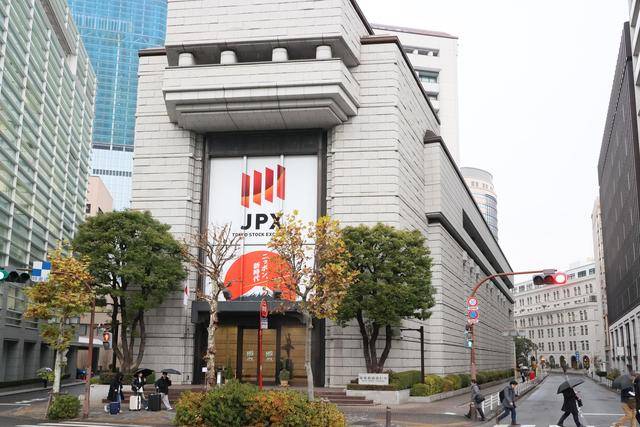
【环球财经】东京股市继续承压下跌
Xin Hua Cai Jing· 2025-11-19 07:52
Core Points - The Tokyo stock market indices continued to decline on November 19, with the Nikkei 225 index falling by 0.34% and the Tokyo Stock Exchange index down by 0.17% [1][2] - Over the previous three trading days, the Nikkei index had dropped more than 2500 points, leading to increased buying activity among some investors during the early session on the 19th [1] - Investor sentiment was affected by a comprehensive decline in the New York stock market and anticipation surrounding Nvidia's upcoming earnings report, resulting in pressure on semiconductor-related stocks [1] - Concerns over deteriorating Japan-China relations continued to impact the market, particularly affecting companies like Shiseido, Food & Life Companies, Sony Group, and Sanrio, which are sensitive to Chinese consumer behavior [1] - Analysts noted that the unclear performance outlook for these companies may lead investors to avoid these stocks until the situation improves [1] - Reports indicated that the Japanese government received notification from China about suspending imports of Japanese seafood, causing a significant drop in seafood and seafood-related stocks during the afternoon session [1] Market Performance - By the close, the Nikkei index fell by 165.28 points to 48537.70, while the Tokyo Stock Exchange index decreased by 5.52 points to 3245.58 [2] - Among the 33 industry sectors on the Tokyo Stock Exchange, sectors such as machinery, metal products, seafood, and agriculture faced the largest declines, while sectors like petroleum and coal products, retail, and real estate showed gains [2]
【环球财经】日经225指数重挫3.22% 东证33个行业板块无一上涨
Xin Hua Cai Jing· 2025-11-18 07:24
Core Points - The Tokyo stock market experienced a decline for three consecutive trading days, with the Nikkei 225 index falling by 3.22% and the Tokyo Stock Exchange index dropping by 2.88% on November 18 [1] - The decline was influenced by a comprehensive drop in the three major U.S. stock indices and rising investor concerns regarding the deterioration of China-Japan relations [1] - Major technology stocks, including SoftBank Group, Advantest, and Tokyo Electron, saw significant declines as investors adjusted their positions ahead of Nvidia's earnings report [1] Industry Summary - The retail sector, particularly companies reliant on inbound tourism, faced continued declines, with stocks such as Mitsukoshi Isetan, Takashimaya, and Daimaru Matsuzakaya Holdings falling [1] - Shiseido, which heavily depends on Chinese tourist spending, dropped by 9% on November 17 and further declined by 2.89% on November 18 [1] - All 33 industry sectors on the Tokyo Stock Exchange experienced declines, with non-ferrous metals, electrical products, and machinery sectors leading the downturn [1]
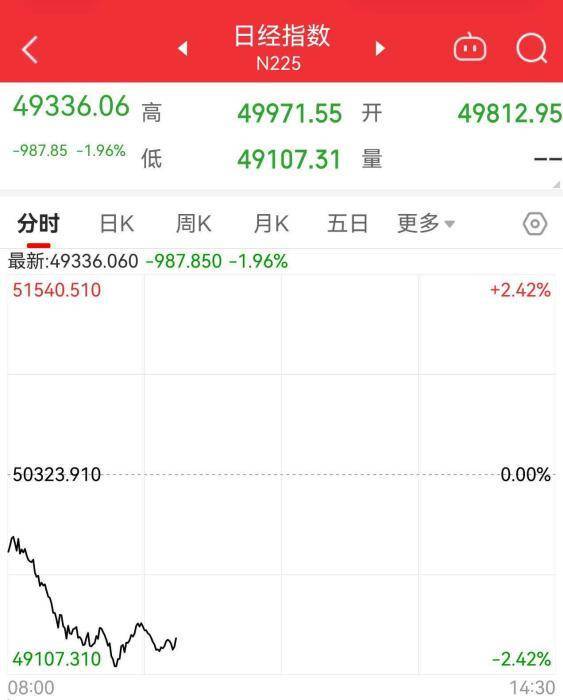
日本东京股市开盘跳水 日经指数一度跌逾千点
Sou Hu Cai Jing· 2025-11-18 04:42
Group 1 - The Nikkei 225 index in Japan experienced a significant decline, dropping over 1000 points during early trading on November 18 [1] - The decline was influenced by the drop in technology stocks and concerns regarding the economic outlook of the United States, with the index falling more than 2% at one point [3] - Notable individual stock performances included Sumitomo Electric Industries and Fujikura, which both fell over 7%, while SoftBank Group dropped nearly 6%, LASERTEC Semiconductor fell over 5%, and Nippon Steel declined over 4% [3] Group 2 - The previous day, the Nikkei 225 index closed down 0.1% and had also seen a decline of over 1% during trading, with sectors such as department stores, transportation, and tourism-related stocks facing significant sell-offs [3]
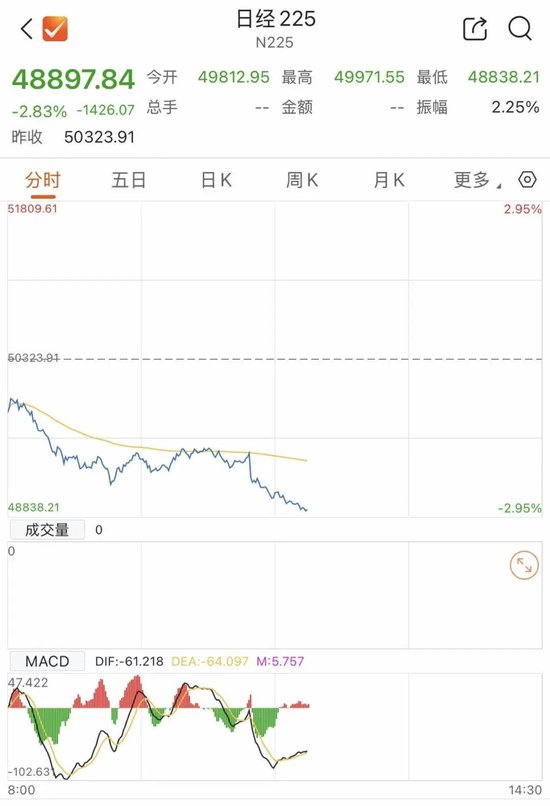
刚刚,日本股汇“双杀”!
Shang Hai Zheng Quan Bao· 2025-11-18 04:26
Group 1 - The Japanese stock market experienced a significant decline, with the Nikkei 225 index falling below 49,000 points, down over 1,400 points, representing a drop of 2.83% [1] - The Japanese yen continued its weakening trend, with the euro to yen exchange rate surpassing 180 for the first time since 1999, driven by concerns over Japan's deteriorating fiscal situation [3] - Political tensions arising from provocative statements by Japanese Prime Minister Suga Yoshihide regarding Taiwan have negatively impacted consumer sentiment, leading to declines in major companies such as SoftBank Group, Tokyo Electron, and Nintendo [5] Group 2 - Analysts express concerns that deteriorating Japan-China relations could further impact Japan's economy, which is already facing downward pressure, potentially leading to negative growth in the fourth quarter [7] - The South Korean stock market also saw a significant drop, with the KOSPI index declining over 3% [7]


日元贬值,日本股市大跳水
第一财经· 2025-11-18 03:39
Core Viewpoint - The Nikkei 225 index experienced a significant decline, dropping over 1000 points in intraday trading, primarily due to the downturn in technology stocks and concerns regarding the U.S. economic outlook [3]. Group 1: Market Performance - On November 18, the Nikkei 225 index fell more than 2% during intraday trading, following a previous day's close that saw a decline of 0.1% and an intraday drop exceeding 1% [3]. - Stocks related to department stores, transportation, and tourism faced heavy selling pressure from investors [3]. Group 2: Currency Trends - The euro against the yen surpassed the 180 mark, marking the first time since 1999 that the yen has fallen into this range [5]. - Concerns over Japan's deteriorating fiscal situation have led to increased selling of the yen, compounded by the government's plans to implement economic measures exceeding the previously estimated 17 trillion yen [5].

亚太股市跳水,日经225跌超1000点
2 1 Shi Ji Jing Ji Bao Dao· 2025-11-18 02:44
Market Overview - The Asia-Pacific stock markets experienced a significant decline on November 18, with the Nikkei 225 index dropping over 1000 points, representing a 2% decrease, while the Tokyo Stock Exchange index fell by more than 1.5% [2] - The KOSPI index in South Korea also saw a decline of 2%, with major companies such as SK Hynix, Hanmi Semiconductor, and Samsung Electro-Mechanics each falling over 4%, and LG Energy Solution dropping more than 3% [5] Individual Stock Performance - In Japan, Sumitomo Electric Industries saw a decline of nearly 7%, while SoftBank Group fell by nearly 5% [2] - Japanese tourism stocks, which had previously dropped, experienced a slight recovery, with Shiseido declining over 3% and Japan Airlines down by 0.22% [2] - Other consumer and retail stocks in Japan showed mixed performance, with Sanrio rising by 0.82%, Asics falling by 1.81%, and Fast Retailing down by 0.39% [2] - Isetan Mitsukoshi Holdings, a department store operator, saw its stock price decrease by 0.69% [2] Bond Market - The yield on 30-year Japanese government bonds increased by 2.5 basis points to 3.280% [3] Currency Exchange - The Japanese yen continued to weaken, with the euro against the yen surpassing the 180 mark during trading [4]
日韩股市,开盘暴跌!
Zheng Quan Shi Bao· 2025-11-18 02:29
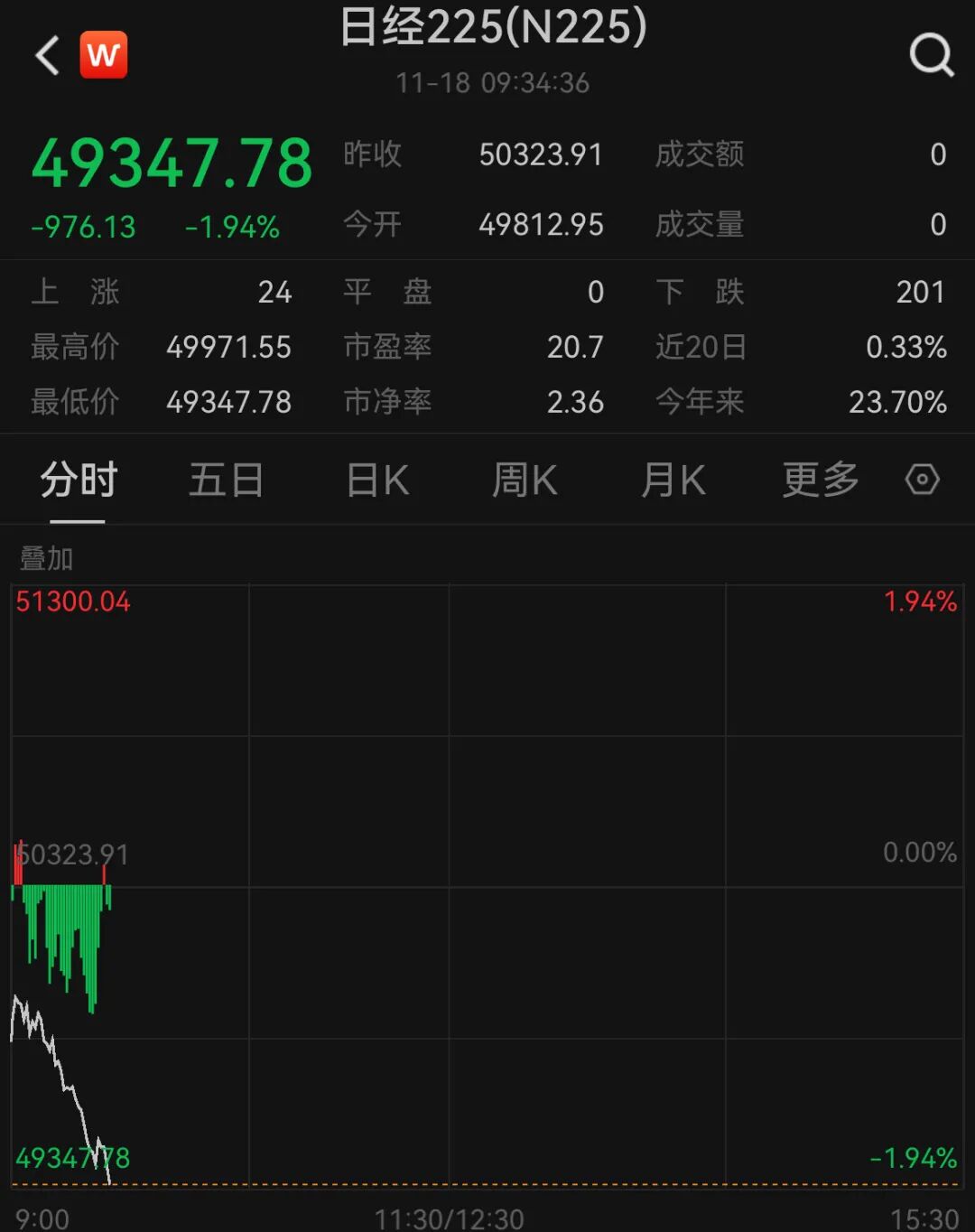
Market Overview - The Japanese stock market opened significantly lower, with the Nikkei 225 index dropping by 1.94% to 49,347.78 points [1][2] - The South Korean Composite Index also experienced a decline, falling by 1.5% during the trading session [3] Impact on Specific Companies - Japanese retail and tourism-related stocks faced heavy selling pressure, with some stocks dropping over 10% due to concerns over reduced Chinese tourist visits [4] - Notable declines included: - Mitsukoshi Isetan Holdings down 10.64% - Takashimaya down 6.29% - Sanrio down 7.8% - Asics down 6.6% - Fast Retailing down 6.9% - Shiseido, heavily reliant on Chinese consumers, saw a drop exceeding 11%, marking its largest single-day decline since early April [4] Economic Forecasts - Analysts predict that the Chinese government's travel warnings could negatively impact Japanese companies' performance, leading to rapid stock sell-offs [4] - A forecast by Nomura Research Institute suggests that reduced Chinese tourist spending could decrease Japan's tourism revenue by approximately 2.2 trillion yen (about 14.3 billion USD), potentially dragging down Japan's GDP by 0.36% [4] GDP Performance - Preliminary data from Japan's Cabinet Office indicated a 0.4% decrease in real GDP for Q3, marking a year-on-year decline of 1.8%, the first contraction in six quarters [5] - The decline is attributed to factors such as the impact of high tariffs from the U.S., reduced exports, and weak housing investment [5]
持续下挫!刚刚,暴跌1000点!
Zhong Guo Ji Jin Bao· 2025-11-18 01:42
Market Overview - The Japanese stock market opened significantly lower on November 18, with the Nikkei 225 index dropping over 1,000 points, a decline of more than 2% [1] - The Tokyo Stock Exchange index also fell sharply, down over 1.5%, currently reported at 3,297.14 points [1] Individual Stock Performance - Major companies such as SoftBank Group experienced a decline of over 5%, influenced by the drop in U.S. tech stocks [2] - Other companies like Tokyo Electron, Advantest, and Nintendo also saw declines, alongside consumer stocks such as Shiseido, Ajinomoto, and Fast Retailing [2] Economic Impact - A report from Nomura Research Institute predicts that a significant drop in Chinese tourists could reduce Japan's tourism revenue by approximately 2.2 trillion yen, which would lower Japan's GDP by 0.36% [4] - The potential impact of reduced Chinese consumer spending on Japanese products could further affect certain Japanese brands [5] Political Context - Japanese Prime Minister Fumio Kishida's recent controversial remarks regarding Taiwan have led to concerns about economic repercussions, including a potential decrease in Chinese tourism and consumer behavior towards Japanese companies [5] - The political climate has raised tensions, with implications for Japan's defense policies and regional stability [5]