财政宽松

Search documents
还没想好?特朗普计划明年初公布新美联储主席人选
Sou Hu Cai Jing· 2025-12-03 02:28
Core Viewpoint - The speculation regarding the next chairperson of the Federal Reserve has intensified following President Trump's recent statements, with a potential announcement expected in early 2026 [1] Group 1: Federal Reserve Chairperson Selection - Trump indicated he plans to announce the new Federal Reserve chairperson in early 2026, which contrasts with Treasury Secretary Mnuchin's earlier suggestion of a timeline around Christmas [1] - The current chair, Jerome Powell, is set to see his term expire in May next year, and there is speculation he may remain on the board [1] - The candidate list has narrowed from 11 to 5, with potential candidates including Hassett, Fed Governor Waller, and Vice Chair Bowman [1][4] Group 2: Candidate Profile - Kevin Hassett - Kevin Hassett, 63, holds a Ph.D. in economics from the University of Pennsylvania and has previously served as a senior economist at the Federal Reserve and a professor at Columbia University [4] - Hassett has been a proponent of monetary easing to stimulate growth and aligns closely with Trump's economic views, advocating for tax cuts, fiscal expansion, deregulation, and low interest rates [4] - Analysts suggest that if Hassett is appointed, he may lower the federal funds rate from the current range of 3.75% to 4% to below 3% without significantly threatening the Fed's independence [4] Group 3: Market Expectations and Economic Indicators - Citic Securities emphasizes that the unemployment rate will be crucial for the Fed's decision on interest rates in December, with expectations of a potential rate cut of 25 basis points [5] - The probability of a 25 basis point rate cut in December is currently at 87.6%, reflecting a growing expectation among market participants [5]

力压黄金,“黑马”跑出历史新高!
Shang Hai Zheng Quan Bao· 2025-11-29 06:29
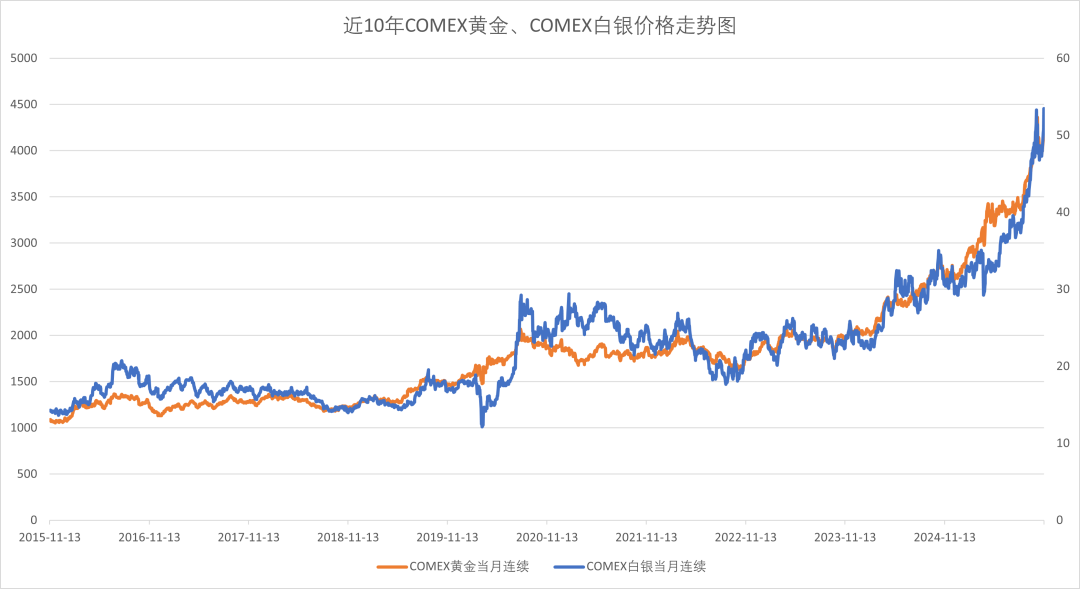
Group 1 - Silver prices have surged, with COMEX silver reaching a record high of $57.245 per ounce, marking a maximum increase of 6.79% during trading [1] - The London spot silver also saw a significant rise, with a peak increase of 5.74%, while domestic futures in China hit a high of 13,239 yuan per kilogram, up 5.55% [1] - The driving force behind the rising silver prices is the increasing expectation of a Federal Reserve rate cut in December, with an 85.4% probability of a 25 basis point cut [2] Group 2 - The global silver supply is expected to remain flat at 813 million ounces in 2025, with a slight increase in recycling but a projected 4% decline in demand to 1.12 billion ounces [3] - Despite the stable industrial demand for silver, a significant supply deficit is anticipated for the fifth consecutive year in 2025, estimated at 95 million ounces [4] - The solar energy sector has emerged as a major variable in silver demand, although it is expected to peak in 2024 and experience a marginal decline in 2025 [4] Group 3 - Over the past decade, silver prices have increased by approximately 301.8%, with the gold-silver ratio fluctuating between 63 and 122 [5] - Silver's dual attributes of being both a financial and industrial metal have led to its price volatility, with periods of correlation and divergence from gold prices [7] - The past ten years have seen silver's industrial demand grow, particularly in sectors like photovoltaics, AI, and semiconductors, indicating potential for further price increases [8]
日本央行年底前加息概率被低估?鸽派首相或挡不住紧缩步伐
Jin Shi Shu Ju· 2025-10-22 06:10
Group 1 - A majority of economists expect the Bank of Japan to raise key interest rates in October or December, with nearly 96% predicting a minimum increase of 25 basis points by the end of March next year [1][2] - Among 75 economists surveyed, 60% anticipate the Bank of Japan will raise short-term rates from 0.50% to 0.75% within the current quarter [1] - The internal stance of the Bank of Japan's policy committee appears to favor an interest rate hike, despite potential delays due to domestic political and global economic uncertainties [2] Group 2 - Financial markets currently price in a 40% probability of an interest rate hike before the end of the year [3] - High City Sawa, the newly appointed Prime Minister, has committed to increasing government spending in key areas such as energy and economic security under a framework of "responsible and proactive fiscal policy" [3] - Among respondents, 67% expressed uncertainty about agreeing with High City Sawa's economic policies [3][4] Group 3 - Concerns about the impact of fiscal policies on financial health were raised by nearly two-thirds of respondents [4] - Market pressures, such as rising long-term bond yields, may constrain fiscal expansion efforts [5]
中金 • 全球研究 | 2025年日本自民党总裁选举#6:高市政权下的日本资本市场展望
中金点睛· 2025-10-08 23:59
Core Viewpoint - The election of Sanna Takichi as the new president of the Liberal Democratic Party (LDP) is expected to lead to her becoming the new Prime Minister of Japan, with a strong inclination towards "Abenomics," favoring monetary easing, yen depreciation, and fiscal expansion [3][4]. Election Results - On October 4, the LDP held a presidential election where Takichi emerged victorious after two rounds of voting, contrary to media predictions that favored her opponent, Shinzo Koizumi [4][5]. - In the first round, Takichi received 119 votes from party members, while Koizumi received 84 votes, leading to a second round where Takichi secured 149 votes from national assembly members compared to Koizumi's 145 [15]. Reasons for Takichi's Victory - Takichi's popularity among LDP members was a significant factor, as she garnered substantial support in both the party member and local party branch votes [5]. - Koizumi's lack of clear policy proposals and cautious election strategy contributed to his defeat, as he failed to resonate with the party's broader membership [5]. Economic and Financial Policy Proposals - Takichi is seen as a staunch supporter of Abenomics, advocating for monetary easing and fiscal expansion [3][7]. - Her proposed tax policies include raising the income threshold for tax exemptions, implementing cash subsidies for low-income families, and abolishing temporary gasoline tax rates, reflecting a strategy for cross-party collaboration [8]. - Takichi has expressed a preference for maintaining a loose monetary policy, indicating that the Bank of Japan should decide on specific monetary tools while emphasizing the negative impacts of rapid interest rate hikes on investment and housing [9]. Currency and Fiscal Policy - Takichi appears to favor a weaker yen, arguing that yen depreciation benefits export industries and contributes positively to Japan's economic strength [10]. - She supports fiscal expansion and deficit financing, focusing on strategic investments to stimulate economic growth and increase tax revenues, while maintaining that as long as nominal growth exceeds government bond interest rates, debt-to-GDP ratios can remain stable [11]. Short-term Market Reactions - The unexpected nature of Takichi's election is likely to lead to significant price fluctuations in Japanese assets, with expectations of yen depreciation, rising stock prices, and a steepening yield curve for Japanese bonds [14]. - Historical trends from previous elections suggest that markets may react similarly, with potential increases in the Nikkei index and further depreciation of the yen against the dollar [14].

香港市场“涨了又跌“,传递什么信号?
Hu Xiu· 2025-10-08 11:05
Group 1 - The article discusses whether the gold market has reached its peak, linking it to global debt dynamics and the recent fluctuations in the Hong Kong market [3] - During the holiday period, gold prices surpassed $4000 per ounce, driven by a long-term trend of debt expansion among major global economies, which is expected to continue until 2025 [3] - The appointment of Japan's first female Prime Minister, who advocates for fiscal and monetary easing, is seen as a reinforcement of the bullish outlook for gold, as her policies aim to revitalize Japan's economy through increased spending and investment [3]
就在今天!美国投票结果出炉,9月20日,特朗普收到噩耗,他要支付351亿巨款
Sou Hu Cai Jing· 2025-09-20 16:33
Group 1 - The Republican Party is showing signs of internal anxiety as they modify rules to confirm 48 positions, including key departments like Defense and Energy, indicating a lack of unified support for President Trump's agenda [1] - Trump's influence over the Federal Reserve is limited, as evidenced by the recent 25 basis point rate cut, which did not meet his expectations of at least 50 basis points [1] - The struggle for control over the federal government is evident, with Trump's ability to influence the Federal Reserve being significantly constrained [1] Group 2 - The $35.1 billion agricultural subsidy, which helped Trump gain support from agricultural states during the last election, is now under threat due to rising national debt and budget deficits [3] - The Democratic-controlled House is particularly cautious about agricultural subsidies, which are seen as driven by electoral considerations, complicating Trump's ability to fulfill his promises [3] - Farmers' support for Trump is wavering, and failure to deliver on subsidies could lead to a loss of backing from this crucial voter base [3] Group 3 - Trump's strategy to encourage the EU to purchase more U.S. soybeans is facing resistance, as European officials are wary of being drawn into a trade conflict with China [4] - The EU's economic ties with China complicate Trump's push for increased purchases, as any tariffs on Chinese goods could disrupt their supply chains [4] - The "America First" policy is leading to international isolation, reducing the effectiveness of domestic economic strategies [4] Group 4 - The combination of a narrow victory in Senate confirmations, the pressure of agricultural subsidies, fiscal constraints, and international isolation presents a significant challenge for Trump's administration [7] - The current situation reflects structural pressures rather than short-term political struggles, indicating a critical test for Trump's governance [7]
海外高频 | 市场消化年内三次降息预期,贵金属价格持续上涨(申万宏观·赵伟团队)
申万宏源宏观· 2025-09-16 16:03
Group 1 - The article highlights that global stock indices mostly rose, with significant increases in the Nikkei 225 (up 4.1%) and the Hang Seng Index (up 3.8%) [2][3] - Precious metals prices have continued to rise for three consecutive weeks, with COMEX gold increasing by 1.3% to $3646.3 per ounce [2][56] - The U.S. market has fully priced in expectations for three interest rate cuts by the Federal Reserve within the year, following the August CPI data release [2][87] Group 2 - Japan's Prime Minister Shigeru Ishiba announced his resignation, which has heightened expectations for more expansive fiscal policies in Japan [2][68] - The resignation is attributed to the ruling party's historic losses in elections, leading to a potential increase in long-term interest rates if a more expansionary fiscal policy is adopted [2][68] - The 30-year Japanese government bond yield rose to 3.3% following the announcement, indicating market reactions to potential fiscal changes [2][68] Group 3 - The article notes that the U.S. average tariff rate stands at 9.75%, with a notably high rate of 40.36% on imports from China, contributing approximately $10.1 billion in tariff revenue [2][72] - The U.S. Supreme Court is set to review tariff policies, which could impact future tariff structures [2][72] Group 4 - The U.S. Treasury auction results indicate strong demand for government bonds, particularly in the mid-term category, with bid-to-cover ratios exceeding 3 for certain maturities [2][74] - The auction results reflect robust interest from global institutions in locking in U.S. Treasury yields [2][74] Group 5 - As of September 9, the cumulative fiscal deficit for the U.S. in 2025 reached $1.32 trillion, slightly up from $1.31 trillion in the previous year [2][75] - Total expenditures for the year amounted to $5.67 trillion, compared to $5.30 trillion in the same period last year [2][75]


全球长债抛售潮蔓延,日本30年期国债收益率创历史新高
Hua Er Jie Jian Wen· 2025-09-03 05:56
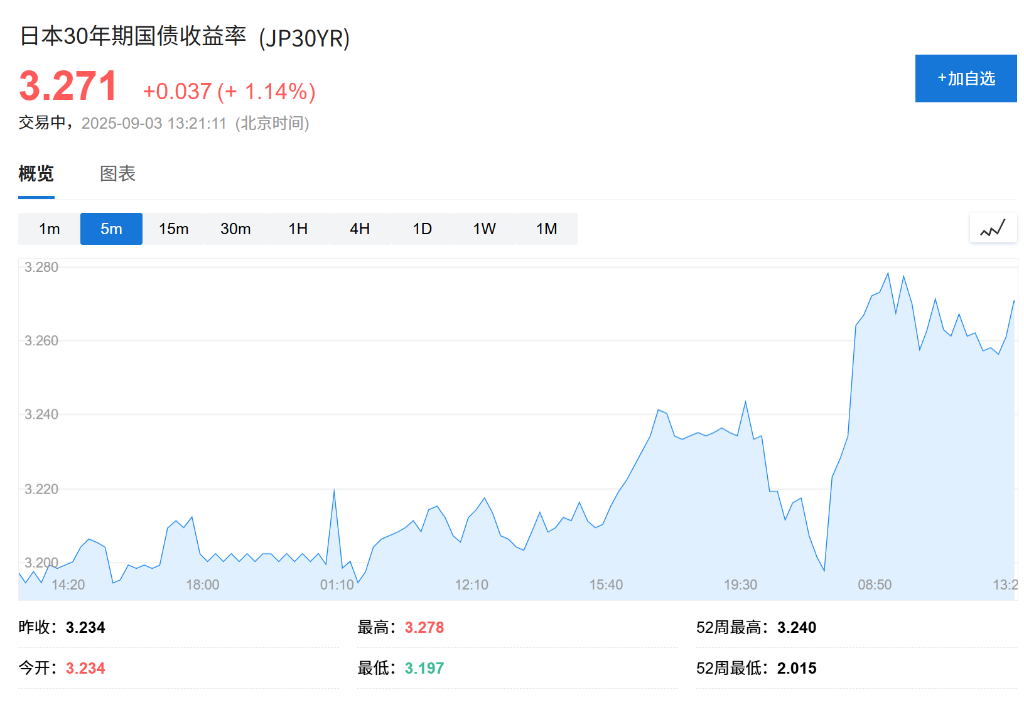
Core Viewpoint - The Japanese bond market is facing dual pressures from both internal political uncertainty and external global bond market turmoil, leading to significant increases in bond yields [1][4][10]. Group 1: Market Conditions - The yield on Japan's 30-year government bonds reached a record high of 3.28%, while the 20-year bond yield hit 2.69%, the highest since 1999 [1]. - Global concerns over government debt levels are driving up long-term yields, with the UK and France also experiencing significant increases in their bond yields [4]. - The US 30-year bond yield is approaching 5%, reflecting a pessimistic sentiment among investors regarding long-term debt [4]. Group 2: Domestic Political Factors - Internal political uncertainty in Japan, particularly regarding Prime Minister Shigeru Ishiba's potential ousting due to election losses, is exacerbating market fears [7][10]. - The ruling Liberal Democratic Party's internal strife has led to resignations among senior members, increasing the likelihood of leadership changes [10][11]. - Analysts suggest that any new leadership may pursue more populist policies, including increased government spending, which could further unsettle investors [11]. Group 3: Investor Sentiment and Upcoming Auctions - The upcoming auction of Japan's 30-year bonds is seen as a critical test of investor confidence, with global markets closely monitoring the results [10][12]. - Recent demand for Japanese long-term bonds has been weak, with institutional investors favoring shorter-term sovereign debt since May [12]. - Analysts express caution regarding the auction, predicting it will be challenging due to rising yields and investor reluctance to engage with long-duration bonds [13].
全球银行股的“上涨逻辑”:民粹主义、财政宽松、本币升值
Hua Er Jie Jian Wen· 2025-07-24 07:05
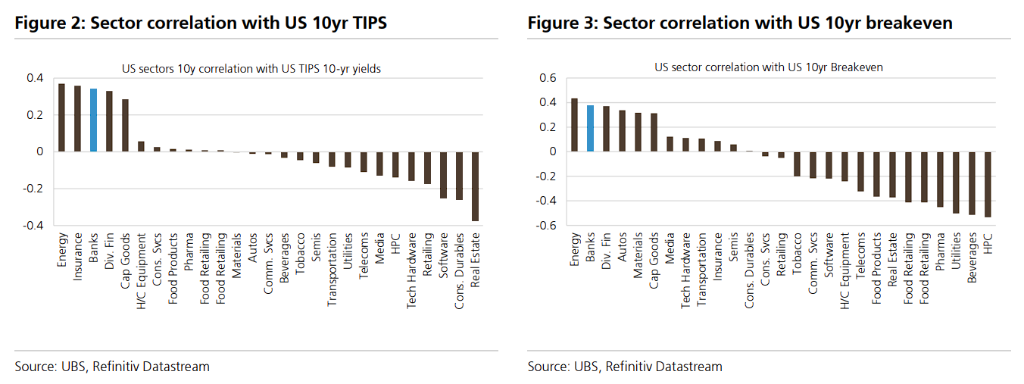
Core Viewpoint - UBS highlights multiple favorable factors driving global bank stocks, including populism, fiscal easing, currency appreciation, structural improvements, and attractive valuations [1][2]. Macro Factors - The rise of populism is leading to concerns over fiscal easing, which is pushing up bond yields, benefiting bank stocks as they are highly localized and gain from currency appreciation in regions like Europe and Japan [1][3]. - UBS maintains a bearish outlook on the US dollar, predicting a 1% rate cut by the end of the year, which will strengthen the euro and yen, directly enhancing the asset value and profitability of local banks [7][11]. Structural Improvements and Valuation - The banking sector has significantly improved its risk resilience post-financial crisis, with reduced litigation risks and manageable fintech disruption [2][26]. - Current bank stock valuations are attractive, reflecting excessive market concerns about an economic slowdown, with forward P/E ratios in Europe and the US showing about a 10% discount to historical norms [16][20]. Credit Growth and Economic Recovery - A turning point in private sector credit growth is evident, particularly in Europe, where demand for corporate loans is increasing, signaling a new upward cycle for banks' core lending business [11][15]. Indicators Supporting Bank Stock Allocation - UBS identifies several indicators supporting bank stock allocation, including moderate crowding and strong earnings revisions, with bank stocks ranking favorably in terms of earnings adjustments [36][41]. - The macro model indicates potential upside for bank stocks, particularly in Europe and Japan, where interest rates are nearing the end of a tightening cycle and will benefit from currency appreciation [41].

重大进展!特朗普,传来大消息!
券商中国· 2025-07-03 09:12
Core Viewpoint - The "Big and Beautiful" bill has made significant progress with its passage in the procedural vote in the House of Representatives, indicating a shift in support among previously opposing Republican members towards President Trump's agenda [1][4]. Legislative Progress - A group of Republican opponents in the House has changed their stance to support Trump, allowing his agenda to move forward after initially threatening to block the bill [4]. - The House cleared a key procedural hurdle and voted to pass the bill, with Republican leaders working to win over dissenting votes by delaying the vote on the bill's debate rules [6]. - Republican leaders are optimistic about securing enough votes for the bill's passage in the full voting stage, although the outcome remains uncertain [7]. Financial Implications - The bill is expected to implement most of Trump's policy agenda, which could have profound effects on the U.S. capital markets and global investors if successfully enacted [13]. - Estimates suggest that the Senate version of the bill could increase the U.S. fiscal deficit by $3.9 trillion over the next decade, compared to $3 trillion for the House version, raising concerns about fiscal sustainability [14]. - If the "Big and Beautiful" bill is passed, it may support U.S. economic growth but could also heighten doubts about fiscal sustainability and balance of payments, impacting the risk premium and valuation of U.S. debt in the long term [14]. Market Reactions - Following the news of the bill's passage in the procedural vote, the U.S. dollar index experienced a significant drop, indicating market anticipation of the bill's final approval [11].