资本回报率

Search documents
QCR (QCRH) - 2025 Q4 - Earnings Call Transcript
2026-01-28 17:02
Financial Data and Key Metrics Changes - The company reported record adjusted net income of $37 million, or $2.21 per diluted share for Q4 2025, and $130 million, or $7.64 per diluted share for the full year 2025, driven by significant growth in net interest income and capital markets revenue [17][29] - Net interest income increased by $4 million, or 22% annualized in Q4, and $23 million, or 10% for the year, supported by margin expansion [17][18] - The net interest margin (NIM) increased by 6 basis points from Q3, nearing the upper end of guidance, with a 14% increase in average earning assets [18][19] Business Line Data and Key Metrics Changes - The wealth management business added nearly 500 new client relationships, bringing in over $1 billion in new assets under management, with a five-year compound annual growth rate of 10% for both assets and revenue [8][9] - The LIHTC lending platform performed exceptionally well, with the company adding 18 new developer partners and benefiting from strong demand for affordable housing [9][10] Market Data and Key Metrics Changes - The company experienced strong organic growth and enhanced profitability in traditional banking operations, with total loans growing by $304 million, or 17% annualized in Q4 [24][25] - Total criticized loans decreased by $5 million in Q4 and $20 million for the full year, reflecting a 12% reduction, indicating improved asset quality [26][27] Company Strategy and Development Direction - The company aims to continue advancing its digital transformation, expand its wealth management business, and grow its LIHTC lending platform, supported by a positive NIM outlook and solid loan and deposit pipelines [16][19] - The multi-charter model allows the company to outperform competitors and gain market share, with a focus on improving balance sheet efficiency and enhancing service capabilities through technology investments [7][13] Management's Comments on Operating Environment and Future Outlook - Management expressed confidence in sustaining momentum into 2026, with expectations for continued growth in net interest income and capital markets revenue [5][16] - The company anticipates additional core margin expansion in Q1 2026, supported by repricing opportunities and a favorable deposit mix [20][21] Other Important Information - The company executed share repurchases totaling approximately $13 million in Q4, returning nearly $22 million to shareholders for the full year [27][28] - The effective tax rate for Q4 was 8%, down from 10% in the prior quarter, reflecting a favorable mix of tax-exempt income [29] Q&A Session Summary Question: Guidance on capital markets revenues - Management indicated that Q1 is historically the slowest quarter for capital markets revenue, setting expectations accordingly [34][36] Question: Update on securitization plans - The company expects to securitize approximately $300 million-$350 million in loans before June 30, 2026, despite some delays in the process [37] Question: Earning assets starting point for Q1 - Earning assets heading into Q1 will be consistent with the end of Q4, with robust loan growth anticipated throughout the year [43][45] Question: Deposit gathering expectations - The company is focused on improving core deposit growth and enhancing the mix, with strategies in place to attract new retail checking accounts and private banking clients [54][55] Question: LIHTC business growth opportunities - Management expressed optimism about the LIHTC business, emphasizing the importance of maintaining a balanced growth approach across all business segments [66][70]

QCR (QCRH) - 2025 Q4 - Earnings Call Transcript
2026-01-28 17:02
Financial Data and Key Metrics Changes - The company reported record adjusted net income of $37 million, or $2.21 per diluted share for Q4 2025, and $130 million, or $7.64 per diluted share for the full year [17] - Net interest income increased by $4 million, or 22% annualized in Q4, and $23 million, or 10% for the year, driven by margin expansion [17][18] - The net interest margin (NIM) increased by 6 basis points from the previous quarter, supported by a 14% increase in average earning assets [18] Business Line Data and Key Metrics Changes - The wealth management business added nearly 500 new client relationships, bringing in over $1 billion in new assets under management, with a 5-year compound annual growth rate of 10% for both assets and revenue [8] - The LIHTC lending platform performed exceptionally well, with significant demand for affordable housing and the addition of 18 new developer partners [9][10] Market Data and Key Metrics Changes - Total loans grew by $304 million, or 17% annualized in Q4, with traditional loan portfolio growth of $92 million, or 8% annualized [24] - Core deposits increased by $64 million, or 4% annualized in Q4, with average deposit balances rising by $237 million, or 13% annualized compared to Q3 [25] Company Strategy and Development Direction - The company aims to advance its digital transformation, expand its wealth management business, and continue growing its LIHTC lending platform [16] - The multi-charter model allows the company to outperform competitors and gain market share, with a focus on enhancing service capabilities and client experience through technology upgrades [7] Management's Comments on Operating Environment and Future Outlook - Management expressed confidence in maintaining strong financial performance, supported by a positive NIM outlook and solid loan and deposit pipelines [16] - The company anticipates continued growth in net interest income and capital markets revenue, with guidance for capital markets revenue set at $55 million-$70 million over the next four quarters [10][21] Other Important Information - The company executed share repurchases totaling approximately $13 million in Q4, returning nearly $22 million to shareholders for the full year [27] - The effective tax rate for Q4 was 8%, down from 10% in the prior quarter, reflecting a favorable mix of tax-exempt income [29] Q&A Session Summary Question: Guidance on capital markets revenues and seasonality - Management noted that Q1 is historically the slowest quarter for capital markets revenue, with expectations set accordingly [34][36] Question: Update on securitization plans - The company expects to securitize approximately $300 million-$350 million in loans before June 30, 2026 [37] Question: Guidance for earning assets in Q1 - Earning assets are expected to be consistent with the end of Q4, with robust loan growth anticipated throughout the year [44][45] Question: Deposit gathering expectations - The company is focused on improving core deposit growth and enhancing the deposit mix, with strategies in place to attract new retail checking accounts and private banking clients [55][56] Question: Impact of recent M&A activity on market share - Management is actively targeting clients from a competitor's recent acquisition, expecting to gain market share in the Cedar Rapids area [60]
Dime Community Bancshares, Inc. (NASDAQ:DCOM) Capital Utilization Analysis
Financial Modeling Prep· 2026-01-22 02:00
Core Insights - Dime Community Bancshares, Inc. (DCOM) is a significant player in the U.S. banking sector, providing various financial services [1] - DCOM's Return on Invested Capital (ROIC) is 4.43%, while its Weighted Average Cost of Capital (WACC) is 15.63%, resulting in a ROIC to WACC ratio of 0.28, indicating insufficient returns to cover capital costs [2] - Comparatively, Flushing Financial Corporation (FFIC) has a negative ROIC of -2.36% and a WACC of 16.81%, leading to a less favorable ROIC to WACC ratio of -0.14 [2] - Brookline Bancorp, Inc. (BRKL) and OceanFirst Financial Corp. (OCFC) also show negative and low ROIC to WACC ratios of -0.08 and 0.15, respectively, highlighting inefficiencies in capital utilization [3] - In contrast, CVB Financial Corp. (CVBF) has a ROIC of 5.80% and a WACC of 9.25%, resulting in a more favorable ROIC to WACC ratio of 0.63, indicating better capital efficiency [3] - City Holding Company (CHCO) leads with a ROIC of 30.02% and a WACC of 8.02%, achieving a remarkable ROIC to WACC ratio of 3.74, showcasing superior capital utilization among peers [3] - Overall, while DCOM maintains a positive ROIC, its capital utilization performance is less effective compared to peers like CVBF and CHCO [4]



投资者为何应考虑“撤出美元”?专访BCA Research首席新兴市场策略师
第一财经· 2026-01-16 12:21
Core Viewpoint - The article discusses the gradual fading of the "American exceptionalism" narrative in global capital markets, highlighting a shift in leadership from U.S. equities to other global markets, with a recommendation for investors to consider withdrawing from the dollar [3][4]. Dollar Depreciation Logic - The driving logic behind the dollar's depreciation has shifted from "interest rate differentials" to "balance of payments" due to limited room for interest rate cuts and insufficient capital inflows to support the large current account deficit of approximately $1.4 trillion [6][7]. - Foreign investment in U.S. stocks reached a record net inflow of $700 billion over the past year, with a similar amount in the bond market, but this trend is expected to reverse, leading to a significant drop in total securities investment inflows [6][7]. - A reduction in capital inflows will force the dollar to depreciate, as U.S. consumers will struggle to purchase imports without sufficient external financing, leading to a deep correction in the dollar's value [6][8]. Market Leadership Transition - The article posits that the leadership of global stock markets is changing, with a bearish outlook on U.S. equities due to the belief that future growth will not match historical performance [9][10]. - The current high price-to-earnings (P/E) ratios in U.S. markets may reflect a market bubble, as the PEG ratio does not account for potential future growth declines [9][10]. - The shift in the technology sector's capital discipline is noted, with large investments in AI infrastructure expected to lead to lower capital returns in the coming years, as initial high costs will not be matched by profits [10][12]. Investment Recommendations - The strategist recommends a "neutral" allocation to emerging markets relative to global stock benchmarks, while advising a significant underweight in U.S. equities [13][14]. - Emerging markets are expected to perform better than U.S. stocks in a weakening dollar environment, despite their cyclical nature and reliance on global trade [13][14]. - Japan is favored due to the undervaluation of the yen, while Europe is seen as having potential for relative market performance despite growth concerns, as capital flows may shift back to Europe with a weakening U.S. market [14].

中金:料今年香港上市银行资本回报率维持10%至17%水平
Zhi Tong Cai Jing· 2026-01-05 08:58
Core Viewpoint - Hong Kong bank stocks have performed well over the past year, primarily due to an unexpected increase in return on tangible equity (ROTE) [1] Group 1: Capital Return and Dividends - CICC forecasts that the capital return rate for listed Hong Kong banks will maintain a high level of 10% to 17% until 2026, with a dividend and buyback return rate of around 7%, indicating investment value [1] Group 2: Interest Rate Outlook - The market is expected to remain in a rate-cutting cycle this year, with the Federal Reserve's dot plot indicating potential rate cuts of 1 to 2 times in 2026 and 0 to 1 time in 2027, eventually reaching a level of 3% [1] - Based on this backdrop, Hong Kong banks' net interest margin is expected to continue narrowing, but the anticipated rate cuts, combined with slight asset growth, will keep the decline in net interest income to a low single-digit percentage [1] Group 3: Wealth Management Growth - CICC estimates that Hong Kong banks' wealth management business will continue to grow this year, driven by expectations of domestic and international investment returns and global economic factors [1] - Regions such as Singapore, India, and the Middle East are experiencing rapid growth in wealth management, and the presence of Hong Kong banks in these areas will further boost revenue [1] Group 4: Credit Costs and Risk Management - It is anticipated that credit costs for Hong Kong banks may see a slight increase this year but will remain manageable within the range of 30 to 50 basis points [1] - Key areas of focus include the evolution of the real estate market in mainland China and Hong Kong, risks associated with high overseas interest rates, and potential risks arising from financial market volatility [1] - However, it is expected that the cost-to-income ratio for Hong Kong banks will continue to decline [1]
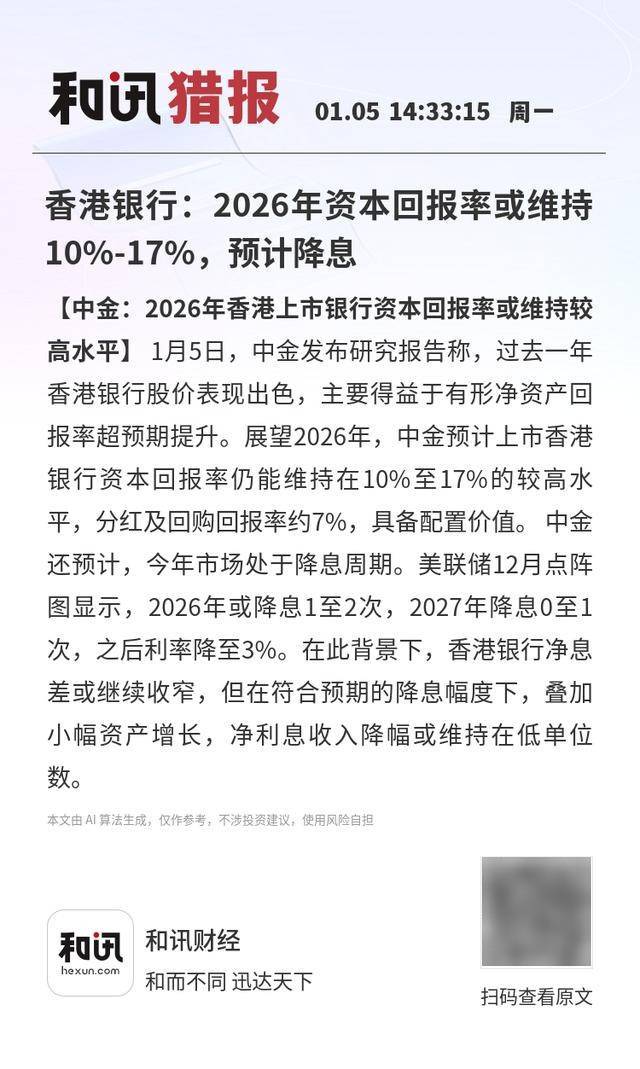
香港银行:2026年资本回报率或维持10%-17%,预计降息
Sou Hu Cai Jing· 2026-01-05 07:30
Core Viewpoint - CICC forecasts that the capital return rate of listed banks in Hong Kong will remain at a high level of 10% to 17% by 2026, supported by strong tangible net asset return rates and a dividend and buyback return rate of approximately 7% [1] Group 1 - In the past year, Hong Kong bank stocks have performed well, primarily due to an unexpected increase in tangible net asset return rates [1] - CICC anticipates that the market will enter a rate-cutting cycle this year, with the Federal Reserve's December dot plot indicating potential rate cuts of 1 to 2 times in 2026 and 0 to 1 time in 2027, leading to a rate drop to 3% [1] - Despite expectations of a narrowing net interest margin for Hong Kong banks due to the anticipated rate cuts, the decline in net interest income is expected to remain in the low single digits, supported by slight asset growth [1]
香港银行:2026年资本回报率10%-17%,或迎降息周期
Sou Hu Cai Jing· 2026-01-05 07:08
Core Viewpoint - Hong Kong bank stocks have shown strong performance over the past year, primarily due to an unexpected increase in return on tangible equity (ROTE) [1] Group 1: Performance and Projections - The capital return rate for listed Hong Kong banks is expected to remain at a high level of 10% to 17% through 2026 [1] - Dividend and buyback returns are projected to be around 7%, indicating investment value [1] Group 2: Interest Rate Outlook - The market is anticipated to remain in a rate-cutting cycle this year, with the Federal Reserve's December dot plot indicating potential rate cuts of 1 to 2 times in 2026 and 0 to 1 time in 2027, leading to a rate drop to 3% [1] - In this context, the net interest margin for Hong Kong banks may continue to narrow, but the expected decline in net interest income is likely to remain in the low single digits due to slight asset growth [1]
中金:预计今年上市香港银行资本回报率维持10%至17%水平
Sou Hu Cai Jing· 2026-01-05 06:29
Core Viewpoint - Hong Kong bank stocks have performed well over the past year, primarily due to an unexpected increase in return on tangible equity (ROTE) [1] Group 1: Performance and Projections - CICC expects the capital return rate of listed Hong Kong banks to maintain a high level of 10% to 17% by 2026, with a dividend and buyback return rate of around 7% [1] - The market is anticipated to remain in a rate-cutting cycle this year, with the Federal Reserve's dot plot indicating potential rate cuts of 1 to 2 times in 2026 and 0 to 1 time in 2027, eventually reaching a level of 3% [1] Group 2: Interest Income Outlook - Given the expected narrowing of net interest margins due to rate cuts, along with slight asset growth, the decline in net interest income is projected to remain in the low single digits [1]
easyJet plc (ESYJY) Q4 2025 Earnings Call Prepared Remarks Transcript
Seeking Alpha· 2025-12-01 16:53
Financial Performance - EasyJet achieved a profit before tax of GBP 665 million for the year ending September 30, 2025, representing a 9% year-on-year increase and an 18% improvement at the EBIT level [1] - The owned asset book value increased by over GBP 0.5 billion during the year, indicating a strengthening of the company's financial position [2] Operational Performance - The company has made proactive investments in resilience, leading to strong operational performance and improved punctuality, despite challenges in the external operational environment, particularly in French airspace [1] - Disruption costs have been materially reduced year-on-year, contributing to enhanced customer satisfaction, which is currently at the highest level in over a decade [2] Strategic Initiatives - EasyJet holidays has surpassed its previous ambitious target and has set a new profit before tax target of GBP 450 million by the full year 2030 [3] - The focus on capital allocation has resulted in a return on capital employed (ROCE) of 18%, a 2 percentage point improvement year-on-year, aligning with the company's medium-term target of high-teen returns on capital [3]


富临精工增收不增利实控人连续减持 负债率升至64%拟募资12.5亿再扩产
Xin Lang Cai Jing· 2025-11-19 08:34
Core Viewpoint - The actual controller of Fulin Precision, An Zhifu, plans to reduce his stake by up to 17.1 million shares, representing 1% of the company's total share capital, citing "personal funding needs" as the reason for the reduction [1] Group 1: Shareholding and Financial Performance - An Zhifu has already reduced his holdings earlier this year by 6.79 million shares, amounting to approximately 86.56 million yuan [1] - As of the announcement date, An Zhifu holds 169 million shares, accounting for 9.90% of the total share capital, and after the reduction, his and his concerted parties' shareholding will decrease from 41.24% to 40.24% [1] - For the first three quarters of 2025, the company reported total revenue of 9.085 billion yuan, a year-on-year increase of 54.43%, but the net profit attributable to shareholders was only 325 million yuan, a growth of 4.63% [1] - In Q3, the company achieved revenue of 3.272 billion yuan, a year-on-year increase of 43.0%, but the net profit attributable to shareholders decreased by 15.83% [1] Group 2: Profitability and Cash Flow - The company's gross profit margin for the first three quarters was 11.23%, and the net profit margin was 3.98%, both showing a significant decline year-on-year [1] - The operating cash flow per share is only 0.07 yuan, a substantial decrease of 78.5% year-on-year, indicating low profit quality [2] Group 3: Balance Sheet and Debt - As of the end of Q3, accounts receivable reached 2.278 billion yuan, a year-on-year increase of 46.81%, nearly seven times the net profit attributable to shareholders [3] - The company’s cash and cash equivalents amounted to 2.219 billion yuan, a year-on-year increase of 103.72%, while interest-bearing debt rose by 45.41% to 1.868 billion yuan [3] - The debt-to-asset ratio stands at 63.65%, an increase of 10.36 percentage points year-on-year, exceeding the industry average of 51.96% [4] Group 4: Expansion Plans and Market Concerns - Despite the pressure on profitability, the company is actively pursuing capacity expansion, planning to raise up to 1.252 billion yuan through convertible bonds for projects related to electric drive systems and other components [5] - The contrast between the expansion plans and the actual controller's share reduction raises concerns about capital returns [6] - The company has experienced two years of losses since its listing, indicating a need for improved operational resilience [6]