
轻资产运营

Search documents
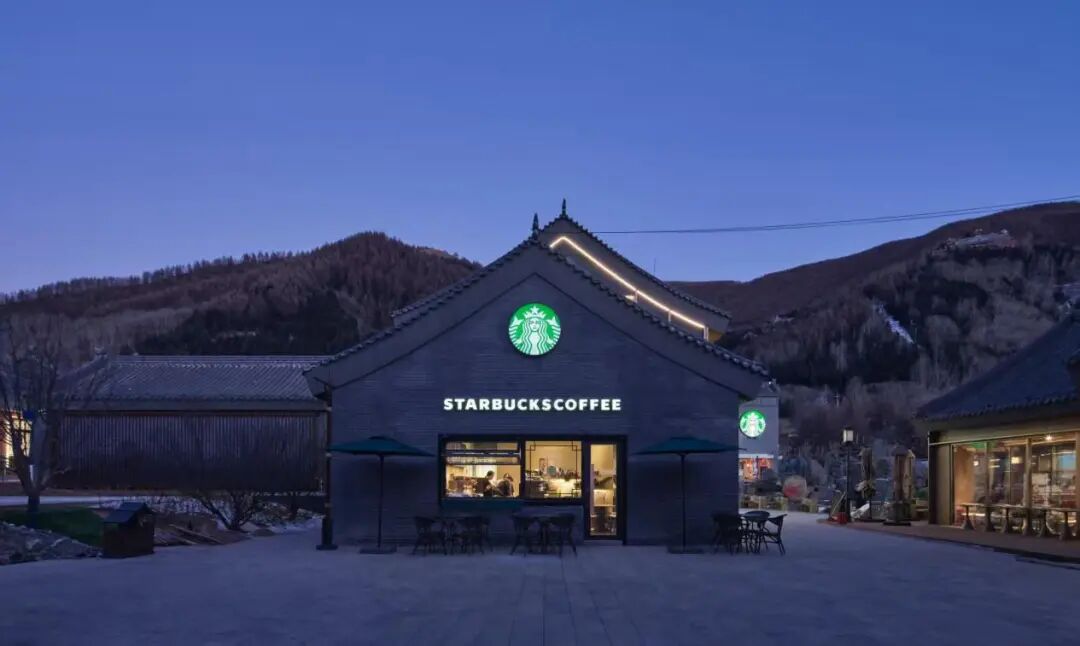
星巴克中国的新门店,过半开在低线城市
3 6 Ke· 2026-01-30 11:06
Core Viewpoint - Starbucks has announced its first quarterly results after forming a joint venture with Boyu Capital to operate its retail business in China, marking a significant shift in its operational strategy in the region [1][3]. Group 1: Joint Venture and Financial Performance - Starbucks will establish a joint venture with Boyu Capital, with Boyu holding up to 60% equity and Starbucks retaining 40% [1]. - The CEO stated that the transformation plan is progressing as expected, with global revenue increasing by 5% year-over-year, and China showing an impressive 11% growth in the latest quarter [1][3]. - The CFO indicated that the transaction is expected to be completed in the spring, pending regulatory approval, and will result in Starbucks' Chinese retail business being excluded from the consolidated financial statements [1][3]. Group 2: Cost Management and Operational Changes - In the first quarter of the fiscal year, Starbucks classified its Chinese retail assets and liabilities as held for sale, leading to a reduction in monthly expenditures by approximately $39 million starting December 2025 [3]. - Post-transaction, all 8,011 of Starbucks' direct-operated stores in China will transition to franchise stores under the international business segment, allowing for a lighter asset model [3]. - The company plans to continue optimizing costs globally, with expectations that management expenses will be lower than in fiscal year 2023, partially offsetting investment expenditures [7]. Group 3: Store Expansion and Market Strategy - Starbucks has opened new stores in 13 county-level cities in China, with over half of the new openings located in lower-tier cities or special business districts, indicating a downward market trend [4]. - For fiscal year 2026, Starbucks plans to open 600 to 650 new coffee shops globally, with nearly half of these in the Chinese market [4]. - The company anticipates a 3% or higher year-over-year growth in global coffee chain sales, with similar growth expected in the U.S. market [4].


壹网壹创(300792.SZ)预计2025年净利同比增长21.10%-57.32%
Ge Long Hui A P P· 2026-01-30 09:11
Core Viewpoint - The company expects a net profit attributable to shareholders for the year 2025 to be between 92.03 million yuan and 119.55 million yuan, representing a year-on-year increase of 21.10% to 57.32% [1] Group 1: Business Strategy - The company is actively promoting a strategy focused on enhancing productivity through technology [1] - The use of AI agents is aimed at improving operational efficiency [1] - The company collaborates with platforms like Alibaba to expand its business types through vertical applications of AI agents [1] Group 2: Operational Efficiency - The company continues to implement a light asset operation strategy to optimize its business structure [1] - Online brand management services have seen year-on-year growth, contributing to improved profitability [1] - Cost control measures in online marketing and content e-commerce have enhanced profit levels, supporting overall performance growth [1]

A股上市房企首家!保利发展拟发行商业不动产REITs
2 1 Shi Ji Jing Ji Bao Dao· 2026-01-28 12:29
本次申报发行商业不动产REITs的标的资产选定了粤港澳大湾区的两大核心城市项目,分别是广州保利 中心项目和佛山保利水城项目。 另一项标的资产则是佛山保利水城项目,该项目位于佛山市金融CBD,是一座成熟的购物中心项目 。 该资产目前由保利发展全资子公司佛山保城企业管理有限公司持有。 从现实经验来看,这类资产符合市场的偏好。证监会相关负责人表示,"从全球成熟市场发展经验来 看,商业综合体、商业零售、写字楼、酒店等商业不动产是REITs产品重要的底层资产。我国商业不动 产存量规模庞大,具有通过REITs进行盘活并拓宽权益融资渠道的内在需求。" 对于此次发行计划,保利发展也有着清晰的战略考量。 保利发展(600048)终于搭上REITs申请的班车。 1月27日晚间,保利发展发布公告,拟以持有的商业不动产项目作为底层资产,开展商业不动产投资信 托基金(以下简称"商业不动产REITs")的申报发行工作。 保利发展在公告中表示,这标志着保利发展正式启动将旗下商业不动产资产通过发行不动产投资信托基 金(REITs)进行证券化的进程,旨在盘活存量资产、拓宽融资渠道。董事会同时授权管理层办理与本 次REITs申报发行相关的具体事 ...

2026年全国计划新开430个购物中心,上海继续领跑
3 6 Ke· 2026-01-27 02:58
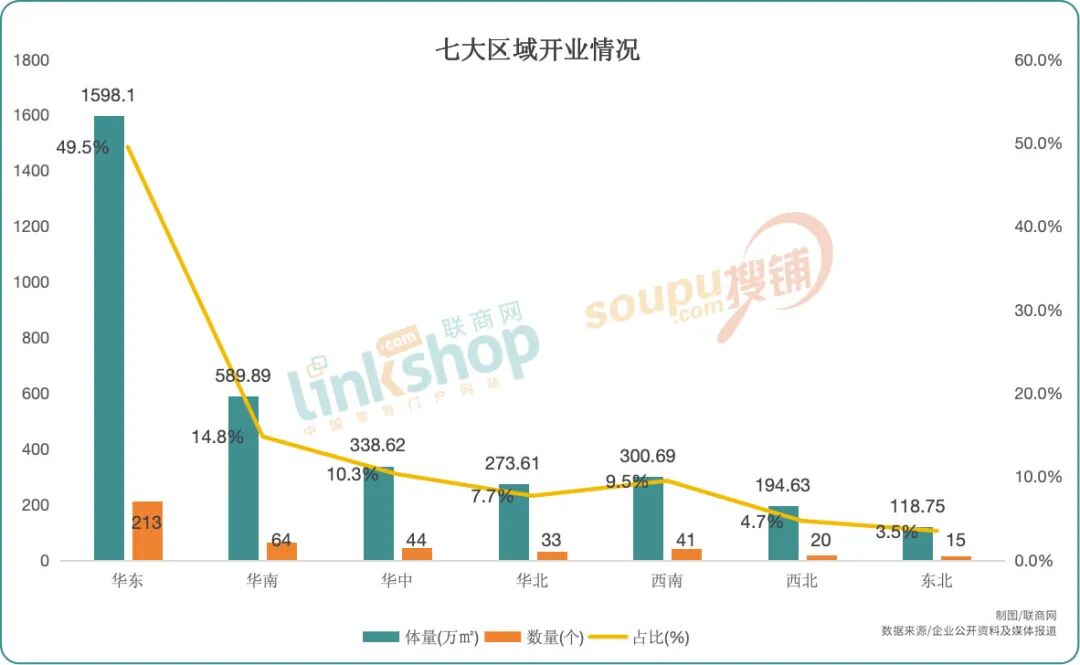
2026年,全国商业地产市场即将迎来一波"上新潮"! 城市供应方面: 据联商网统计,2026年全国拟开业的商业项目共430个(不含专业市场、酒店及写字楼,商业建筑面积≥2万㎡),新增商业建筑面积3414.29万㎡,平均单体 建筑面积约7.94万㎡。 这其中,全新开业的商业项目达361个,其余69个为存量升级物业,或通过更换运营商、重新改造招商,或经内部升级后全新亮相。 01 华东区域领跑开业数量 全国七大区域均有新商业项目新开,且华东(213个)继续占比"半壁江山",华南(64个)、华中(44个)、西南(41个)等"商业活力强区"表现不俗,紧随华东。其 他华北、西北和东北分别为33个、20个和15个。 在城市开业数量方面,TOP10均为经济发达、常住人口基数大、消费潜力充足的一线和新一线城市,彰显了商业发达程度与城市发展水平的紧密关联。其 中,杭州、南京、广州、苏州、成都开业数量均超10个。 02 企业贡献数量榜首易主? 开发及运营企业的开业量上,2026年或首次迎来"新王"。 2026年拟开商业项目中,华润万象生活、珠海万达商管、爱琴海集团、京东集团、龙湖商业、新城控股集团、宝龙商业、招商商管、正和城邦、德 ...
商业不动产REITs落地重构价值
Di Yi Cai Jing Zi Xun· 2026-01-25 10:41
Core Viewpoint - The recent implementation of commercial real estate REITs pilot regulations marks a significant shift in China's real estate market, transitioning from incremental expansion to stock optimization and high-quality development [2][3]. Group 1: Market Transition - China's real estate market is undergoing structural adjustments, moving towards stock optimization and high-quality development, with "activation" and "breakthrough" being key paths for industry development [2]. - The activation of stock assets is a complex system project that involves multiple interests and objectives, requiring reform courage and innovative wisdom [2]. Group 2: Principles for Asset Activation - There are four main principles for activating stock assets: 1. Market-oriented and rule of law principles for fair asset circulation [3]. 2. Professionalization as a core support for precise identification and efficient operation of assets [3]. 3. Integration of industry and finance as a key path, utilizing tools like REITs and asset securitization [3]. 4. Using incremental growth to drive stock asset value enhancement through new technologies and business models [3]. Group 3: REITs Market Development - The China Securities Regulatory Commission officially launched the commercial real estate REITs pilot program on December 31, 2025, marking a new phase in the development of the REITs market alongside infrastructure [3][4]. - Compared to infrastructure REITs, commercial real estate REITs have differences in asset scope, regulatory review, and fund usage, focusing on commercial complexes, retail, office buildings, and hotels [4][5]. Group 4: Market Potential and Growth - As of January 25, 2026, there are 79 listed REITs in China with a total market value of 228 billion yuan [5]. - Long-term projections suggest that the REITs market could reach a scale of 2 trillion yuan, depending on market development and the transformation of the real estate sector [5][6]. - Industry experts believe that the REITs market could potentially exceed 2 trillion yuan, influenced by the pace of real estate transformation [6]. Group 5: Recommendations for Market Improvement - Suggestions for enhancing the REITs market include optimizing existing product structures, improving management frameworks, and streamlining the expansion process [6]. - There is a call for establishing a delisting system and further developing a multi-tiered market to support diverse investment entities and improve the Pre-REITs and private REITs systems [6].

融创中国归来,重启地产开发业务
Bei Jing Shang Bao· 2026-01-25 09:23
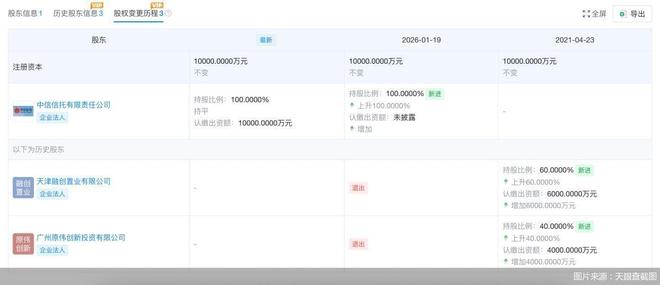
随着债务重组的完成,融创中国的经营修复已迈入业务重启的实质性阶段。1月25日,北京商报记者了 解到,融创中国位于天津的梅江地块项目近期已完成开发主体的股权变更,并由中信信托全面接手。据 知情人士透露,该项目开发公司"天津融创致成"的股权已于2026年1月19日发生变更。原股东全部退 出,中信信托以全资股东身份入场,实现了对项目公司的完全控制。这标志着融创中国在获得中信体 系"全周期、全链条"支持后,首个重大合作项目已进入落地执行环节,也被视为融创中国穿越债务周 期、恢复正常经营的关键一步。 作为曾经以激进并购快速扩张的行业巨头,融创中国于2022年5月公开债务违约。在创始人孙宏斌的带 领下,目前融创中国已完成包括境内债重组、近600亿元债务压降以及境外债"债转股"等一系列操作。 随着2025年孙宏斌两度公开现身并传递聚焦业务的信号,融创中国的经营重心正从风险化解转向常态运 营。 标志性项目重启 1月25日,北京商报记者获悉,融创中国与中信集团合作重启的天津梅江地块,其项目开发主体"天津融 创致成"已于2026年1月19日完成股权变更。原股东全部退出,中信信托以全资股东身份入场,实现对项 目公司的完全控制。这标 ...
30天裂变10万会员?顶俏模式如何用“积分闭环”打破增长瓶颈
Sou Hu Cai Jing· 2026-01-21 09:41
Core Concept - The article outlines a new retail ecosystem designed for integrated online and offline operations, focusing on self-driven growth mechanisms and addressing key business challenges [1][3]. Group 1: Growth Mechanisms - The system targets companies seeking rapid channel expansion and exponential user growth, particularly in high-frequency repurchase categories like daily chemicals and fast-moving consumer goods [5]. - Membership entry requires a minimum spend of 100 yuan, offering exclusive pricing and a 22.5% direct referral reward, promoting a "buy more, save more, sell more" model [6]. - The factory store model requires a 20,000 yuan fee, providing high commission rates starting at 30% and regional monopoly benefits [6]. Group 2: Pain Points Addressed - The system employs a flexible supply chain model (S2B2C) to eliminate inventory risks by shifting to a demand-driven production approach, ensuring zero inventory operations [11]. - High commission rates of up to 44% and a 22.5% direct referral reward incentivize consumers to become promoters, facilitating viral channel expansion [12]. - A pre-collection model converts entry fees into advance payments, significantly reducing capital occupation and allowing partners to operate with minimal asset investment [13]. Group 3: Incentive Structures - The incentive system is designed to ensure product circulation through a points mechanism, stimulating sales and transforming passive waiting into active engagement [14]. - Regional protection policies and team-level differentiation prevent cross-region price wars, maintaining market stability and ensuring reasonable profit margins for channel partners [14]. Group 4: Operational Logic - The "order-driven production" model transfers inventory risk to the market, enhancing operational efficiency and reducing fulfillment costs [18]. - The points system serves as a unique purchasing credential, controlling product flow and preventing hoarding while encouraging active selling [19]. - A multi-tiered profit-sharing model creates a community of interests among members, distributors, and factory stores, ensuring everyone benefits from the value chain [20]. Group 5: Practical Demonstration - A breakdown of a 100 yuan order illustrates the profit distribution: the referrer earns 22.5 yuan, the distributor receives 10 yuan plus 100 points for future purchases, and additional profits are shared among various levels, ensuring the platform retains 50-58% of the total revenue [24].

武商集团:公司与沃尔玛在企业定位、业务模式与市场属性上存在根本差异
Zheng Quan Ri Bao Wang· 2026-01-15 09:47
Core Viewpoint - The company emphasizes its fundamental differences from Walmart in terms of corporate positioning, business model, and market attributes, asserting that financial metrics alone are not comparable [1] Group 1: Business Strategy - The new board of directors is focused on high-quality development goals, optimizing operational strategies, and enhancing cost management [1] - The company aims to strengthen its competitive edge through high-end commercial complexes, department stores, and the integration of cultural and tourism businesses, driven by a dual focus on "assets + operations" [1] - The strategy includes addressing regional consumer upgrade demands by introducing international high-end brands and optimizing the supply chain to reinforce competitive barriers [1] Group 2: Financial Performance - The company expects a significant increase in its non-recurring net profit, projecting a year-on-year growth of 66.83% for the full year of 2024 [1] - For the first half of 2025, a year-on-year growth of 21.45% in non-recurring net profit is anticipated [1] - By the third quarter of 2025, net profit is expected to grow by 2.98%, with non-recurring net profit increasing by 12.74%, maintaining strong core profitability metrics compared to industry peers [1]

入住率跌至45.8%,客房不足8000间,绿地酒店怎么了?
Tai Mei Ti A P P· 2026-01-14 03:36
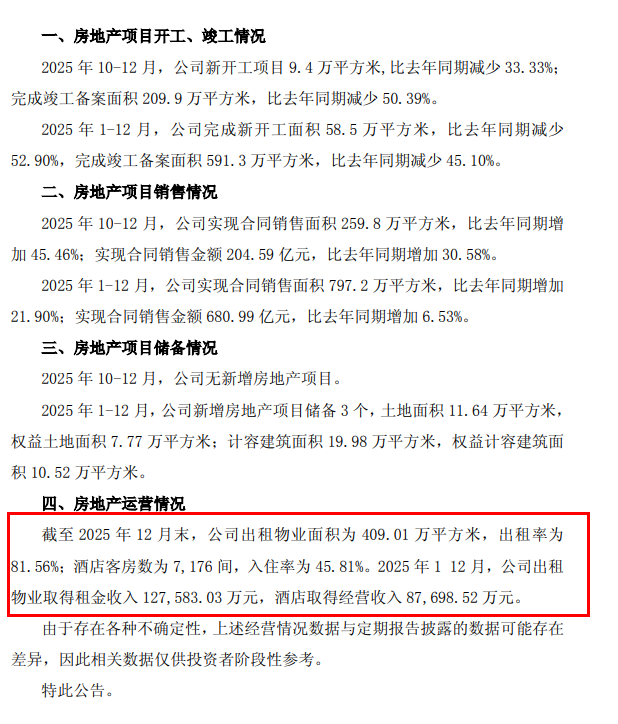
Core Insights - Greenland Holdings' hotel business is facing significant challenges, with a decline in occupancy rates, a reduction in the number of hotel rooms, and a drop in revenue per room [1][9][12] Group 1: Performance Metrics - As of the end of 2025, the number of hotel rooms has decreased to 7,176, down from 9,738 at the end of 2024 and 11,455 in 2023 [1][6][7] - The occupancy rate for 2025 stands at 45.81%, a decline from 49.1% in 2024 and 53.4% in 2023, indicating a downward trend in the hotel industry [9][10] - Average daily revenue per room has fallen to 335 yuan in 2025, down from 365 yuan in 2024 and 420 yuan in 2023, marking a new low over the past five years [12][14] Group 2: Strategic Challenges - The management has acknowledged that many hotels are inefficient and unprofitable, failing to meet investment return requirements [1][17] - The slow expansion of light-asset models is evident, with a low conversion rate of project reserves into actual contracts, despite a reported near 100 signed projects [18] - The hotel sector's performance is reflective of a broader industry trend where supply exceeds demand, leading to continued declines [9][10] Group 3: Industry Context - Owner-operated hotel groups, including Greenland, are struggling in a post-real estate era, facing operational and expansion difficulties [20][22] - The company has been forced to adapt to liquidity issues, with a projected loss of up to 19 billion yuan in 2025, leading to asset sales [23][24] - The future of owner-operated hotel groups may involve a shift towards asset management and diversified business models, leveraging their experience in integrated projects [35][36]

宁做代建不做自投,一批民营房企的经营逻辑变了
Di Yi Cai Jing· 2026-01-13 10:17
Core Insights - The real estate construction agency industry is experiencing significant growth, with over 100 companies targeting this sector, driven by the strong expansion intentions of leading firms [1] - The top 20 construction agency companies are expected to sign approximately 220 million square meters of new contracts in 2025, representing a year-on-year increase of 16%, which is 6 percentage points higher than in 2024 [1] - Major players like Jindi Management, Longfor Longzhizao, and New City Construction Management have seen their new contract areas increase by over 50% year-on-year [4] Group 1: Market Trends - The number of contracts awarded in the construction agency sector has been rising, with the third quarter of 2025 seeing 172 contracts awarded, reflecting a year-on-year increase of 37% and a quarter-on-quarter increase of 17% [2] - Ten companies are projected to add over 10 million square meters of construction agency scale in 2025, with the top five companies accounting for 45% of the new construction area [2] - The industry is shifting from scale expansion to value creation, requiring companies to enhance product quality, innovate services, and manage risks effectively during the industry reshuffle [2][3] Group 2: Company Performance - Jindi Management, Longfor Longzhizao, and New City Construction Management are gaining market attention, with their new signed construction areas being 15.31 million square meters, 13.87 million square meters, and 10.61 million square meters, respectively [4] - The sales scale for Longfor Longzhizao and Jindi Management reached 20.6 billion and 19.3 billion yuan, ranking them third and fourth in sales scale [4] - These companies are reducing their self-investment project scales significantly, with new value added being less than 9 billion yuan, compared to previous peaks of over 100 billion yuan [4] Group 3: Industry Dynamics - The construction agency sector is benefiting from government policies promoting affordable housing and urban village renovations, creating a demand for professional operators [5] - The light-asset model of construction agencies allows companies to focus on product quality and service while managing risks, aligning with current market demands [5] - The construction agency market is expected to grow at an annual rate of 21.3%, indicating significant potential compared to the 20%-30% penetration rates in mature markets like Europe and the U.S. [5] Group 4: New Opportunities - Local government investment entities hold many undeveloped land parcels, which are becoming key targets for construction agencies [6] - Non-real estate companies are increasingly willing to engage in construction agency projects, providing new growth opportunities for construction firms [6] - Some construction agencies are proactively engaging in the construction process to secure quality land reserves, representing a new expansion strategy [6]

