黄金储备

Search documents
中国黄金储备达2307吨!赶在特朗普访华前,美国代表团低调抵京
Sou Hu Cai Jing· 2026-02-13 04:38
Group 1 - The upcoming meeting in April between the U.S. and China is characterized by a heavy silence, indicating the weight of the issues at stake, particularly the U.S. national debt of $38 trillion [1][3] - The U.S. delegation to China is led by Treasury officials rather than the Secretary of State, highlighting the urgent financial discussions rather than traditional diplomatic engagements [1][3] - China's response to U.S. inquiries has been to tighten its gold reserves, which have reached 2,307.57 tons, reflecting a strategic move in the context of global financial stability [5][7] Group 2 - The geopolitical landscape has shifted, with trust in currencies being questioned, especially after the freezing of Russian reserves, leading to a focus on hard assets like gold [7][9] - Internal political struggles in the U.S. may impact the Federal Reserve's independence, potentially leading to increased money supply and devaluation of the dollar, which China is preparing for by increasing gold reserves [9][11] - The upcoming meeting is not just a diplomatic handshake but a confrontation of two different financial logics, with the U.S. burdened by debt and China holding significant gold reserves [11]



世界黄金协会: 1月中国市场黄金ETF流入440亿元人民币 创历年开局新高
Sou Hu Cai Jing· 2026-02-12 12:17
Core Insights - The World Gold Council released the "China Gold Market Monthly Review," indicating robust upstream physical gold demand in January [1] Group 1: Physical Gold Demand - The total gold withdrawal from the Shanghai Gold Exchange (SGE) reached 126 tons in January, showing a slight year-on-year increase of 1 ton and a month-on-month increase of 11 tons [1] - Strong sales momentum for gold bars was noted, with jewelry retailers increasing inventory ahead of the Spring Festival, supporting black market demand for gold [1] Group 2: Gold ETF Inflows - In January, China saw gold ETF inflows of 440 billion RMB (approximately 62 million USD, 38 tons), marking the highest opening month on record [1] - Both the total assets under management (AUM) and total holdings of gold ETFs reached historical highs [1] Group 3: Central Bank Activity - The People's Bank of China continued to release gold purchase announcements, increasing its gold reserves by 1.2 tons to 2,308 tons, which now constitutes 9.6% of its total foreign exchange reserves [1]
游戏结束,中国囤储2308吨黄金!赶在访华前,特朗普试探中方口风
Sou Hu Cai Jing· 2026-02-12 11:53
Group 1 - China's gold reserves have quietly increased to 2,308 tons, prompting concern in the U.S. government, particularly from Treasury Secretary Mnuchin, who sent officials to gauge the situation [1][3][5] - The strategic selling of U.S. Treasury bonds by China has nearly halved its holdings from over $1.3 trillion to below $700 billion, indicating a calculated withdrawal from U.S. debt [3][5][7] - This selling trend aligns with the U.S.-China trade tensions and reflects a systematic response to U.S. actions, showcasing China's strategic financial maneuvering [5][9][11] Group 2 - The U.S. faces a significant debt crisis, with national debt exceeding $38 trillion, which is over 120% of GDP, raising concerns about fiscal sustainability [15][17][23] - The loss of the U.S.'s AAA credit rating by major rating agencies has eroded confidence in U.S. debt, leading to fears of potential asset confiscation due to political actions [17][19][21] - As China accumulates gold, it signals a shift in global capital flows, emphasizing the importance of gold as a stable asset in an uncertain world [13][19][25] Group 3 - China's strategy includes not only selling U.S. bonds but also building a new asset framework that bypasses the dollar, such as establishing offshore gold trading and introducing RMB-denominated gold futures [27][29][31] - This new system aims to enhance the credibility of the RMB by linking it to tangible gold reserves, contrasting with the diminishing trust in the dollar [29][31][33] - The ongoing geopolitical tensions and the U.S.'s financial mismanagement have led to a re-evaluation of asset security, with gold emerging as a critical hedge against instability [19][25][35] Group 4 - The U.S. response to China's financial maneuvers has been characterized by contradictory statements, revealing underlying anxiety about the shifting balance of power in global finance [40][42][50] - The U.S. is struggling to revitalize its industrial base to support the dollar, facing challenges from domestic political strife and a hollowed-out manufacturing sector [42][44][48] - The ongoing asset reallocation by China is a rational decision based on national interests, indicating a fundamental change in the rules of the financial game [48][52][54]
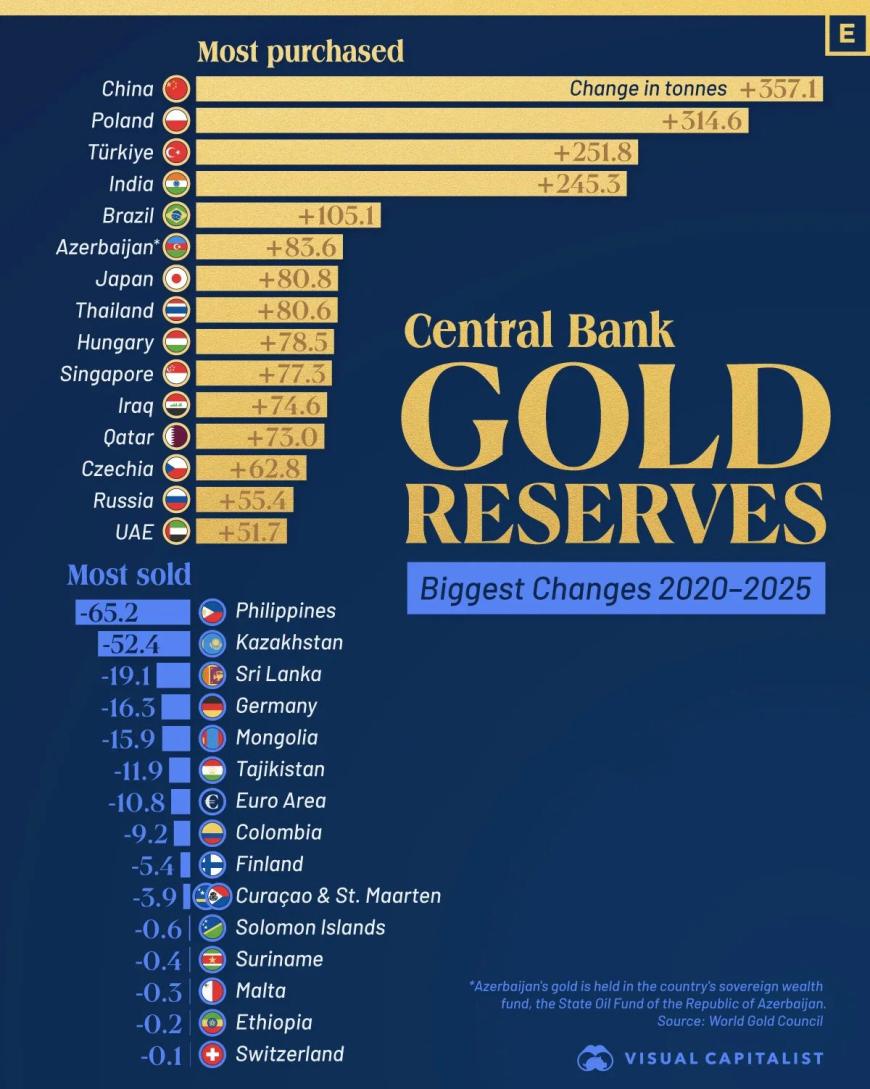
2020至2025年“囤金”VS“卖金”最多的国家
Ge Long Hui· 2026-02-12 08:33
Core Insights - From 2020 to 2025, gold prices have surged approximately 230%, driven by a strong wave of central bank gold purchases [1] - The top 15 gold buyers collectively increased their net gold reserves by nearly 2000 tons, indicating a significant shift in official strategies [1] Summary by Category Central Bank Purchases - China recorded the largest increase in gold reserves, adding 357.1 tons [1] - Poland followed with an increase of 314.6 tons, as part of its long-term strategy to enhance monetary security [1] - Turkey and India also ranked high, increasing their reserves by 251.8 tons and 245.3 tons, respectively [1] Decrease in Gold Reserves - The Philippines had the largest reduction in gold reserves, decreasing by over 65 tons [1] - Kazakhstan and Sri Lanka also reduced their reserves by 52.4 tons and 19.1 tons, respectively, often reflecting domestic liquidity pressures or active reserve rebalancing during economic stress [1]
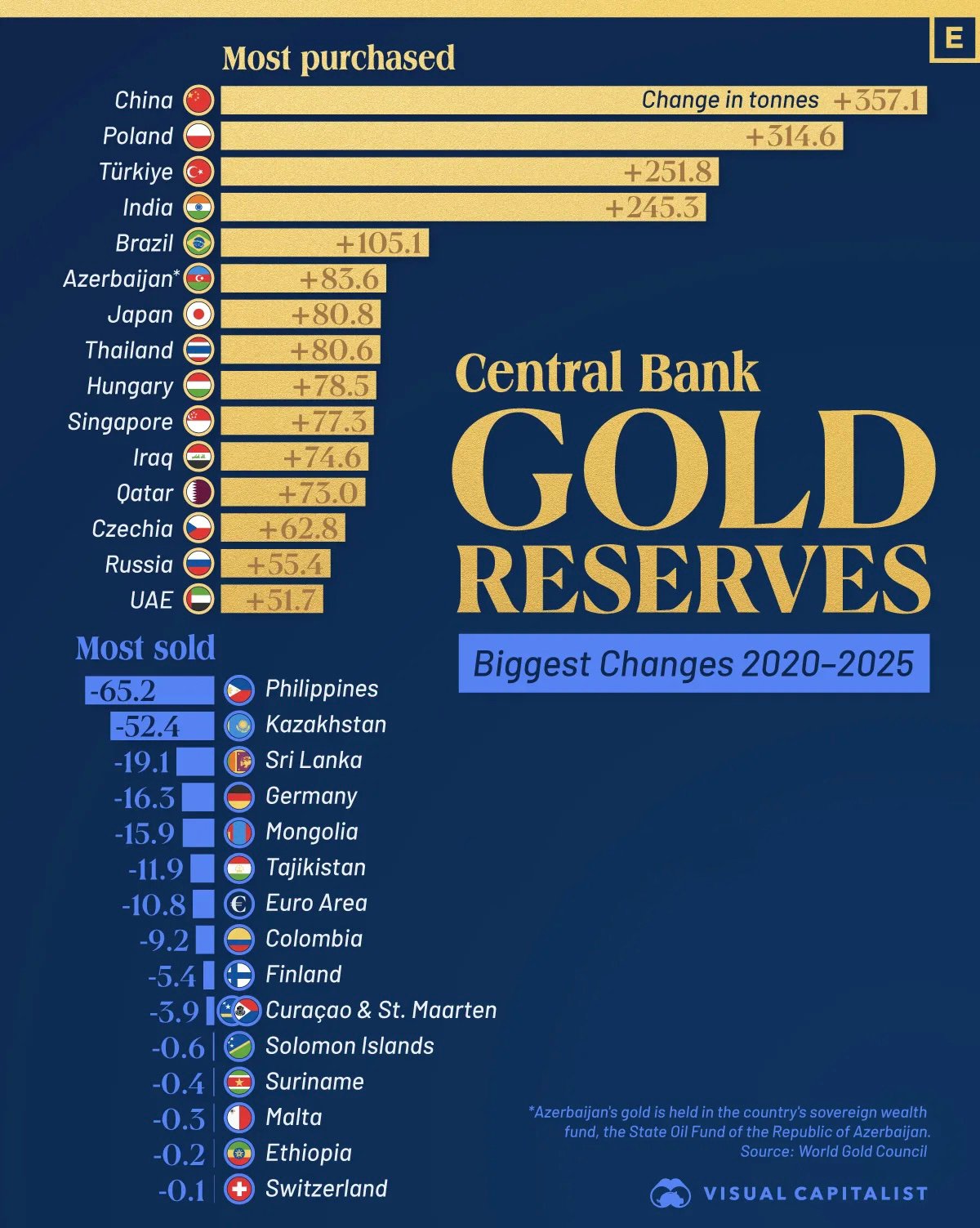
看图:2020至2025年“囤金”vs“卖金”最多的国家
Xin Lang Cai Jing· 2026-02-12 07:51
Core Insights - The price of gold has surged approximately 230% from 2020 to 2025, driven by a strong wave of central bank gold purchases [1] - The top 15 gold buyers collectively increased their gold reserves by nearly 2000 tons, indicating a significant shift in official strategies towards gold accumulation [1] Summary by Category Central Bank Purchases - Central banks have shown a robust trend in increasing gold reserves, with China leading the way by adding 357.1 tons [1] - Poland follows closely with an increase of 314.6 tons, as part of its long-term strategy to enhance monetary security [1] - Turkey and India also rank among the top buyers, with additions of 251.8 tons and 245.3 tons respectively [1]
中国为何持续扩大黄金储备?
Sou Hu Cai Jing· 2026-02-12 07:45
Core Viewpoint - The People's Bank of China (PBOC) has become one of the most active participants in the global gold market due to its significant gold purchases and accumulation of reserves [2][3]. Group 1: Gold Market Trends - As of February 9, 2026, spot gold prices surpassed $5,000 per ounce, reflecting a volatile market with a peak of $5,598.75 per ounce in January, followed by a significant drop of 9% [2]. - The PBOC's gold reserves reached 74.19 million ounces by the end of January 2026, marking a continuous increase for 15 months since November 2024 [2]. Group 2: Global Central Bank Behavior - China has become the sixth largest gold reserve holder globally as of the second quarter of 2025, with central banks worldwide also increasing their gold purchases significantly [3]. - From 2022 to 2024, global central banks have consistently purchased over 1,000 tons of gold annually, with 2022 at 1,081.9 tons, 2023 at 1,050.8 tons, and 2024 at 1,044.6 tons [3]. Group 3: Motivations Behind Gold Accumulation - The strong desire among central banks to hold and increase gold reserves is primarily driven by ongoing geopolitical tensions, such as the Russia-Ukraine conflict and the Israel-Palestine situation, which have heightened market uncertainty [3][6]. - The PBOC's cautious strategy of incremental gold purchases aims to stabilize the domestic precious metals market and support the national currency and fiscal policies [6]. Group 4: Economic and Policy Considerations - Recent central meetings in China have indicated a shift towards maintaining stability in capital and fiscal markets, providing a supportive environment for gold accumulation [8]. - The accumulation of gold serves as a hedge against potential risks associated with the fluctuating US dollar and other uncertainties in the international market [8].
美国担心的事情发生了!俄罗斯大量黄金涌入中国,美元霸权完了?
Sou Hu Cai Jing· 2026-02-11 13:25
制裁压力下俄罗斯把黄金当成了主心骨 2022年西方冻结俄罗斯几千亿美元外汇资产以后,俄罗斯央行直接把黄金储备当成最靠谱的底牌。几年 下来,实物黄金存量一直稳在2300多吨,2025年底还有2326吨左右。 金价一路猛涨,俄罗斯手里这些金条账面价值直接翻倍,2025年一年就增值1300多亿美元,差不多把被 冻结的损失补回一大半。 以前大家总觉得黄金不灵活,变现麻烦,可真到关键时候才发现,只有金条谁也动不了。俄罗斯央行基 本没怎么大卖,而是把黄金死死攥在手里,当成战略缓冲。 俄罗斯一下子从中国黄金供应国第11位冲到第7位,排在瑞士、加拿大、南非、澳大利亚和吉尔吉斯斯 坦后面。 交易主要集中在下半年,10月9.3亿美元,11月9.61亿美元,12月单月10吨、13.5亿美元,三个 月就把全年大部分量给吃掉了。 这些金条基本都是标准金锭,纯度999.9,交易方式也越来越直接,用人民币和卢布结算的比例明显增 加,彻底绕开了美元和SWIFT。 与此同时,中俄石油贸易也在悄悄变样。 俄罗斯卖给中国的原油比布伦特便宜三成多,其中一部分货款直接用黄金抵扣。俄罗斯拿到黄金就能买 关键物资,中国把黄金直接计入储备,两边都觉得这笔账 ...
黄金期货日报-20260211
Guo Jin Qi Huo· 2026-02-11 06:56
成文日期:20260209 报告周期:日报 :杜宇(从业资格号:F3075043; 投资咨询从业证书号:Z0017815) 黃金期货日报 1期货市场 上海期货交易所黄金期货主力合约(AU.SHF)2026年2月9日开 盘价为 1104 元/克,收盘价为 1125.94 元/克,较前一交易日上涨 3.88%。当日最高价达到 1133.16 元/克,最低价为 1098.38 元/克, 呈现出震荡上行的走势。 2 价格波动分析 从近 5 个交易日的价格走势来看,黄金期货价格呈现震荡整理 态势。2 月 3 日收盘价 1093.78 元/克,2 月 4 日冲高至 1141.7 元/ 克, 随后回调至 2 月 6 日的 1090.12 元/克,2 月 9 日再次反弹至 1125.94 元/克,形成一个类似"W"型底部形态,技术支撑有所加强。 3 市场动态 中国央行黄金储备实现"十五连增",截至 2026 年 1 月末,黄金 储备报 7419 万盎司,较上月增加 4 万盎司,央行持续增持黄金显示 对市场形成利好支撑。国际金价近期经历剧烈波动, 1 月 29 日盘中 突破 5590 美元/盎司历史新高后出现暴跌,2月2日跌至 ...
暴涨800%!白宫收到噩耗:普京找到出路,西方最大的王牌瞬间失灵
Sou Hu Cai Jing· 2026-02-11 05:18
Hello,大家好呀!欢迎来到老闫侃时事。就在不久前,2025年的海关数据一公布,立刻在国际金融圈掀起了不小的波澜:中国从俄罗斯进口的实物黄金总 量达到了惊人的25.3吨。也许你一时没有感受到这个数字的震撼,但如果告诉你,这个数字比去年同期暴涨了800%,你是否会察觉到一种异样的气息正在 蔓延? 在这一时刻,俄罗斯为什么急于把其手中压箱底的硬通货黄金送往中国?这25吨黄金的东流背后,究竟隐藏着怎样的深层动机?而当全球央行持有的黄金总 值首次超越美债时,我们是否正目睹一个旧时代的落幕?今天,老闫带大家一同剖析这背后的深刻原因,看透其中的地缘博弈与金融暗战。 黄金东流背后的保命符 让我们将时间倒回到2025年,当一箱箱沉甸甸的黄金穿过严密的安保运输线,从俄罗斯的金库跨境流入中国时,这一幕背后,实际上是俄罗斯在经历了多次 惨痛教训后,所做出的最务实的选择。过去几年,俄罗斯也曾信任过美元,手中握有大把美元资产,可结果呢?西方国家的一纸制裁令,毫不犹豫地宣布冻 结。 这一记重击让俄罗斯彻底清醒:原来,那些躺在银行账户里的数字,只是别人手中的把柄。于是,俄罗斯开始了一场彻底的资产置换。既然美元不可靠,那 就换成谁都无法控 ...
我国外储稳站3.3万亿,黄金悄悄增持,背后藏着我们的资产安全感
Sou Hu Cai Jing· 2026-02-11 05:18
2月7日,两组数字同时刷屏。国家外汇管理局公布,截至2026年1月末,我国外汇储备规模为33991亿美 元,较2025年12月末上升412亿美元,升幅1.23%。同一批官方储备资产数据还显示,黄金项下为 3695.82亿美元,对应实物口径7419万盎司。 乍一看,这像是一份平平无奇的"月度账单"。但把它放进全球货币环境和资产价格的波动里,你会发现 它透露出的信息更耐读:外汇储备总量维持在一个相对稳的区间,同时黄金配置在时间维度上持续推 进,节奏不快,态度很硬。 一、先把"外储变动"的账算清楚 很多人会把外汇储备的升降,理解为"买了多少美元"或"抛了多少美元"。月度数据里,真实情况往往更 复杂。外汇局在这次说明里点得很直白:2026年1月,受主要经济体财政政策、货币政策及预期等因素 影响,美元指数下跌,全球主要金融资产价格总体上涨,汇率折算和资产价格变化等因素综合作用,带 动当月外汇储备规模上升。 换句话说,外储的"表观增加",里面通常混着两类力量:一类是估值,另一类才更接近资金流。美元走 弱时,储备里以欧元、日元等计价的资产,换算成美元会"显得更值钱"。全球债券、股票等价格波动, 也会通过资产估值反映到外储口 ...