美债抛售

Search documents
游戏结束,中国囤储2308吨黄金!赶在访华前,特朗普试探中方口风
Sou Hu Cai Jing· 2026-02-12 11:53
Group 1 - China's gold reserves have quietly increased to 2,308 tons, prompting concern in the U.S. government, particularly from Treasury Secretary Mnuchin, who sent officials to gauge the situation [1][3][5] - The strategic selling of U.S. Treasury bonds by China has nearly halved its holdings from over $1.3 trillion to below $700 billion, indicating a calculated withdrawal from U.S. debt [3][5][7] - This selling trend aligns with the U.S.-China trade tensions and reflects a systematic response to U.S. actions, showcasing China's strategic financial maneuvering [5][9][11] Group 2 - The U.S. faces a significant debt crisis, with national debt exceeding $38 trillion, which is over 120% of GDP, raising concerns about fiscal sustainability [15][17][23] - The loss of the U.S.'s AAA credit rating by major rating agencies has eroded confidence in U.S. debt, leading to fears of potential asset confiscation due to political actions [17][19][21] - As China accumulates gold, it signals a shift in global capital flows, emphasizing the importance of gold as a stable asset in an uncertain world [13][19][25] Group 3 - China's strategy includes not only selling U.S. bonds but also building a new asset framework that bypasses the dollar, such as establishing offshore gold trading and introducing RMB-denominated gold futures [27][29][31] - This new system aims to enhance the credibility of the RMB by linking it to tangible gold reserves, contrasting with the diminishing trust in the dollar [29][31][33] - The ongoing geopolitical tensions and the U.S.'s financial mismanagement have led to a re-evaluation of asset security, with gold emerging as a critical hedge against instability [19][25][35] Group 4 - The U.S. response to China's financial maneuvers has been characterized by contradictory statements, revealing underlying anxiety about the shifting balance of power in global finance [40][42][50] - The U.S. is struggling to revitalize its industrial base to support the dollar, facing challenges from domestic political strife and a hollowed-out manufacturing sector [42][44][48] - The ongoing asset reallocation by China is a rational decision based on national interests, indicating a fundamental change in the rules of the financial game [48][52][54]

德国1200吨黄金急着要回,欧洲集体抛美债,金融霸权或将崩塌?
Sou Hu Cai Jing· 2026-01-31 11:46
Core Viewpoint - The article discusses the rising concerns over the security and credibility of gold reserves held by countries, particularly Germany, in the context of the U.S. dollar's dominance and the potential risks associated with it [1][4][14]. Group 1: Gold Reserves and Trust Issues - Gold prices have surpassed $5000, reflecting a shift in perception regarding wealth and financial security, particularly in Europe [1]. - Germany's demand to repatriate its gold reserves is driven not by financial need but by fears that their gold may have physically disappeared or been misappropriated [3][6]. - The U.S. delayed the repatriation of Germany's gold for seven years, raising suspicions about the integrity of the gold reserves [4][6]. Group 2: Political and Financial Implications - The discovery that the serial numbers of the gold bars returned to Germany did not match the original records has led to allegations of misappropriation by the U.S. [4][6]. - The urgency expressed by German officials for the return of their gold indicates a looming crisis and a lack of confidence in the U.S. financial system [7][16]. - European pension funds, traditionally conservative investors, have begun to sell off U.S. Treasury bonds, signaling a significant shift in market sentiment and trust in U.S. financial stability [9][10]. Group 3: Changing Dynamics in Global Finance - The total value of global central bank gold reserves is projected to surpass that of U.S. Treasury holdings by the end of 2025, indicating a fundamental shift in asset preference [13]. - The Bretton Woods system, which relied on the dollar's backing by gold, is being questioned as countries increasingly favor gold over paper assets [14]. - The internal conflict within European leadership regarding trust in the U.S. reflects deep-seated anxieties about financial security and geopolitical stability [16].
美国政府突发,黄金、白银暴涨
Zhong Guo Ji Jin Bao· 2026-01-26 22:37
Group 1 - The probability of a U.S. government shutdown by the end of January has surged to 78%, up from less than 10% the previous week, with total betting volume around $7.5 million [1] - A temporary funding bill passed in December ended a 43-day government shutdown, but it is set to expire at the end of January, necessitating a new funding bill to avoid another shutdown [3] - The Senate is expected to vote on the funding bill after delays caused by severe weather, with strong opposition from several Democratic senators regarding funding for the Department of Homeland Security [3][4] Group 2 - If the Senate fails to pass the funding legislation by midnight on Friday, multiple federal departments, including Health and Human Services, Education, and Transportation, will face partial shutdowns [4] - The previous government shutdown had significant negative impacts, including unpaid government employees and disruptions to the aviation system, which damaged confidence in the U.S. political system and its international reputation [6] - Major pension funds in Nordic countries are rapidly divesting from U.S. Treasuries, with Sweden's Alecta selling most of its $11 billion holdings, indicating a shift in confidence towards U.S. fiscal policies [6] Group 3 - The price of gold surged to a record high of $5,100 per ounce, with forecasts from Goldman Sachs and Morgan Stanley predicting further increases to $5,400 and $5,700 per ounce, respectively [6] - Silver prices also saw significant gains, breaking through $110 per ounce with a daily increase of over 9% [7] - Analysts suggest that the weakening confidence in the U.S. dollar is driving up precious metal prices, reflecting a broader crisis of confidence in the global monetary system [8]
美国政府,突发!黄金、白银暴涨!
中国基金报· 2026-01-26 15:54
Group 1 - The article discusses the high probability of a U.S. government shutdown, with Polymarket indicating a 78% chance of a shutdown occurring by the end of January, up from less than 10% the previous week [2] - The temporary funding bill passed in December is set to expire at the end of January, necessitating a new funding bill to avoid a government shutdown [4] - Several Democratic senators have expressed strong opposition to funding the Department of Homeland Security, which is complicating the approval of the spending bill in the Senate [4][5] Group 2 - If the Senate fails to pass the funding legislation by the deadline, multiple federal departments, including Health and Human Services, Education, and Transportation, will face partial shutdowns [6] - The previous government shutdown had severe consequences, including hundreds of thousands of government employees being furloughed and significant disruptions to daily life and business activities [7] - Concerns over U.S. fiscal policy and uncertainty have led to a shift in international investment strategies, with major pension funds in Nordic countries rapidly divesting from U.S. Treasuries in favor of gold [7] Group 3 - Gold prices surged to a record high of $5,100 per ounce, with forecasts from Goldman Sachs and Morgan Stanley predicting further increases to $5,400 and $5,700 per ounce, respectively [7] - Silver also experienced significant gains, breaking through $110 per ounce with a daily increase of over 9% [8] - Analysts attribute the rising prices of precious metals to a growing lack of confidence in the U.S. dollar and the broader monetary system, indicating a crisis of confidence [9][10]

刹不住!金银迎“史诗级”大涨
Guo Ji Jin Rong Bao· 2026-01-26 14:10
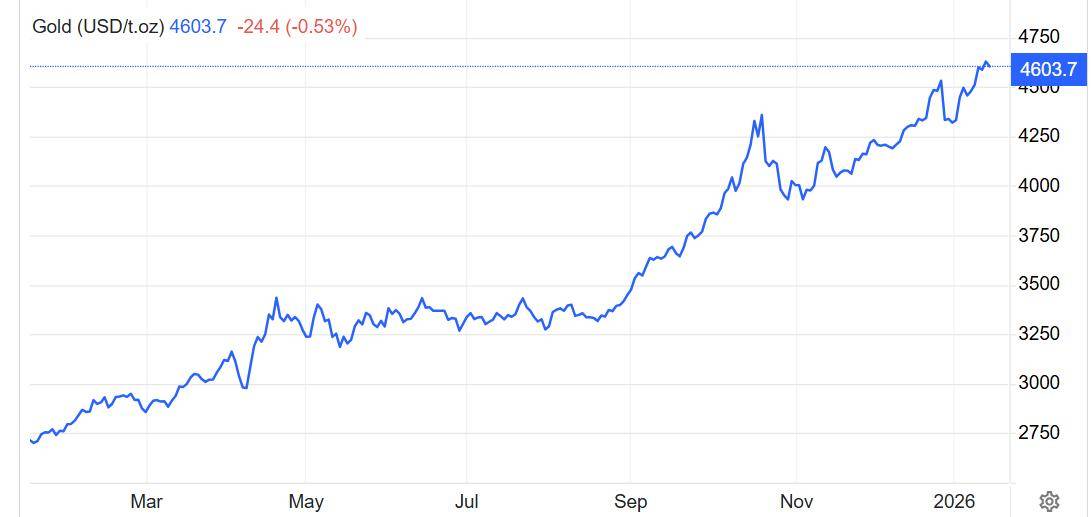
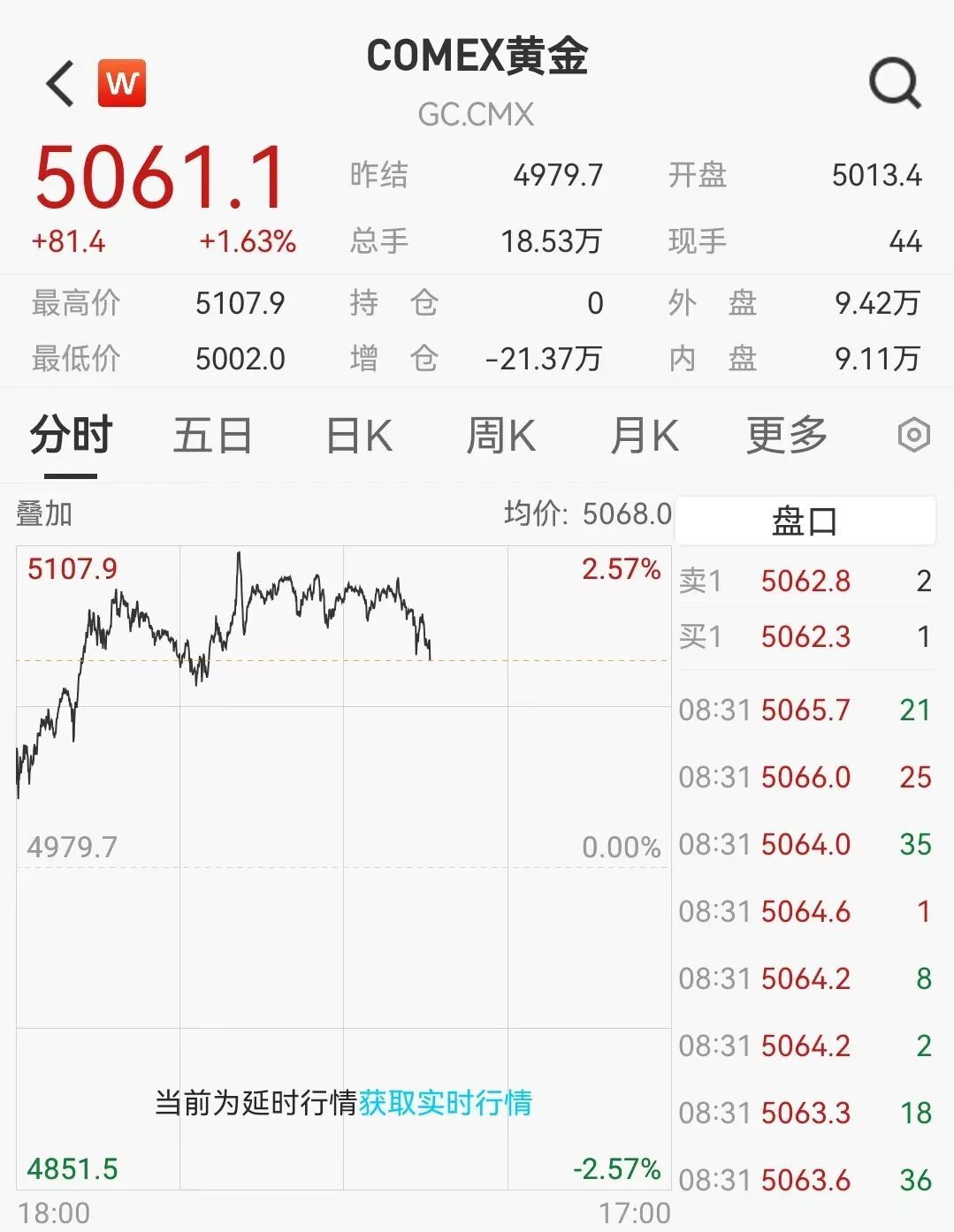
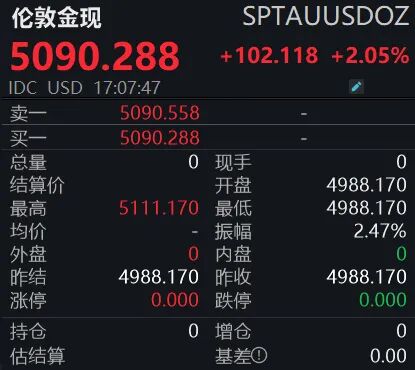
Core Viewpoint - The prices of gold and silver have surged to historic highs, with spot gold breaking the $5000 per ounce mark, driven by factors such as weakened dollar credibility, strong central bank demand for gold, and geopolitical premiums [1][11]. Market Performance - As of the report, spot gold rose by 2.05% to $5090.288 per ounce, reaching a peak of $5111.17, while spot silver surged by 6.06% to $109.6 per ounce, surpassing the $110 mark [3][5]. - In the futures market, COMEX gold futures increased by 2.02% to $5080.4 per ounce, with a peak of $5107.9, and COMEX silver futures rose by 7.54% to $108.97 per ounce, hitting a high of $110.065 [6][7]. Influencing Factors - The current gold price rally, which began in early 2025 at around $3000 per ounce, reflects significant changes in the macroeconomic environment [9]. - Short-term factors include ongoing geopolitical risks, such as tensions over Greenland's sovereignty and escalating US-Iran relations, which have heightened demand for safe-haven assets like gold [9]. - Mid-term factors involve the interplay between the Federal Reserve's policy path and its independence, with expectations of weakened monetary policy independence supporting gold prices [9][10]. - Long-term drivers include the structural weakening of the dollar credit system, with global central banks increasing gold reserves and a steady de-dollarization process [10]. Future Outlook - The long-term upward trend for gold remains intact, influenced by factors such as weakened dollar credibility, strong central bank demand, and geopolitical premiums [11]. - Analysts predict that gold prices could potentially reach $6000 per ounce by 2026, driven by ongoing geopolitical uncertainties and expectations of continued monetary easing [11]. - Investment strategies suggested include a diversified approach based on individual financial capacity and risk tolerance, with recommendations for different investment vehicles such as gold futures, ETFs, and physical gold [11].
出大事了,欧洲发起最强反击,北约亮明立场,白宫将失去掌控力
Sou Hu Cai Jing· 2026-01-26 11:09
Market Overview - On January 20, the U.S. financial market experienced a sudden crash, with the Dow Jones Industrial Average dropping over 900 points at one point, ultimately closing down 1.76%, marking the worst decline since October of the previous year [1] - The Nasdaq index fell by 2.39%, while the S&P 500 index dropped by 2.06%, leading to significant losses for investors [1] Bond Market Reaction - Contrary to expectations, U.S. Treasury bonds, typically seen as a safe haven, faced a sell-off, with the 10-year Treasury yield rising by 6.76 basis points to 4.2906%, and the 30-year yield nearing 5% [3] - This rise in yields indicates a drop in bond prices, contributing to a broader financial panic that affected stocks, bonds, and even cryptocurrencies like Bitcoin, which fell by 5% [3] Triggering Event - The sell-off was initiated by the Danish Academic Pension Fund, which announced plans to liquidate $100 million in U.S. Treasuries by the end of January, citing concerns over the deteriorating fiscal situation in the U.S. [5] - Although the amount seems small relative to the overall bond market, it acted as a catalyst for a larger panic, akin to striking a match in a gas-filled room [5] European Response - The situation is compounded by geopolitical tensions, particularly related to Trump's aggressive trade policies towards Europe, including potential tariffs on several European countries [7] - The Danish fund's actions signal a loss of trust in U.S. assets among European investors, which could lead to a broader sell-off if other countries follow suit [9] Potential Consequences - If major European nations like Germany and France begin to sell U.S. Treasuries, it could threaten the stability of the U.S. dollar system and lead to a credit crisis [9] - The European Union has prepared a targeted response to U.S. tariffs, focusing on specific American products that could inflict economic pain without significant backlash on European economies [11] Internal Divisions in Europe - Europe is divided between hardliners, led by France, who advocate for a strong response to U.S. actions, and moderates, like Germany, who fear the economic repercussions of a trade war [13] - Germany's economy is already struggling, and significant tariffs could exacerbate its downturn, highlighting the delicate balance Europe must maintain in its response to U.S. policies [13] Strategic Considerations - Trump's approach may be risky, as it could provoke Europe into adopting non-traditional retaliatory measures that could destabilize U.S. markets further [14] - The uncertainty surrounding these geopolitical tensions is a primary concern for investors, as markets typically react negatively to unpredictability [14]

欧洲人终于明白,原来手头握着的美债,才是最具杀伤力的弹药
Sou Hu Cai Jing· 2026-01-23 10:01
Group 1 - The core argument of the article revolves around the impact of European funds' decisions to sell U.S. Treasury bonds, which could significantly affect the U.S. bond market and the broader economy [3][5][7] - Alecta, Sweden's largest private pension fund, announced plans to gradually reduce its holdings of U.S. Treasury bonds starting in early 2025, with a total reduction amounting to approximately $7.7 billion to $8.8 billion [3] - Denmark's academic pension fund also stated it would sell $100 million worth of U.S. Treasury bonds by the end of January, leading to a combined sell-off that, while small in percentage terms, caused significant market volatility [3][5] Group 2 - The announcement from these funds led to a sharp increase in the yield of 10-year U.S. Treasury bonds, rising from 4.21% to 4.29%, and reaching a five-month high of 4.31% during trading [5] - The yield on 30-year U.S. Treasury bonds also increased to 4.92%, marking the largest single-day drop since July [5] - European politicians, such as the chairman of the European Parliament's Renaissance Group, suggested that Europe should sell between $1.5 trillion to $2.3 trillion in U.S. Treasury bonds to exert pressure on the U.S. [5] Group 3 - However, the potential consequences of such a sell-off could be detrimental to Europe, leading to significant economic losses and asset depreciation, particularly affecting export-driven economies like Germany and Italy [7] - European Commission President Ursula von der Leyen indicated a preference for using trade measures and anti-coercion tools rather than resorting to the risky strategy of selling U.S. Treasury bonds [7] - The article highlights the paradox that while U.S. Treasury bonds appear to be a powerful weapon, European nations may find themselves unable to effectively utilize this asset due to the majority being held by private institutions [7]

国泰海通|固收:欧洲抛售美债对美债有何影响
国泰海通证券研究· 2026-01-22 14:01
Core Viewpoint - The global bond market experienced a significant sell-off on January 20, 2026, primarily driven by rising political uncertainties and a fragile supply-demand structure in the interest rate market, with the U.S. and Japanese long-term bonds leading the decline [1][2]. Group 1: Market Reactions - The 30-year U.S. Treasury yield rose above 4.9%, while the 10-year yield approached 4.30%, leading to a direct increase in discount rates and compressing valuations of stocks and credit assets, with the S&P 500 falling by 2.1% and the Nasdaq by 2.4% [2]. - The escalation of trade tensions and policy uncertainties intensified the sentiment to "sell U.S. assets," resulting in a weaker dollar and increased demand for safe-haven assets like gold and silver [2]. Group 2: Transmission Mechanisms - Three transmission chains amplified the market shock: 1. The rise in Japanese long-term rates forced a global increase in term premiums, impacting U.S. Treasuries and other long-term bonds [2]. 2. The narrative of U.S.-European conflicts transitioned from trade friction to financial tool repricing, leading to market adjustments for cross-border capital allocation and hedging costs [2]. 3. The increase in risk-free rates combined with a decline in risk appetite exerted pressure on emerging markets, particularly those with high beta and external debt dependencies, making them more sensitive to refinancing and exchange rate fluctuations [2]. Group 3: Structural Constraints - The fundamental issue behind the volatility lies in the structural constraints of the U.S. fiscal and debt path, with total U.S. debt projected to reach $38 trillion by the end of 2025 and facing approximately $10 trillion in refinancing pressure in 2026 [3]. - The three major credit rating agencies downgraded the U.S. sovereign credit rating in 2025, raising market concerns about entering a vicious feedback loop characterized by "credit discount → higher yields → increased interest expenses → rising financing costs → worsening fiscal pressure" [3].

美国财长贝森特:不担忧美债抛售问题 日本同行会出手
Xin Hua Cai Jing· 2026-01-21 08:43
Group 1 - The core viewpoint is that U.S. Treasury Secretary Yellen is not concerned about the sell-off of U.S. Treasuries and links it to the volatility of Japanese government bonds, indicating communication with Japanese counterparts to ensure market stability [1][1][1] - Yellen mentioned that Denmark's position in U.S. Treasuries is not significant [1][1][1] Group 2 - The World Economic Forum has scheduled a public speech by Trump at 21:30 Beijing time in Davos, but Yellen noted that Trump would arrive approximately three hours late [1][1][1]
黄金信仰永不灭!狂飙70%的金价仍在翱翔,华尔街奏响5000美元狂想曲
Sou Hu Cai Jing· 2026-01-15 03:35
Core Viewpoint - Gold and silver futures prices have reached new historical highs due to escalating geopolitical tensions, particularly in Venezuela, Cuba, and Iran, alongside concerns regarding the independence of the Federal Reserve's monetary policy and the depreciation of the US dollar [1][2][3] Group 1: Geopolitical Factors - The ongoing unrest in Iran and threats from the Trump administration regarding military intervention have heightened geopolitical risks, driving investors towards gold as a safe haven [1][2] - Analysts from ANZ Bank suggest that geopolitical instability and concerns over the Federal Reserve's independence will continue to boost global demand for gold, with expectations for prices to exceed $5,000 per ounce in the latter half of the year [2][3] Group 2: Market Predictions - Citigroup has raised its bullish forecast for silver to $100 per ounce and for gold to $5,000 per ounce, citing unprecedented high price trends and ongoing geopolitical tensions [3][6] - HSBC predicts that gold prices could surpass $5,000 per ounce in the first half of 2026, driven by increasing geopolitical risks and rising fiscal deficits [6][7] Group 3: Economic Indicators - The US federal deficit is projected to reach $2.05 trillion in the 2026 fiscal year, approximately 6.5% of GDP, which is expected to erode the credibility of fiat currencies and stimulate demand for gold [7][8] - Emerging market central banks are accelerating the process of "de-dollarization," leading to a stronger demand for gold as a reserve asset [8][9] Group 4: Investment Trends - The past year has seen gold and silver prices significantly outperforming other asset classes, with gold futures rising approximately 70% and silver nearly quadrupling in value [3][5] - Analysts emphasize that even a small shift of private investment from US Treasury bonds to gold could lead to substantial price increases, reinforcing the bullish outlook for gold prices [8][9]