黄金定价权

Search documents
争夺全球黄金定价权 香港在下一盘什么“大棋”|中环观察
2 1 Shi Ji Jing Ji Bao Dao· 2026-01-29 14:55
Core Viewpoint - The establishment of a central clearing system for gold in Hong Kong is expected to enhance its position as an international financial center and improve the efficiency and safety of gold transactions, addressing long-standing market bottlenecks [1][5][14]. Group 1: Market Context and Growth - Gold prices have surged, reaching a historical high of $5,598 per ounce on January 29, 2026, with an approximate 18% increase since the beginning of the year [1]. - Hong Kong's gold trading market has seen significant growth, with daily trading volume reaching HKD 2.9 billion in November 2025, more than doubling year-on-year [2]. - The global demand for gold is rising, with central banks reportedly purchasing between 750 to 900 tons of gold in 2025, reflecting gold's status as a key reserve asset [3][14]. Group 2: Central Clearing System Development - The Hong Kong government has announced the launch of a central clearing system for gold, which aims to fill a critical gap in the market and facilitate better integration with global gold markets [1][5]. - The new system will operate under a governance structure that includes major banks and financial regulators, ensuring a collaborative approach to its implementation [6][5]. - The system will integrate clearing, storage, and trading, enhancing operational efficiency and reducing transaction costs [7][6]. Group 3: Infrastructure and Collaboration - The Hong Kong government is investing in advanced gold storage facilities, aiming to increase capacity to over 2,000 tons within three years [7]. - The collaboration between Hong Kong and the Shanghai Gold Exchange is expected to create a dual hub for gold trading, enhancing pricing influence and resource allocation in the global market [9][13]. - The establishment of a unified clearing platform will facilitate smoother transactions between mainland China and Hong Kong, addressing current market fragmentation [3][9]. Group 4: Product Innovation and Diversification - The central clearing system will support the development of diverse gold financial products, including ETFs and tokenized gold assets, catering to both institutional and retail investors [10][11]. - The launch of the Hang Seng Gold ETF, which allows for physical gold redemption, marks a significant step in product innovation within the Hong Kong market [10]. - The integration of traditional gold products with digital financial innovations is expected to attract more international investors and enhance market liquidity [10][11]. Group 5: Strategic Implications - The establishment of the central clearing system is seen as a proactive measure by Hong Kong to align with national financial strategies and enhance its global competitiveness [14][5]. - The move towards a RMB-denominated gold market is anticipated to facilitate cross-border transactions and attract more international participation [14][9]. - The collaboration with mainland China in refining and trading gold is expected to leverage Hong Kong's unique advantages, further solidifying its role in the global gold market [12][13].
“全球黄金定价权,会越来越多掌握在中国手里”
Guan Cha Zhe Wang· 2026-01-29 13:37
今年的【问诊2026中国经济】专题,观察者网将聚焦"十五五"开局年的各种机遇和挑战。专题的第二 篇,上海交通大学高级金融学院张春教授与我们分享了他的精彩看法。张春教授长期关注离岸人民币金 融体系,是该领域既具国际视野,又不断探索中国路径的金融学者。 张春表示,中国也在建设黄金相关的储备体系。"上海黄金所已经在香港建了仓库,海外投资者来中国 买卖黄金不用担心,他们可以在香港实现交割。还有传言会在中东建分仓——就是说投资者买了上海的 黄金,他们可以储藏在其他国家或地区,中东或者新加坡,都是有可能的。" "这样就使得黄金在全球的定价权,会越来越多地掌握在中国手里,"张春强调,因为中国本身就是黄金 生产大国,又可能是最大的持有者,这会加持中国人民币的储备资产能力。 本文系观察者网独家稿件,未经授权,不得转载。 "所以,当前的策略,可能要用黄金来助力人民币国际化。"张春说。 他提到,美元在1945年替代英镑之际,没有让美债立刻变成储备资产,而是让"美元盯住黄金"。至少一 直到1971年尼克松宣布美元与黄金脱钩之前,黄金才是美元背后真正的储备资产。 "所以今后人民币实现国际化的过程中,中国的人民币信用有可能会以黄金储备资 ...
黄金时间·香港黄金中央清算系统将于2026年内开展试运营
Zhong Guo Jin Rong Xin Xi Wang· 2026-01-06 12:49
1974年1月1日,《禁止黄金进出口条例》被取消之后,香港黄金市场进入快速发展阶段。 转自:新华财经 香港特别行政区(简称香港)打造国际黄金交易中心的步伐到了一个关键节点。2025年12月22日由香港 财经事务及库务局(简称财库局)举办的黄金市场发展简介会上,财库局局长许正宇介绍,香港黄金市 场的全产业链已初步形成,政府正积极以打造香港成为黄金交易、储存、清算及风险管理中心为目标。 在黄金交易清算方面,由政府全资拥有的公司所管理的香港黄金中央清算系统计划于2026年内开展试运 营。 如今,2026年已经拉开序幕,即将试运营的香港黄金中央清算系统可能成为香港打造国际黄金交易中心 的关键节点。 自1900年设立金银业贸易场至今,香港黄金市场已有100多年的历史。 由于香港黄金市场在时差上刚好填补了纽约、芝加哥收市和伦敦开市前的真空,方便国际投资者继续在 香港买卖,香港由此成为连贯亚、欧、美市场的枢纽。 在天时与地利两大有利因素推动下,香港黄金市场在二十世纪七八十年代进入全盛期,成为纽约、伦敦 之外的全球第三大黄金市场。 之后随着东京、新加坡、迪拜等黄金市场的崛起,香港黄金市场受到一定的影响,部分黄金业务被分 流。 ...
3900吨海底金矿现世!中国黄金霸权梦要实现了吗?
Sou Hu Cai Jing· 2025-12-18 12:49
Core Insights - The discovery of a seabed gold mine containing 3,900 tons of gold in the northern waters of Shanshan Island, Yantai, is poised to reshape the global gold industry and enhance China's gold reserves significantly [2][4]. Group 1: Seabed Gold Mine Discovery - The newly discovered seabed gold mine represents 26% of China's existing gold reserves, reinforcing Yantai's title as "China's Gold Capital" [2]. - This mine is the largest seabed gold deposit found in Asia, highlighting its strategic importance [2]. Group 2: Challenges of Seabed Mining - Seabed mining presents multiple challenges, including seawater corrosion, high-pressure environments, and ecological protection [2]. - Countries like Australia and Canada are in the exploratory phase of seabed mining, indicating that China must focus on technological innovation to successfully develop this resource [2]. Group 3: Technological Innovations in Deep-Sea Mining - China has developed the "Jiaolong" manned submersible, demonstrating its capability for deep-sea operations [3]. - An intelligent mining system is under development, which aims to revolutionize traditional mining methods and improve efficiency while minimizing ecological impact [3]. Group 4: Global Gold Pricing Power - The discovery of the seabed gold mine provides China with a significant asset in its quest for global gold pricing power, currently dominated by London and New York [4]. - To achieve breakthroughs in pricing power, China needs to accelerate the internationalization of the Shanghai Gold Exchange, expand the influence of the RMB in gold pricing, and establish a comprehensive gold reserve system [4][5]. - Although the development of the seabed gold mine will take time and will not immediately affect market supply and demand, it strengthens China's market influence and lays the groundwork for future pricing power [5].



央妈反向操作!中国扫货、俄国砸盘,2026黄金会崩吗?
Sou Hu Cai Jing· 2025-12-12 01:44
一边是连续增持的坚定布局,一边是财政需要的现实考量。 12月初,中国央行发布最新数据显示,11月末黄金储备报7412万盎司(约2305.39吨),环比增加3万盎司(约0.93吨),增持量与上月持平,连续第13个 月增持黄金。而另一边,俄罗斯央行确认,开始出售储备的实物黄金,以弥补国家预算所需资金。 一买一卖的鲜明对比,让不少投资者心生疑惑:两大央行为何做出相反选择?这种分歧会改变黄金的牛市格局吗?2026年金价将走向何方? 中俄央行操作,逻辑完全不同 中国央行连续增持,本质是长期战略布局,优化官方储备资产,降低对美元的过度依赖,增强整体资产的安全性和对抗风险能力。在全球地缘政治不确定 性加剧、美元信用体系受挑战的背景下,黄金作为终极避险资产,能为人民币提供坚实的价值支撑。 2025年11月,柬埔寨国家银行已决定将新购买的金条运往中国,寄存在深圳保税区内的上海黄金交易所注册金库。 俄罗斯会展基金会认为,中国有成为新的原材料大宗商品贸易中心的长期战略,目前已经在铁矿石、煤炭、铜和石油贸易上有所展现。在黄金、白银等贵 金属领域,中国只是在执行这一战略。增持黄金,也间接在为主要原材料大宗贸易人民币化提供支持。 俄罗斯 ...

和讯投顾魏玉根:黄金定价权在谁手里
Sou Hu Cai Jing· 2025-10-15 12:46
Core Insights - The price of gold has recently surpassed $4,200 per ounce, reaching a historical high, raising concerns about potential sudden declines in value [1] - The consumption market for gold and silver jewelry accounts for over 52% of gold usage, but this segment lacks pricing power as it is tied to international gold prices [1] - Investment markets, including gold bars, coins, and ETFs, represent 28% of gold usage, also lacking pricing power and showing a trend of increasing purchases as prices rise [1] - The industrial sector accounts for 8% of gold usage, similarly influenced by international pricing without pricing power [1] Pricing Power Dynamics - The true pricing power of gold lies with global central banks, which, despite only accounting for 13% of consumption, significantly influence prices through their purchasing activities [2] - Central banks continuously buy gold through established markets like the London Bullion Market Association and the New York Mercantile Exchange, leading to limited supply and rising prices [2] - The annual production from mining companies is insufficient to meet the demand from central banks, which do not sell their holdings, contributing to the upward price trend [2] Investment Strategy Recommendations - Experts suggest allocating 10% of investment portfolios to gold as a long-term asset, with opportunities to buy during price corrections of 5% [2] - It is noted that a 10% price drop is challenging to achieve, particularly for gold ETFs, as opposed to gold stocks, which can see increased supply when prices rise [2] - An example is provided of a significant shareholder in Western Gold announcing a sell-off of 18.22 million shares, indicating potential liquidity in the stock market that does not apply to gold itself [2]
中国连续9月增持黄金,还是买的太少了?特朗普对瑞士加征39%关税
Sou Hu Cai Jing· 2025-08-24 15:42
Core Viewpoint - China's central bank has been steadily increasing its gold reserves for nine consecutive months, reaching a total of 73.96 million ounces (approximately 2300 tons), amidst speculation that this trend may soon halt due to external pressures, particularly from the U.S. [2][4][9] Group 1: China's Gold Accumulation Strategy - The Chinese central bank's approach to gold accumulation is characterized by a steady and methodical increase, purchasing 50,000 to 100,000 ounces monthly since November, which has resulted in a significant accumulation of hard currency [4][7] - Unlike other countries, China's gold purchases are all repatriated, enhancing its domestic reserves rather than relying on foreign storage [7][9] - China's gold reserves currently account for only 7% of its total reserves, significantly below the global average of 15%, indicating potential for further accumulation [9][11] Group 2: Impact of U.S. Tariffs on Gold Prices - The U.S. has imposed a punitive 39% tariff on Switzerland, which is expected to affect gold prices due to Switzerland's role in the global gold supply chain [4][11] - This tariff could lead to a situation where U.S. gold becomes more expensive compared to other countries, as Switzerland refines 70% of the world's gold [11][13] - The imposition of tariffs reflects a broader strategy by the U.S. to maintain dollar dominance, but it may inadvertently strengthen the position of gold as a reliable asset [11][15] Group 3: Global Monetary Dynamics - Central banks worldwide are accumulating gold at an unprecedented rate, with 95% indicating plans to continue buying in the coming year, signaling a shift in global monetary dynamics [11][15] - The rise in gold accumulation is seen as a preparation for potential instability in the dollar system, with countries like China reducing U.S. Treasury holdings while increasing gold reserves [15][16] - The evolving landscape suggests that gold is becoming more than just a safe-haven asset; it is emerging as a key player in the reconfiguration of the global financial order [16]
当年『中国大妈』抢黄金的故事该如何续写?
Sou Hu Cai Jing· 2025-07-18 04:04
Group 1 - The core viewpoint of the article highlights the significant rise in gold prices over the past few years, with a cumulative increase of approximately 13% in 2023 and nearly 30% in 2024, leading to a peak price around 3000 USD, which has doubled the cost basis for many investors, particularly the "Chinese aunties" who bought gold years ago [3][6][10] - The article discusses the historical context of gold price fluctuations, noting a bear market from late 2013 to late 2019, where prices ranged between 1045 USD and 1500 USD, and how the Federal Reserve's monetary policies, particularly during the COVID-19 pandemic, have influenced gold prices [7][8] - It emphasizes the dynamic relationship between U.S. inflation expectations and Federal Reserve monetary policy, indicating that a potential interest rate cut could further increase gold's attractiveness as an investment [8][9] Group 2 - The article outlines the strong demand for gold, driven by both consumer and central bank purchases, with central banks significantly increasing their gold reserves as a hedge against economic instability and currency depreciation [10][12] - It provides insights into the various channels for investing in gold, recommending gold ETFs as a preferred method due to their lower transaction costs, better liquidity, and reduced risk compared to physical gold or futures contracts [12][15][22] - The article compares traditional gold ETFs with Shanghai Gold ETFs, highlighting the latter's advantages in terms of tracking accuracy, lower costs, and broader investment options, making them a more attractive choice for investors [17][20][21]
黄金期货锁利润、控风险 我国“商品期货重器”如何护航黄金产业发展
Zheng Quan Ri Bao Zhi Sheng· 2025-06-26 17:12
Core Viewpoint - The high gold prices have led to a decline in consumer demand for gold jewelry, creating challenges for the industry, while gold derivatives are emerging as a crucial tool for risk management and stabilizing operations in the gold market [1][3][6]. Industry Challenges - The gold jewelry market is experiencing a downturn, particularly in major trading hubs like Shenzhen and Shandong, due to elevated gold prices, which have caused consumers to hesitate in making purchases [2][3]. - Data from the China Gold Association indicates a 5.96% year-on-year decline in gold consumption in Q1, with gold jewelry consumption dropping by 26.85% [3]. Risk Management Strategies - Gold retail businesses are increasingly focusing on inventory management and risk mitigation strategies, utilizing futures and options to hedge against price fluctuations [3][4][7]. - The introduction of gold futures and options has provided effective tools for price discovery and risk management, allowing companies to lock in profits and reduce the impact of price volatility [7][8]. Market Development - The Chinese gold futures market has seen significant growth, with trading volume and capital inflow increasing, indicating a rising importance in the global gold market [8][10]. - The Shanghai Futures Exchange has become a key player, with its daily trading volume reaching $90.8 billion, accounting for 22% of the global market during a recent price surge [10]. Internationalization Efforts - There is a strong industry call for the acceleration of the internationalization of China's gold futures market, including the introduction of RMB-denominated contracts and improved access for foreign investors [11]. - Enhancing the international competitiveness of China's gold market is seen as essential for increasing its influence in global gold pricing [11].
黄金单日暴跌6%!做市商“黑手”再现,这次谁成了冤大头?
Sou Hu Cai Jing· 2025-05-04 09:11
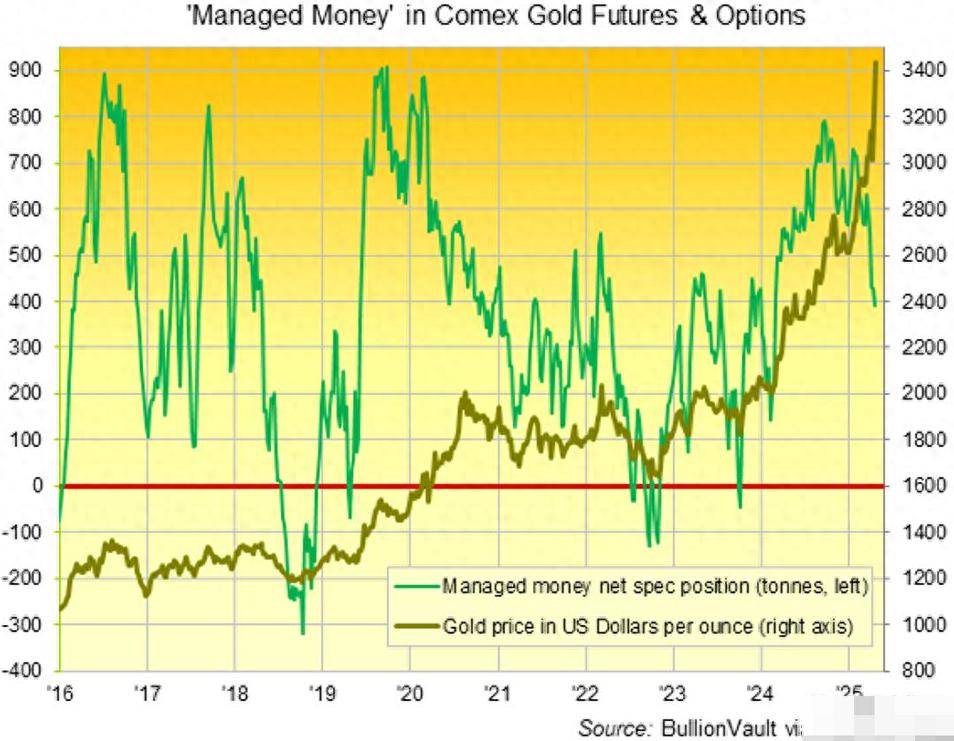
Core Viewpoint - The recent volatility in the gold market, characterized by a sharp decline in gold prices, raises concerns reminiscent of the market turmoil experienced in March 2020, indicating potential risks that need to be monitored closely [1][5]. Group 1: Market Dynamics - The COMEX gold inventory has seen a significant outflow, with 1.86 million ounces (approximately 85.58 tons) leaving the market, and a total outflow of 3.37 million ounces in April, suggesting a shift in supply-demand dynamics [1]. - There has been a notable trend of profit-taking, with large amounts of gold flowing back from customer accounts to market makers, exerting downward pressure on prices [2]. - The current situation mirrors the timeline of the 2020 market crash, with a similar four-month period of decline starting from December 10, 2022 [5]. Group 2: Market Sentiment and Predictions - Major Western market makers have been bullish on gold, with predictions from UBS and Goldman Sachs suggesting prices could exceed $3,500 and $3,700 respectively by year-end, raising questions about the underlying motivations behind such optimism [6]. - The recent sharp decline in gold prices, including a 6% drop in one day, aligns with expectations of market makers attempting to regain control over pricing [5][6]. Group 3: ETF and Trading Activity - The GLD ETF experienced its largest single-day redemption since 2011, with $1.3 billion withdrawn, indicating a significant shift in market sentiment and panic selling [7]. - The trading volume of GLD surged, ranking third among all ETFs, which is unusual for gold ETFs, suggesting a heightened state of market distress [7]. - Market makers are likely employing strategies across multiple markets, including the GLD ETF, to create a cascading effect that drives prices down [7][8]. Group 4: Chinese Market Response - Unlike previous market downturns, the Chinese market has not reacted with panic; instead, many investors view the price drop as a buying opportunity, reflecting a different perception of gold's value [8]. Group 5: Overall Market Complexity - The current gold market is characterized by unprecedented complexity, with vulnerabilities exposed in both the London spot market and the New York gold reserve system since significant buying began in December 2022 [11].