制度创新

Search documents
在全球第一大港感知开放新脉动
Xin Hua Wang· 2025-10-06 11:13
Core Insights - Ningbo-Zhoushan Port has achieved a record-breaking container throughput of over 30 million TEUs by September 11 this year, surpassing last year's figures by 23 days, highlighting its robust operational performance [1][2] - The port's growth is attributed to the release of foreign trade momentum in the Yangtze River Delta and nationwide, with significant exports in high-tech products such as new energy vehicles and photovoltaic products [1][2] - The port has expanded its logistics capabilities with the launch of new shipping routes, including a fast container route to Europe via the Arctic, reducing transit time to 18 days, significantly faster than traditional routes [2] Container Throughput and Shipping Routes - Ningbo-Zhoushan Port operates over 300 container shipping routes, with an average of nearly 300 vessels arriving and departing daily, connecting major ports across five continents [2] - The introduction of the Arctic shipping route marks a significant improvement in shipping efficiency, with a transit time of only 18 days to Felixstowe, compared to 25 days via the China-Europe Railway Express and up to 50 days via the Cape of Good Hope [2] Technological and Operational Innovations - The port utilizes advanced technologies such as remote-controlled cranes and AI navigation systems, which have improved operational efficiency, reducing the deviation rate of external trucks by over 10% and increasing gate passage efficiency by 7% [3] - Ningbo-Zhoushan Port has implemented a ship berthing reservation system to optimize operations and alleviate congestion, ensuring that vessels can dock and operate promptly [3] Economic Resilience and Future Outlook - The performance of Ningbo-Zhoushan Port reflects the strong resilience of the Chinese economy amid complex external conditions, with ongoing efforts to enhance the efficiency of its logistics and transportation systems [3] - The port aims to continue improving its service offerings to contribute to the construction of a new development pattern in the economy [3]

无锡“六优六免”新政落地 为无偿献血者送上暖心就医礼包
Zhong Guo Xin Wen Wang· 2025-10-04 01:32
Core Points - The article discusses the "Six Priorities and Six Exemptions" medical policy launched in Wuxi, which provides benefits to blood donors, enhancing their healthcare experience [1][2] - The policy aims to improve the efficiency of medical services for blood donors and reduce their financial burden [1][2] Group 1: Policy Overview - The "Six Priorities" include priority services in registration, hospitalization, examinations, medication, blood usage, and health check-ups [1] - The "Six Exemptions" cover waivers for various medical fees, including general and specialist registration fees, emergency registration fees, internet hospital registration fees, routine blood tests, electrocardiograms, and clinical blood usage [1] - The policy is designed to provide comprehensive care from pre-diagnosis to post-diagnosis for over 14,000 blood donors in Wuxi [1] Group 2: Implementation and Impact - As of two months after implementation, the policy has served 1,340 honor certificate holders, resulting in a total medical fee reduction of 24,000 yuan [2] - In the first half of 2025, Wuxi processed 662 cases of blood fee exemptions for donors and their relatives, amounting to 486,400 yuan [2] - Since the launch of the cross-province blood fee exemption feature in October 2024, Wuxi has assisted 62 blood donors from 14 provinces, with a total exemption amount of 64,700 yuan [2] Group 3: Public Response - Feedback from beneficiaries indicates a significant improvement in the convenience and efficiency of medical services, with shorter waiting times and a stronger sense of support [2] - The policy is viewed as a meaningful acknowledgment of the contributions made by blood donors, reflecting the city's commitment to honoring their service [2]
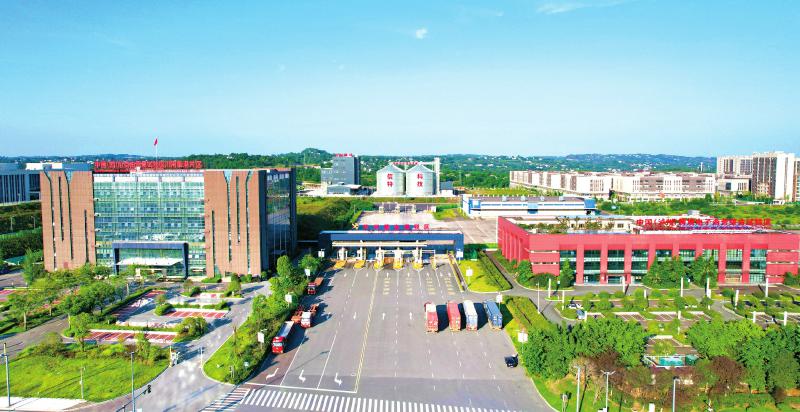
自贸区川南临港片区:剑指“满园满产”,打造泸州开放发展核心引擎
Si Chuan Ri Bao· 2025-10-01 07:48
Core Viewpoint - The China (Sichuan) Free Trade Zone (FTZ) Nanchuan Port Area is actively promoting high-quality economic development through institutional innovation and project signings, aiming to enhance its role as a core engine for the city's open economy [3][4]. Institutional Innovation - The Nanchuan Port Area has developed 540 institutional innovation achievements, including 21 new models since 2025, focusing on customs clearance, administrative approval, and tax management [4][5]. - Nine of these innovations have been promoted nationwide, while 36 have been adopted across Sichuan Province, demonstrating the area's commitment to reform and market vitality [4][5]. Project Signings and Economic Impact - On September 29, 12 projects were signed with various companies, covering areas such as bonded processing, bonded logistics, and cross-border e-commerce, marking a significant step towards achieving the "full garden, full production" goal [3][4]. - The Nanchuan Port Area aims to achieve an annual import and export value of 1 billion yuan from the newly signed projects, particularly in the international trade of imported meat [8]. Logistics and Transportation - The Nanchuan Port Area is enhancing its logistics capabilities by integrating water, rail, and road transport, with a focus on establishing a resource allocation hub for bulk commodities in the Sichuan-Chongqing region [7][8]. - The port has seen a 10.02% year-on-year increase in container throughput, reaching 186,700 TEUs from January to September [7]. Industry Development - The area is transitioning from a logistics channel to an "import + processing" ecosystem, focusing on developing outward-oriented industries, particularly in food and advanced materials [9][10]. - The cross-border e-commerce industry park is projected to achieve a transaction volume of 980 million yuan from January to September, reflecting a 27.77% year-on-year growth [10]. Future Goals - The Nanchuan Port Area aims to complete a foreign trade import and export volume of 14 billion yuan by the end of the year and achieve "full garden, full production" within three years [10][11].

海口海关从三方面发力支持跨境电商企业发展
Zhong Guo Xin Wen Wang· 2025-09-29 18:38
Core Viewpoint - The Haikou Customs is implementing innovative measures in institutional, management, and service aspects to support the development of cross-border e-commerce enterprises, aiming to create a better business environment for them [1][2]. Institutional Innovation - Haikou Customs is allowing enterprises to fully enjoy policy benefits by supporting the display of bonded imported goods in special regulatory zones and promoting the integration of online and offline e-commerce businesses [1]. - The customs authority is also facilitating the "cross-border e-commerce + duty-free" development, leveraging unique policy advantages of Hainan Free Trade Port to enhance market competitiveness for international new products [1]. Management Innovation - To ensure customs clearance efficiency, Haikou Customs is implementing measures such as "first enter the zone, then inspect," catering to the flexible supply chain needs of enterprises [1]. - The customs has optimized processes for cross-border packages, offering "one-stop" handling and 24/7 instant inspection services through WeChat appointments, ensuring "zero waiting" for customs clearance [1]. Service Innovation - Haikou Customs is reducing costs and increasing efficiency for enterprises by strictly implementing preferential policies for the comprehensive pilot zone, simplifying export procedures, and canceling the registration for overseas warehouse enterprises [2]. - The customs authority is enhancing the regulatory environment by shifting the responsibility for transaction authenticity to enterprises, thereby reducing institutional transaction costs [2]. - Future efforts will focus on continuously optimizing regulatory and service levels to support the high-quality development of the cross-border e-commerce industry in Hainan Free Trade Port [2].
原创科技成果是促进新质生产力发展的基石
Zhong Guo Xin Wen Wang· 2025-09-29 01:40
Group 1: Core Technological Breakthroughs - The importance of achieving self-controlled key technologies for national strategic security is emphasized, as reliance on external sources is insufficient [2] - Recent advancements in various fields such as aerospace, biomedicine, quantum communication, and semiconductor technology demonstrate China's resilience and capability in overcoming core technology challenges [2][3] - The development of indigenous technologies, such as the domestication of high-thrust rocket engines and the creation of innovative drugs, showcases the potential for China to lead in critical sectors [2][3] Group 2: Innovation Ecosystem and Talent Development - The need for a deep integration of industry, academia, and research to facilitate the transformation of scientific achievements into practical applications is highlighted [3][5] - Innovative educational models, such as interdisciplinary training and collaboration between universities and enterprises, are essential for cultivating talent that meets the demands of new productive forces [5][6] - The establishment of supportive mechanisms, such as the "shared engineer" platform in the Guangdong-Hong Kong-Macao Greater Bay Area, addresses the technical resource shortages faced by small and medium-sized enterprises [5] Group 3: Institutional Reforms and Policy Support - Continuous reforms at the institutional level are necessary to enhance the efficient flow of innovation elements, including the establishment of mechanisms for technology transfer and commercialization [4][7] - The creation of a favorable regulatory environment, such as the data asset registration system and the dual assessment system for green technology, is crucial for fostering emerging industries [7] - Strengthening intellectual property protection through specialized courts and new registration systems is vital for incentivizing original innovation [7]
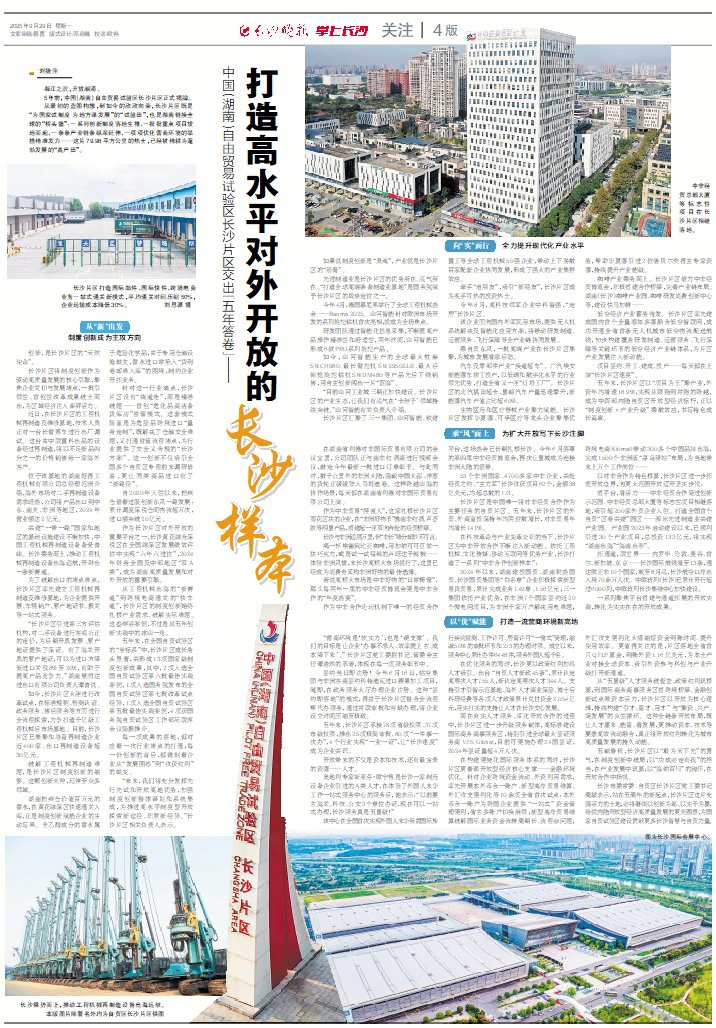
自贺长沙片区五周年答卷:打造高水平对外开放的长沙样本
Chang Sha Wan Bao· 2025-09-28 23:26
Core Viewpoint - The Changsha Free Trade Zone has evolved into a vibrant hub for innovation and economic development, focusing on institutional reforms and industry upgrades to enhance its global competitiveness [8][10][14]. Group 1: Institutional Innovation - Changsha Free Trade Zone prioritizes institutional innovation as a core driver for high-quality development, addressing enterprise concerns and development bottlenecks [10]. - The establishment of a remanufacturing and repair base for construction machinery has facilitated exports to regions like the Middle East and Africa, with projected revenues of 200 million yuan in 2024 [10][11]. - The zone has introduced a regulatory model for hazardous chemicals, enabling rapid customs clearance and addressing industry pain points, leading to significant growth in imports [13][14]. Group 2: Industry Development - Advanced manufacturing is a key strength of the Changsha Free Trade Zone, with a strategic focus on becoming a global high-end equipment manufacturing base [16]. - Major companies like SANY Group and Zoomlion are driving the development of a robust industrial cluster, enhancing competitiveness in the construction machinery sector [16][19]. - The automotive and new energy vehicle sectors are experiencing rapid growth, with GAC Aion's new energy vehicle production contributing to over 60% of the sector's output [19]. Group 3: International Trade and Cooperation - The Changsha Free Trade Zone has established itself as a vital platform for Sino-African trade, achieving an annual growth rate of 141% in trade with Africa [23][24]. - The zone has successfully hosted the China-Africa Economic and Trade Expo, attracting numerous projects and investments, with a total value exceeding 3.8 billion USD [23][24]. - The establishment of international trade routes and logistics networks has enhanced connectivity, with 13 international flight routes and over 6,000 China-Europe freight trains operated [24][25]. Group 4: Business Environment and Talent Attraction - The Changsha Free Trade Zone has implemented streamlined administrative processes, significantly reducing the time required for business registration and approvals [26][27]. - Talent attraction initiatives have led to the recognition of over 755 high-level talents, supported by substantial funding for research and development [27][28]. - Financial innovations, such as the establishment of the first QFLP fund in the province, have facilitated foreign investment and capital flow into local industries [28].
“第一动力”结出累累硕果
Jing Ji Ri Bao· 2025-09-28 21:59
Group 1 - The core message emphasizes China's advancements in technology and innovation during the 14th Five-Year Plan, showcasing significant achievements in various sectors such as aerospace, nuclear power, and large-scale manufacturing [1][2] - The report highlights the importance of innovation as a driving force for economic development and national security, with a focus on enhancing core technological capabilities and addressing challenges in the global value chain [2][3] - China's innovation landscape is evolving, with major breakthroughs in high-performance equipment, smart robotics, and advanced manufacturing technologies, contributing to the upgrade of the manufacturing sector [3][4] Group 2 - The optimization of innovation space is evident, with major technology innovation centers in Beijing, Shanghai, and the Guangdong-Hong Kong-Macao Greater Bay Area ranking among the top 10 globally [3][6] - The digital economy is experiencing rapid growth, with the core industries' added value increasing by 73.8%, reaching 10.4% of GDP, surpassing the targets set for the 14th Five-Year Plan [6][7] - The integration of technology and industry is crucial for fostering new productive forces, with a focus on enhancing the quality and efficiency of production processes [5][6] Group 3 - The report outlines the need for institutional innovation to support technological advancements, emphasizing reforms in education, talent development, and the establishment of a robust innovation ecosystem [7][8] - A market-oriented and legally sound business environment is being cultivated, with efforts to lower barriers for investment and entrepreneurship while maintaining national security [8][9] - The upcoming 15th Five-Year Plan period is identified as a critical phase for implementing reforms and achieving the goal of becoming a global technology powerhouse [9]
湖南自贸试验区5年推出制度创新成果109项
Zhong Guo Xin Wen Wang· 2025-09-28 15:02
Core Insights - Hunan Free Trade Zone has achieved significant institutional innovations and reforms over the past five years, enhancing cross-border trade, investment, and financial facilitation [1][2][3] Group 1: Institutional Innovations - A total of 109 institutional innovation results have been launched, addressing key challenges and improving efficiency for enterprises [1] - Seven institutional innovations have been recognized as national pilot reform experiences and best practice cases [1] Group 2: Economic Impact - Over 54,700 new enterprises have been established in the Hunan Free Trade Zone, averaging more than 10,000 new companies each year [1] - The zone has attracted 575 major projects with a total investment of 767.37 billion yuan [1] Group 3: Specific Reforms and Initiatives - The zone has introduced innovative measures such as a remanufacturing system for construction machinery and a new model for international cooperation on certification and standards [1] - The "Postal and Express Cross" business has been streamlined, reducing average customs clearance time by 50% and lowering transportation costs for enterprises by 30% [2] Group 4: Regional Collaboration - The Changsha area is collaborating with Hainan to build an advanced manufacturing industrial park, attracting 30 projects with a total investment of 13.3 billion yuan [2] - The Yueyang area is integrating into the Yangtze River Economic Belt, saving 5 to 10 days in transportation time and reducing first-leg costs by 20% [2] - The Chenzhou area is connecting with the Guangdong-Hong Kong-Macao Greater Bay Area, achieving 24-hour rapid customs clearance [2] Group 5: Business Environment Enhancements - Continuous reforms in business licensing and commercial systems have been implemented, enhancing market vitality [3] - Establishment of legal frameworks such as the Hunan (Changsha) International Legal Zone and various courts has improved the efficiency of handling foreign-related cases [3] - The establishment of a cross-border RMB center and the first QFLP fund in the province has significantly improved cross-border investment and financing facilitation [3]
湖南自贸试验区建设五周年成绩单出炉 3个自贸片区贡献全省近三成外贸总量
Chang Sha Wan Bao· 2025-09-28 12:50
Core Insights - The Hunan Free Trade Zone has significantly contributed to the province's foreign trade, accounting for nearly 30% of the total trade volume, with 5.47 million new enterprises established and 575 major projects attracting a total investment of 767.37 billion yuan over the past five years [1] Group 1: Institutional Innovations - The Hunan Free Trade Zone has introduced 109 institutional innovation achievements, with 7 recognized as national best practices, enhancing cross-border trade, investment, and financial facilitation [2] - The establishment of a remanufacturing system for construction machinery has led to the creation of 8 group standards and 3 local standards, attracting numerous remanufacturing and repair export enterprises [2] Group 2: Industrial Upgrades - The Free Trade Zone focuses on upgrading seven key industries: equipment manufacturing, digital economy, air economy, port economy, non-ferrous metals, biomedicine, and artificial intelligence [3] - The equipment manufacturing sector is leading nationally, with major companies like SANY and Zoomlion located in the Changsha area, and the Yueyang area becoming the largest servo motor production base in the country [3] Group 3: Full Industry Chain Innovation - Hunan aims to establish itself as a significant advanced manufacturing hub, with Changsha focusing on the entire equipment manufacturing industry chain from R&D to remanufacturing [4] - The Changsha area has helped 656 manufacturing enterprises protect 7.78 million commercial secrets and has seen the addition of over 9,000 invention patents [4] Group 4: International Trade Growth - Companies like SANY and Zoomlion have over 50% of their revenue coming from overseas markets, with products reaching over 20 countries including Indonesia and Ghana [5] - Since the establishment of the Free Trade Zone, foreign trade and foreign investment have achieved double-digit annual growth, with trade with Africa growing by an average of 141% annually [5]
历史深处的商业智慧:钱乘旦揭示大国兴衰的经济逻辑
首席商业评论· 2025-09-28 04:11
Core Viewpoint - The article discusses the global competition and cooperation among major powers over the past 500 years, focusing on wealth creation and institutional innovation as key themes in the rise and fall of nations [2]. Group 1: Economic Interpretation of Major Powers' Rise and Fall - Qian Chengdan defines "world powers" as countries that significantly impact global development and changes in the world order since the formation of the capitalist world system [4]. - The nine world powers over the past 500 years are categorized into four types: mercantilist powers (Portugal, Spain, Netherlands), early industrialized powers (UK, France), capitalist powers (Germany, Japan), and 20th-century superpowers (Soviet Union, USA) [4]. - Each type of power is analyzed for its economic model innovations, with Portugal and Spain relying on early overseas exploration and colonial plunder, while the Netherlands emphasized commercial trade and financial innovation [4]. Group 2: Institutional Innovation as the Fundamental Driver - The rise of Western powers is attributed to the development model of "nation-state + mercantilism," with Portugal being the first world power to adopt this model [6]. - The UK's industrial revolution was facilitated by a favorable political and social environment post-Glorious Revolution, allowing individuals to pursue diverse interests [6]. - Germany and Japan's rise involved a different industrialization model, emphasizing effective resource allocation through state power, providing valuable lessons for developing countries [6]. Group 3: Historical Lessons on Overexpansion and Institutional Rigidity - The book analyzes the common causes of decline among major powers, such as overexpansion (e.g., Spanish Empire), institutional rigidity (e.g., late Soviet Union), and technological stagnation (e.g., Netherlands) [8]. - The rise and fall of major powers are closely linked to era changes, with the loss of leadership capacity leading to a decline in status [8]. - The current status of the USA can be summarized as "absolute advantage, relative decline," offering a historical perspective on future global economic growth [8]. Group 4: Insights for Chinese Modernization - The book provides insights for Chinese readers on modernization, emphasizing the need to build a modern state, develop a modern economy, and construct a modern society [10]. - It suggests that latecomer countries should not simply replicate Western paths but should explore innovative routes that align with their unique characteristics [10]. - In the context of the 21st century's "new world changes," four paths converge, forming a significant transformation not seen in a century [10].