
新能源消纳

Search documents
光伏板块强势领涨,光伏50ETF(516880)早盘涨逾1%创年内新高
Mei Ri Jing Ji Xin Wen· 2025-11-11 02:01
Core Viewpoint - The solar energy sector is experiencing significant growth, driven by favorable government policies and market performance, particularly highlighted by the rise of the photovoltaic sector and related ETFs [1][2]. Group 1: Market Performance - The three major indices opened higher on November 11, with the photovoltaic sector showing strong gains, including notable increases in stocks such as Shangneng Electric, GCL-Poly Energy, Canadian Solar, and Maiwei Technology [1]. - The photovoltaic 50 ETF (516880) rose over 1.7% as of 9:44 AM, reaching a new high for the year [2]. Group 2: Government Policy - On November 10, the National Development and Reform Commission and the National Energy Administration released guidelines to promote the consumption and regulation of new energy, emphasizing the construction of advanced, safe, and efficient new energy storage [2]. - The guidelines aim to meet the annual demand for the reasonable consumption of over 200 million kilowatts of new energy by 2030, supporting the goal of carbon peak [2]. Group 3: Industry Index - The photovoltaic 50 ETF tracks the CSI Photovoltaic Industry Index, which selects up to 50 representative listed companies involved in the photovoltaic industry chain to reflect the overall performance of these securities [2].
国泰君安期货商品研究晨报:绿色金融与新能源-20251111
Guo Tai Jun An Qi Huo· 2025-11-11 01:32
2025年11月11日 国泰君安期货商品研究晨报-绿色金融与新能源 | 观点与策略 | | --- | | 镍:高库存累增与印尼风险博弈,低位震荡 | 2 | | --- | --- | | 不锈钢:向上缺乏驱动,下方难言广阔 | 2 | | 碳酸锂:储能预期与现实双强,短期走势偏强 | 4 | | 工业硅:重心上移 | 6 | | 多晶硅:进入政策真空期,盘面交易供需逻辑 | 6 | 国 泰 君 安 期 货 研 究 所 请务必阅读正文之后的免责条款部分 1 2025 年 11 月 11 日 镍:高库存累增与印尼风险博弈,低位震荡 不锈钢:向上缺乏驱动,下方难言广阔 张再宇 投资咨询从业资格号:Z0021479 zhangzaiyu@gtht.com 【基本面跟踪】 镍基本面数据 | | | 指标名称 | T | T-1 | T-5 | T-10 | T-22 | T-66 | | --- | --- | --- | --- | --- | --- | --- | --- | --- | | | | 沪镍主力(收盘价) | 119,680 | 240 | -1,270 | -2,720 | -4,800 | ...
高层指导意见发布,2035年新型电力系统基本建成
Mei Ri Jing Ji Xin Wen· 2025-11-11 01:16
Group 1 - The core viewpoint of the articles emphasizes the importance of developing a new energy system and enhancing the consumption and regulation of renewable energy by 2035, with a focus on establishing a unified national electricity market [1] - The "14th Five-Year Plan" further clarifies the significance of the new energy system, highlighting long-term development priorities such as consumption, resilience, and electrification in power system construction [1] - According to CITIC Securities, there are medium to long-term opportunities in ultra-high voltage, flexible DC transmission, and smart grid sectors due to policy guidance [1] Group 2 - The electric grid equipment ETF (159326) is the only ETF tracking the China Securities Electric Grid Equipment Theme Index, with a strong representation in sectors like transmission and distribution equipment, grid automation, and cable components [1] - The ultra-high voltage sector has a significant weight of 64% in the index, the highest in the market [1] - The green electricity ETF (562550) and its off-market connections (018734/018735) track the China Securities Green Power Index, which includes clean energy companies as well as transitional samples from thermal and nuclear power [2]
两部门发文:到2035年适配高比例新能源新型电力系统基本建成
Zhong Guo Zheng Quan Bao· 2025-11-11 00:55
《意见》提出,大力推动新能源消纳新模式新业态创新发展。在创新新能源集成发展模式方面,《意 见》提出,研究制定促进新能源集成发展的政策举措,支持"沙戈荒"等新能源资源富集地区加强新能源 上下游产业链协同,建立集成发展产业体系。提升新能源装备制造绿电应用水平,实现"以绿造绿"。统 筹布局绿氢、氨、醇等绿色燃料制储输用一体化产业,打造"灵活负荷"。推进零碳园区建设。 在推动新能源与产业融合发展方面,《意见》要求,积极推进东部地区产业梯度转移和新能源基地就地 消纳协同对接,稳妥有序推动高载能产业向西部清洁能源优势地区转移。支持新能源资源富集地区实现 信息技术、高端装备制造、新材料等战略性新兴产业与新能源融合发展。加强新能源与算力设施协同规 划布局及优化运行,推动算力设施绿色发展。 在支持新能源就近消纳新业态发展方面。《意见》明确,推动源网荷储一体化、绿电直连、智能微电 网、新能源接入增量配电网等新能源就近消纳新业态健康可持续发展,支持新能源就近接入。此外, 《意见》还提出,完善促进新能源消纳的全国统一电力市场体系等。 11月10日,国家发展改革委、国家能源局发布《关于促进新能源消纳和调控的指导意见》。《意见》提 出, ...
财联社11月11日早间新闻精选
Xin Lang Cai Jing· 2025-11-11 00:40
Group 1 - The State Council issued measures to promote private investment, encouraging participation in low-altitude economy infrastructure and supporting the issuance of real estate investment trusts for qualified projects [1][1] - The Ministry of Industry and Information Technology plans to accelerate the development of key application scenarios in areas such as 5G, artificial intelligence, and industrial internet [2][2] - The National Development and Reform Commission and the National Energy Administration released guidelines to enhance the consumption and regulation of renewable energy, aiming for a new power system by 2035 [3][3] Group 2 - The Ministry of Commerce announced that specific chemical exports to the US, Mexico, and Canada require licensing, while exports to other regions do not [4][4] - The Ministry of Commerce suspended countermeasures against five US subsidiaries of Hanwha Ocean for one year [5][5] - In October, retail sales of new energy passenger vehicles reached 1.282 million units, a year-on-year increase of 7.3% but a month-on-month decrease of 1.3% [6][6] Group 3 - The National Development and Reform Commission announced an increase in retail prices for gasoline and diesel, with an increase of 125 and 120 yuan per ton respectively, translating to an increase of 0.10 yuan per liter [7][7] - The Asset Management Association of China is seeking opinions on guidelines for managing thematic investment styles in public securities investment funds [8][8] - Southbound funds through the Hong Kong Stock Connect net bought 6.654 billion HKD, bringing the year-to-date net purchase to over 1.3 trillion HKD [9][9] Group 4 - Zhongbei Communication signed a 1 billion yuan comprehensive service framework agreement with Hongxin Electronics [10][10] - Super Electronics plans to invest 1.468 billion yuan in Thailand for an AI computing high-end PCB expansion project [10][10] - Ganfeng Lithium announced that its PPGS lithium salt lake project has obtained an environmental assessment report with approximately 15.07 million tons of LCE resources [12][12] Group 5 - The US stock market saw all three major indices rise, with the Dow Jones up 0.81%, S&P 500 up 1.54%, and Nasdaq up 2.27%, driven by gains in large tech stocks [17][17] - The Senate Majority Leader expressed hope for a vote on a temporary funding bill within hours, while the House Speaker indicated a vote could occur on Wednesday [18][18] - The Bank of Japan's Prime Minister plans to introduce a stimulus plan focusing on key areas such as chips and artificial intelligence [20][20]
促进新能源消纳和调控的指导意见发布;黄金再度大涨丨盘前情报
2 1 Shi Ji Jing Ji Bao Dao· 2025-11-11 00:37
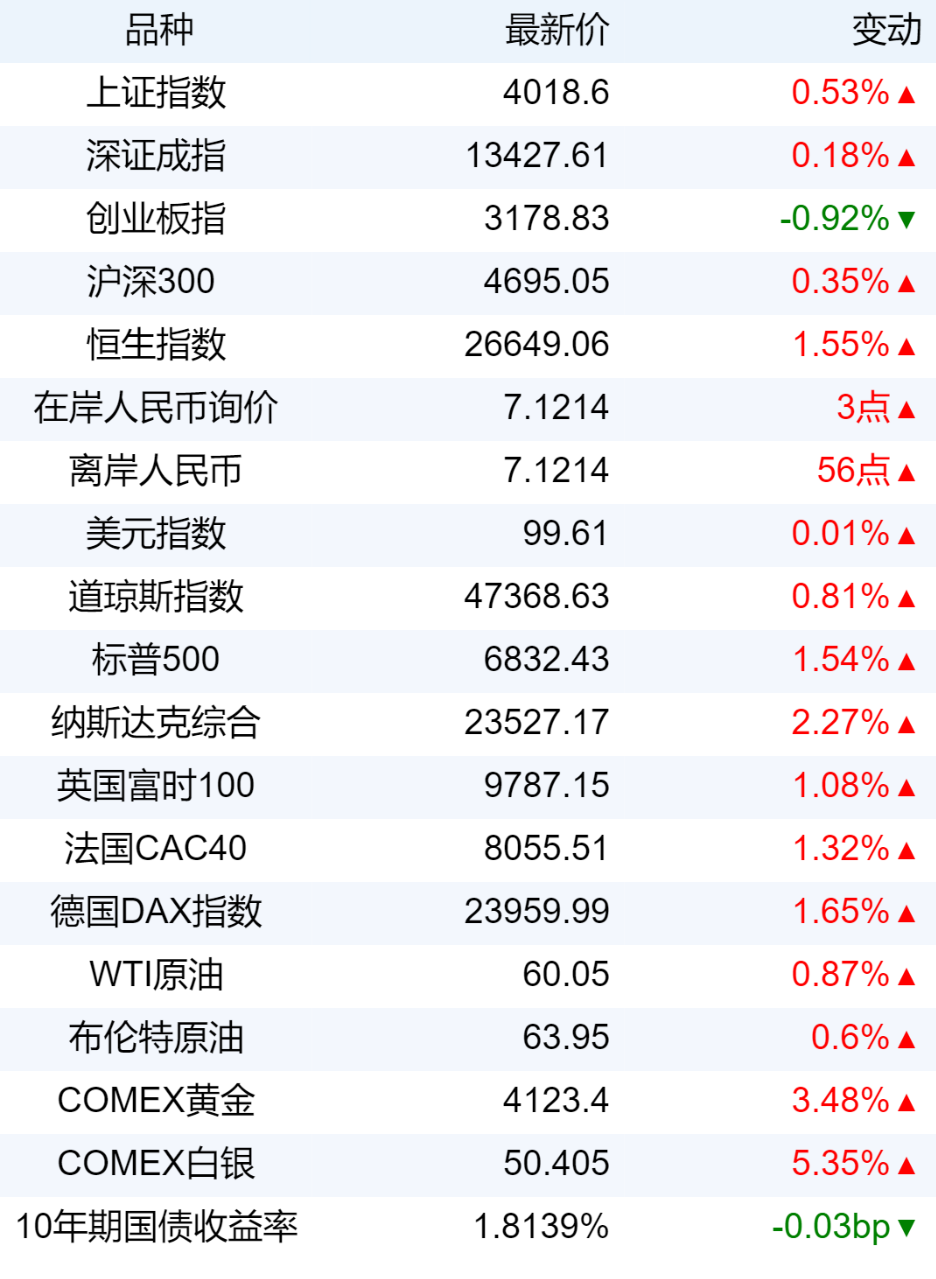
Market Overview - On November 10, the A-share market showed a mixed performance with the Shanghai Composite Index rising by 0.53% to close at 4018.66, while the Shenzhen Component Index increased by 0.18% to 13427.61. The ChiNext Index fell by 0.92% to 3178.83 [2][3] - The total trading volume in the Shanghai and Shenzhen markets reached 2.17 trillion, an increase of 175.4 billion compared to the previous trading day [2] Sector Performance - The consumer sector experienced a significant rally, particularly in food and beverage stocks, which led the gains. Other active sectors included lithium batteries and solar energy, while the humanoid robot concept saw a decline [2] - Notable gainers included the liquor, tourism and hotel, and duty-free shop sectors, while gas, wind power equipment, and robotics sectors faced losses [2] International Market - The U.S. stock market saw significant gains on November 10, with the Dow Jones Industrial Average rising by 381.53 points (0.81%) to 47368.63, the S&P 500 increasing by 103.63 points (1.54%) to 6832.43, and the Nasdaq Composite up by 522.64 points (2.27%) to 23527.17 [4][5] - European markets also experienced upward movement, with the FTSE 100 rising by 104.58 points (1.08%), the CAC 40 increasing by 105.33 points (1.32%), and the DAX up by 390.03 points (1.65%) [4] Commodity Prices - International oil prices saw a slight increase, with WTI crude oil futures rising by $0.38 to $60.13 per barrel (0.64%) and Brent crude oil futures increasing by $0.43 to $64.06 per barrel (0.68%) [4] Investment Trends - The investment community is focusing on the growth of the new energy vehicle market, with October retail sales reaching 1.282 million units, a year-on-year increase of 7.3% [8] - The Chinese government is promoting private investment in key infrastructure projects, encouraging private capital participation in sectors such as railways and energy [7] Fund Management - The China Fund Industry Association is seeking feedback on new guidelines aimed at controlling style drift and high concentration in theme-based investment funds, which have faced criticism in the past [6] Capital Flow - The liquor industry saw a net inflow of 29.81 billion, with a notable performance from Kweichow Moutai, while the consumer electronics sector experienced a significant outflow of 53.55 billion [12] - Key stocks with substantial net inflows included Cambridge Technology and China Duty Free, while major outflows were observed in Industrial Fulian and Xin Yisheng [13]

两部门发文表示:到2035年适配高比例新能源新型电力系统基本建成
Zhong Guo Zheng Quan Bao· 2025-11-11 00:20
《意见》明确,分类引导新能源开发与消纳。在大型基地层面,重点推进三类场景协同发展:统筹"沙 戈荒"新能源基地外送与就地消纳,通过新能源集成发展、东部地区产业梯度转移、西部地区挖掘消纳 潜力等方式,促进"沙戈荒"新能源基地实现规模化就地消纳;优化水风光基地一体化开发与消纳,依托 西南大型水电基地,充分考虑水电调节特性,优化配置新能源;推动海上风电规范有序开发与消纳,落 实海洋经济高质量发展要求,科学布局海上风电,继续推动近海风电开发,有序推动深远海风电基地建 设。 《意见》提出,大力推动新能源消纳新模式新业态创新发展。在创新新能源集成发展模式方面,《意 见》提出,研究制定促进新能源集成发展的政策举措,支持"沙戈荒"等新能源资源富集地区加强新能源 上下游产业链协同,建立集成发展产业体系。提升新能源装备制造绿电应用水平,实现"以绿造绿"。统 筹布局绿氢、氨、醇等绿色燃料制储输用一体化产业,打造"灵活负荷"。推进零碳园区建设。 11月10日,国家发展改革委、国家能源局发布《关于促进新能源消纳和调控的指导意见》。《意见》提 出,到2030年,协同高效的多层次新能源消纳调控体系基本建立,持续保障新能源顺利接网、多元利 用 ...
新华财经早报:11月11日
Xin Hua Cai Jing· 2025-11-11 00:20
Group 1 - The U.S. announced a one-year suspension of the 301 investigation measures against China's shipbuilding industry, including the suspension of port fees and tariffs on related equipment, marking a step towards mutual cooperation between the U.S. and China [1] - The National Development and Reform Commission (NDRC) introduced measures to promote private investment, encouraging participation in key sectors like railways and nuclear power, and supporting private enterprises in major technological projects [2] - The NDRC announced an increase in domestic gasoline and diesel prices by 125 yuan and 120 yuan per ton respectively, effective from November 10, impacting consumer costs [2] Group 2 - The State Administration for Market Regulation issued guidelines for the "Double 11" online promotional activities, aiming to eliminate illegal practices such as "choose one from two" and "big data killing familiarity" [2] - The recent performance of listed securities firms has been strong, with a focus on brokerage and proprietary trading businesses, as well as advancements in AI applications within the industry [2][3] - Shandong Gold announced that its subsidiary needs to pay approximately 738 million yuan in corporate income tax and late fees, which is expected to impact the company's net profit by 230 million yuan [5]
11月11日早餐 | 美股大涨;促进新能源消纳方案印发
Xuan Gu Bao· 2025-11-11 00:17
Group 1: Market Overview - The U.S. government is nearing the end of a shutdown, leading to significant gains in the stock market, with the S&P 500 rising by 1.54%, the Dow Jones increasing by 0.81%, and the Nasdaq climbing by 2.27% [1] - Chip stocks and AI-related stocks saw substantial increases, with the chip index rising by 3%, AMD up over 4%, Palantir nearly 9%, and Nvidia leading the tech giants with a nearly 6% increase [2] - CoreWeave, a cloud computing company, reported a more than 100% year-over-year revenue growth in Q3, although it still experienced a post-earnings drop of over 5% [3] Group 2: Commodity Prices - Oil prices increased by over 1% during the day, marking a rebound for two consecutive days; gold prices rose nearly 3% to a two-week high; and copper prices also saw gains, reaching a one-week high [4] Group 3: Domestic Policy Developments - The National Development and Reform Commission and the National Energy Administration released guidelines to promote the consumption and regulation of renewable energy [7] - The State Council issued measures to further promote private investment, proposing 13 targeted policy initiatives to expand access, eliminate bottlenecks, and strengthen guarantees [8] - The Ministry of Commerce addressed the U.S. decision to suspend the implementation of Section 301 investigations into Chinese shipbuilding and other industries [9] Group 4: Corporate Announcements - Fangzheng Technology plans to acquire 100% of Zhixiang Technology for 116 million yuan, focusing on AI classrooms and smart learning spaces [19] - Zhongbei Communication signed a 1 billion yuan comprehensive service framework agreement with Hongxin Electronics [20] - Several companies announced significant investments, including Shangtai Technology's 4.07 billion yuan project for lithium-ion battery anode materials and Chaoying Electronics' 1.468 billion yuan investment in AI circuit board expansion in Thailand [21] Group 5: Industry Trends - The logistics sector is set to benefit from the implementation of a plan to open up logistics data, aiming to reduce overall logistics costs in China [14] - The AI voice market is projected to grow significantly, with estimates suggesting it will reach $10.05 billion by 2025 and expand to $19.48 billion by 2033 [15] - Advances in perovskite solar cells have been reported, with a prototype achieving a conversion efficiency of 27.2%, which could significantly impact the solar energy market [16]
【财经早报】这家公司,拟被终止上市!今起停牌
Zhong Guo Zheng Quan Bao· 2025-11-11 00:08
Group 1: Government Policies - The State Council issued measures to stimulate private investment, proposing 13 targeted policy initiatives [1][2] - Private capital participation in certain projects like railways and nuclear power can exceed 10% after special feasibility studies [2] - Support for private enterprises to lead major technological breakthroughs and establish significant pilot platforms [2] Group 2: Energy Sector - By 2030, a multi-level renewable energy consumption and regulation system is expected to be established, ensuring smooth integration and efficient operation of renewable energy [3] - The new power system will significantly enhance adaptability and regulation capabilities, meeting an annual demand for over 200 million kilowatts of new renewable energy [3] Group 3: Company News - Zhongbei Communication signed a framework agreement for a 1 billion yuan comprehensive computing power service with Xiamen Hongxin Electronics [4] - *ST Yuancheng's stock will be suspended due to continuous low market capitalization, with a potential delisting notice received [5] - Victory Shares plans to acquire gas-related assets and raise matching funds, with stock resuming trading [6] - Lingzhi Software is planning a major asset restructuring through the acquisition of a financial technology company [6] - Shangtai Technology intends to invest approximately 4.07 billion yuan in a lithium-ion battery anode material project in Shanxi [8] Group 4: Market Insights - CITIC Securities suggests that technology growth is currently the most logical investment direction, with a focus on AI, new energy, and resources [9] - Huatai Securities indicates a shift in market focus towards advanced manufacturing and consumer sectors, with potential opportunities in power equipment and new energy industries [9]