基建投资

Search documents
【建筑建材】雅江水电站正式开工,有望释放丰厚建筑工程及材料订单——建筑建材行业更新报告(孙伟风/吴钰洁)
光大证券研究· 2025-07-22 08:38
点击注册小程序 查看完整报告 特别申明: 本订阅号中所涉及的证券研究信息由光大证券研究所编写,仅面向光大证券专业投资者客户,用作新媒体形势下研究 信息和研究观点的沟通交流。非光大证券专业投资者客户,请勿订阅、接收或使用本订阅号中的任何信息。本订阅号 难以设置访问权限,若给您造成不便,敬请谅解。光大证券研究所不会因关注、收到或阅读本订阅号推送内容而视相 关人员为光大证券的客户。 报告摘要 事件: 新华社报道,雅鲁藏布江下游水电工程开工仪式7月19日上午在西藏自治区林芝市举行。中共中央政治局常 委、国务院总理李强出席开工仪式,并宣布工程正式开工。国家发展改革委、项目业主中国雅江集团、项目参 研参试参建单位代表中国电建、西藏自治区主要负责同志先后发言。 点评: 雅鲁藏布江下游水电站正式开工,总投资额约1.2万亿元 西藏水能资源主要集中分布在雅鲁藏布江、怒江、澜沧江和金沙江干流。其中,雅鲁藏布江流域干流水能资源 最丰富,理论蕴藏量近8000万千瓦。雅鲁藏布江下游水电工程位于西藏自治区林芝市,主要采取截弯取直、隧 洞引水的开发方式,建设5座梯级电站,梯级开发能够将梯级水库上一级发电后的尾水,流入下一级再次发 电,一股水 ...

基建板块再度大涨,基建50ETF(516970)午后涨超5%,成分股中国能建、中国电建两连板!
Xin Lang Cai Jing· 2025-07-22 06:03
Group 1 - The China Infrastructure Engineering Index (399995) has seen a strong increase of 4.24%, with constituent stocks such as China Energy Engineering (601868), Tunnel Co. (600820), and China Power Construction (601669) hitting the 10% daily limit up [1] - The Infrastructure 50 ETF (516970) has risen by 5.05%, marking its fourth consecutive increase, with a trading volume of 7.32 billion yuan and a turnover rate of 23.73% [1] - As of July 21, the Infrastructure 50 ETF has achieved a net inflow of 5.98 billion yuan, with its latest scale reaching 2.978 billion yuan, a six-month high [1] Group 2 - The Infrastructure 50 ETF closely tracks the China Infrastructure Engineering Index, which includes listed companies in the construction and engineering sectors, reflecting the overall performance of these companies [2] - The top ten weighted stocks in the China Infrastructure Engineering Index account for 61.81% of the index, with major companies including China State Construction (601668) and China Railway (601390) [2] - The commencement of the Yarlung Tsangpo River downstream hydropower project, with a total investment of approximately 1.2 trillion yuan, is expected to boost demand for construction materials and services in the hydropower sector [2] Group 3 - In the first half of the year, infrastructure investment in China grew by 4.6%, outpacing overall investment growth by 1.8 percentage points, contributing to a 1.0 percentage point increase in total investment [3] - The ongoing construction of major regional projects is anticipated to further stimulate infrastructure investment growth in China [3] - Investors can access the infrastructure sector through various off-market connection products linked to the Infrastructure 50 ETF [3]


如何衡量雅江水电工程对行业的影响?
2025-07-21 14:26
Summary of Conference Call on Yarlung Tsangpo River Hydropower Project Industry Overview - The Yarlung Tsangpo River hydropower project has a total investment of approximately 1.2 trillion yuan, with an installed capacity nearly three times that of the Three Gorges Project, significantly increasing the demand for new energy and unmanned equipment [1][2][4] - The project is located in a high-altitude area with harsh construction conditions, leading to a high equipment investment ratio of about 20%, creating substantial demand for large excavators, mining machinery, concrete mixers, and shield machines [1][2][4] Key Points and Arguments - The project is expected to generate a demand for approximately 1,000 large excavators, accounting for about 10% of the domestic sales market [2][4] - In 2024, China's total infrastructure investment is projected to reach approximately 24.8 trillion yuan, with investments in water conservancy, environment, and public facilities management nearing 10 trillion yuan, providing significant incremental demand for the industrial equipment sector [3][5] - Since March 2024, excavator sales have turned positive, driven by the renewal of old energy cycles, equipment electrification, and second-hand machine exports, indicating an upward trend in the domestic photovoltaic industry over the next three to four years [6][7] Impact on Related Companies - The Yarlung Tsangpo project is expected to enhance the profitability of related companies due to the high market demand for specialized, high-value equipment [4][5] - Key companies to focus on include XCMG, SANY Heavy Industry, Shantui, Zoomlion, and Liugong, which have competitive advantages in the project and excel in mining trucks, training equipment, and shield machines [2][13][14] Market Trends - The domestic industrial machinery sector is currently in an upward cycle, with excavator sales showing consistent growth since March 2024, and concrete machinery and lifting machinery experiencing double-digit growth in sales and revenue in the second quarter [7][8] - The industrial machinery sector's performance heavily relies on exports, with export revenue contributing approximately 52% and profit exceeding 70% in 2024 [8][9] Global Market Influence - The overseas market is showing signs of stabilization, with strong demand from emerging markets in Latin America, Africa, and Southeast Asia, and a recovery trend in Europe and North America [10][11] - The global competitiveness of China's construction machinery manufacturing industry is improving, with domestic companies increasing overseas capital expenditure, enhancing production capabilities, R&D investment, and sales channels [11][12] Investment Opportunities - The current state of the industrial machinery sector presents high investment value, especially after a correction in May, with valuations at historical lows [12][14] - Companies such as XCMG, SANY Heavy Industry, Shantui, Zoomlion, and Liugong are highlighted as strong investment candidates due to their competitive advantages and performance in the Yarlung Tsangpo project [14]
建筑建材行业更新报告:雅江水电站正式开工,有望释放丰厚建筑工程及材料订单
EBSCN· 2025-07-21 12:05
Investment Rating - The report maintains an "Overweight" rating for the construction and building materials industry [4] Core Insights - The commencement of the Yarlung Zangbo River downstream hydropower project, with a total investment of approximately 1.2 trillion yuan, is expected to generate substantial construction and material orders [1][2] - The project is estimated to have a capacity of 60 million kW, with an average construction cost of 20,344 yuan/kW for hydropower projects in 2023 [1][2] - The project is anticipated to have a construction period of 15-20 years, leading to an annual investment of 60-80 billion yuan [2] - The project will significantly boost infrastructure investment growth in China, with a 4.6% year-on-year increase in infrastructure investment in the first half of 2025 [3] Summary by Sections Project Overview - The Yarlung Zangbo River downstream hydropower project is located in Linzhi City, Tibet, and involves the construction of five tiered power stations to enhance power generation efficiency [1] - The total investment is about six times that of the Three Gorges Project, which had a total investment of 207.2 billion yuan [2] Investment Structure - The investment structure for hydropower projects includes approximately 32%-45% for permanent construction, 18%-25% for electromechanical equipment, and 10%-35% for other costs [2] Market Impact - The project is part of China's "14th Five-Year Plan" and is expected to effectively stimulate infrastructure investment growth [3] - Recommended companies to watch include China Power Construction, China Energy Engineering, and several others involved in construction and materials [3]



港股异动 | 基建股普遍上扬 重大水电项目落地 机构看好基建龙头基本面改善
智通财经网· 2025-07-21 02:08
消息面上,7月19日上午,雅鲁藏布江下游水电工程开工仪式在西藏自治区林芝市举行。雅鲁藏布江下 游水电工程将建设5座梯级电站,总投资约1.2万亿元。国投证券认为,雅下工程作为国家级战略项目, 涉及水电建设、基础设施建设、特高压输电、设备制造、民爆、水泥建材供应等多个产业链环节,其开 工建设将带来上下游产业链需求逐步释放,建议关注产业链投资机会。该行指出,建筑企业联合倡议反 内卷,专项债发行同比高增,基建龙头基本面或将改善,国企改革/央企市值管理驱动破净建筑央企价 值提升。 智通财经APP获悉,基建股普遍上扬,截至发稿,中国中铁(00390)涨4.17%,报4港元;中国交建 (01800)涨3.17%,报5.53港元;中国铁建(01186)涨3.12%,报5.62港元;中国中冶(01618)涨2.27%,报1.8 港元。 天风证券指出,近期建筑央国企陆续披露二季度订单情况:从央企的订单情况来看,央企的订单二季度 环比一季度有回暖的趋势,以中国中铁为例,25Q1订单同比下滑9.9%,但是25H1订单同比增速转正为 2.8%,其中Q2单季度订单同比增速为20.08%,中国核建25H1订单同比增速13.72%,仍保持了 ...

宏微观验证基建景气回升,重点关注低估值央国企
Tianfeng Securities· 2025-07-20 12:43
Investment Rating - Industry Rating: Outperform the market (maintained rating) [5] Core Viewpoints - The construction index rose by 0.32% this week, while the Shanghai and Shenzhen 300 index increased by 1.07%, indicating that the construction sector underperformed the market by 0.75 percentage points. Professional engineering, architectural design, and infrastructure sectors showed stronger gains [1][33] - Infrastructure investment continued to support the economy, with energy-related and water conservancy investments maintaining strength, while transportation infrastructure showed signs of recovery. For the first half of 2025, real estate development investment, narrow infrastructure, broad infrastructure, and manufacturing grew by -11.2%, +4.6%, +8.9%, and +7.5% year-on-year, respectively [1][13] - Recent disclosures of second-quarter orders from central state-owned enterprises (SOEs) indicate a recovery trend, with China Railway's second-quarter orders showing a year-on-year growth of 20.08%. The overall order situation for central SOEs is optimistic, suggesting a rebound in physical workload [2][27] Summary by Sections Macro and Micro Verification of Infrastructure Recovery - Infrastructure investment in June continued to provide support, with energy and water conservancy investments remaining strong, while transportation infrastructure showed signs of recovery. The year-on-year growth rates for real estate development investment, narrow infrastructure, broad infrastructure, and manufacturing from January to June 2025 were -11.2%, +4.6%, +8.9%, and +7.5%, respectively [1][13][14] Recent Order Disclosures from Central SOEs - Central SOEs such as China Railway, China Energy Construction, China Chemical, and China Nuclear Engineering reported a recovery in second-quarter orders. For instance, China Railway's first-half orders showed a year-on-year growth of 2.8%, with a significant increase in the second quarter [2][27][28] Valuation Perspective - As of July 18, the construction sector's PE (TTM) and PB (LF) ratios were among the lowest across all primary industries, indicating significant room for valuation improvement. The construction sector's PE (TTM) was 11.12 times, with a historical percentile of 48.50%, compared to the Shanghai and Shenzhen 300's PE of 13.39 times [3][30][32]



基建ETF: 国泰中证基建交易型开放式指数证券投资基金2025年第2季度报告
Zheng Quan Zhi Xing· 2025-07-18 09:17
国泰中证基建交易型开放式指数证券投资基金 2025 年第 2 季度报告 国泰中证基建交易型开放式指数证券投资基金 基金管理人:国泰基金管理有限公司 基金托管人:中信建投证券股份有限公司 报告送出日期:二〇二五年七月十九日 国泰中证基建交易型开放式指数证券投资基金 2025 年第 2 季度报告 §1 重要提示 基金管理人的董事会及董事保证本报告所载资料不存在虚假记载、误导性陈述或重大遗 漏,并对其内容的真实性、准确性和完整性承担个别及连带责任。 标的指数成份股及其权重构建基金股票投资组合,并根据 投资策略 基金托管人中信建投证券股份有限公司根据本基金合同约定,于 2025 年 07 月 17 日复 核了本报告中的财务指标、净值表现和投资组合报告等内容,保证复核内容不存在虚假记载、 误导性陈述或者重大遗漏。 基金管理人承诺以诚实信用、勤勉尽责的原则管理和运用基金资产,但不保证基金一定 盈利。 基金的过往业绩并不代表其未来表现。投资有风险,投资者在作出投资决策前应仔细阅 读本基金的招募说明书。 本报告中财务资料未经审计。 本报告期自 2025 年 04 月 01 日起至 2025 年 06 月 30 日止。 | | ...

苏博特(603916):混凝土外加剂龙头,基建保障中期确定性
GOLDEN SUN SECURITIES· 2025-07-18 08:47
Investment Rating - The report gives an "Accumulate" rating for the company, marking its first coverage [5]. Core Viewpoints - The company is a leader in concrete additives, with a recovery in performance from its bottom [1][14]. - Infrastructure demand is providing a crucial support, while supply is accelerating its exit from the market [1][50]. - The company has a strong technical foundation and is involved in major engineering projects, which enhances its reputation and customer base [2][14]. Summary by Sections Company Overview - The company specializes in the research, production, and sales of concrete additives, with production bases in multiple provinces [1][14]. - It has participated in significant projects such as the Hong Kong-Zhuhai-Macao Bridge and the Three Gorges Project, establishing a solid reputation [14]. Industry Analysis - The real estate sector is experiencing a downturn, leading to a 10.1% year-on-year decline in concrete production in 2024 [1][41]. - Infrastructure investment remains resilient, with a reported 8.9% year-on-year growth in the first half of 2025, partially offsetting the decline in real estate demand [45][48]. Financial Performance - In 2024, the company reported revenues of 35.6 billion yuan, a slight decrease of 0.75% year-on-year, and a net profit of 1.0 billion yuan, down 40.2% [20]. - The first quarter of 2025 showed a recovery with revenues of 6.8 billion yuan, up 17.8% year-on-year, and a net profit of 0.2 billion yuan, up 15.4% [21]. Profitability and Cash Flow - The company is expected to see improvements in profit margins due to operational optimizations and scale effects, with projected revenues of 38.0 billion yuan in 2025 [3][4]. - The cash flow from operating activities is expected to significantly improve, with a net cash flow of 5.8 billion yuan in 2024, up 57.0% year-on-year [2]. Future Outlook - The company anticipates revenue growth of 24.4% over the next three years, with net profits projected to increase to 2.46 billion yuan by 2027 [3][4]. - The demand for functional materials is expected to grow, with a projected revenue increase of 29.5% in 2024 [2].

央视财经×三一重工:2025年上半年全国工程机械平均开工率为44.81%
工程机械杂志· 2025-07-17 07:52
Core Viewpoint - The article highlights the robust growth in China's infrastructure investment and the corresponding increase in sales of construction machinery, particularly excavators and loaders, indicating a positive economic outlook for the industry [1][2]. Infrastructure Investment Trends - In the first half of the year, infrastructure investment across the country showed a "blossoming" trend, with six provinces maintaining an operating rate above 50% for six consecutive months [2][4]. - The average operating rate for engineering machinery in the first half of 2025 was 44.81%, with a quarter-on-quarter increase of 4.62% in the second quarter [3]. Regional Performance - Six provinces, including Anhui, Fujian, Henan, Jiangxi, Zhejiang, and Chongqing, led the way with operating rates exceeding 50%, particularly in East and South China [4]. - Fifteen provinces reported increased operating rates compared to the same period last year, indicating a higher level of infrastructure activity and project execution [5]. Equipment Utilization - In the first half of 2025, the average operating rate for hoisting equipment was 66.87%, the highest among all equipment categories, with top-performing provinces including Anhui, Hubei, and Jiangxi [6][7]. - The central region had the highest average operating rate at 50.13%, with Anhui leading at 66.24% [8]. Western and Northeastern Developments - The western region's operating rate was 48.45%, benefiting from the "Belt and Road" initiative, with significant increases in the workload of specific equipment types [9]. - The northeastern region showed a recovery with an operating rate of 45.68%, particularly strong performance in stackers and crawler cranes [10]. Eastern Region Insights - The eastern region's operating rate was 45.58%, with concrete equipment leading in utilization rates [11].
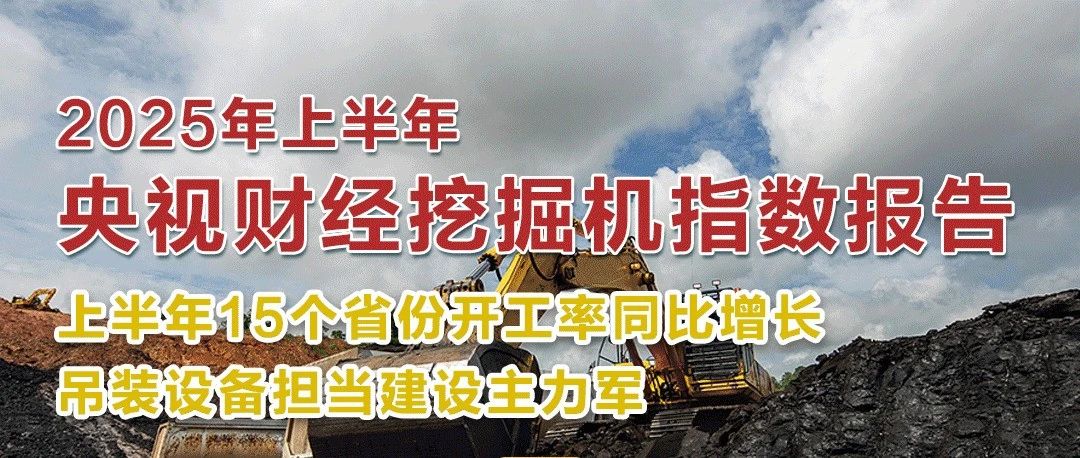
港股概念追踪|上半年全国基建投资多点开花 工程机械行业持续回暖(附概念股)
智通财经网· 2025-07-17 00:13
Group 1 - In the first half of 2025, infrastructure investment across the country showed a "blossoming" trend, providing continuous momentum for economic development, with an average construction machinery operating rate of 44.81% [1] - The operating rate in the second quarter was 47.1%, an increase of 4.62% compared to the first quarter, with 15 provinces exceeding an average operating rate of 50% [1] - Six provinces, including Anhui, Fujian, Henan, Jiangxi, Zhejiang, and Chongqing, maintained a comprehensive operating rate above 50% for six consecutive months, indicating strong performance particularly in East and South China [1] Group 2 - In the first half of 2025, the average operating rate of lifting equipment was 66.87%, ranking first among various types of equipment [1] - In June 2025, sales of various aerial work vehicles reached 539 units, a year-on-year increase of 153%, with domestic sales of 509 units up by 147% and exports of 30 units up by 329% [1] - From January to June 2025, a total of 2,445 aerial work vehicles were sold, representing a year-on-year growth of 27.9%, with domestic sales of 2,312 units increasing by 25% and exports of 133 units rising by 115% [1] Group 3 - In June 2025, sales of various forklifts reached 137,570 units, a year-on-year increase of 23.1%, with domestic sales of 83,892 units up by 27.3% and exports of 53,678 units up by 17.2% [2] - From January to June 2025, a total of 739,334 forklifts were sold, reflecting a year-on-year growth of 11.7%, with domestic sales of 476,382 units increasing by 9.79% and exports of 262,952 units rising by 15.2% [2] - Major engineering machinery companies such as SANY Heavy Industry, XCMG, Zoomlion, and Liugong have continued to see steady growth in overseas markets, with overseas sales accounting for nearly or exceeding 50% [2]