
联邦基金利率

Search documents
临近半年末,美国SOFR涨至4.40%,与美联储的准备金余额利率一致
news flash· 2025-06-27 14:35
Core Points - The secured overnight financing rate (SOFR) reached 4.40% on June 26, marking a two-month high, up from 4.36% the previous day [1] - The effective federal funds rate remained unchanged at 4.33% on the same day [1]
美联储副主席鲍曼暗示支持最早7月降息 前提是通胀持续回落
智通财经网· 2025-06-23 15:15
Group 1 - The Vice Chair of the Federal Reserve, Bowman, indicated that the current regulatory approach to leverage requirements has led to unexpected consequences in the market, suggesting a need to reassess this critical capital buffer mechanism [1] - Bowman highlighted that the current Supplementary Leverage Ratio (SLR) rules may restrict the trading activities of bank-affiliated broker-dealers in the $29 trillion U.S. Treasury market, potentially impacting the broader market [1] - A reform proposal is expected to be announced by the Federal Reserve and other financial regulators this week, which will adjust the overall leverage ratio rather than just excluding assets like Treasury securities as previously anticipated [1] Group 2 - Bowman criticized the plan requiring large banks to significantly increase capital reserves to address potential crises, which was originally expected to raise capital requirements by 19% under the Basel III final framework, but faced pushback from the financial industry [2] - In terms of monetary policy, Bowman expressed willingness to support a rate cut as early as July if inflation continues to decline, emphasizing the need to adjust rates to maintain a healthy labor market [2] - The Federal Reserve's target range for the federal funds rate remains at 4.25% to 4.5%, and Bowman supports this decision while noting that recent economic data has not shown significant impacts from tariffs [2]
富国银行:预计特朗普政府的债务上限问题结束后,SOFR 将高于联邦基金利率
news flash· 2025-06-20 14:25
Core Viewpoint - The report by Wells Fargo strategists indicates that once the debt ceiling issue is resolved and the Treasury releases a significant amount of short-term securities to rebuild its cash balance, the Secured Overnight Financing Rate (SOFR) is likely to be sustained at or above the federal funds rate by late 2025 [1] Group 1 - Wells Fargo's economic team anticipates that the debt ceiling resolution will occur before August 1, with a deadline (X-Date) around early September [1]
骏利亨德森:美联储鸽式按兵不动 但为下半年降息保持大门敞开
Zhi Tong Cai Jing· 2025-06-20 02:56
骏利亨德森投资环球短存续期及流动性主管兼投资组合经理Dan Siluk指,美联储鸽式按兵不动,并为 2025年下半年降息保持大门敞开。美联储明确传达出不急于行动的讯号,但若通胀持续回落、劳动市场 继续软化,将随时准备采取行动。通胀预测上调或会使市场较不预期大幅宽松政策出现,但对2025年利 率路径维持不变,则是向市场保证了灵活性。 2025年GDP增速自1.7%下修至1.4%,反映对贸易与全球逆风的担忧。失业率自4.4%微幅上调至4.5%, 显示劳动市场已有初步软化迹象。2025年PCE通胀率由2.7%上调至3.0%,核心PCE由2.8%上调至3.1%, 反映关税与能源价格压力。2025年联邦基金利率预测维持在3.9%,预示降息两次;2026及2027年的利率 路径略为上移,长期利率则为3.0%。 骏利亨德森指,总统特朗普呼吁大幅降息1至2.5%并公开批评鲍威尔,凸显美联储所面临的政治压力。 尽管如此,美联储仍决定按兵不动,进一步巩固了其独立性及对双重使命的承诺。经济预测摘要(SEP) 显示,尽管通胀风险依然存在,但经济与劳动市场预测留有宽松的空间,若情势恶化仍可考虑降息。 骏利亨德森提到,接下来,市场将密切 ...
维持利率不变,美联储下调增长上调通胀预期
Huan Qiu Wang· 2025-06-19 02:57
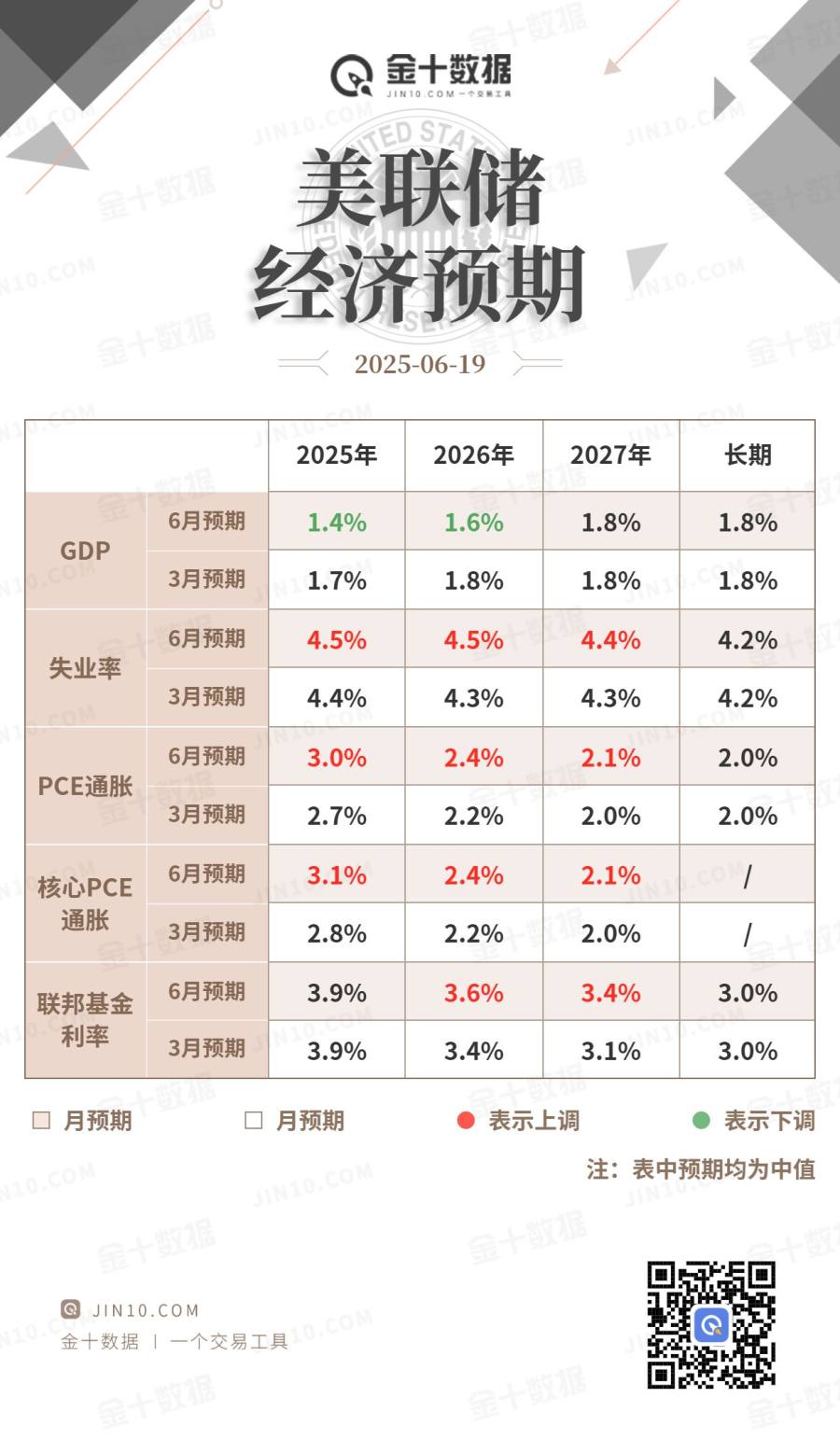
Group 1 - The Federal Reserve has maintained the federal funds rate target range at 4.25% to 4.50% for the fourth consecutive time since November of the previous year, indicating a cautious approach to monetary policy [1] - The Fed's statement highlights that economic activity is expanding steadily, with low unemployment and a strong labor market, although inflation remains slightly above the 2% target [1] - The Fed is committed to achieving maximum employment and the 2% inflation target, while closely monitoring data and economic outlook for future policy adjustments [1] Group 2 - The Summary of Economic Projections (SEP) shows a significant downward adjustment in GDP growth expectations for the next three years, with median growth rates for 2025, 2026, and 2027 revised to 1.4%, 1.6%, and 1.8%, respectively, down from 1.7%, 1.8%, and 1.8% [3] - Unemployment rate expectations have been raised, with median rates for 2025, 2026, and 2027 now at 4.5%, 4.5%, and 4.4%, compared to previous expectations of 4.4%, 4.3%, and 4.3% [3] - Inflation expectations have also been increased, with median PCE and core PCE inflation rates for 2025 set at 3.0% and 3.1%, and for 2026 and 2027 at 2.4% and 2.1%, respectively, all above the Fed's 2% inflation target [3] Group 3 - The dot plot indicates that the median rate expectation for the end of 2024 is between 3.75% and 4.00%, suggesting a potential cumulative rate cut of 50 basis points from the current level, consistent with the March meeting results [3] - For the end of 2026, the median rate expectation is between 3.50% and 3.75%, which is higher than the previous range of 3.25% to 3.50%, indicating a narrowing of the expected rate cut from 50 basis points to 25 basis points [3]


美联储主席鲍威尔:关税影响正在显现 利率政策需继续观望
智通财经网· 2025-06-18 22:26
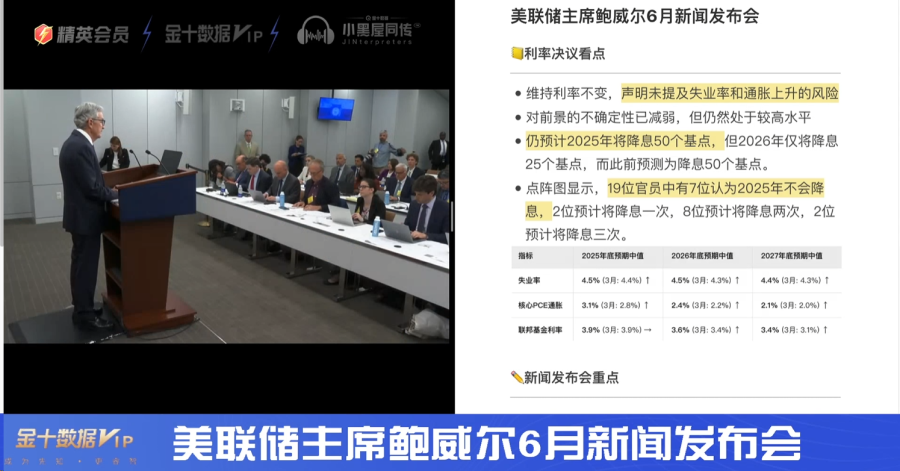
智通财经APP获悉,美联储鲍威尔在最新新闻发布会上重申,美联储目前最关心的依旧是"让经济稳健 运行并保持物价稳定"。面对记者转述总统特朗普长期对"利率迟迟不降"的批评,鲍威尔拒绝正面回 应,只表示:"这对我们而言并不复杂,联邦公开市场委员会(FOMC)的所有成员都希望看到一个稳固的 经济和稳定的物价,这就是全部重点。" 与此同时,FOMC将今明两年失业率预测小幅上调,并首次在公开场合提及"挑战性场景",当通胀回落 速度慢于就业市场降温时,联储或陷入目标冲突。"若出现这种情况,我们会考虑离双重目标各有多 远,以及各自回归正常的时间维度。" 随着通胀、失业率双升的可能性增加,市场对滞涨担忧升温。JanusHenderson投资组合经理DanSiluk指 出,通胀预测上修意味着激进降息空间受限,而若就业继续走软,美联储或被迫在两难中权衡。 鲍威尔则给出了"静观其变"的基调:"在进一步了解经济路径之前,我们拥有充足的耐心。"FOMC维持 联邦基金利率在4.25%–4.5%区间不变,并保留"年内两次降息"的前瞻指引,但鲍威尔明言时点尚无定 论。 鲍威尔警告,4月初宣布的大规模关税仍在链式传导:"关税渗透到消费者端需要时 ...
美联储主席鲍威尔:净出口的异常波动使GDP衡量变得更加复杂。
news flash· 2025-06-18 18:35
Group 1 - The Federal Reserve Chairman Powell stated that unusual fluctuations in net exports complicate GDP measurements [1] Group 2 - Unemployment rate projections for the end of 2025, 2026, and 2027 are 4.5%, 4.5%, and 4.4% respectively, with slight increases from previous estimates [4] - Core PCE inflation expectations for the end of 2025, 2026, and 2027 are 3.1%, 2.4%, and 2.1% respectively, indicating upward revisions [4] - Federal funds rate projections for the end of 2025, 2026, and 2027 are 3.9%, 3.6%, and 3.4% respectively, with increases noted for 2026 and 2027 [4]
金十图示:2025年06月19日(周四)美联储经济预期
news flash· 2025-06-18 18:18
Economic Forecasts - The GDP growth expectations for 2025, 2026, and 2027 are projected at 1.4%, 1.6%, and 1.8% respectively, with a long-term forecast also at 1.8% [2] - The unemployment rate is expected to be 4.5% in 2025 and 2026, slightly decreasing to 4.4% in 2027, with a long-term expectation of 4.2% [2] - PCE inflation is forecasted at 3.0% for 2025, decreasing to 2.4% in 2026 and 2.1% in 2027, with a long-term target of 2.0% [2] - Core PCE inflation is anticipated to be 3.1% in 2025, dropping to 2.4% in 2026 and 2.1% in 2027, with a long-term goal of 2.0% [2] - The federal funds rate is projected to be 3.9% in 2025, 3.6% in 2026, and 3.4% in 2027, with a long-term expectation of 3.0% [2]
连续第四次 美联储维持联邦基金利率目标区间不变
news flash· 2025-06-18 18:13
当地时间6月18日,美联储最新的联邦公开市场委员会(FOMC)货币政策会议纪要显示,美联储决定将联 邦基金利率目标区间维持在4.25%至4.50%之间不变。这是美联储货币政策会议连续第四次决定维持利 率不变。会议纪要显示,在考虑进一步调整联邦基金利率目标区间的幅度和时机时,委员会将仔细评估 后续数据、不断变化的前景以及风险平衡。委员会将继续减持美国国债、机构债券和机构抵押贷款支持 证券。会议纪要显示,如果出现可能阻碍委员会目标实现的风险,委员会将准备酌情调整货币政策立 场。委员会的评估将考虑广泛的信息,包括劳动力市场状况、通胀压力和通胀预期,以及金融和国际形 势发展。(央视新闻) ...
美联储点阵图:2025年底联邦基金利率预期中值为3.9%(3月预期为3.9%)。
news flash· 2025-06-18 18:03
Core Viewpoint - The Federal Reserve's dot plot indicates that the median expectation for the federal funds rate by the end of 2025 is 3.9%, unchanged from the March forecast [1] Summary by Relevant Categories - **Interest Rate Projections** - The median federal funds rate expectation for the end of 2025 remains at 3.9%, consistent with the previous March forecast [1]