
隐含波动率

Search documents
追逐“电锯”的利润!投资者豪赌美股波动率回归
智通财经网· 2025-09-28 23:41
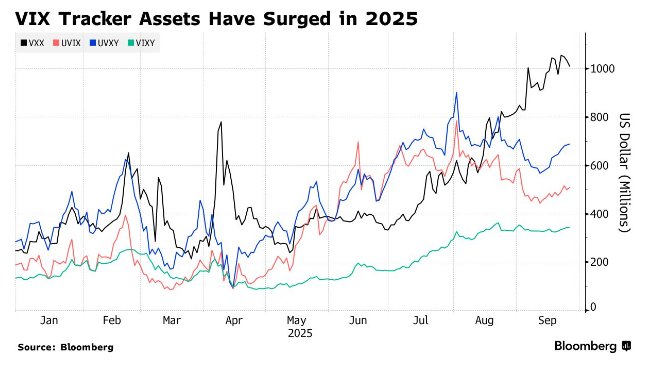
Core Viewpoint - Investors are flocking to exchange-traded products (ETPs) betting on a rise in market volatility, but a specific market mechanism is causing their returns to diminish despite increasing asset management in volatility-related products [1][3]. Group 1: Investment Trends - The largest product tracking Cboe Volatility Index (VIX) futures, Barclays iPath S&P 500 VIX Short-Term Futures ETN, has seen its assets under management grow over 300% this year, surpassing $1 billion [1]. - The appeal of these products lies in the potential for significant returns if the current record stock market rally fades, leading to a spike in market volatility [1]. - However, long-term holders of these securities face hidden traps as the cost of holding increases with inflows, leading to a severe erosion of returns [1][5]. Group 2: Performance Analysis - Bloomberg Intelligence's senior ETF analyst Eric Balchunas likens VIX-related ETPs to a "chainsaw," effective in specific scenarios but potentially harmful if not timed correctly [3]. - For instance, an investment in a volatility ETF before a major market event could double in value within a week, but holding the fund for a year could result in a loss of up to 78% [3][4]. - Current performance data shows significant losses for various VIX-related ETPs, with UVIX down 78% and VXX down 32% since September 26 [4]. Group 3: Cost and Strategy - The cost of holding these tools is significant, with the UVIX ETF having an expense ratio of 2.8% and engaging in a strategy of rolling over VIX futures contracts, which leads to continuous capital erosion [8]. - The strategy involves selling near-month contracts and buying next-month contracts, which can widen the price gap and further increase holding costs [8]. - Historical precedents show that similar products have previously underperformed compared to their underlying assets, as seen with oil ETFs a decade ago [8]. Group 4: Market Dynamics - As the stock market rises, implied volatility remains suppressed due to low actual market fluctuations, leading traders to be reluctant to pay high prices for volatility options [9][12]. - The current VIX futures curve is in a contango state, indicating that near-term futures are priced lower than longer-term futures, which presents arbitrage opportunities [12][15]. - Strategies that involve shorting the near-term VIX futures while going long on the next month are being employed, but they carry risks, particularly if the stock market experiences a sharp downturn [15][16].

白糖期货波动加大 关注系列期权参与机会
Qi Huo Ri Bao· 2025-09-28 23:29
Group 1 - The core viewpoint of the articles highlights the impact of Brazil's sugar production data on sugar futures prices, leading to increased volatility and potential investment strategies using sugar options [1][6] - Sugar series options are the first short-term commodity options in China, with a shorter duration of approximately 2.5 months compared to conventional options, allowing investors to realize strategies and returns in a shorter trading window [2] - The cost advantage of sugar series options is significant, as their premiums are generally lower due to reduced time value, making them cost-effective tools for risk management and investment, especially for short-term hedging needs [2][5] Group 2 - Sugar series options exhibit a higher Theta value, indicating faster time decay, which provides differentiated opportunities for investors; sellers can benefit from quicker time value gains, while buyers may achieve better returns during rapid market fluctuations [3] - The implied volatility curve of sugar series options is typically steeper due to the short duration, reflecting market sentiment and risk events more rapidly, which can enhance opportunities for volatility trading and various strategies [4] - Sugar series options are particularly suitable for capturing event-driven market movements and managing short-term price volatility risks, making them ideal tools for efficient risk management in rapidly changing markets [5] Group 3 - Brazil's sugar production data shows an increase in sugar output and cane crushing, but concerns remain about the sustainability of this growth due to economic factors favoring ethanol production over sugar [6] - Investors can consider strategies such as buying call options at a strike price of 5700 yuan/ton to capture potential price increases while minimizing margin requirements, or purchasing put options at 5300 yuan/ton to protect long positions [7] - Current sugar volatility is at a medium level, and if volatility decreases, there may be potential losses on call options, indicating the need for careful consideration of volatility when making investment decisions [7]
金属期权策略早报:金属期权-20250926
Wu Kuang Qi Huo· 2025-09-26 03:14
1. Report Industry Investment Rating - Not provided in the given content 2. Core Viewpoints of the Report - For non - ferrous metals, construct a neutral volatility strategy for sellers when the market is range - bound; for the black series, build a short - volatility portfolio strategy due to large fluctuations; for precious metals, create a spot hedging strategy as they break through and rise [2]. 3. Summary by Relevant Catalogs 3.1 Futures Market Overview - Copper (CU2511): The latest price is 82,380, up 220 (0.27%), with a trading volume of 33.49 million hands (an increase of 28.32 million hands) and an open interest of 23.85 million hands (an increase of 6.61 million hands) [3]. - Aluminum (AL2511): The latest price is 20,800, up 20 (0.10%), with a trading volume of 14.61 million hands (an increase of 3.82 million hands) and an open interest of 22.06 million hands (a decrease of 0.07 million hands) [3]. - Other metals also have detailed price, trading volume, and open - interest data provided in the table [3]. 3.2 Option Factors - Volume and Open Interest PCR - PCR indicators are used to describe the strength of the option underlying market and the turning point of the market. For example, the copper option's volume PCR is 0.28 (a decrease of 0.29), and the open - interest PCR is 0.70 (a decrease of 0.14) [4]. 3.3 Option Factors - Pressure and Support Levels - From the perspective of the strike prices with the largest open interest of call and put options, the pressure and support levels of various metals are determined. For example, the pressure level of copper is 84,000, and the support level is 7,800 [5]. 3.4 Option Factors - Implied Volatility - The implied volatility of various metals' options is presented, including at - the - money implied volatility, weighted implied volatility, and their changes. For example, the at - the - money implied volatility of copper is 22.06%, and the weighted implied volatility is 25.75% (an increase of 7.56%) [6]. 3.5 Strategy and Recommendations 3.5.1 Non - Ferrous Metals - **Copper Options**: Build a bull - spread strategy for call options and a short - volatility strategy for sellers, and a spot long - hedging strategy [8]. - **Aluminum/Alumina Options**: Construct a short - neutral call + put option combination strategy and a spot collar strategy [9]. - **Zinc/Lead Options**: Create a short - neutral call + put option combination strategy and a spot collar strategy [9]. - **Nickel Options**: Build a short - bearish call + put option combination strategy and a spot covered - call strategy [10]. - **Tin Options**: Implement a short - volatility strategy and a spot long - hedging strategy [10]. - **Lithium Carbonate Options**: Construct a short - bearish call + put option combination strategy and a spot long - hedging strategy [11]. 3.5.2 Precious Metals - **Gold Options**: Build a bull - spread strategy for call options, a short - volatility strategy for long - biased sellers, and a spot hedging strategy [12]. 3.5.3 Black Series - **Rebar Options**: Construct a short - bearish call + put option combination strategy and a spot long - covered - call strategy [13]. - **Iron Ore Options**: Build a short - neutral call + put option combination strategy and a spot long - collar strategy [13]. - **Ferroalloy Options**: Implement a short - volatility strategy for manganese - silicon options; for industrial silicon/polysilicon options, construct a short - volatility call + put option combination strategy and a spot hedging strategy; for glass options, build a short - volatility strategy and a spot long - collar strategy [13][14][15].
能源化工期权策略早报:能源化工期权-20250926
Wu Kuang Qi Huo· 2025-09-26 01:25
1. Report Industry Investment Rating - Not provided in the document 2. Core Viewpoints of the Report - The energy and chemical sector is mainly divided into energy, alcohols, polyolefins, rubber, polyesters, alkalis, and others. Strategies suggest constructing option portfolios mainly from sellers and using spot hedging or covered strategies to enhance returns [3][9] 3. Summaries by Related Catalogs 3.1 Futures Market Overview - This section presents the latest prices, price changes, trading volumes, and open interest of various energy and chemical futures contracts, including crude oil, LPG, methanol, etc [4] 3.2 Option Factors - Volume and Open Interest PCR - The PCR indicators of volume and open interest for different option varieties are provided, which are used to describe the strength of the option underlying market and the turning point of the underlying market [5] 3.3 Option Factors - Pressure and Support Levels - The pressure and support levels of different option varieties are analyzed from the perspective of the strike prices with the largest open interest of call and put options [6] 3.4 Option Factors - Implied Volatility - The implied volatility data of different option varieties are presented, including at - the - money implied volatility, weighted implied volatility, and the difference between implied and historical volatility [7] 3.5 Strategy and Recommendations 3.5.1 Energy - related Options - **Crude Oil**: OPEC plans to increase production, and Russia plans to cut production. The market shows a bearish recovery. Option strategies include constructing a short - biased call + put option combination, and a long collar strategy for spot hedging [8] - **LPG**: PDH device maintenance affects supply. The market shows an oversold rebound. Option strategies include constructing a neutral - biased call + put option combination and a long collar strategy for spot hedging [10] 3.5.2 Alcohol - related Options - **Methanol**: Port and enterprise inventories are at high levels. The market is bearish. Option strategies include a bear spread of put options, a short - biased call + put option combination, and a long collar strategy for spot hedging [10] - **Ethylene Glycol**: Port inventory is expected to increase. The market is bearish. Option strategies include a bear spread of put options, a short - volatility strategy, and a long + put + short call option strategy for spot hedging [11] 3.5.3 Polyolefin - related Options - **Polypropylene**: Inventory pressure varies between PE and PP. The market is bearish. Option strategies include a long + put + short call option strategy for spot hedging [12] 3.5.4 Rubber - related Options - **Rubber**: Affected by the peak rubber - tapping season, the market is bearish. Option strategies include a neutral - biased call + put option combination [13] 3.5.5 Polyester - related Options - **PTA**: Inventory is rising, but downstream demand is high. The market is bearish. Option strategies include a short - biased call + put option combination [13] 3.5.6 Alkali - related Options - **Caustic Soda**: Factory inventory is increasing. The market is bearish. Option strategies include a long collar strategy for spot hedging [14] - **Soda Ash**: Factory inventory is decreasing. The market shows low - level fluctuations. Option strategies include a short - volatility combination and a long collar strategy for spot hedging [14] 3.5.7 Urea - related Options - **Urea**: Enterprise inventory is increasing, and domestic demand is weak. The market is bearish. Option strategies include a short - biased call + put option combination and a long + put + short call option strategy for spot hedging [15] 3.6 Option Charts - Charts for various option varieties, such as crude oil, LPG, methanol, etc., are provided, including price trends, trading volume and open interest, PCR indicators, implied volatility, and historical volatility cones [16][34][53]
波动率数据日报-20250925
Yong An Qi Huo· 2025-09-25 13:27
Report Summary 1. Core Concepts - The implied volatility index of financial options reflects the 30 - day implied volatility trend as of the previous trading day. The implied volatility index of commodity options is obtained by weighting the implied volatilities of the two - strike options above and below the at - the - money option of the main contract month, reflecting the implied volatility change trend of the main contract [3] - The difference between the implied volatility index and historical volatility: a larger difference indicates that the implied volatility is relatively higher than historical volatility, while a smaller difference means the opposite [3] - The implied volatility quantile represents the current level of the implied volatility of a variety in history. A high quantile means the current implied volatility is high, and a low quantile means it is low. The volatility spread is the implied volatility index minus the historical volatility [5] 2. Implied Volatility and Historical Volatility Data - The report presents the implied volatility (IV), historical volatility (HV), and their differences (IV - HV) of various financial and commodity options, including 300股指, 50ETF, 1000股指, 500ETF, silver, Shanghai gold, soybean meal, corn, sugar, cotton, methanol, rubber, iron ore, PTA, crude oil, aluminum, PVC, rebar, zinc, urea, palm oil, etc. [4] 3. Implied Volatility Quantile and Volatility Spread Quantile Ranking - Implied volatility quantile ranking: 50ETF (0.65), 300股指 (0.78 for one and 0.52 for another), PTA (0.32 and 0.38), cotton (0.14 and 0.22), iron ore (0.07), PVC (0.20), etc. [6]
金属期权策略早报:金属期权-20250925
Wu Kuang Qi Huo· 2025-09-25 02:44
1. Report Industry Investment Rating - Not provided in the given content 2. Core Viewpoints of the Report - For non - ferrous metals, construct a seller neutral volatility strategy as they are in a range - bound oscillation; for black metals, build a short - volatility portfolio strategy due to their large - amplitude fluctuations; for precious metals, establish a spot hedging strategy as they are rising and breaking upward [2] 3. Summaries According to Relevant Catalogs 3.1 Futures Market Overview - Copper (CU2511) closed at 82,610, up 2,620 (3.28%), with a trading volume of 5.17 million lots (down 1.15 million) and an open interest of 17.24 million lots (down 0.09 million) [3] - Aluminum (AL2511) closed at 20,805, up 120 (0.58%), with a trading volume of 10.79 million lots (down 1.54 million) and an open interest of 22.13 million lots (down 0.41 million) [3] - Other metals such as zinc, lead, nickel, etc. also have detailed price, trading volume, and open - interest data [3] 3.2 Option Factors - Volume and Open Interest PCR - PCR indicators are used to describe the strength of the option underlying market and the turning point of the market. For example, the open - interest PCR of copper was 0.84 (up 0.06), indicating some support below the price [4] 3.3 Option Factors - Pressure and Support Levels - For copper, the pressure level is 82,000 and the support level is 78,000; for aluminum, the pressure level is 20,800 and the support level is 20,000, etc. These levels are determined by the strike prices of the maximum open - interest call and put options [5] 3.4 Option Factors - Implied Volatility - The implied volatility of copper options was 13.14% (at - the - money), and the weighted implied volatility was 18.20% (down 0.01%). Other metals also have corresponding implied - volatility data [6] 3.5 Strategy and Recommendations 3.5.1 Non - ferrous Metals - **Copper**: Build a bull - spread call option strategy, a short - volatility seller option portfolio strategy, and a spot long - hedging strategy [8] - **Aluminum/Alumina**: Build a short - neutral call + put option combination strategy and a spot collar strategy [9] - **Zinc/Lead**: Build a short - neutral call + put option combination strategy and a spot collar strategy [9] - **Nickel**: Build a short - bearish call + put option combination strategy and a spot covered - call strategy [10] - **Tin**: Build a short - volatility strategy and a spot collar strategy [10] - **Lithium Carbonate**: Build a short - bearish call + put option combination strategy and a spot long - hedging strategy [11] 3.5.2 Precious Metals - **Gold**: Build a bull - spread call option strategy, a short - volatility option seller portfolio strategy, and a spot hedging strategy [12] 3.5.3 Black Metals - **Rebar**: Build a short - bearish call + put option combination strategy and a spot long - covered - call strategy [13] - **Iron Ore**: Build a short - neutral call + put option combination strategy and a spot long - collar strategy [13] - **Ferroalloys**: Build a short - volatility strategy for manganese silicon; for industrial silicon/polysilicon, build a short - volatility call + put option combination strategy and a spot hedging strategy; for glass, build a short - volatility call + put option combination strategy and a spot long - collar strategy [13][14][15]
Is the Options Market Predicting a Spike in IDEX Stock?
ZACKS· 2025-09-24 13:51
Company Overview - IDEX Corporation (IEX) is experiencing significant activity in the options market, particularly with the Oct 17, 2025 $125.00 Call option showing high implied volatility, indicating potential for a major price movement [1] Implied Volatility Insights - Implied volatility reflects market expectations for future price movements, suggesting that investors anticipate a significant change in IDEX's stock price, possibly due to an upcoming event [2] Analyst Sentiment - IDEX currently holds a Zacks Rank of 4 (Sell) within the Manufacturing - General Industrial industry, which is in the top 21% of the Zacks Industry Rank. Over the past 60 days, earnings estimates for the current quarter have decreased from $2.20 to $1.95 per share, with four analysts lowering their estimates [3] Trading Strategy Implications - The high implied volatility surrounding IDEX may indicate a developing trading opportunity. Options traders often seek to sell premium on options with high implied volatility, aiming to benefit from the decay of the option's value if the stock does not move as much as anticipated [4]

金属期权策略早报:金属期权-20250923
Wu Kuang Qi Huo· 2025-09-23 01:48
1. Report Industry Investment Rating - No information provided in the document 2. Core Viewpoints of the Report - For non - ferrous metals, construct a seller neutral volatility strategy as they are in a range - bound oscillation [2] - For black metals, build a short - volatility portfolio strategy due to their large - amplitude fluctuations [2] - For precious metals, create a spot hedging strategy as they are rising and breaking through [2] 3. Summary by Related Catalogs 3.1 Market Overview of Underlying Futures - Copper (CU2511): Latest price 80,100, down 20 (-0.02%), volume 6.34 million lots, open interest 17.70 million lots [3] - Aluminum (AL2511): Latest price 20,715, down 55 (-0.26%), volume 11.87 million lots, open interest 23.61 million lots [3] - Zinc (ZN2511): Latest price 22,035, up 40 (0.18%), volume 14.05 million lots, open interest 13.04 million lots [3] - And other metal futures with their respective prices, changes, volumes, and open interests [3] 3.2 Option Factors - Volume and Open Interest PCR - Different metal options have their own volume PCR, volume change, open interest PCR, and open interest change, which are used to describe the strength of the option underlying market and the turning point of the market [4] 3.3 Option Factors - Pressure and Support Levels - Each metal option has its pressure point, pressure point offset, support point, support point offset, maximum call open interest, and maximum put open interest, indicating the pressure and support levels of the underlying [5] 3.4 Option Factors - Implied Volatility - The implied volatility of different metal options includes at - the - money implied volatility, weighted implied volatility, its change, annual average, call implied volatility, put implied volatility, 20 - day historical volatility, and the difference between implied and historical volatility [6] 3.5 Strategies and Recommendations for Different Metals 3.5.1 Non - ferrous Metals - Copper: Build a short - volatility seller option portfolio strategy and a spot long - hedging strategy [7] - Aluminum/Alumina: Construct a short - neutral call + put option combination strategy and a spot collar strategy [9] - Zinc/Lead: Build a short - neutral call + put option combination strategy and a spot collar strategy [9] - Nickel: Create a short - bearish call + put option combination strategy and a spot covered call strategy [10] - Tin: Implement a short - volatility strategy and a spot collar strategy [10] - Lithium Carbonate: Build a short - bearish call + put option combination strategy and a spot long - hedging strategy [11] 3.5.2 Precious Metals - Gold/Silver: Construct a bullish call spread strategy, a short - volatility option seller portfolio strategy, and a spot hedging strategy [12] 3.5.3 Black Metals - Rebar: Build a short - bearish call + put option combination strategy and a spot covered call strategy [13] - Iron Ore: Construct a short - neutral call + put option combination strategy and a long - collar strategy [13] - Ferroalloys: Implement a short - volatility strategy [14] - Industrial Silicon/Polysilicon: Build a short - volatility call + put option combination strategy and a spot hedging strategy [14] - Glass: Implement a short - volatility call + put option combination strategy [15]
能源化工期权策略早报:能源化工期权-20250922
Wu Kuang Qi Huo· 2025-09-22 03:46
1. Report Industry Investment Rating - Not available in the provided content 2. Core Viewpoints - Energy chemical options cover various categories including energy, polyolefins, polyesters, alkali chemicals, and others [3]. - The strategy suggests constructing option - combination strategies mainly as sellers, along with spot hedging or covered strategies to enhance returns [3]. 3. Summary by Related Catalogs 3.1. Futures Market Overview - Different energy - chemical option underlying futures have different price, trading volume, and open - interest changes. For example, crude oil (SC2511) closed at 484, down 8 (-1.55%), with a trading volume of 10.89 million lots and an open interest of 3.38 million lots [4]. 3.2. Option Factors - Volume and Open - Interest PCR - PCR indicators for different options vary. For instance, the volume PCR of crude oil options is 0.94, down 0.07, and the open - interest PCR is 1.03, down 0.13 [5]. 3.3. Option Factors - Pressure and Support Levels - Each option has its pressure and support levels. For example, the pressure level of crude oil options is 570, and the support level is 480 [6]. 3.4. Option Factors - Implied Volatility - Implied volatility of different options shows different trends. For example, the flat - strike implied volatility of crude oil options is 30.21%, and the weighted implied volatility is 32.98%, up 0.27% [7]. 3.5. Strategy and Recommendations 3.5.1. Energy - Class Options (Crude Oil) - Fundamental analysis: OPEC may discuss early release of 1.6 million barrels per day of production cuts, and Russia has its own production - cut plan [8]. - Market analysis: Crude oil has been in a weak and range - bound pattern since July, with short - term weakness in August and September [8]. - Option factor research: Implied volatility fluctuates around the mean, open - interest PCR is above 1.00, indicating a range - bound market, and the pressure and support levels are 570 and 480 respectively [8]. - Strategy recommendations: Directional strategy: None; Volatility strategy: Construct a short - biased call + put option combination strategy; Spot long - hedging strategy: Construct a long collar strategy [8]. 3.5.2. Energy - Class Options (LPG) - Fundamental analysis: PDH device maintenance is stable, but profit decline may lead to a decrease in capacity utilization [10]. - Market analysis: LPG has shown an oversold rebound pattern with pressure above [10]. - Option factor research: Implied volatility has dropped significantly to around the mean, open - interest PCR is around 0.80, indicating a range - bound market, and the pressure and support levels are 4800 and 4700 respectively [10]. - Strategy recommendations: Directional strategy: None; Volatility strategy: Construct a neutral - biased call + put option combination strategy; Spot long - hedging strategy: Construct a long collar strategy [10]. 3.5.3. Alcohol - Class Options (Methanol) - Fundamental analysis: Port inventory has reached a new high, and enterprise inventory and orders have changed [10]. - Market analysis: Methanol has shown a weak pattern with pressure above [10]. - Option factor research: Implied volatility has declined and fluctuates below the mean, open - interest PCR is around 0.80, indicating a weak - range - bound market, and the pressure and support levels are 2400 and 2250 respectively [10]. - Strategy recommendations: Directional strategy: Construct a bear - spread strategy with put options; Volatility strategy: Construct a short - biased call + put option combination strategy; Spot long - hedging strategy: Construct a long collar strategy [10]. 3.5.4. Alcohol - Class Options (Ethylene Glycol) - Fundamental analysis: Port inventory is expected to be in a low - level shock and then enter a stock - building cycle [11]. - Market analysis: Ethylene glycol has shown a weak pattern with pressure above [11]. - Option factor research: Implied volatility fluctuates below the mean, open - interest PCR is around 0.60, indicating strong short - side power, and the pressure and support levels are 4500 and 4250 respectively [11]. - Strategy recommendations: Directional strategy: Construct a bear - spread strategy with put options; Volatility strategy: Construct a short - volatility strategy; Spot long - hedging strategy: Hold spot long + buy put options + sell out - of - the - money call options [11]. 3.5.5. Polyolefin - Class Options - Fundamental analysis: Polyolefin inventory has different changes in production enterprises, traders, and ports, with PP having higher inventory pressure than PE [12]. - Market analysis: Polypropylene has shown a weak pattern with pressure above [12]. - Option factor research: Implied volatility has declined to below the mean, open - interest PCR is around 0.80, indicating a weak trend, and the pressure and support levels are 7400 and 6700 respectively [12]. - Strategy recommendations: Directional strategy: None; Volatility strategy: None; Spot long - hedging strategy: Hold spot long + buy at - the - money put options + sell out - of - the - money call options [12]. 3.5.6. Rubber Options - Fundamental analysis: Affected by the rubber - tapping season in Southeast Asia and increased overseas supply expectations, the global rubber futures market has declined [13]. - Market analysis: Rubber has shown a weak - range - bound pattern with support below and pressure above [13]. - Option factor research: Implied volatility has risen sharply and then dropped to around the mean, open - interest PCR is below 0.60, and the pressure and support levels are 17000 and 15750 respectively [13]. - Strategy recommendations: Directional strategy: None; Volatility strategy: Construct a neutral - biased call + put option combination strategy; Spot hedging strategy: None [13]. 3.5.7. Polyester - Class Options - Fundamental analysis: PTA inventory has increased slightly, but it is expected to maintain a de - stocking pattern due to high downstream load and more maintenance in September [14]. - Market analysis: PTA has shown a weak - bearish pattern with pressure above [14]. - Option factor research: Implied volatility fluctuates at a relatively high level, open - interest PCR is around 0.70, indicating a range - bound market, and the pressure and support levels are 5000 and 4400 respectively [14]. - Strategy recommendations: Directional strategy: None; Volatility strategy: Construct a short - biased call + put option combination strategy; Spot hedging strategy: None [14]. 3.5.8. Alkali - Class Options (Caustic Soda) - Fundamental analysis: Caustic soda factory inventory has increased [15]. - Market analysis: Caustic soda has shown a downward - trending pattern with pressure above [15]. - Option factor research: Implied volatility fluctuates at a high level, open - interest PCR is below 0.90, indicating a weak - range - bound market, and the pressure and support levels are 3000 and 2440 respectively [15]. - Strategy recommendations: Directional strategy: None; Volatility strategy: None; Spot collar hedging strategy: Hold spot long + buy put options + sell out - of - the - money call options [15]. 3.5.9. Alkali - Class Options (Soda Ash) - Fundamental analysis: Soda ash factory inventory has decreased [15]. - Market analysis: Soda ash has shown a low - level range - bound pattern with support below [15]. - Option factor research: Implied volatility fluctuates at a relatively high historical level, open - interest PCR is below 0.60, indicating strong short - side pressure, and the pressure and support levels are 1300 and 1200 respectively [15]. - Strategy recommendations: Directional strategy: Not specified; Volatility strategy: Construct a short - volatility combination strategy; Spot long - hedging strategy: Construct a long collar strategy [15]. 3.5.10. Urea Options - Fundamental analysis: Urea enterprise inventory has increased, and domestic demand is still weak [16]. - Market analysis: Urea has shown a low - level weak - range - bound pattern [16]. - Option factor research: Implied volatility fluctuates around the historical mean, open - interest PCR is below 0.60, indicating strong short - side pressure, and the pressure and support levels are 1800 and 1620 respectively [16]. - Strategy recommendations: Directional strategy: None; Volatility strategy: Construct a short - biased call + put option combination strategy; Spot hedging strategy: Hold spot long + buy at - the - money put options + sell out - of - the - money call options [16].
波动率数据日报-20250919
Yong An Qi Huo· 2025-09-19 03:28
Group 1: Index Explanation - The implied volatility index of financial options reflects the 30 - day implied volatility trend as of the previous trading day. The implied volatility index of commodity options is obtained by weighting the implied volatilities of the two - strike options above and below the at - the - money option of the main contract, reflecting the implied volatility change trend of the main contract [3] - The difference between the implied volatility index and historical volatility indicates the relative level of implied volatility compared to historical volatility. A larger difference means higher implied volatility relative to historical volatility, and a smaller difference means lower implied volatility relative to historical volatility [3] - Implied volatility quantile represents the historical level of the current variety's implied volatility. A high quantile means the current implied volatility is high, and a low quantile means the current implied volatility is low [4] - Volatility spread is the difference between the implied volatility index and historical volatility [4] Group 2: Implied Volatility Quantile Ranking - For the 50ETF, the implied volatility quantile is 0.80, and the historical volatility quantile is 0.76 [5][7] - For the 300 Index, the implied volatility quantile is 0.78, and the historical volatility quantile is 0.71 [5] - For other varieties such as Tianjun, Yingge, etc., their implied and historical volatility quantiles are also provided in the report [5] Group 3: Volatility Spread Chart - The report presents the IV - HV differences of various financial and commodity options including 300 Index, 50ETF, 1000 Index, 500ETF, silver, soybean meal, etc. through charts, showing the relationship between implied volatility and historical volatility for each option [8]