
GDP增长

Search documents
富国银行:预计美联储将在2026年中前降息五次
Sou Hu Cai Jing· 2025-09-10 11:35
Core Viewpoint - Wells Fargo anticipates that the Federal Reserve will lower interest rates five times before mid-2026, with each cut being 25 basis points [1] Economic Outlook - The bank expects the next three meetings to result in consecutive rate cuts, bringing the rate down to a range of 3.50% to 3.75% by the end of the year [1] - Further cuts are projected in March and June 2026, reducing the rate to a range of 3.00% to 3.25% [1] Labor Market and Inflation - The labor market shows signs of weakness, with only 29,000 average job additions in August and an unemployment rate rising to 4.3% [1] - Inflation remains a challenge, with core PCE increasing by 2.9% year-over-year, although inflation expectations are stable [1] Economic Growth Projections - The likelihood of a recession in the U.S. next year has been raised to 35% [1] - However, stronger economic growth is anticipated in the coming years, with GDP growth projected to reach 2.4% by 2026, driven by fiscal stimulus and rate cuts [1]

印度的惨痛教训,让人更加清醒地认识中国
Hu Xiu· 2025-09-10 11:28
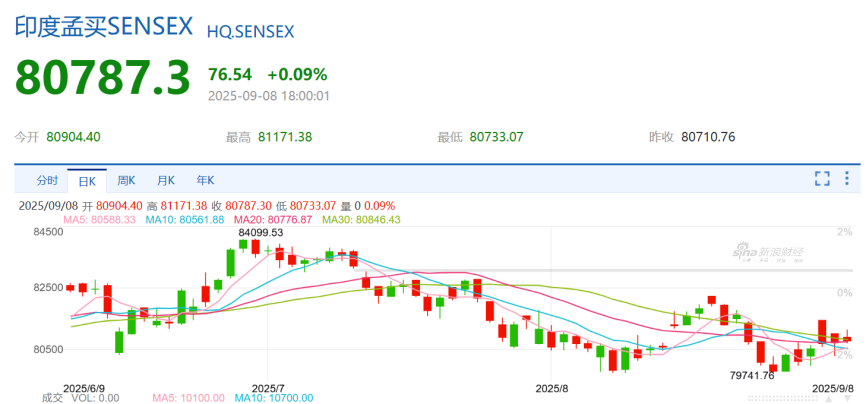
Group 1 - India is perceived as both undervalued and overvalued, with significant potential for development following China due to demographic dividends, market prospects, and geopolitical factors [1] - The Indian stock market reached a peak of 84,000 points on June 22, 2025, but subsequently underperformed, with the Bombay 30 Index down 3.39% year-to-date as of September 8, 2025, lagging behind other markets by nearly 20% [5][8] - The Indian rupee depreciated nearly 3% against the dollar and over 5% against the yuan in 2025, marking it as one of the weakest currencies among major economies [12] Group 2 - A significant decline in foreign direct investment (FDI) was reported, with net FDI dropping 96.5% in the fiscal year 2025, from $10 billion to just $353 million, a historical low [19] - Despite an overall increase in foreign investment totaling $81 billion, the outflow of $49 billion from foreign investors was noted, with a withdrawal rate approaching 20% [21] - Indian companies are increasingly investing abroad, with outbound investments reaching $29 billion in the fiscal year 2025, up from $17 billion in 2024 [23] Group 3 - The U.S. government's changing stance, including potential tariffs of 50% on Indian goods, could reduce India's GDP growth to below 6% [31] - The manufacturing sector in India has been declining, with its GDP share falling to 12.5% in 2024, the lowest since 1967 [64] - The Indian manufacturing industry faces challenges in competitiveness due to high import tariffs on intermediate goods, which inflate local production costs [92] Group 4 - The IT services sector in India is experiencing significant job losses due to the rise of AI, with estimates suggesting that around 200,000 IT jobs were lost in the past year, potentially rising to 300,000 by 2025 [112] - The Indian stock market's IT sector has been the worst performer, reflecting the broader challenges faced by the industry [113] - The relationship between population and productivity in India is shifting, with the potential for a demographic burden rather than a demographic dividend [114]

南非2025年第二季度GDP同比增长0.8%
Zhong Guo Xin Wen Wang· 2025-09-10 09:23
Core Insights - South Africa's GDP grew by 0.8% year-on-year in Q2 2025, exceeding most economists' expectations [1] - The actual GDP reached nearly 1.2 trillion rand in Q2 2025 [1] Economic Performance - The growth in Q2 was primarily driven by a recovery in the mining sector and increased consumer spending [1] - In Q1 2025, the GDP growth rate remained unchanged at 0.1%, with an overall economic growth of 0.7% in the first half of 2025 [1] - Eight out of ten economic sectors experienced growth in Q2, compared to only four in Q1 [1] Sector Contributions - The mining sector rebounded with a growth of 3.7% in Q2 after contracting over 4% in Q1, marking the fastest growth in over four years, driven by platinum group metals, gold, and chrome ore [1] - Agriculture grew by 2.5%, while manufacturing saw a growth of 1.8% [1] Consumer Activity - Consumer activity remained robust, with household consumption increasing for the fifth consecutive quarter by 0.8% [1] - Significant increases were noted in spending on dining, hotels, clothing, and footwear [1] Trade Dynamics - Imports decreased by 2.1%, mainly due to reduced imports of chemical products, machinery and electrical equipment, minerals, and agricultural products [1] - Exports fell by 3.2%, primarily due to declines in basic metals, agricultural products, and vehicles and transport equipment (excluding large aircraft) [1]
业绩专题:上半年A股盈利增速放缓,后续有望温和回升
Dongguan Securities· 2025-09-08 02:58
Group 1 - The overall profit of A-shares in the first half of 2025 increased by 2.44% year-on-year, but the growth rate has slowed down compared to the first quarter [2][9][10] - The net profit of non-financial A-shares rose by 1.03% year-on-year, a decrease of 3.48 percentage points from the first quarter [9][10] - The net profit of the non-financial and non-oil and gas A-shares increased by 4.82% year-on-year, with a decrease of 3.08 percentage points from the first quarter [9][10] Group 2 - The total revenue of all A-shares increased by 0.03% year-on-year, marking a return to positive growth after a year of decline [15][19] - The revenue growth rates for the ChiNext and Sci-Tech Innovation Board were 7.04% and 4.81% respectively, while the North Stock A-share saw a growth of 5.66% [18][19] - The main board's revenue growth rate decreased by 0.5% year-on-year, but improved by 0.25 percentage points from the first quarter [19] Group 3 - The overall gross profit margin for A-shares was 17.84%, a slight increase from the first quarter [22][24] - The gross profit margins for the ChiNext and Sci-Tech Innovation Board were 23.25% and 28.98% respectively, with the latter maintaining a high level [24][25] - The gross profit margin for the main board decreased by 0.03 percentage points compared to the first quarter [24] Group 4 - Major expenses for non-financial enterprises saw a year-on-year decline, with sales expenses down by 2.29% and financial expenses down by 15.38% [29][30] - The revenue and cost growth rates for non-financial enterprises were -0.18% and -0.17% respectively, indicating a narrowing decline [29][30] - The overall economic environment is expected to improve, with policies aimed at boosting consumption and stabilizing infrastructure investment [30] Group 5 - The return on equity (ROE) for all A-shares remained stable at 7.73%, with slight variations across different sectors [33][34] - The sales net profit margin for all A-shares increased slightly to 7.87% [33][34] - The total asset turnover ratio for all A-shares improved, indicating better efficiency in asset utilization [33][34] Group 6 - In the upstream sector, the performance of the coal industry was weak, with revenue and net profit declining significantly [41][42] - The agricultural sector showed signs of recovery, with a revenue increase of 8.95% and a notable rise in net profit [42] - The machinery equipment sector experienced steady growth, with revenue and net profit increasing by 7.26% and 18.08% respectively [44] Group 7 - The real estate sector continued to face pressure, with a year-on-year revenue decline of 11.92% [46] - The consumer sector showed overall performance slowdown, with the automotive sector's revenue growth rate decreasing significantly [47] - The TMT sector exhibited mixed results, with the electronic sector showing strong growth while the media sector experienced a decline [48] Group 8 - The banking sector's net profit growth turned positive, with a year-on-year increase of 0.77% [49] - Non-bank financial institutions continued to perform well, with a net profit increase of 18.36% [49] - Other sectors such as transportation and defense showed improvement, while environmental and public utility sectors faced challenges [50]
日本第二季度GDP折合年率增长2.2%,预估为1.0%
Mei Ri Jing Ji Xin Wen· 2025-09-08 00:01
每经AI快讯,9月8日,日本第二季度GDP折合年率增长2.2%,预估为1.0%。日本第二季度GDP环比增 长0.5%,预估为0.3%。 ...
瑞典第二季度GDP增长1.4%
Shang Wu Bu Wang Zhan· 2025-09-05 17:34
Core Viewpoint - Sweden's GDP experienced a quarter-on-quarter growth of 0.5% and a year-on-year growth of 1.4% in the second quarter of 2025, driven by increases in gross capital formation, exports, and household consumption [1] Economic Growth Components - Gross capital formation increased by 1.7% compared to the previous quarter [1] - Final household consumption rose by 0.4% quarter-on-quarter [1] - Exports grew by 0.7% compared to the previous quarter [1] Household Income - Real disposable income for households increased by 2.5% compared to the same period in 2024 [1]
【环球财经】欧元区二季度GDP环比增长0.1%
Xin Hua Cai Jing· 2025-09-05 13:45
Economic Growth - In Q2 2025, the Eurozone GDP grew by 0.1% quarter-on-quarter, while the EU overall grew by 0.2% [1] - Year-on-year, the Eurozone and EU GDP increased by 1.5% and 1.6%, respectively [1] - Finland, Germany, and Italy experienced declines in GDP by 0.4%, 0.3%, and 0.1% respectively, while Denmark, Croatia, and Romania saw increases of 1.3% and 1.2% [1] Demand Structure - Final consumption by households showed slight growth, government final consumption rebounded, while fixed capital investment declined significantly [1] - Exports decreased, imports remained stable, and overall EU imports increased by 0.3% [1] - Inventory growth contributed approximately 0.5 percentage points to the quarterly growth, while fixed capital investment negatively contributed by 0.4 percentage points [1] Employment Trends - Employment in the Eurozone and EU grew by 0.1% quarter-on-quarter, with year-on-year growth of 0.6% and 0.4%, respectively [2] - Bulgaria, Spain, and Malta experienced the fastest employment growth rates of 1.1%, 0.7%, and 0.7% [2] - The total employment in the EU is approximately 219.9 million, with the Eurozone accounting for 171.6 million [2] Productivity Improvement - Labor productivity improved, with a year-on-year increase of 0.8% in the Eurozone and 1.2% in the EU based on headcount [2] - When measured by hours worked, productivity increased by 1.1% in the Eurozone and 1.5% in the EU year-on-year [2]
北京经开区“十四五”GDP年均增长9.6%
Bei Jing Shang Bao· 2025-09-04 09:24
Core Insights - Since the beginning of the 14th Five-Year Plan, Beijing Economic-Technological Development Area (BDA) has achieved an average annual GDP growth rate of 9.6%, surpassing 360 billion yuan, with a remarkable growth rate of 12.3% in the first half of this year, ranking first among national-level economic development zones in terms of growth rate and contributing over 15% to the city's economic growth [1][1][1] Economic Performance - The industrial sector in BDA has shown significant performance, with total industrial output exceeding 600 billion yuan, accounting for 25.8% of the city's total; the area, which occupies only 1.37% of Beijing's land, contributes nearly 40% of the city's industrial added value [1][1] - In the first half of this year, industrial growth in BDA reached 15.6%, with leading industries such as high-end automobiles, integrated circuits, and electronic information all experiencing growth rates exceeding 20% [1][1] Structural Optimization - The industrial structure in BDA is continuously optimizing, with the ratio of secondary to tertiary industries adjusting from 65:35 in 2020 to 59:41 in 2024, indicating a 6 percentage point increase in the service sector's share [1][1] - In the first half of this year, revenue from the information service industry grew by 23.8%, retail and wholesale sales increased by 25.4%, and net income from the financial sector saw a growth of 31.4% [1][1] Investment and Innovation - Fixed asset investment in the region has grown at an average annual rate of over 28%, maintaining a scale of over 100 billion yuan for three consecutive years, with both total industrial investment and growth rate ranking first in the city [1][1] - Corporate R&D investment has increased by an average of 18.8% annually, with total R&D investment consistently ranking second in the city, reflecting strong innovation vitality and growth potential [1][1]
2025年二季度澳大利亚GDP增幅升至0.6%
Xin Hua Cai Jing· 2025-09-03 05:47
Core Insights - Australia's GDP grew by 0.6% quarter-on-quarter and 1.8% year-on-year in Q2 2025, marking the 15th consecutive quarter of growth, surpassing market expectations and previous quarters' performance [1] - The main drivers of economic growth were domestic final demand, primarily fueled by increases in household and government spending, while public investment was a significant drag on growth [1] - The economic growth forecast for the fiscal year 2024-25 is set at 1.3% [1] Economic Performance - Government spending increased by 1% and household consumption rose by 0.9% in Q2 2025 [1] - Private sector investment saw minimal growth of 0.1% due to a decline in residential investment and new construction projects, while public sector investment decreased by 3.9% [1] Trade and Exports - Overall goods exports increased due to a rebound in iron ore and liquefied natural gas exports, alongside growth in service exports driven by an increase in short-term visitors to Australia [2] - However, the increase in Australians traveling abroad and higher spending per traveler negatively impacted net trade growth, with a significant drag from service imports [2] - A decrease in imports of consumer goods such as automobiles and clothing also affected the overall goods imports for the quarter [2] Household Financials - The household savings rate fell from 5.2% in Q1 to 4.2% in Q2 2025, while total disposable income grew by 0.6%, lagging behind the 1.5% increase in nominal household spending [2]
澳大利亚第二季度GDP同比增长1.8%
Mei Ri Jing Ji Xin Wen· 2025-09-03 01:43
每经AI快讯,9月3日,澳大利亚第二季度GDP同比增长1.8%,预估为1.6%。 ...