
关税

Search documents
印度制造业重镇抱怨:被美国害惨了,1500亿卢比订单泡汤
Sou Hu Cai Jing· 2025-12-18 16:11
Core Points - The trade agreement between the US and India remains unresolved, with Indian goods facing tariffs as high as 50% from the US, significantly impacting Tamil Nadu's economy [1][3] - Tamil Nadu's Chief Minister M.K. Stalin has highlighted the severe economic damage caused by these tariffs, urging Prime Minister Modi to expedite the trade agreement [1][3] - The high tariffs have led to a drastic reduction in exports to the US, which is India's largest export market, particularly affecting labor-intensive sectors such as textiles, jewelry, leather, and footwear [3][4] Economic Impact - Tamil Nadu, a major manufacturing hub, is experiencing daily losses of up to 600 million rupees (approximately 46.8 million RMB) due to the tariffs [1][3] - The textile industry in Tamil Nadu accounts for 28% of India's textile exports, employing around 7.5 million people, while leather and footwear represent 40% of India's exports in those categories, employing over 1 million workers [4] - The economic crisis has pushed many small and medium-sized enterprises to the brink of collapse, as described by M.K. Stalin [3][4] Government Response - Prime Minister Modi has engaged in discussions with US President Trump regarding trade expansion and energy cooperation, indicating India's desire to negotiate tariff reductions [4][5] - Recent trade talks have seen India offering its best-ever proposals to the US for agricultural market access, reflecting the urgency of the situation [5]


美国上周首申人数回落至22.4万人,扭转此前激增趋势
Sou Hu Cai Jing· 2025-12-18 15:41
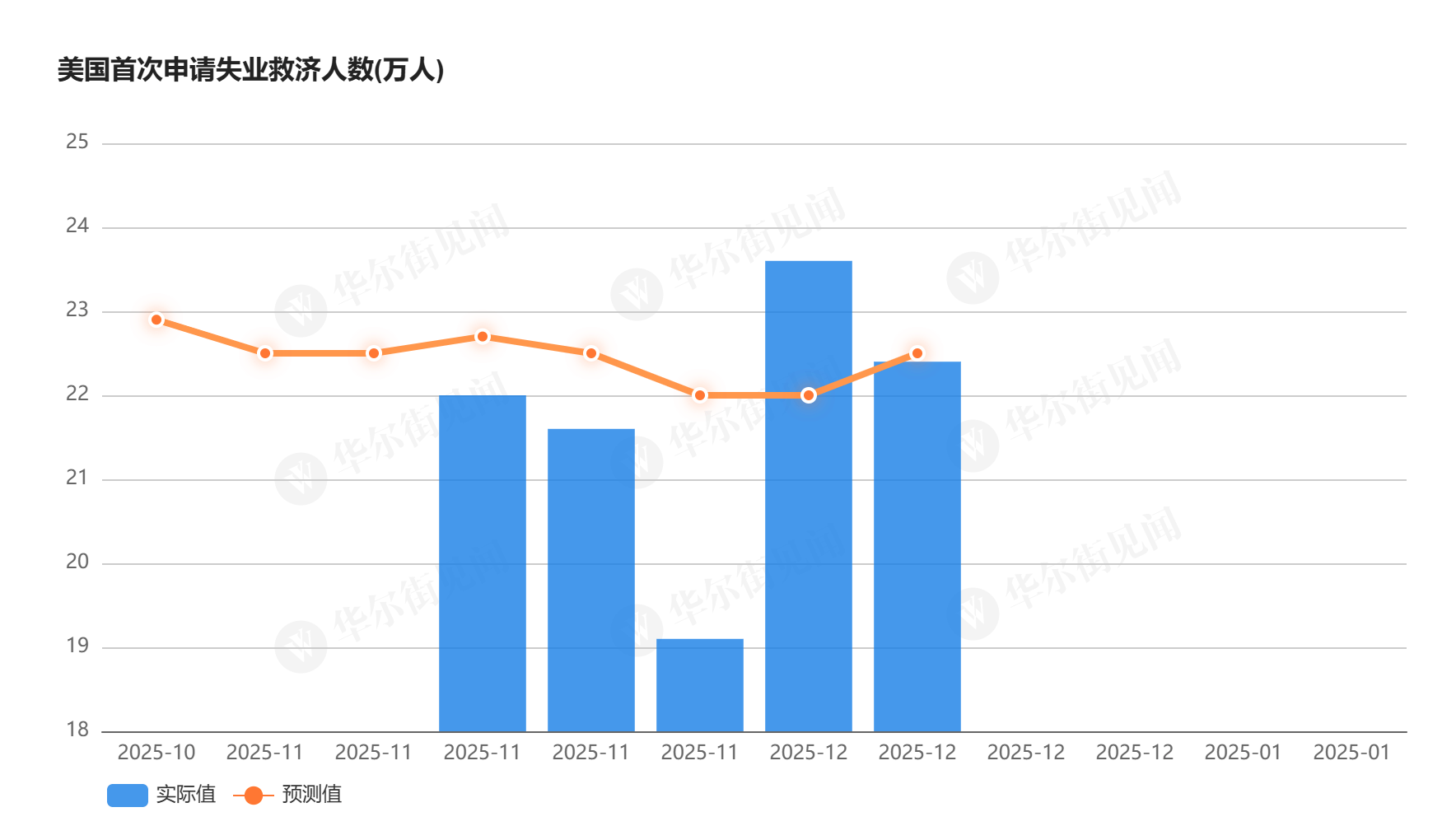
Group 1 - The overall U.S. labor market remains in a "moderate fluctuation" range despite seasonal disruptions during the holiday period, with initial jobless claims decreasing to 224,000, down from 237,000 the previous week, and below economists' expectations of 225,000 [1] - The four-week moving average of initial claims rose slightly to 217,500, indicating ongoing moderate fluctuations in the labor market [1] - Continuing claims for unemployment benefits increased to 1.897 million, better than the market expectation of 1.93 million, with a four-week average of 1.902 million [4] Group 2 - Recent weeks have seen significant volatility in jobless claims, reflecting challenges in data adjustments around the Thanksgiving holiday, but there are no clear signs of acute employment pressure in any region [7] - A survey conducted by the Richmond Fed and Atlanta Fed, involving 548 CFOs, indicated that tariffs are a major concern affecting hiring plans, as companies are scaling back expansion due to unexpected impacts from comprehensive tariff measures introduced by President Trump [8] - The November unemployment rate rose to 4.6%, the highest level since September 2021, influenced by technical factors related to a prolonged government shutdown that hindered data collection [8] Group 3 - The Federal Reserve recently cut interest rates but signaled a pause in further cuts while awaiting clearer signals regarding the labor market and inflation trends [9] - Concerns were raised by Fed Chair Powell that the actual state of the labor market may be weaker than indicated, with potential downward revisions of recent employment data by up to 60,000 jobs [9] - Notable companies such as UPS, General Motors, Amazon, and Verizon have announced layoffs, which typically take months to reflect in government statistics [9]
特朗普宣布将为美国士兵每人发1776美元
Xin Jing Bao· 2025-12-18 09:25
Core Viewpoint - Trump announced a "warrior bonus" of $1,776 for nearly 1.5 million U.S. military personnel, claiming it would be funded by tariffs [1] Group 1 - The bonus amount of $1,776 is symbolically linked to the year of American independence [1] - The announcement was made during a nationwide televised address [1] - Public reaction on social media highlighted concerns about the inadequacy of the bonus in covering living expenses, such as rent and mortgage payments [1] Group 2 - Critics pointed out that the bonus's purchasing power is diminished due to inflation, questioning the effectiveness of Trump's economic policies [1] - The funding source for the bonus, tariffs, has raised discussions about its sustainability and impact on the economy [1]
12月18日金市早评:金价高位整理!美联储放鸽持续发酵
Jin Tou Wang· 2025-12-18 03:59
Group 1 - The US dollar index is trading around 98.367, while spot gold opened at $4340.68 per ounce and is currently trading at approximately $4332.10 per ounce [1] - On the previous trading day, the US dollar index rose by 0.18% to 99.319, and spot gold increased by 0.81% to $4337.16 per ounce [1] - Other precious metals saw gains, with spot silver up 3.82% to $66.17 per ounce, platinum up 2.62% to $1896.20 per ounce, and palladium up 2.52% to $1646.50 per ounce [1] Group 2 - As of December 17, COMEX gold inventory remains unchanged at 1119.46 tons, while COMEX silver inventory decreased by 27.85 tons to 14088.35 tons [2] - SPDR gold ETF holdings increased by 0.85 tons to 1052.54 tons, while SLV silver ETF holdings remained unchanged at 16018.29 tons [2] Group 3 - The Federal Reserve's joint survey indicates that tariffs continue to trouble businesses, with an expected 4% increase in prices next year [4] - Federal Reserve Governor Waller stated that monetary policy remains in a restrictive range, with room for further rate cuts, as current rates are 50 to 100 basis points above neutral [4] - US Treasury Secretary Basant mentioned that the "Trump account" could help ensure all Americans own stocks, aiming to reduce the 38% of Americans who do not currently hold stocks to zero [4]
富格林:鉴识欺诈铸就交易可信防线
Sou Hu Cai Jing· 2025-12-18 03:02
12月18日 资讯分享 周三,现货黄金一度重回4340美元附近,随后开启宽幅震荡,最终收涨0.84%,报4338.44美元/盎司; 现货白银将历史新高刷新至66美元上方,最终收涨3.87%,报66.19美元/盎司。 因特朗普对委内瑞拉的封锁缓解了全球供应过剩担忧,油价大幅反弹。WTI原油最终收涨3.03%,报 56.70美元/桶;布伦特原油重回60美元上方,最终收涨2.95%,报60.79美元/桶。 美联储联合调查:关税持续困扰企业,预计明年物价上涨4%。 美联储理事沃勒:货币政策仍处于限制性区间,仍有降息空间。就业市场表明美联储应继续降息。利率 水平比中性利率高出50到100个基点。 美媒称若俄罗斯拒绝俄乌和平协议,美国将对俄"影子舰队"采取新制裁。白宫回应:暂无任何新决定。 美媒:美俄将于本周末在迈阿密就俄乌冲突举行会谈。 ...
美国11月CPI迷雾重重,今晚数据暗藏哪些变量?
Jin Shi Shu Ju· 2025-12-18 02:57
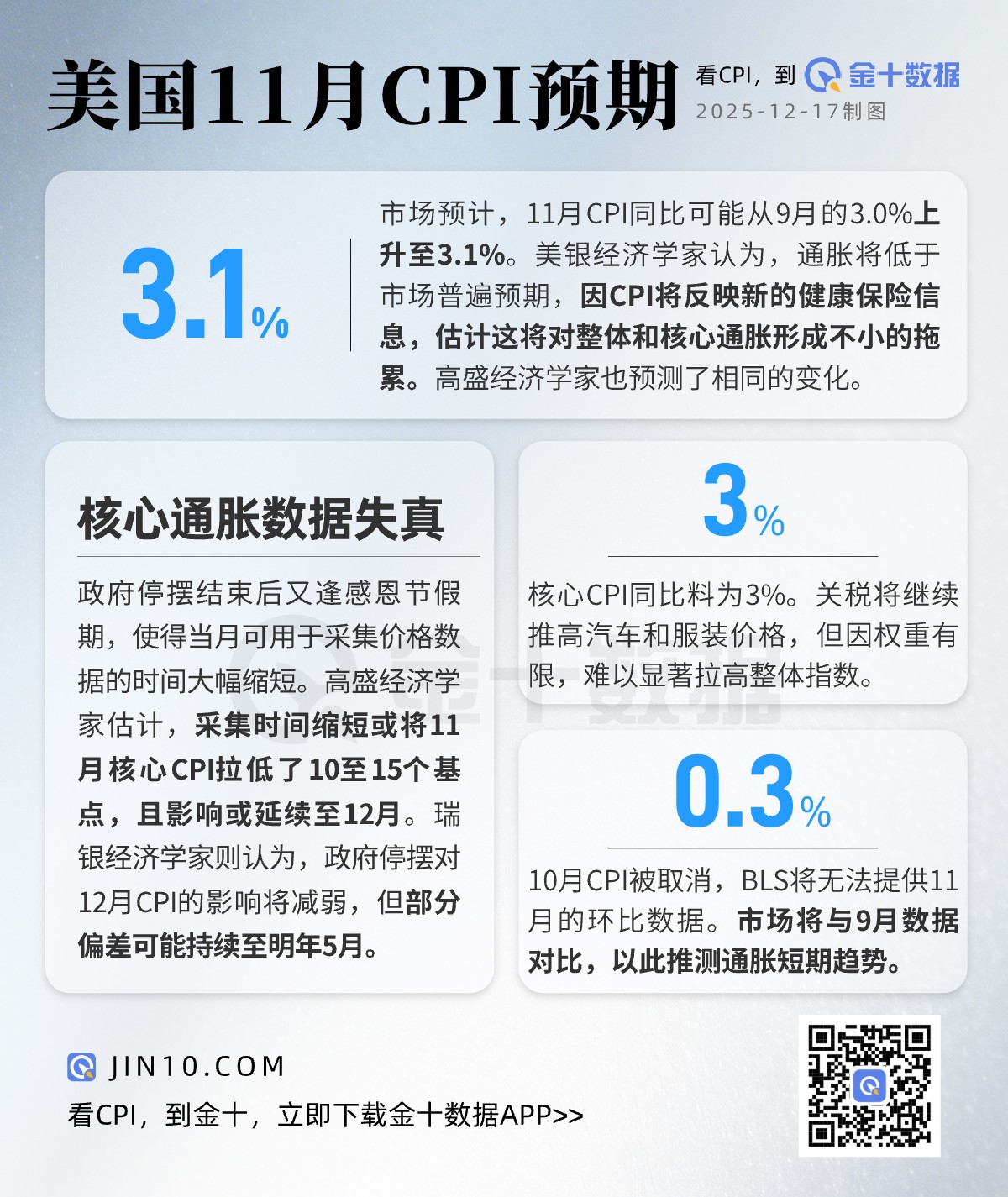
12月18日(周四)21:30,美国将公布11月消费者价格指数(CPI)报告,预计将显示通胀小幅回升。 经济学家预计,11月CPI同比或从9月的3.0%小幅上升至3.1%。剔除食品和能源后的核心CPI同比料将录得3%。 由于政府停摆导致10月期间大部分数据无法采集,美国劳工统计局(BLS)取消发布10月的CPI数据。这也意味着,BLS将无法提供11月的环比数据。一位 BLS发言人表示: "即将发布的新闻稿和数据库更新中,将不包含2025年11月的单月百分比变化数据,因为缺少2025年10月的数据。" 法国外贸银行(Natixis)首席美国经济学家克里斯托弗·霍奇(Christopher Hodge)表示,环比变化对于判断通胀趋势至关重要。"人们真正关注的是环比数 据,"他说,"同比通胀并不能提供太多信号。" 尽管如此,经济学家仍尝试通过将11月价格指数水平与9月进行对比,来推测通胀的短期变化趋势。市场预测显示,整体CPI在11月可能环比上涨0.3%,与9 月的0.30%涨幅相当,核心CPI环比涨幅预计为0.3%,略高于9月的0.2%。 数据采集缺失可能对CPI质量产生持续影响 数据采集缺失也为本次CPI的可靠 ...
国泰君安期货所长早读-20251218
Guo Tai Jun An Qi Huo· 2025-12-18 01:27
所长 早读 国泰君安期货 2025-12-18 期 请务必阅读正文之后的免责条款部分 1 期货研究 期货研究 2025-12-18 所长 早读 今 日 发 现 | 板块 | 关注指数 | | --- | --- | | 碳酸锂 | ★★★★ | 碳酸锂:基本面变化有限,市场情绪驱动锂价向上。一方面,宜春市自然资源局拟注销 27 宗采矿许可证,虽然所涉矿山此前多处于停产状态,对实际供需影响有限,但市场将此解读 为宜春地区锂矿资源管控趋严的信号,并预期未来云母锂供应增量可能受限。另一方面,市 场对大厂复产时间的预期不断推迟,在未复产的情况下,周度库存仍保持 2000 吨以上的去 化速度,现实层面的持续去库,叠加未来需求向好的预期,共同支撑了多头的看涨情绪。不 过需注意的是,目前现货市场成交仍显清淡,下游对当前高价接受度不高,期货与现货市场 请务必阅读正文之后的免责条款部分 2 出现一定背离。整体来看,当前市场情绪偏乐观,短期锂价预计高位运行,波动加剧,建议 谨慎持仓。 | 所 | | 长 | 首 | 推 | | | --- | --- | --- | --- | --- | --- | | 板块 | | | | ...
摩根士丹利:2026年美国经济展望:走出政策不确定性
摩根· 2025-12-17 15:50
Investment Rating - The report does not explicitly provide an investment rating for the industry Core Insights - The Trump administration's tariffs, effective from Spring 2025, have raised the effective tax rate to approximately 16%, contributing to a 30 basis point increase in commodity prices, with an expected total transmission of 70 basis points by Q1 2026, exerting upward pressure on inflation [1][3][4] - PCE inflation is projected to peak at around 3% in Q1 2026, declining to 2.6% by Q4 2026, primarily driven by tariff-affected commodity price increases, with no significant second-round effects anticipated [1][5] - The labor market is expected to remain weak, with a peak unemployment rate of 4.7% in Q2 2026, as companies respond to higher tariffs by reducing labor costs and profit margins, leading to a slowdown in job growth [1][6] - The "Beautiful Bill" is estimated to contribute approximately 40 basis points to economic growth, with actual impacts potentially ranging from 0 to 1 percentage point depending on fiscal multiplier assumptions [1][7][8] - Artificial intelligence (AI) capital expenditure is expected to contribute about 30% to GDP growth, with AI projected to account for approximately 40% of U.S. economic growth in 2026 and 2027, translating to about 20% of total growth [1][11][12] Summary by Sections Economic Outlook - The U.S. economy is anticipated to emerge from a period of high uncertainty, achieving moderate growth of around 2% over the next few years, although inflation may remain above the 2% target until 2027 [2][12] Tariff Impact - The tariffs implemented by the Trump administration have significantly increased commodity prices, with expectations that this upward pressure will peak in Q1 2026 [3][4] Inflation Projections - PCE inflation is expected to peak at 3% in Q1 2026 and decrease to 2.6% by Q4 2026, largely due to the impact of tariffs on commodity prices [5] Labor Market and Federal Reserve Policy - The labor market is projected to remain weak, with a peak unemployment rate of 4.7% in Q2 2026, leading to a cumulative 75 basis point rate cut by the Federal Reserve between September and December [6] Legislative Impact - The "Beautiful Bill" is expected to have a growth effect of about 40 basis points, with potential variations based on fiscal multiplier assumptions [7][8] AI Contribution - AI is projected to significantly enhance productivity, contributing approximately 25-35 basis points to productivity improvements by 2027, with a potential for 40-50 basis points in a supply-driven scenario [11]
财政部:1-11月 房产税4714亿元,同比增长10.8%
Jing Ji Guan Cha Bao· 2025-12-17 10:23
Core Insights - The Ministry of Finance reported that from January to November 2025, property tax revenue reached 471.4 billion yuan, reflecting a year-on-year growth of 10.8% [1] Summary by Category Tax Revenue - Corporate income tax collected amounted to 402.34 billion yuan, showing a year-on-year increase of 1.7% [1] - Individual income tax revenue was 146.89 billion yuan, with a year-on-year growth of 11.5% [1] - Value-added tax and consumption tax from imported goods totaled 165.2 billion yuan, which represents a year-on-year decline of 4.7% [1] - Customs duties collected were 21.49 billion yuan, down 3.2% year-on-year [1] - Export tax rebates reached 190.38 billion yuan, indicating a year-on-year increase of 5.6% [1] - Vehicle purchase tax revenue was 18.14 billion yuan, reflecting a significant year-on-year decrease of 17.4% [1]
美财长贝森特预计明年通胀将大幅降温,驳斥哈塞特缺乏自主权的传言
Jin Shi Shu Ju· 2025-12-16 14:33
Group 1 - The U.S. Treasury Secretary Scott Bessent predicts a significant decline in inflation by the first half of 2026 [1] - Bessent mentioned that President Trump is expected to announce a candidate for the Federal Reserve Chair in early January, with one or two interviews possibly taking place this week [1] - Bessent highlighted that former Fed Governor Kevin Warsh and NEC Director Kevin Hassett are both "very, very qualified" candidates for the Fed Chair position [1] Group 2 - Bessent emphasized the need for an open-minded Fed Chair who can challenge the notion that economic growth leads to inflation, stating that inflation occurs when demand exceeds supply [1] - Concerns were raised about Hassett's close relationship with Trump potentially undermining the Fed's independence, but Bessent refuted this claim, asserting that individuals have the autonomy to make decisions [1] - Bessent expressed worries about the Fed's status, describing it as "a non-elected institution that has lost trust" [1] Group 3 - In economic forecasts, Bessent predicts a GDP growth rate of 3.5% for 2025 and suggests that 2026 could be a prosperous year if the government remains operational [2] - He attributes current economic pressures to "Biden inflation" but anticipates relief for Americans by early 2026, with tax refunds expected to reach $100 billion to $150 billion in the first quarter of the following year [2] - Bessent links the decline in rental inflation to border security measures, stating that rental costs have decreased due to the closure of the U.S. border [3] Group 4 - Bessent mentioned that the Supreme Court is expected to rule on tariff issues in early January, confirming that there are multiple revenue sources beyond IEEPA tariffs [3] - He committed to reducing the budget deficit by "hundreds of billions" this year [3]