卫星互联网

Search documents
美企竞逐卫星互联网,太空新赛道博弈升温
Xin Lang Cai Jing· 2026-01-23 06:33
Core Insights - The competition for near-Earth orbital resources is intensifying, with U.S. companies significantly increasing their investments in satellite internet infrastructure [1][2] - Blue Origin has announced its "TeraWave" project, which aims to provide high-speed data connectivity for enterprise users through a multi-orbit satellite network [1][3] Company Developments - Blue Origin's "TeraWave" will consist of 5,408 satellites, including 5,280 low Earth orbit satellites and 128 medium Earth orbit satellites, offering data speeds of up to 6 terabits per second [1][3] - SpaceX's "Starlink" project has over 9,000 satellites in orbit and serves more than 9 million users, focusing on the mass market and underserved areas [3] - Amazon's "Low Earth Orbit Satellite Plan" plans to deploy over 3,000 satellites, targeting enterprise clients and government agencies [3] Industry Trends - Satellite internet is emerging as a crucial supplement to traditional ground-based communication networks, especially in areas with challenging geographical conditions [2][5] - The global market for satellite internet is expanding, driven by the need for better connectivity in underserved regions, with approximately 2.6 billion people lacking adequate internet access [5] Competitive Landscape - Various U.S. companies are entering the satellite internet space, each with distinct user targets and technological approaches, leading to a diverse competitive environment [3][4] - Companies like AST SpaceMobile are developing satellite networks that connect directly to smartphones, aiming to provide 4G and 5G coverage in remote areas [4] Opportunities and Challenges - The satellite internet sector offers significant market potential due to its global coverage capabilities and redundancy advantages over traditional networks [5] - The competition for orbital positions and spectrum resources is becoming a critical factor in the development of space infrastructure, with challenges related to orbital congestion and space debris management [5]

综述|美企竞逐卫星互联网 太空新赛道博弈升温
Xin Hua She· 2026-01-23 06:04
Core Viewpoint - The competition for satellite internet among U.S. companies is intensifying, with multiple firms launching projects aimed at providing high-speed internet services through satellite networks, marking a shift from conceptual exploration to large-scale competition in space communication [1][2]. Group 1: Company Initiatives - Blue Origin announced its satellite internet project "TeraWave," which aims to provide up to 6 terabits per second of symmetrical data connectivity through a network of 5,408 satellites, including 5,280 low Earth orbit satellites and 128 medium Earth orbit satellites, targeting enterprise, data center, and government users [1][2]. - SpaceX's "Starlink" project has over 9,000 satellites in orbit and serves more than 9 million users, focusing on the mass market and small institutions, particularly in remote areas and emergency communication scenarios [2][3]. - Amazon's "Low Earth Orbit Satellite Plan" plans to deploy over 3,000 low Earth orbit satellites, primarily targeting enterprise customers, government agencies, and remote communities, with a more measured rollout [2][3]. Group 2: Market Dynamics - The satellite internet sector is characterized by varying technical paths and strategic focuses among U.S. companies, with some emphasizing high throughput and redundancy for enterprise users, while others target broader consumer markets [3]. - The global market for satellite internet is expanding due to the limitations of traditional ground-based networks, with approximately 2.6 billion people lacking adequate internet access, particularly in rural and low-income areas [3][4]. - The competition for orbital positions and frequency resources is becoming a critical factor in the future of space infrastructure, with the rapid increase in satellite numbers leading to concerns about orbital congestion and space debris [4].
午评:沪指涨0.27% 北证50指数涨3.36% 光伏设备板块掀涨停潮
Xin Hua Cai Jing· 2026-01-23 05:38
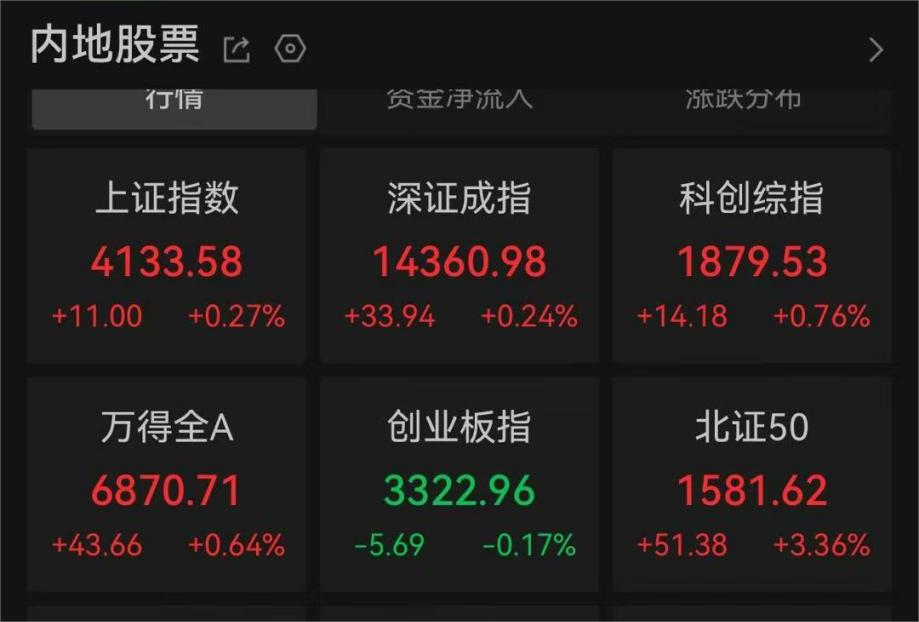
新华财经北京1月23日电沪深两市三大股指23日早间普遍小幅高开。各股指盘初在未回补与上一交易日 之间缺口的情况下震荡上扬,10时16分后开始逐渐收窄涨幅,其中,沪指和深成指在完成缺口回补后再 度上扬。北证50指数23日早间表现强势,显著高开,至午间收盘时大幅上涨。 从盘面来看,光伏、贵金属、医药商业板块在盘初涨幅靠前,燃气、航天航空、煤炭板块在盘初跌幅靠 前。海南自贸、仿制药、锂矿、电网设备、卫星互联网、6G概念、培育钻石等多个板块在盘中相继走 强。至午间收盘时,光伏设备板块掀涨停潮,因板块内成分股多有交叉,HIT电池、TOPCon电池、钙 钛矿电池等光伏领域相关板块均有大幅上涨。卫星互联网、6G概念、贵金属、珠宝首饰、有色金属、 锂矿、医药商业等多板块亦有较大幅度上涨。保险、高带宽内存、燃气等板块跌幅靠前,但整体跌幅不 大。 至午间收盘时,上证指数报4133.58点,涨幅0.27%,成交额约8073亿元;深证成指报14360.96点,涨幅 0.24%,成交额约10856亿元;创业板指报3322.96点,跌幅0.17%,成交额约5063亿元;科创综指报 1879.53点,涨幅0.76%,成交额约2084亿元; ...
商业航天、光伏 集体爆发!
Zhong Guo Ji Jin Bao· 2026-01-23 04:53
Market Overview - As of January 23, the A-share market showed mixed results with the Shanghai Composite Index rising by 0.27% to 4133.58, the Shenzhen Component Index increasing by 0.24% to 14360.98, while the ChiNext Index fell by 0.17% to 3322.96 [1][2]. Commercial Aerospace Sector - The commercial aerospace sector experienced significant gains, with stocks such as Ruihua Tai, Feiwo Technology, and others hitting the 20% daily limit up [3][4]. - The first batch of tourists for China's commercial spacecraft has been revealed, with tickets priced at 3 million yuan, and over 20 individuals, including notable figures, have already signed up [5][7]. Photovoltaic Industry - The photovoltaic industry saw a surge, with multiple stocks reaching the 20% daily limit up, including Dongfang Risheng and Maiwei Shares [9][10]. - The demand for photovoltaic cells is expected to increase significantly due to the planned launch of 200,000 satellites, which will drive both quantity and quality improvements in solar energy technology [10]. Gold Market - Gold stocks continued to rise, with Sichuan Gold increasing by over 8% and other companies like Chifeng Gold and Zhongjin Gold also seeing gains [11][12]. - The price of gold jewelry in China has surpassed 1500 yuan per gram, with major brands exceeding 1540 yuan per gram [13].






卫星互联网板块强势 信维通信涨幅居前
Xin Lang Cai Jing· 2026-01-23 03:46
Core Viewpoint - The satellite internet sector is experiencing significant gains, with multiple companies showing strong stock performance on January 23rd [1] Group 1: Company Performance - Fenghuo Communication and Tongyu Communication reached their daily limit up [1] - Xunwei Communication, Aerospace Electronics, Tianyin Machinery, Jiuzhiyang, Sanwei Communication, China Satellite Communications, Putian Technology, and China Satellite also saw notable stock increases [1]


通宇通讯涨幅9.99%!卫星通信为炒作核心,通信政策落地叠加商业航天展启幕
Sou Hu Cai Jing· 2026-01-23 03:02
交易所数据显示,截至2026年1月23日10时45分,通宇通讯最新价52.17元,涨幅9.99%,开盘47.69元, 最高52.17元,最低47.45元,成交量59.84万手,成交额30.01亿元,振幅9.95%,换手率17.71%。 市场炒作通宇通讯的核心逻辑在于其作为卫星通信设备提供商的行业定位,契合卫星互联网产业链的发 展方向。 通信行业相关政策持续落地,产业链上下游协同联动效应显现。 声明:本内容由AI生成,数据资料来自于交易所及第三方公开信息,仅供参考,不构成投资建议。 来源:市场资讯 消息面上,上海市通信管理局召开上海信息通信业2026年工作会议,强调适度超前布局建设新型信息基 础设施,健全"双千兆"网络提质升级政策措施,抓好新一轮万兆光网试点,纵深推动"5G+工业互联 网",促进产业智能化、绿色化、融合化发展。2026北京商业航天展暨大会于1月23日至25日举办。 ...
海能达涨2.06%,成交额1.57亿元,主力资金净流入1028.91万元
Xin Lang Cai Jing· 2026-01-23 02:47
Core Viewpoint - The stock price of Hainengda has shown fluctuations, with a recent increase of 2.06% and a total market capitalization of 20.732 billion yuan, indicating active trading and interest from investors [1]. Group 1: Stock Performance - Hainengda's stock price has increased by 0.71% since the beginning of the year, but has decreased by 2.98% over the last five trading days [2]. - Over the past 20 days, the stock has risen by 5.46%, while it has only increased by 0.35% over the last 60 days [2]. Group 2: Company Overview - Hainengda Communication Co., Ltd. is based in Nanshan District, Shenzhen, Guangdong Province, and was established on May 11, 1993, with its stock listed on May 27, 2011 [2]. - The company specializes in the research, production, and sales of professional wireless communication equipment, including intercom terminals and cluster systems, and is a leading provider in the industry [2]. - The revenue composition of Hainengda is as follows: terminals account for 44.36%, systems for 42.37%, and OEM and others for 13.27% [2]. Group 3: Financial Performance - For the period from January to September 2025, Hainengda reported a revenue of 3.746 billion yuan, a year-on-year decrease of 10.26%, and a net profit attributable to shareholders of 186 million yuan, down 26.00% year-on-year [2]. - The company has distributed a total of 309 million yuan in dividends since its A-share listing, with no dividends paid in the last three years [3]. Group 4: Shareholder Information - As of September 30, 2025, Hainengda had 257,200 shareholders, a decrease of 11.45% from the previous period, with an average of 4,987 circulating shares per person, an increase of 12.94% [2]. - The top ten circulating shareholders include Hong Kong Central Clearing Limited, which holds 13.6172 million shares, a decrease of 350,900 shares from the previous period [3].

太空光伏或成下一个增长蓝海!光伏ETF(159857)昨日成交额深市同标的居首,机构:期待2026光伏拐点之年
2 1 Shi Ji Jing Ji Bao Dao· 2026-01-23 01:23
Group 1 - The market experienced a rebound on January 22, with the three major indices turning positive, and the CSI Photovoltaic Industry Index rising by 1.33% [1] - The Photovoltaic ETF (159857) had a trading volume of nearly 150 million yuan, leading among similar products in the Shenzhen market, with component stocks such as GoodWe and Junda shares hitting the daily limit [1] - As of January 21, the Photovoltaic ETF had a circulating share of 2.267 billion and a market size of 2.012 billion yuan, and it is the largest ETF tracking the CSI Photovoltaic Industry Index in the Shenzhen market [1] Group 2 - The commercial aerospace industry in China has achieved significant milestones in key areas such as reusable rocket technology and large satellite constellation networking, driving rapid development in the emerging field of space photovoltaics [2] - Analysts believe that space photovoltaics, leveraging the unique advantage of continuous sunlight in space, has become a critical support for long-term stable power supply for spacecraft, with demand expected to grow due to satellite networking and equipment upgrades [2] - According to Zheshang Securities, the photovoltaic industry has faced a loss trend since Q4 2023, with a projected 33% reduction in workforce in 2024, and the average interest-bearing debt ratio has increased from 23% to 31% [2]
SpaceX上市,有新消息!航空航天ETF天弘(159241)标的指数昨日大涨3.6%,机构:今年航空航天行业将迎来供需拐点
2 1 Shi Ji Jing Ji Bao Dao· 2026-01-23 01:23
消息面上,据证券时报,马斯克据悉希望在7月前让SpaceX上市。当地时间1月21日,据媒体报道,马 斯克正积极推进麾下太空探索技术公司SpaceX的首次公开募股(IPO)计划,其目标是在今年7月之前 完成IPO。报道称,知情人士称,马斯克一心想着让SpaceX成为首家在太空建数据中心的公司。如果没 有IPO一次性带来的数十亿美元资金,就很难尝试这样的壮举。马斯克还认为,SpaceX IPO将有助于他 的AI公司xAI追赶上竞争对手。 国金证券认为,2026年航空航天行业将迎来供需拐点。供给端受飞机制造商产能制约显著。需求端则持 续增长,中国民航客运量预计同比增速4.7%-5.5%,供需缺口或达1.4%,推动客座率超2019年水平。 (文章来源:21世纪经济报道) 相关ETF方面,航空航天ETF天弘(159241)昨日成交额为1.59亿元,溢价率为0.14%。资金流向方面,该 ETF1月19日至21日三日累计获资金净流入额超4000万元。截至1月21日收盘,该ETF最新流通份额为 5.44亿份,最新流通规模为8.12亿元。 航空航天ETF天弘(159241)紧密跟踪国证航天航空行业指数,该指数覆盖航空装备、航天 ...




贝佐斯发大招了,马斯克星链霸主不保?
Xin Lang Ke Ji· 2026-01-23 01:17
Core Insights - The article discusses the contrasting work ethics and business strategies of Elon Musk and Jeff Bezos, highlighting Musk's intense work schedule compared to Bezos's semi-retirement and leisure lifestyle [1] - Bezos's company Blue Origin announced an ambitious satellite network plan, TeraWave, which aims to deploy 5,408 satellites to provide high-speed data transmission, significantly surpassing SpaceX's Starlink [3][4] - The competition between Musk and Bezos in the space industry is evolving, with both now seen as allies in promoting space exploration despite their historical rivalry [3][27] Company Strategies - TeraWave will deploy 5,408 satellites, including 5,280 low Earth orbit satellites and 128 medium Earth orbit satellites, using a dual-orbit design to achieve data transmission speeds of up to 6 Tbps [4][6] - In contrast, Starlink currently has over 9,400 satellites in orbit, with plans to expand to between 12,000 and 50,000 satellites, primarily targeting the consumer market with speeds of 100-200 Mbps [4][7] - TeraWave is specifically targeting enterprise clients, data centers, and government customers, while Starlink focuses on a mass-market approach, aiming to serve millions of ordinary users [6][7] Market Positioning - Blue Origin's TeraWave is positioned in the high-end market, emphasizing quality and specialized services for businesses, while SpaceX's Starlink is designed for mass accessibility and rapid deployment [9][11] - Amazon's satellite project, Amazon Leo, is also in development, targeting consumer and enterprise broadband services, which positions it as a direct competitor to Starlink [11][12] - The dual strategy of Blue Origin with TeraWave and Amazon Leo allows Bezos to avoid direct competition with Musk in the consumer market while still challenging Starlink in different segments [11][12] Historical Context - The rivalry between Musk and Bezos dates back to their early ventures in space exploration, with notable tensions arising from competitive bids and differing visions for the future of space [13][21] - Their relationship has evolved from direct competition to a more collaborative stance, particularly in light of shared political interests and mutual respect for each other's technological advancements [24][26] Industry Implications - The satellite internet market is becoming increasingly competitive, with geopolitical implications as various countries, including China and the EU, accelerate their own satellite projects [28] - Concerns about space debris and the environmental impact of satellite proliferation are growing, as the number of satellites in orbit increases significantly [30][31] - The lack of effective regulation in the satellite internet sector poses risks for future developments, potentially leading to overcrowded orbits and interference with astronomical observations [31]