元宇宙

Search documents
上城召开区委全会定调“十五五”新路径
Hang Zhou Ri Bao· 2026-01-06 02:48
Core Insights - The article emphasizes the strategic focus of Shangcheng District on "Two Strengths, Two Supplements, Two Stabilizations" as a pathway for economic development during the "14th Five-Year Plan" period [1] - The district aims to enhance advanced manufacturing and leverage artificial intelligence for industrial upgrades, marking a significant shift in its economic strategy [1] Group 1: Economic Performance and Goals - Over the past five years, Shangcheng has achieved a GDP exceeding 280 billion yuan and a resident population of over 1.7 million, solidifying its advantages in modern finance, high-end business, and fashion consumption [1] - The district's economic deployment reflects a clear strategy of strengthening existing advantages while addressing weaknesses in innovation and manufacturing [1] Group 2: Consumer and Fashion Industry Development - Shangcheng is focusing on developing three major commercial circles to establish itself as a leading digital fashion consumption district, with initiatives in various areas such as high-tech and cultural integration [2] - The transformation of the "Four Seasons Green Clothing Street" from a traditional wholesale market to a new consumption destination illustrates the district's commitment to evolving its fashion industry [2] Group 3: Advanced Manufacturing and AI Integration - Despite limited space for advanced manufacturing, Shangcheng is targeting the "133X" manufacturing sector, emphasizing artificial intelligence to develop high-density, high-value urban industrial service models [2] - The district is advancing AI as a key driver of economic integration, with initiatives including digital transformation for traditional businesses and collaboration with universities for research and development [3] Group 4: Urban Development and Governance - Shangcheng is addressing multiple challenges such as development dynamics, urban quality, cultural heritage, and governance efficiency, indicating a comprehensive approach to urban planning [4] - The district's strategy includes optimizing land and housing supply while fostering a resilient industrial ecosystem and enhancing the business environment [4] Group 5: Future Outlook - The deployment for the beginning of the year marks the start of Shangcheng's "14th Five-Year Plan" narrative, with a focus on leveraging its 122 square kilometers for sustainable growth [5]
罗曼股份近一月获6亿算力订单 多元跨界布局显效业绩双增
Chang Jiang Shang Bao· 2026-01-06 00:06
Core Viewpoint - Roman Holdings has successfully signed a significant computing power contract, indicating strong performance in the computing sector and a successful diversification strategy [1][2]. Group 1: Recent Contracts - Roman Holdings' subsidiary, Wutong High-tech, has signed a computing power contract worth approximately 156 million yuan, marking the second large order in a month, totaling around 600 million yuan [1][2]. - The recent contract accounts for 21.3% of Roman Holdings' revenue for the first three quarters of 2025, which is expected to enhance the company's performance if executed smoothly [2]. Group 2: Financial Performance - For the first three quarters of 2025, Roman Holdings reported total revenue of 732 million yuan, a year-on-year increase of 63.1%, and a net profit attributable to shareholders of 21.09 million yuan, up 33.55% year-on-year [1][3]. Group 3: Strategic Diversification - Roman Holdings has diversified into three main sectors, including virtual entertainment through a partnership with Holovis, solar energy management in collaboration with state-owned enterprises, and computing power services via Wutong High-tech [3]. - The company has undergone a strategic transformation from a traditional lighting enterprise to a representative of "new productive forces," with plans to launch a "Going Global 2.0" strategy in 2026 to enhance global operations [4].

加强新兴领域知识产权保护
Jing Ji Ri Bao· 2026-01-05 22:39
Group 1 - The core viewpoint emphasizes the importance of strengthening intellectual property (IP) protection in emerging fields to drive innovation and economic growth, as outlined in the 2026 economic work priorities set by the Central Economic Work Conference [1] - The protection system for IP in emerging fields should encompass authorization, confirmation, enforcement, management, and utilization, tailored to the specific requirements of different industries [1][2] - Strategic emerging industries require enhanced IP protection to improve efficiency, while future industries need to secure competitive advantages through effective IP strategies [2] Group 2 - Different sectors, such as new energy and high-end equipment, have varying levels of IP strength and require tailored protection measures to enhance their development [2] - Future industries like the metaverse and artificial intelligence necessitate proactive IP protection to prevent monopolization by large enterprises and to foster innovation among small and medium-sized enterprises [2][3] - There is a need to improve the IP protection framework for underdeveloped areas within emerging fields, focusing on enhancing the willingness and capability of research institutions and enterprises to convert IP into practical applications [3] Group 3 - International cooperation in IP protection is crucial, particularly in trade and investment contexts, to safeguard national and business interests [3][4] - The optimization of global supply chains should leverage IP protection as a competitive tool, with a focus on improving the quality of IP held by domestic enterprises to enhance their competitive position [4] - The establishment of truly competitive innovative enterprises is essential for participating effectively in global supply chains, utilizing international IP rules for better market positioning [4]
“脑机接口”火了!老“妖股”300459,单日爆拉16.34%!
Xin Lang Cai Jing· 2026-01-05 15:37
Core Viewpoint - The "brain-computer interface" (BCI) concept is gaining significant attention in the A-share market, particularly following Elon Musk's announcement regarding Neuralink's plans for large-scale production of BCI devices in 2026 [1][2]. Industry Summary - The BCI sector is recognized as a rapidly developing industry, with approximately 11 provinces and cities in China having established related charging standards, spurred by the National Healthcare Security Administration's guidance on BCI rehabilitation fees [2]. - The "14th Five-Year Plan" has identified BCI as one of the six key future industries for development [3]. Company Summary - Tom Cat (300459.SZ) experienced a notable stock increase of 16.34% on January 5, 2026, following its involvement in the BCI field through its subsidiary, Shanghai Jinke Tom Cat Life Technology Co., Ltd., which focuses on BCI research and applications [4][5]. - The company has filed multiple patents related to BCI technologies, including flexible sleep monitoring devices and wireless brain stimulation systems [5]. - Despite its involvement in BCI, Tom Cat has a total of 37 concepts, including cloud gaming, metaverse, artificial intelligence, and more [6]. - Currently, Tom Cat does not have any formal commercialized products in the BCI sector, focusing instead on technology accumulation and business exploration [7]. - The company has faced financial challenges, reporting a net loss of 865 million yuan in 2023 and a projected loss of 859 million yuan in 2024 [9][10]. - Historical stock performance shows significant volatility, with a maximum increase of 210.49% from late 2022 to mid-2025, followed by a substantial decline of 66.53% [11][12]. - The company has incurred substantial goodwill impairment losses, totaling 2.611 billion yuan in 2019 and over 1.7 billion yuan in 2023 and 2024 [12].

米哈游,投出两个IPO
Xin Lang Cai Jing· 2026-01-05 08:13
Core Viewpoint - The article highlights the recent IPO activities of MiHoYo, showcasing its significant investments in companies like MiniMax and Suplay, positioning itself as a key player in the venture capital space within the gaming and technology sectors [2][3][19]. Investment Activities - MiHoYo is a major investor in MiniMax, holding a 7.34% stake prior to its IPO, and has been involved since its angel round of funding [2][18]. - MiHoYo also holds an 11.86% stake in Suplay, which recently submitted its IPO application, making it the largest external investor [2][19]. - The company has been actively investing in various sectors, including AI and gaming, to enhance its technological capabilities and reduce development costs [6][18]. Strategic Partnerships - MiHoYo has established itself as a client of MiniMax, utilizing its AI models for game development, including character behavior control and NPC dialogue in titles like "Honkai: Star Rail" [7][18]. - The partnership with Suplay allows MiHoYo to expand its IP derivative product offerings and reach a broader Gen Z consumer base [19]. Historical Context - MiHoYo was founded in 2011 with initial funding from a government loan and has since evolved into a significant player in the gaming industry, leveraging its cash flow to explore venture capital opportunities [20][21]. - The company began its venture capital activities around 2018, initially focusing on familiar gaming sectors before branching into cutting-edge technologies [20][22]. Future Directions - MiHoYo's recent leadership changes indicate a strategic shift towards enhancing its focus on frontier technologies and new project development [23]. - The company is also investing in AI-driven projects, with plans to release an AI-native game in 2025, reflecting its commitment to innovation in the gaming industry [23][24].


米哈游,投出两个IPO
投资界· 2026-01-05 07:55
Core Viewpoint - MiHoYo is actively investing in and partnering with emerging companies in the AI and gaming sectors, positioning itself as a significant player in the venture capital landscape while preparing for multiple IPOs [2][3][4]. Investment in MiniMax - MiHoYo holds a 7.34% stake in MiniMax, which is set to IPO on January 9, and has been a key investor since early 2022, aligning with its strategy to integrate advanced AI technologies into gaming [2][4]. - The relationship between MiHoYo's founder Liu Wei and MiniMax's CEO Yan Junjie dates back to 2021, indicating a long-standing connection that facilitated this investment [3]. Investment in Supply - MiHoYo is the largest external investor in Supply, holding an 11.86% stake, and has been involved since leading its A+ round financing in November 2021 [5][7]. - This investment supports MiHoYo's strategy to expand its IP merchandise ecosystem and reach the Z-generation consumer market [7]. Strategic Partnerships - MiHoYo has transitioned from being merely an investor to becoming a customer of MiniMax, utilizing its AI models in various gaming applications, thereby creating a symbiotic relationship [5][6]. - The company has also opened its IPs for collaboration, enhancing its product offerings and market reach [7]. Venture Capital Approach - Since 2018, MiHoYo has been actively engaging in venture capital, making numerous investments across various sectors, including cutting-edge technologies [8][11]. - The company’s investment strategy is characterized by a focus on young, innovative founders who share a vision of technological advancement [11][12]. Future Directions - MiHoYo's recent leadership changes indicate a shift towards prioritizing research and development in frontier technologies, with a focus on attracting top talent in the AI field [12][13]. - The company is also developing its proprietary AI model, which is expected to enhance game production efficiency by over 30% [12].

竞逐新赛道,都有啥新招?
Xin Lang Cai Jing· 2026-01-04 22:08
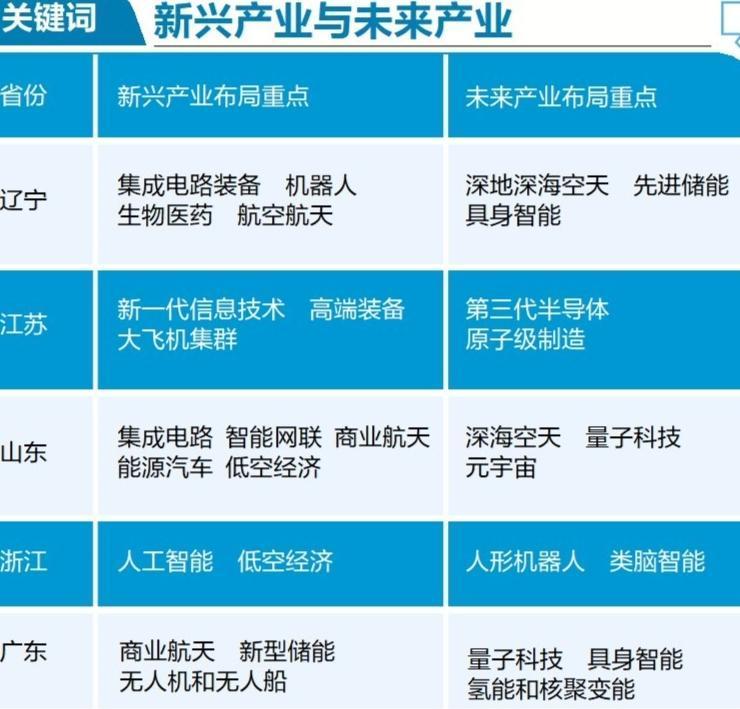
Group 1: Emerging and Future Industries - Various provinces are focusing on emerging and future industries, with specific emphasis on sectors like integrated circuits, robotics, and advanced energy storage [1][6] - Jiangsu aims to deepen integration into the Yangtze River Delta's aircraft manufacturing cluster and emphasizes atomic-level manufacturing [6] - Provinces like Shandong and Guangdong are prioritizing sectors such as quantum technology and hydrogen energy, indicating a trend towards high-tech and sustainable industries [1][7] Group 2: Digital Development - Provinces are actively developing digital infrastructure, with Liaoning focusing on data annotation industries and integrating AI into traditional industries [2][9] - Beijing aims to become a global benchmark city for digital economy, emphasizing core technologies like high-end chips and software [2][9] - Guangdong is enhancing its data trading platforms to foster industrial clusters, showcasing a strong market-driven approach [2][9] Group 3: Marine Economy - Coastal provinces are shifting their focus to marine economies, with Guangdong and Shandong aiming to create comprehensive marine industry ecosystems [8][19] - Liaoning and Jiangsu are leveraging their industrial bases to upgrade traditional marine industries towards high-end and green solutions [8][19] - The emphasis on marine economic development reflects a strategic pivot towards utilizing ocean resources for economic growth [8][19] Group 4: Consumption and Economic Growth - Guangdong is promoting the establishment of international consumption centers, aiming to enhance service industry standards and consumer environments [10][11] - Provinces like Beijing and Jiangsu are emphasizing high-energy consumption innovations, focusing on cultural and tourism integration to stimulate local economies [11][15] - The strategies aim to release local market potential and enhance consumer confidence through improved infrastructure and services [11][15] Group 5: Strategic Technology and Talent Development - Provinces are prioritizing the establishment of national laboratories and major scientific facilities to strengthen strategic technological capabilities [12][14] - There is a focus on integrating education, technology, and talent development to foster innovation and address regional needs [13][14] - Collaborative efforts across provinces aim to enhance the overall effectiveness and resilience of the national innovation system [12][14]
星网锐捷拟公开挂牌出售德明通讯65%股权 后者业务高度依赖美国市场
Zheng Quan Shi Bao Wang· 2026-01-04 12:29
1月4日晚,星网锐捷(002396)发布公告,拟通过公开挂牌方式转让其持有的德明通讯(上海)股份有限 公司(以下简称"德明通讯")65%股权,交易完成后公司将不再持有德明通讯股权,后者也将退出合并报 表范围。 回溯股权渊源,星网锐捷与德明通讯的合作始于2015年。当年公司通过发行股份及支付现金的方式,以 3.22亿元的总价收购德明通讯65%股权,完成过户后德明通讯成为其控股子公司。彼时收购的核心目 的,是借助德明通讯在4G LTE市场的技术优势与客户资源,快速切入移动互联网产业链,补强公司在 无线通信领域的布局。 公告披露的财务数据显示,德明通讯近年经营保持稳定态势。2024年全年实现营业收入13.81亿元,净 利润6332万元;2025年前7个月,其营收与净利润分别达到8.84亿元和4739万元。作为一家专注于无线 通信与物联网解决方案的企业,德明通讯自成立起便确立国际化战略,业务主要面向美国等海外市场, 客户群体集中于海外地区。企查查信息显示,德明通讯成立于2003年,曾用名德明通讯(上海)有限责任 公司,注册资本1亿元,经营范围涵盖通讯及电子产品开发设计、计算机软件销售等,同时涉及货物与 技术进出口业务 ...

融资难?酒店RWA模式:不抵押、不稀释股权!3个月收回5年成本!
Sou Hu Cai Jing· 2026-01-04 09:40
Core Insights - The hotel RWA (Real World Assets) model represents an innovative approach that combines blockchain technology with the digital economy, allowing hotel assets to be tokenized and traded as security tokens, thus facilitating digitalization, liquidity, and global asset allocation [1][3]. Group 1: Core Logic of Hotel RWA Model - Traditional hotels are capital-intensive, with core assets including property rights, facilities, brand value, and stable cash flows from various revenue streams [3]. - The RWA model enables the tokenization of these assets, allowing investors to indirectly hold shares in hotel assets through the purchase of standardized digital tokens, which entitle them to profit-sharing and potential capital gains [3][5]. Group 2: New Opportunities for Traditional Hotel Transformation - The RWA model addresses several pain points in the traditional hotel industry, such as high capital investment, limited financing channels, poor asset liquidity, and weak digital capabilities [5]. - It facilitates a shift towards asset-light operations by allowing hotels to tokenize part of their assets, thereby releasing liquidity and reducing capital requirements [6]. - The model promotes digital upgrades through blockchain's smart contract capabilities, enhancing operational efficiency and cost reduction [6]. - Token trading on blockchain networks allows hotels to reach a global customer base, attracting small investors and high-net-worth individuals [6]. Group 3: New Entrepreneurial Opportunities - The implementation of the hotel RWA model creates new business avenues for entrepreneurs, including RWA technology service providers that offer asset tokenization solutions [8]. - Vertical platforms focusing on hotel asset tokenization and trading can emerge, providing more flexibility than traditional real estate investment trusts (REITs) [10]. - Innovative product offerings such as fractional ownership and time-sharing rights can be developed, allowing tourists to invest in hotel revenue streams [10]. - Compliance and consulting services are needed due to the regulatory aspects of RWA, creating demand for professionals with expertise in law, finance, and blockchain [10]. Group 4: New Financing Channels - The RWA model opens up low-cost, efficient, and widely accessible financing channels for traditional hotels [13]. - Tokenization lowers financing thresholds by allowing large assets to be divided into smaller shares, attracting a broader range of investors [13]. - The model shortens financing cycles through automated processes, significantly reducing time costs compared to traditional methods [13]. - Global fundraising is facilitated by the open nature of blockchain networks, enabling hotels to attract investors from around the world [13]. - The dynamic valuation and liquidity of tokens allow real-time reflection of hotel asset values, addressing traditional real estate valuation and liquidity challenges [13]. Conclusion - The hotel RWA model represents a dual innovation of asset financialization and digitalization, revitalizing traditional hotel operations and enhancing financing flexibility [18]. - It serves as a critical lever for traditional hotels transitioning from heavy asset operations to a model that combines light assets with capital operations [18]. - For entrepreneurs, it presents a new avenue for integrating digital economy with traditional industries [18]. - For investors, it offers a new tool for participating in the growth of the hotel industry [18].
知名歌手邓紫棋写20万字长篇科幻小说,入围“中国科幻最高奖”银河奖!298元版销量超20万册,方文山、何炅、韩寒等写推荐语
Mei Ri Jing Ji Xin Wen· 2026-01-03 16:13
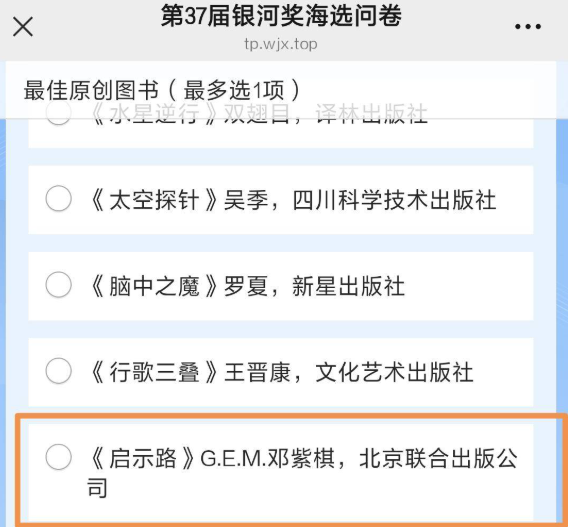
Core Viewpoint - The 37th Galaxy Awards have announced the voting list, featuring G.E.M. Tang's science fiction novel "The Road to Revelation," which is nominated for the Best Original Book category [1]. Group 1: Awards and Recognition - The Galaxy Awards, established in 1985, are the oldest and most influential science fiction awards in China, often referred to as the "highest award in Chinese science fiction" [1]. - The awards are divided into two main categories: "Essay Awards" and "Industry Awards," with the "Essay Awards" following a traditional selection process [1]. Group 2: Author's Background and Novel Details - G.E.M. Tang expressed that publishing "The Road to Revelation" fulfills her childhood dream of becoming a writer [3]. - The novel is her first long-form science fiction work, featuring a three-world structure that explores themes of identity, love, and the impact of technology on human life [11]. - The book is available in two editions: a paperback priced at 89 yuan and a deluxe edition at 298 yuan, with pre-sales of the deluxe edition exceeding 200,000 copies [11]. Group 3: Critical Reception - Notable figures in the science fiction community have commented on Tang's transition from music to writing, highlighting her previous works that incorporated science fiction narratives [13]. - Critics have praised "The Road to Revelation" for its depth and emotional resonance, noting that it explores complex themes of love and self-awareness within a science fiction context [14].