
大模型

Search documents
云从科技20260223
2026-02-24 14:16
Summary of CloudWalk Technology Conference Call Company Overview - **Company**: CloudWalk Technology - **Industry**: AI and Intelligent Solutions Core Points and Arguments - **Strategic Transformation**: CloudWalk is transitioning from a tool-based company to a comprehensive solution provider, focusing on AI infrastructure and AI agents to drive customer growth [2][3] - **Dual-Driven Strategy**: The company implements a "dual-driven" strategy combining AI infrastructure and AI agents, alongside a "dual-line" development approach targeting serious industries and emerging markets [2][3] - **Technological Advancements**: Emphasis on multi-modal technology, particularly in visual models, to meet industry demands for real-time data and real-world applications [2][3] - **Intelligent Platforms**: Development of specialized platforms like Aging and Coding, structured into three layers: technology platform, business product platform, and growth/commercialization platform [2][6] - **Revenue Model Shift**: Transitioning from project-based to customized services with long-term operational contracts, enhancing revenue diversification and profitability [2][9] - **Cash Flow Stability**: Focus on reducing TOP and TOG business scales and large-scale integration projects to ensure stable cash flow [2][10] - **Customer Retention**: Over 50% repurchase rate from single clients in banking, public security, and government sectors, with long-term service contracts enhancing customer loyalty [3][18] Future Plans - **Infrastructure Development**: Plans to enhance infrastructure with national models and training grounds, aiming for broader commercialization in verticals like finance and governance from 2026 to 2028 [4][11] - **Market Expansion**: Intent to increase international market presence through high-margin, replicable delivery models, expecting significant revenue growth starting in late 2026 [12][16] - **Focus on Software Industry**: Anticipation of a software explosion period due to clearer commercialization paths and improved technical readiness [5][16] Challenges and Responses - **To B Sector Challenges**: High investment and customization demands, along with long delivery cycles, are addressed by standardizing and reusing project components to reduce costs and improve efficiency [10][13] - **Competitive Advantages**: CloudWalk holds a leading position in visual technology and has unique strengths in data understanding and real-time processing, enhancing its competitive edge [14][15] Market Outlook - **AI Industry Potential**: The software industry is expected to see significant growth, with CloudWalk positioned to leverage its technological advancements and market strategies for future success [5][12] - **Valuation Trends**: High valuations of native AI companies in the Hong Kong market reflect strong investor interest, indicating potential for CloudWalk to achieve higher valuations as it continues to innovate [18] Conclusion - **Growth Expectations**: CloudWalk anticipates double-digit revenue growth in 2026, with a projected growth rate between 20% and 40%, aiming for profitability in the near future [15][19]

人形机器人量产拐点与产业链机遇
2026-02-24 14:16
Summary of Key Points from the Conference Call Industry Overview - The humanoid robot industry in China is represented by companies such as Fengyuan Power, Yushu Technology, Magic Atom, and Galaxy General, showcasing diverse development directions including affordability, hardware-software integration, autonomy, and commercial applications [1][3]. Core Insights and Arguments - The overseas market has highly praised Chinese humanoid robots for their motion control algorithms, hardware explosiveness, and automatic recovery capabilities, particularly recognizing Yushu Technology's advanced technology [1][4]. - Yushu Technology plans to focus on guiding and relatively fixed industrial scenarios in 2026, expecting a shipment volume of 10,000 to 20,000 units, with sufficient production capacity, although smart models remain a technical bottleneck that may take around three years to overcome [1][5]. - Wang Xingxing emphasizes avoiding homogenization, focusing on smart models, and the integration of hardware and software, believing that the current excitement around humanoid robots has not yet reached the potential post-large model maturity [1][7]. - The performance of humanoid robots during the Spring Festival Gala exceeded expectations, likely boosting short-term shipment volumes, but long-term investments should focus on large models and application scenarios, with companies possessing scene and intelligence capabilities being more valuable [1][9]. Additional Important Insights - The Spring Festival Gala featured six performances showcasing humanoid robots, with four companies participating, each demonstrating unique strengths: Fengyuan Power with cost-effective basic movements, Yushu Technology with advanced control capabilities, Magic Atom with domestically produced components, and Galaxy General with potential commercial applications [3]. - The industry is currently waiting for new models or improvements to existing models, with a focus on commercializing humanoid robots for greater breakthroughs [1][8]. - Tesla plans to launch its third-generation humanoid robot, V3, in 2026, which is expected to become a bestseller, suggesting attention to related companies in the supply chain such as Top, Sanhua, Xinjianshi Wuzhou Xinchun, Hengli Hydraulic, and Zhenyu Technology [2][10]. - In vertical fields, companies may introduce smaller models that do not require extensive data and scenarios, with strong competitiveness in areas like sewing (Jack Technology), packaging (Yongchuang Intelligent), material handling (Anhui Heli and Hangcha Group), and automotive production (UBTECH) [11]. - Overall, the Spring Festival has raised expectations for humanoid robots both technically and in market attention, presenting investment opportunities, but the primary investment focus remains on brain models, including the Tesla supply chain and vertical industry chains [1][12].


电子行业开年观点汇报
2026-02-24 14:16
Summary of Key Points from Conference Call Records Industry Overview - The conference call primarily discusses the **electronic industry** and the **AI computing sector** in China, highlighting the transition from hardware-driven to model and application-driven computing capabilities [1][2]. Core Insights and Arguments - **Domestic Computing Shift**: Major internet companies like ByteDance are increasing investments in self-developed AI chips, with plans to mass-produce AI inference chips, potentially capturing significant market share. Companies like Xinyuan Co. are expected to benefit from the unexpected demand for large models [1][2]. - **AI Demand Surge**: The overseas AI landscape is dominated by OpenAI, which has integrated digital employees into workflows, significantly increasing the demand for inference computing power. This trend is beneficial for domestic model companies like Minimax and Zhiyu GLM, leading to exponential growth in API call volumes [1][5]. - **Supercomputing Development**: Various internet companies and GPU manufacturers are focusing on developing domestic supercomputing solutions. The switch chip segment is highlighted as a key beneficiary, with companies like Shengke Communication being recommended for investment [1][6]. - **New Market Variables**: In Q1 and Q2 of 2026, the demand for high-density fiber connectors and high-power continuous laser chips is expected to be a core variable for the valuation reassessment of A-share segments. The exposure of NVIDIA's next-generation AI chips will guide GPU development [1][7]. - **NVIDIA's Impact**: NVIDIA's flagship product, the 120.4T switch, is anticipated to drive growth in high-end PCB and core component suppliers, with companies like Shenghong and Shenyin expected to benefit from this trend [1][8]. Additional Important Insights - **Storage Chip Market**: The storage chip industry is entering a seller's market, with prices expected to rise throughout 2026. DRAM and NAND supply-demand gaps are widening, with significant increases in contract prices forecasted [3][11]. - **Opportunities for Domestic Storage Manufacturers**: Domestic manufacturers are poised to gain market share as major companies like Apple expand their supplier base to include Chinese firms, optimizing supply chains and reducing costs [3][12]. - **Consumer Electronics Trends**: The consumer electronics sector is expected to see significant changes driven by end-to-end model shifts, with potential breakthroughs in the single-client model and the emergence of new products from both domestic and overseas manufacturers [3][14][20]. - **Investment Opportunities**: The conference emphasizes the importance of monitoring developments in AI hardware, supercomputing solutions, and the evolving landscape of consumer electronics, suggesting that these areas will present substantial investment opportunities in the near future [1][19][20].
春节AI综述-大模型-CPO与光纤光缆
2026-02-24 14:15
Summary of Key Points from Conference Call Industry Overview - The conference call primarily discusses the **AI**, **CPU**, and **optical fiber communication** industries, highlighting the performance of companies like **Lumentum**, **长飞 (Changfei)**, and **亨通 (Hengtong)** during the 2026 Spring Festival period [1][2]. Core Insights and Arguments - **AI and Agent Technology**: The application of Agent technology is driving demand for personal terminal devices, with significant updates from major players like **字节跳动 (ByteDance)** and **阿里巴巴 (Alibaba)**, as well as overseas models like **GPT-3.1** and **Cloud 4.6** [2]. - **CPU Market Performance**: Companies in the CPU sector, particularly **Lumentum**, have shown strong performance despite challenges in the market, with expectations for rationality as new product launches approach [2]. - **Optical Fiber Communication Growth**: Companies like **长飞** and **亨通** are benefiting from domestic infrastructure projects and global division of labor, with high-end product exports contributing to growth potential [1][2]. - **CPO Technology Impact**: CPO technology has a limited impact on power consumption reduction (2%-4%), and the stability of AI infrastructure is deemed crucial for large capital expenditure projects [7][8]. - **NPU Adoption**: The NPU (Network Processing Unit) solution is expected to gain traction, potentially increasing shipment volumes significantly by 2027 [9]. Emerging Trends - **Cabinet Market Dynamics**: The optical communication field is seeing a shift towards low-power, high-efficiency optical interconnection solutions, with CPU and NPU becoming mainstream choices [3]. - **Silicon Photonics Development**: Companies like **新易盛 (NewEase)** are advancing in silicon photonics, with the potential for large-scale production of core components [11][12]. - **Challenges in Silicon-Based Technology**: The industry faces challenges related to light emission, heat control, and signal modulation, necessitating collaboration across the supply chain [13]. Market Opportunities - The optical communication market is viewed as a growth opportunity for both established and emerging companies, with various regions (Mainland China, Taiwan, North America) having unique advantages [5]. - A-share companies in the optical communication sector are considered to have investment value, particularly in the context of an expanding market [6]. Additional Insights - **AI Application Penetration**: Currently, only about 0.01% of the population is paying for AI services, but this is expected to grow rapidly with advancements in model capabilities [16]. - **User Behavior Changes**: There is a notable shift in user behavior from app engagement to API interactions via agents, leading to increased uncertainty in software ecosystems [17]. - **Domestic Inference Computing Limitations**: Domestic inference computing is currently insufficient to meet the demand for agent overflow, highlighting a need for improved infrastructure [19]. - **Future AI Trends**: The proliferation of personal agents is anticipated to lead to exponential growth in token consumption and hardware demand, particularly for GPUs [20][21].
金现代(300830.SZ):轻骑兵低代码开发平台已经应用了DeepSeek等大模型
Ge Long Hui· 2026-02-24 13:03
Group 1 - The core viewpoint of the article is that Jin Modern (300830.SZ) has successfully applied its low-code development platform, Light Cavalry, to large models such as DeepSeek [1] - The company is actively monitoring the new features and release progress of DeepSeek V4 and other versions [1]

瑞芯微:公司RK3588、RK182X等多款芯片适合个人部署OpenClaw等AI Agent应用产品
Zheng Quan Ri Bao Wang· 2026-02-24 11:12
Core Viewpoint - The company, Rockchip (瑞芯微), is actively promoting its RK3588 and RK182X chips for personal deployment of AI Agent applications, indicating a strategic focus on enhancing user data privacy and low-latency responses [1] Group 1: Product Capabilities - The RK3588 chip is already being utilized in AI Agent application solutions that leverage cloud-based large models [1] - The RK182X co-processor offers high computing power and bandwidth, enabling various smart terminal devices to deploy large models locally [1] Group 2: Market Demand - The solutions provided by the RK182X are designed to meet user demands for data privacy, security, and efficient multi-tasking capabilities [1]

阿里云千问:第一
Xin Lang Cai Jing· 2026-02-24 11:05
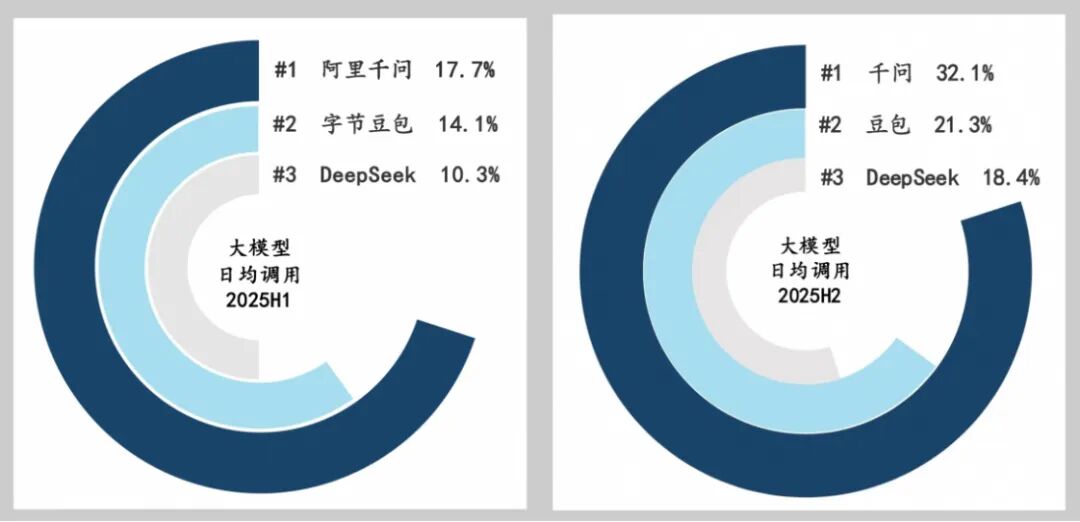
Core Insights - The report by Frost & Sullivan indicates that the daily usage of enterprise-level large models in China is expected to surge to 37 trillion tokens in the second half of 2025, a 263% increase from 10.2 trillion tokens in the first half of the year [1][10]. Group 1: Market Dynamics - The primary drivers for enterprises using large models shifted from enhancing product performance and customer experience in the first half of 2025 to improving operational efficiency and R&D effectiveness in the second half [4][14]. - The market for enterprise-level large models is rapidly concentrating among leading vendors, with the top three models in terms of daily token consumption being Qwen (32.1%), Doubao (21.3%), and DeepSeek (18.4%) in the second half of 2025 [5][15]. - The combined market share of these top three models increased from less than half in the first half of 2025 to over 70% in the second half, indicating a significant consolidation trend [5][15]. Group 2: Vendor Insights - Alibaba Cloud's Qwen model has seen the most significant growth, with a market share increase from 17.7% in the first half to 32.1% in the second half of 2025, reflecting a 14.4% growth rate [5][15]. - Companies are increasingly favoring fewer vendors to reduce long-term operational costs related to interface maintenance and version management, leading to higher migration barriers for top vendors with robust cloud infrastructure [5][15]. Group 3: Open Source Trends - There is a notable increase in enterprises' willingness to adopt open-source models, with the proportion of closed-source users planning to switch to open-source models doubling from 22.6% in the first half of 2025 to 48.5% in the second half [7][18]. - Chinese companies accounted for 90.2% of the global new open-source large models introduced in the second half of 2025, significantly outpacing international competitors [9][19]. - Since its launch in 2023, Qwen has released over 400 models, achieving over 1 billion downloads and extending its language support to 201 languages, establishing itself as the leading open-source model globally [10][20].

马上"红" | 谈股论金
水皮More· 2026-02-24 09:41
Market Overview - A-shares experienced a positive start to the year, with the Shanghai Composite Index rising by 0.87% to close at 4117.41 points, the Shenzhen Component Index increasing by 1.36% to 14291.57 points, and the ChiNext Index up by 0.99% to 3308.26 points [2][3] - The total trading volume across the Shanghai, Shenzhen, and Beijing markets reached 22.184 billion, an increase of 2.193 billion compared to the previous trading day [2][3] Market Sentiment - Despite the overall gains, the market showed a high open followed by a decline, with the K-line patterns indicating a bearish sentiment [3] - The increase in the indices was seen as a mere compensation for previous losses rather than a reward, as the gains did not recover the significant drop experienced before the holiday [3] Sector Performance - The oil service engineering sector led the market with a substantial increase of 12%, followed by the oil and gas development sector with a 7.53% rise, and precious metals with a 7.01% increase [4] - The "Big Three Oil" companies significantly contributed to the index's rise, accounting for approximately 13.50 points of the Shanghai Composite Index's total increase of 35.34 points, indicating their dominant influence on market performance [4] Capital Flow - The market saw a net inflow of 4 billion in the Shanghai market, while the Shenzhen market experienced a net outflow of approximately 7 billion [3] Technology Sector Trends - The previously high-profile sectors of robotics and AI applications faced declines, attributed to profit-taking after prior gains, leading to a weak performance in related fields such as film, digital media, software development, and gaming [5] - The ChiNext Index fell by 0.61%, reflecting a broader trend of capital withdrawal from technology stocks [5] Hong Kong Market Dynamics - The Hong Kong market exhibited a stark contrast, with the Hang Seng Index dropping by 1.8% and the Hang Seng Tech Index declining over 2%, influenced by short-term capital movements targeting southern funds [5] - The volatility in the Hong Kong market is partly a reflection of the U.S. market's fluctuations, particularly in technology stocks, which have faced significant pressure [5] Geopolitical Influences - Geopolitical factors, particularly the U.S. pressure on Iran, have impacted global precious metals and oil prices, with gold prices rising to 5200 as a safe-haven asset [6] - The recent U.S. Supreme Court decision to reject Trump's tariff proposal is seen as a positive development for future U.S.-China trade negotiations, potentially easing trade tensions [6]

无界动力完成数亿元天使+轮融资 红杉、线性、高瓴等老股东持续追投
Zhong Guo Jing Ying Bao· 2026-02-24 09:23
Core Insights - The article highlights the significant advancements in the field of embodied intelligence and robotics, particularly through the company Wujie Power, which has recently secured over 200 million yuan in angel financing to accelerate the development of its general-purpose robotic brain and hardware [1][2]. Group 1: Company Overview - Wujie Power, founded in 2025 in Beijing, focuses on the core technology research and industrial application of general embodied intelligent robots, aiming to create a "general brain" for robots and overcome key bottlenecks in hand-eye-brain coordination [2]. - The company has made substantial progress in technology research and commercialization within just six months of team formation, establishing long-term technological barriers through innovation in key technologies of embodied intelligence [2]. Group 2: Financial Developments - Wujie Power announced the completion of over 200 million yuan in angel financing, with continued investment from existing shareholders and new investors, bringing the total financing amount to 800 million yuan as the third round approaches completion [1]. - The funds raised will be utilized to accelerate the research and development of the robotic general brain and hardware, facilitating large-scale deployment of products in domestic and international customer scenarios [1]. Group 3: Technological Advancements - The company has developed an end-to-end multimodal large model that incorporates an implicit world model, enhancing the robot's capabilities in 3D perception, historical memory modeling, future environment prediction, and fine motor action generation [2][3]. - Wujie Power's hardware platform has undergone multiple iterations, focusing on compact design, rapid energy replenishment, and safety features, achieving over 1100 TOPS in computing power for efficient reasoning and operation of large models [3]. Group 4: Market Position and Collaborations - Wujie Power's robots have entered international industrial production lines, marking a new phase of mass delivery, and the company is collaborating with top global enterprises, including ZF LIFETEC, to refine the capabilities of the "general operational brain" in high-value sectors [4]. - The company aims to set new standards and paradigms for the large-scale application of embodied intelligence technology in various core scenarios through deep collaboration in real-world settings [4].
A股马年“开门红”:沪指重返4100点,资源品补涨科技分化
Bei Ke Cai Jing· 2026-02-24 08:41
Core Viewpoint - The A-share market experienced a strong opening on the first trading day after the Lunar New Year, with major indices showing positive performance, particularly in resource and hard technology sectors [1][2][4]. Market Performance - On February 24, the Shanghai Composite Index rose by 0.87% to 4117.41 points, while the Shenzhen Component increased by over 1% and the ChiNext Index gained 0.99%. The total market turnover exceeded 2 trillion yuan, with over 4000 stocks rising and 111 stocks hitting the daily limit [1][2][3]. - The market saw a strong performance in defensive sectors, with resource stocks experiencing a rebound. Key sectors such as energy equipment, oil and gas, and precious metals led the gains [1][3][4]. Sector Analysis - The hard technology sector also showed significant strength, particularly in optical modules (CPO) and optical communication concepts, which saw notable increases. In contrast, several large model concepts, including AI applications and the film and media sector, experienced declines [1][4]. - The human-robot concept stocks opened high, reflecting investor interest in this emerging technology [2][3]. Analyst Insights - Analysts suggest that the market's overall performance is promising, with resource stocks providing substantial support to the indices. The Shenzhen Component rose by 1.36%, indicating active growth in certain sectors [4]. - Geopolitical risks and uncertainties in global trade policies are seen as short-term disturbances, but they do not alter the mid-term trends. The expectation of a stronger renminbi and upcoming policy influences from the "Two Sessions" are expected to support the market [6][7]. Investment Strategies - Analysts recommend focusing on structural opportunities rather than broad index movements. Key investment themes include sectors benefiting from improved supply-demand dynamics and industry profit recovery, such as non-ferrous metals, basic chemicals, and construction materials [7][8]. - The robot sector is highlighted as having dual support from policy expectations and capital inflows, with a strong performance anticipated due to ongoing demand for new productive forces and smart manufacturing [8].