
太空算力

Search documents
国泰海通:商业航天快速发展 太空光伏将充分受益
Zhi Tong Cai Jing· 2026-01-26 06:47
Core Insights - Solar energy is identified as the only reliable energy source in commercial space, with its intensity being 5-10 times greater than terrestrial photovoltaic systems, leading to significantly higher power generation [1] - Domestic manufacturers are expected to play a crucial role in energy supply for space data centers due to their cost and technological advantages in silicon and perovskite technologies [1] Development Opportunities - Gallium arsenide is currently the mainstream technology for space energy, but the cost and efficiency of silicon and perovskite technologies are continuously improving, while gallium arsenide's cost-effectiveness has limited potential [2] - The demand for space data centers is projected to grow significantly, prompting companies to explore silicon and perovskite tandem solutions, with some silicon companies already successfully shipping products [2] Technological Pathways - Economic factors will be critical for the success of commercial scenarios like space data centers, with perovskite and silicon having favorable cost advantages [3] - According to Starcloud's white paper, energy costs represent the largest variable in the operational costs of space data centers, with silicon components showing significant advantages in manufacturing costs, while perovskite components can notably reduce launch costs due to their power-to-weight ratio [3] Market Outlook - Elon Musk's ambition to deploy 100GW of AI computing power in space annually could lead to an explosive growth in satellite demand [4] - If perovskite tandem cell efficiency reaches 30% and satellite solar wing areas are 350 square meters, achieving Musk's target of 100GW annual installations could result in a demand increase of 680,000 satellites per year, compared to the current global inventory of just over 10,000 satellites, indicating substantial market potential for space computing [4]

光伏设备行业深度报告:太空光伏深度报告:光伏向空,志在星海
KAIYUAN SECURITIES· 2026-01-26 05:43
Investment Rating - The investment rating for the photovoltaic equipment industry is optimistic (maintained) [1] Core Insights - The photovoltaic sector is entering a silicon era in space applications, driven by the need for cost reduction and efficiency improvement in photovoltaic technology [5][18] - Photovoltaic systems are the most reliable and sustainable power source for spacecraft, providing stable energy supply without the need for fuel resupply [18] - The transition to silicon-based photovoltaic technology in space is being accelerated by the high costs and limitations of III-V multi-junction solar cells, which are currently the most efficient but expensive [64][67] Summary by Sections 1. From Parallel to Convergence: Space Enters the Silicon Era - Photovoltaics are the most important energy supply for spacecraft, providing stable energy without atmospheric interference [18] - Cost reduction and efficiency improvement are the main drivers for the evolution of photovoltaic technology [19] - P-type HJT (Heterojunction Technology) cells show significant advantages in space applications due to their superior radiation resistance [6][69] - Silicon-perovskite tandem cells are expected to become the ultimate solution, breaking the efficiency-cost-radiation resistance triangle [6][68] 2. The Space Race Begins: Photovoltaics Open New Blue Oceans - Low Earth orbit communication satellites are driving the demand for large-scale satellite deployment [7] - The space computing market is expected to release significant potential, with a focus on reliable power supply rather than cost competition [7] 3. Pre-Volume Layout: Equipment Manufacturers Seize Opportunities - Key equipment manufacturers benefiting from the space photovoltaic technology include Maiwei, Jiejia Weichuang, Laplace, and others [8] 4. Competition Among Giants: Leading Manufacturers Tap into Blue Oceans - Major battery manufacturers deeply involved in space photovoltaic technology include Dongfang Risheng, Junda, Trina Solar, and JinkoSolar [8]





商业航天行业:太空光伏,逐日天穹,叩问千亿星辰市场
2026-01-26 02:49
Summary of the Conference Call on the Space Photovoltaics Industry Industry Overview - **Industry Focus**: Space Photovoltaics - **Key Players**: SpaceX, Amazon, Chinese satellite companies - **Market Potential**: Estimated to reach a trillion-dollar market Core Insights and Arguments 1. **Cost Reduction through Reusable Technology**: The advent of reusable rocket technology has significantly lowered launch costs, creating a golden opportunity for space photovoltaics. The successful exploration of reusable rockets by companies like SpaceX has led to a rapid decrease in launch costs, making commercial space activities more frequent [5][23][24] 2. **US-China Competition in Commercial Space**: The competition between the US and China in commercial space is accelerating, particularly in low Earth orbit (LEO) communications satellites, which is expected to drive demand for solar wings. The US currently leads in LEO satellite deployment, with China planning to submit applications for 203,000 satellites to the International Telecommunication Union (ITU) by December 2025, aiming to secure valuable orbital resources [5][44][46] 3. **AI and Space Computing**: The concept of deploying AI data centers in space is gaining traction among tech giants. Space-based computing, or "computing in space," is seen as a solution to energy and space limitations. The cost of deploying a 40MW AI data center in space is estimated at $8.2 million, significantly lower than ground deployment costs [5][52][53] 4. **Technological Developments in Photovoltaics**: - **Gallium Arsenide (GaAs)** is currently the mainstream choice for space photovoltaics due to its excellent performance, though it is costly and has material sourcing limitations. - **Heterojunction (HJT)** technology is expected to be a significant choice for large-scale industrialization due to its efficiency and simpler manufacturing process. - **Perovskite technology** shows promise but lacks sufficient empirical data for large-scale application in the short term [5][64] 5. **Investment Recommendations**: The space photovoltaics sector is entering an active exploration phase, with equipment manufacturers poised to benefit. Key companies to watch include: - **HJT/Perovskite Equipment Suppliers**: Maiwei Co., Aotwei, and Jiejia Weichuang - **Comprehensive Photovoltaic Companies**: Jing Sheng Mechanical and Gao Ce Co. [5][5] Additional Important Content 1. **Risks**: Potential risks include slower-than-expected development of the commercial space industry, uncertainties in the technological pathways for space photovoltaics, and lower-than-expected investment and application demand for space computing [5][5] 2. **Market Dynamics**: The global satellite launch frequency has increased significantly since 2020, with projections indicating around 4,000 launches annually by 2025, marking a growth rate exceeding 50% [5][38] 3. **Future Projections**: The estimated demand for space photovoltaics from existing satellite plans could reach nearly 10GW in the near term, with significant growth expected as more satellites are deployed [5][46][62] 4. **Cost Comparisons**: The Levelized Cost of Energy (LCOE) for space photovoltaics is projected to decrease significantly due to reduced launch costs and advancements in technology, potentially reaching $0.04/kWh by 2050 [5][33][34] 5. **Global Competition**: The competition for orbital resources is intensifying, with the US and China leading the charge in satellite deployments, highlighting the strategic importance of space resources [5][42][43] This summary encapsulates the key points discussed in the conference call regarding the space photovoltaics industry, emphasizing the technological advancements, market dynamics, and investment opportunities within this rapidly evolving sector.


太空光伏-万亿蓝海市场-产业趋势明确
2026-01-26 02:49
Summary of Key Points from Conference Call Industry Overview - The conference call discusses the space photovoltaic industry, highlighting the rapid growth and development of low Earth orbit (LEO) satellite technology and its implications for the market [1][2][3]. Core Insights and Arguments - **Starlink's Growth**: Starlink has launched over 7,000 LEO satellites, leading to rapid revenue growth and the initiation of direct terminal connections [1][2]. - **China's Satellite Plans**: By the end of 2025, China plans to submit over 200,000 satellites to the International Telecommunication Union, indicating a significant increase in satellite deployment [2]. - **Global Launch Projections**: It is estimated that from 2030 to 2035, global LEO satellite launches will peak at over 18,000, potentially exceeding 20,000 when considering other constellations [1][3]. - **Space Data Centers**: The development of space data centers is driven by advantages such as solar energy utilization, passive radiation cooling, and modular deployment, which lower operational costs [3]. - **Future Data Center Plans**: Elon Musk plans to establish 100GW of data centers annually over the next 4-5 years, with significant contributions from companies like NVIDIA, Google, and Amazon [1][3]. Technological Developments - **Current Technology Trends**: The leading technology is the multi-junction solar cell, which is efficient but costly. The market for this technology is approximately 3 billion RMB [4]. - **Emerging Technologies**: The silicon technology route is expected to gain market share due to cost advantages, while perovskite technology may become the ultimate solution due to its lower production costs and higher efficiency [5]. - **Flexible Solar Wings**: The demand for flexible solar wings is increasing due to the economic considerations of LEO satellites, which require lightweight and compact designs [6]. Supply Chain and Material Considerations - **Material Challenges**: The production of space-grade materials, such as PM films, requires attention to atomic oxygen erosion, necessitating protective layers [7]. - **Supplier Landscape**: Key suppliers for CPI films are from South Korea and Japan, while domestic companies in China are still developing their capabilities [8]. - **Silver Paste Issues**: Silver paste used in solar arrays faces challenges from atomic oxygen erosion, requiring corrosion-resistant treatments [9]. Market Expectations - **Future Market Size**: In an optimistic scenario, the demand for 100GW of space computing capacity is expected to be established within three years, with significant market potential in the battery segment valued at approximately 500 million to 600 million RMB per unit [14]. - **Impact of Perovskite Technology**: If perovskite becomes the dominant technology, it could create a market space of around 50 billion RMB, driving demand across the supply chain [14]. Industry Players and Strategic Moves - **Company Strategies**: Companies like Mingyang Electric and Junda Co. are making strategic moves into the multi-junction battery sector, while others focus on perovskite and heterojunction technologies [15]. - **SpaceX's IPO Impact**: SpaceX's planned IPO is expected to provide capital support for space photovoltaic construction, benefiting equipment manufacturers and domestic suppliers [16]. Conclusion - The space photovoltaic industry is poised for significant growth driven by advancements in satellite technology, emerging materials, and strategic corporate investments, with a strong emphasis on cost reduction and efficiency improvements across the supply chain.
中信建投:卫星通信有望加速发展 未来还将产生太空算力等广阔市场
智通财经网· 2026-01-26 02:32
Group 1 - The core driving force for the development of the satellite communication industry is the upgrade of satellite communication technology, which addresses issues of latency, bandwidth, and stability through innovations such as lower orbital heights, phased array antennas, and laser media applications [1][2] - The global satellite communication market is expected to grow from $25.2 billion in 2025 to $83 billion by 2035, with a compound annual growth rate (CAGR) of approximately 13% [1][2] - The rise of the commercial space industry is generating incremental demand for satellite communication, with applications expanding from traditional broadcasting and maritime communication to remote internet access, IoT, emergency rescue, and defense sectors [2][3] Group 2 - The satellite communication industry chain includes upstream chips and components, midstream communication modules, and downstream satellite communication terminals, with leading companies actively exploring new technologies and products [1][3] - The successful deployment of satellite constellations, such as SpaceX's Starlink, which has over 9,300 satellites in orbit and more than 9 million paying users, is significantly enhancing market penetration and driving growth [2][3] - Domestic players are submitting plans for over 200,000 satellites to the ITU, with the capacity for annual launches expected to reach 10,000, further propelling market growth [2][3]

马斯克谈太空算力,硅谷却狂投天然气?真相:所有未来都离不开 “稳定电”
Jin Rong Jie· 2026-01-26 01:55
当马斯克在公开场合描绘太空算力重构人类文明的蓝图时,美国风险基金与科技公司的投资委员会里, 一场关于燃气轮机项目的回报率论证正在密集展开。他们的目光,牢牢锁定在天然气管道阀门上——这 不是对未来想象的背叛,而是对"数字世界根基"的集体清醒:所有关于未来的想象,都必须建立在"稳 定且便宜的电力"这一最古老物理定律之上。 能源是数字世界的"地基":没有电,就没有未来 历史反复证明,文明的演进从来都是"能源先行":从柴薪到煤炭,从石油到天然气,每一次能源转型的 核心动力,都不是理想的"环保选择",而是物理规律与经济逻辑的必然结果。廉价、可靠、可扩展的能 源,始终是社会经济增长、稳定与国家实力的支柱。一旦能源供应变得昂贵或脆弱,通胀高企、产业外 流、信任崩坏等社会动荡便会接踵而至。 能源的本质是"物理现实",它遵循热力学定律、化学原理与地质约束,从不会因为演讲、法规或愿望而 改变。长期忽视这些硬约束,现实会以"短缺、电价飙升、电网崩溃"的方式强制清算。就像得州寒潮 中,可再生能源的间歇性导致电网崩溃,而燃气发电的稳定输出成为最后的"救命稻草"——这恰恰印证 了能源的"地基"地位。 资本的"清醒选择":天然气是"过渡时 ...
“星算·智联”太空算力研讨会将召开;报道称三星电子将一季度NAND价格上调100%丨盘前情报
2 1 Shi Ji Jing Ji Bao Dao· 2026-01-26 01:01
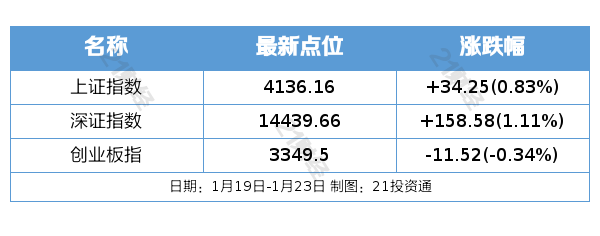
Market Performance - A-shares showed mixed performance in the past week, with the Shanghai Composite Index closing at 4136.16 points, up 0.83%, and the Shenzhen Component Index at 14439.66 points, up 1.11%. However, the ChiNext Index fell by 0.34% to 3349.50 points [1][2] - Over 77% of stocks experienced gains during the week, with 237 stocks rising over 15%, while only 14 stocks fell more than 15% [1] Sector Performance - The building materials, oil and petrochemicals, steel, and basic chemicals sectors saw increases, while the banking, telecommunications, non-bank financials, and food and beverage sectors experienced declines [1] International Market Overview - In the U.S. market, the Dow Jones Industrial Average fell by 285.30 points to 49098.71 points, a decrease of 0.58%. The S&P 500 rose slightly by 2.26 points to 6915.61 points, while the Nasdaq Composite increased by 65.22 points to 23501.244 points [3][4] - European markets showed mixed results, with the FTSE 100 down 0.07%, the CAC 40 down 0.07%, and the DAX up 0.18% [3][4] Commodity Prices - International oil prices rose, with WTI crude oil increasing by $1.71 to $61.07 per barrel, a rise of 2.88%, and Brent crude oil up by $1.82 to $65.88 per barrel, a rise of 2.84% [3][4] Industry Insights - The upcoming "Star Computing and Intelligent Connection" seminar aims to promote the integration of space information and intelligent computing, with a focus on developing a space computing infrastructure [5] - The global space economy is projected to reach $1.8 trillion by 2035, driven by the emergence of space infrastructure and applications [5] - Samsung Electronics plans to raise NAND flash memory prices by over 100% in Q1, indicating a significant supply-demand imbalance in the semiconductor market [7] - The Chinese securities market is expected to see a rise in demand for storage products due to AI-driven growth, with recommendations to focus on various segments of the storage industry [8] Investment Recommendations - Analysts suggest focusing on satellite internet and related sectors, including potential operators, communication equipment providers, and application service providers [5] - The semiconductor storage chain is viewed as having high certainty opportunities, with recommendations for companies involved in distribution, IC design, and domestic semiconductor supply chains [8]

北京鼓励对卫星遥感数据资源开发利用 万亿级太空算力新赛道开启(附概念股)
Zhi Tong Cai Jing· 2026-01-25 23:40
Group 1 - The recent policy measures from Beijing aim to promote the development and utilization of commercial satellite remote sensing data resources from 2026 to 2030, emphasizing the application of new information technologies like cloud computing, AI, and big data in satellite constellations [1] - The commercial space sector is transitioning from a "national strategic direction" to "actual commercial implementation," driven by technological breakthroughs and continuous policy support, which is accelerating the industry's growth [1] - In 2025, China's commercial space sector is expected to maintain rapid development, with 50 launches projected, accounting for 54% of the total annual space launches in the country [1] Group 2 - Core regions like Beijing are providing significant support for the commercial space sector, which is expected to drive industry growth and create new leading enterprises in the commercial space chain [2] - The number of satellite launches in China is anticipated to accelerate further by 2026, with private commercial rocket companies expected to play a crucial role in supplementing national efforts [2] - The commercial launch market is witnessing a shift towards large-capacity reusable rockets, with a comprehensive policy support system being established [2] Group 3 - The focus of investment in the space industry is shifting towards "space computing," with thousands of remote sensing satellites generating vast amounts of data that require new processing methods [3] - The introduction of AI capabilities for real-time data processing on satellites and the establishment of space cloud computing networks are expected to enhance the efficiency of satellite data utilization [3] - The space data center industry is moving towards commercialization, with significant potential for industry value creation projected to exceed tens of billions by 2027 [3] Group 4 - Shanghai Fudan is a leading supplier of programmable devices in China, with extensive applications in aerospace, particularly in FPGA technology [4] - Asia-Pacific Satellite, a subsidiary of China Satcom, is expected to achieve breakthroughs in satellite internet and remote sensing applications as the commercialization of space technology accelerates [5] - JunDa Co., Ltd. specializes in satellite batteries and has a strong background in energy system integration for spacecraft, indicating its potential in the commercial space sector [5] - CIMC Anrui focuses on core equipment for low-temperature and high-pressure storage and transportation, supporting rocket launches with its technology [5]
港股概念追踪 | 北京鼓励对卫星遥感数据资源开发利用 万亿级太空算力新赛道开启(附概念股)
智通财经网· 2026-01-25 23:38
智通财经APP获悉,近期商业航天催化消息不断。1月23日,北京市经济和信息化局等多部门联合印发 《北京市关于促进商业卫星遥感数据资源开发利用的若干措施(2026-2030年)》。其中提出,加强太空云 计算"、人工智能、大数据等新一代信息技术在卫星星座中的应用。此外,中国信息通信研究院将于1月 26日召开2026年"星算.智联"太空算力研讨会,发布"算力星网联合推进倡议。 浙商证券发布研报称,太空数据中心行业已从技术验证迈入以Starcloud-1、中国"三体计算星座"为代表 的商业化星座部署阶段。据测算,2027年一期算力星座建成后,可直接带动产业链产值超数十亿元,长 期看规模有望超万亿元。 作为市场中的热门板块,商业航天持续受到政策推动,板块热度居高不下。机构指出,商业航天正处于 从"国家战略方向"迈向"实际商业落地"的关键转折期,技术硬实力的突破和政策的持续落地形成合力, 为板块按下"加速键"。 2025年3月5日,商业航天再次被写入2025年《政府工作报告》,将商业航天定位为战略性新兴产业。北 京、上海、湖北、重庆、广东、海南等多地发布政策,加码推进商业航天发展。 国家航天局公布的数据显示,2025年, ...
机械行业动态分析:卫星规模化部署在即,太空光伏大有可为
Guotou Securities· 2026-01-25 13:02
Investment Rating - The industry investment rating is "Outperform the Market - A" [7] Core Insights - The large-scale deployment of low Earth orbit satellites is imminent, with a total of 203,000 new satellite applications submitted by Chinese institutions by December 2025, indicating accelerated demand for satellite construction and launch [1] - SpaceX plans to deploy a 100GW/year space data center within the next 4 to 5 years, utilizing thousands of satellites to create a space computing network, aiming for a 1000P level computing power deployment by 2027 [1] - Solar wings are identified as the core energy supply solution for space, with flexible solar wings offering significant advantages in terms of size reduction and efficiency [2] - The future direction of space photovoltaics is expected to focus on perovskite and heterojunction tandem cells, which promise high efficiency, lightweight, and low cost [3] Summary by Sections Industry Dynamics - The commercial space industry is accelerating, with a focus on 3D printing service providers, key structural components, and the space photovoltaic industry chain [6] - The global gas turbine capacity is tightening, with domestic supply chains seizing the AIDC prosperity dividend [6] Investment Recommendations - The report suggests focusing on the photovoltaic equipment industry chain, including companies such as Maiwei Co., Aotewi, High Measurement Co., Jiejia Weichuang, Jing Sheng Machinery, Shuangliang Energy, and Dier Laser for equipment, and Jun Da Co. and Dongfang Risen for batteries and components [4]