
智能网联汽车

Search documents
工信部许可两款L3级自动驾驶车型产品
证券时报· 2025-12-15 13:33
记者12月15日从工业和信息化部获悉,根据有关规定,经受理、审查、公示等程序,工业和信息化部附条 件许可了两家汽车企业提交的搭载L3级有条件自动驾驶功能的智能网联汽车产品准入申请。 点击关键字可查看 据悉,两款产品分别是长安牌SC7000AAARBEV型纯电动轿车,可以实现在交通拥堵环境下高速公路和 城市快速路单车道内的自动驾驶功能,目前该功能仅限在重庆市内环快速路、新内环快速路(高滩岩立交 —赖家桥立交)及渝都大道(人和立交—机场立交)等路段开启;极狐牌BJ7001A61NBEV型纯电动轿 车,可以实现高速公路和城市快速路单车道内的自动驾驶功能,目前该功能仅限在北京市京台高速(大兴 区旧宫新桥—机场北线高速)、机场北线高速(大渠南桥—大兴机场高速)及大兴机场高速(南六环—机 场北线高速)等路段开启。 前期, 工业和信息化部 会同有关部门按照《关于开展智能网联汽车准入和上路通行试点工作的通知》要 求,研究制定工作方案,编制指引文件,组织专家团队,严格按规范、按流程开展初审、择优、测试与安 全评估工作。两家汽车企业已按要求完成并通过了产品测试与安全评估。 下一步,两款车型将由重庆长安车联科技有限公司、北京出行汽 ...


L3来了!深蓝、极狐首批入围 自动驾驶加速迈向“量产应用”
Feng Huang Wang· 2025-12-15 13:24
Core Viewpoint - The approval of two L3-level autonomous driving vehicle models by the Ministry of Industry and Information Technology (MIIT) marks a significant step towards the commercialization of L3 autonomous driving in China [1][3]. Group 1: Approval and Significance - The MIIT granted conditional approval for two L3-level autonomous driving vehicles from Changan Automobile and BAIC Blue Valley Magna, indicating a shift from technology validation to mass production application in the autonomous driving industry [1][4]. - The approved models are the Changan SC7000AAARBEV and the BAIC Alpha S6, which are both pure electric vehicles [1]. Group 2: Technical Capabilities and Testing - Changan Automobile's L3-level autonomous driving system can operate in traffic congestion on highways and urban expressways within a single lane, leveraging its self-developed "Tianshu Intelligent" technology [2]. - Extensive testing has been conducted, including over 500,000 kilometers of road testing, with a focus on safety and compliance with traffic regulations [2]. Group 3: Industry Context and Future Outlook - The approval process for L3 commercial vehicles has been ongoing for over a year, with a pilot program initiated in June of the previous year involving multiple automotive companies [3]. - Industry experts anticipate that more models will receive approval as standards and policies continue to evolve, with a significant increase in demand for intelligent mobility expected by 2025 [4].


中美同步推进,高阶智能驾驶进入政策落地期
Haitong Securities International· 2025-12-15 12:51
Investment Rating - The report does not explicitly state an investment rating for the automotive industry or specific companies within it. Core Insights - The report highlights significant regulatory advancements in both China and the U.S. regarding Level 3 (L3) and Level 4 (L4) autonomous driving, indicating a shift towards commercialization and practical implementation of advanced intelligent driving technologies [1][7][10]. Summary by Sections China - The Ministry of Industry and Information Technology (MIIT) has granted conditional market access to China's first batch of L3 autonomous driving vehicles, marking a regulatory breakthrough and transitioning the sector from testing to compliant mass production [2][8]. - Approved models include the Changan Deepal SL03 and ARCFOX Alpha S, which can only activate L3 functions in designated areas, reflecting a cautious regulatory approach [2][9]. - The management framework for L3 vehicles includes "product access + operating entity + designated operating area," providing a clear template for future OEMs [2][9]. - The report anticipates that by 2026, L3 functionality could expand significantly in China, driven by accumulated pilot experience and regulatory improvements [2][9]. United States - Tesla has achieved a milestone with its Model Y Robotaxi operating fully driverless on public roads in Austin, Texas, utilizing Unsupervised FSD software, which confirms the feasibility of its autonomous technology in real-world environments [3][10]. - The U.S. is pursuing L4/Robotaxi commercialization despite an incomplete legal framework, while China is focusing on regulatory compliance for L3 vehicles, indicating parallel but distinct paths towards the same goal [3][11]. - The advancements in both countries are accelerating the transition of autonomous driving from an engineering challenge to a commercial opportunity, with significant implications for vehicle valuation and competitive dynamics [3][11].

北京、重庆试点!两款L3级自动驾驶车型产品获准上路
Zhong Guo Zheng Quan Bao· 2025-12-15 12:43
下一步,两款车型将由重庆长安车联科技有限公司、北京出行汽车服务有限公司两家使用主体在上述区 域内开展上路通行试点。 业内人士表示,这意味着业内此前呼吁有条件批准L3级车型的生产准入,迎来了实质性的落地和突 破,标志着我国L3级自动驾驶正式从测试阶段迈出商业化应用的关键一步。 一是长安牌SC7000AAARBEV型纯电动轿车,可以实现在交通拥堵环境下高速公路和城市快速路单车 道内的自动驾驶功能(最高车速50km/h),目前该功能仅限在重庆市内环快速路、新内环快速路(高 滩岩立交—赖家桥立交)及渝都大道(人和立交—机场立交)等路段开启。 二是极狐牌BJ7001A61NBEV型纯电动轿车,可以实现高速公路和城市快速路单车道内的自动驾驶功能 (最高车速80km/h),目前该功能仅限在北京市京台高速(大兴区旧宫新桥—机场北线高速)、机场 北线高速(大渠南桥—大兴机场高速)及大兴机场高速(南六环—机场北线高速)等路段开启。 12月15日,工信部网站显示,近期,重庆长安汽车(000625)股份有限公司和北汽蓝谷(600733)麦格 纳汽车有限公司两家车企,提交了搭载L3级有条件自动驾驶功能的智能网联汽车产品准入申请,经受 ...
中国自动驾驶商业化迈出关键一步!长安深蓝和北汽蓝谷两款L3级车型首批获准上路
Ge Long Hui· 2025-12-15 12:24
Core Viewpoint - The Ministry of Industry and Information Technology of China has officially approved two models of smart connected vehicles equipped with L3 level conditional autonomous driving capabilities for road use, marking a significant step in the commercialization of intelligent connected vehicles in China [1] Group 1: Approval of Vehicles - The two approved models are the Changan SC7000AAARBEV electric sedan and the Arcfox BJ7001A61NBEV electric sedan, corresponding to the Deep Blue SL03 and Arcfox Alpha S series respectively [1] - The approval process followed the regulations outlined in the "Management Measures for the Access of Road Motor Vehicle Production Enterprises and Products," involving acceptance, review, and public announcement [1] Group 2: Pilot Operations - The next step involves pilot operations in designated areas by Chongqing Changan Car Networking Technology Co., Ltd. and Beijing Mobility Automobile Service Co., Ltd., indicating that ordinary consumers cannot directly purchase L3 level vehicles yet [1] - This pilot operation will be conducted by professional operating companies within specific regions [1] Group 3: Significance of the Approval - The approval is a milestone for both Changan Automobile and BAIC Blue Valley, representing an important node in the development of China's intelligent connected vehicle industry [1] - L3 level conditional autonomous driving is a critical transition phase from assisted driving to highly automated driving, where vehicles can perform all driving operations under certain conditions, requiring human drivers to take over when requested by the system [1] - The Ministry of Industry and Information Technology stated that this initiative aims to "promote the high-quality development of China's intelligent connected new energy vehicle industry" [1]
首批L3级自动驾驶车型获准入市 长安、极狐开启道路试点
Xin Hua Cai Jing· 2025-12-15 11:10
Core Viewpoint - The Ministry of Industry and Information Technology (MIIT) of China has approved the entry of two electric vehicles equipped with L3 conditional autonomous driving capabilities, marking a significant step towards the commercialization of L3 autonomous driving in the country [1][2]. Group 1: Vehicle Approvals - Chongqing Changan Automobile Co., Ltd. and BAIC BluePark Magna Automotive Co., Ltd. have submitted applications for L3 autonomous driving vehicles, which have been approved by MIIT [1]. - The approved vehicles include the Changan SC7000AAARBEV, which can operate autonomously in congested traffic at speeds up to 50 km/h, and the Arcfox BJ7001A61NBEV, which can operate at speeds up to 80 km/h on highways and urban expressways [2]. Group 2: Testing and Implementation - The vehicles will undergo road trials in designated areas of Beijing and Chongqing, with specific routes outlined for each model [1][2]. - The MIIT has conducted thorough preliminary reviews, testing, and safety assessments before granting approval for these vehicles to operate on public roads [2]. Group 3: Industry Outlook - The release of the "Automobile Industry Stabilization Growth Work Plan (2025-2026)" by MIIT and other departments has introduced L3 vehicle entry at the policy level, aiming to enhance road traffic safety and improve relevant legal frameworks [3]. - Analysts predict that 2026 will be a pivotal year for the large-scale implementation of high-level autonomous driving, with significant advancements in Robotaxi production and revenue growth expected [3][4]. - The demand for safety redundancies and new national standards for assisted driving are anticipated to increase the adoption of lidar technology and related components, benefiting companies in the autonomous driving hardware sector [4].
国内首获准入!长安、北汽极狐L3级自动驾驶汽车获批上路试点丨快讯
Hua Xia Shi Bao· 2025-12-15 10:52
Core Insights - The Ministry of Industry and Information Technology (MIIT) of China has granted approval for Chongqing Changan Automobile Co., Ltd. and BAIC Blue Valley Magna Automotive Co., Ltd. to deploy L3 level conditional autonomous driving vehicles, marking a significant milestone in the commercialization and regulatory management of high-level autonomous vehicles in China [2][3] Group 1: Approval Details - The approved vehicles have passed the rigorous review of MIIT's 401st batch of "Announcement of Road Motor Vehicle Production Enterprises and Products" and are permitted to operate under "conditional approval" in strictly defined geographical areas [2] - The Changan SC7000AAARBEV electric sedan can achieve autonomous driving in congested traffic environments at a maximum speed of 50 km/h, limited to specific routes in Chongqing [2] - The ARC BJ7001A61NBEV electric sedan can operate autonomously at a maximum speed of 80 km/h on designated highways and urban expressways in Beijing [3] Group 2: Future Operations - The next step involves transitioning these two approved smart connected vehicle products from testing to limited area commercial pilot operations, with Chongqing Changan Car Networking Technology Co., Ltd. and Beijing Travel Automotive Service Co., Ltd. designated as the operational entities [3] - These companies will manage the on-road pilot operations and user services in their respective designated areas [3] Group 3: Industry Impact - The approval of these L3 autonomous vehicles represents a key achievement in advancing China's smart connected vehicle industry policy from research and testing to product approval and large-scale application [3] - This development provides a clear pathway for leading automotive companies to transform cutting-edge technology into compliant products, significantly boosting industry innovation confidence [3] - It also establishes a preliminary framework for product technical standards, testing verification norms, and safety regulation models within the industry [3]
从大厂人到汽车人:一群跨界者的生存实录
第一财经· 2025-12-15 10:14
Core Insights - The article discusses the transformative impact of the new energy and intelligentization wave on the automotive industry, highlighting both opportunities and challenges faced by traditional and new car manufacturers [2][3]. Group 1: Industry Trends - The penetration rate of new energy vehicles in China has surpassed 50%, with technology and internet companies entering the market, leveraging their advantages in technology and traffic [3]. - The automotive industry is experiencing a significant shift, with traditional car manufacturers and internet companies expected to collaborate in the next decade [3]. Group 2: Workforce Dynamics - Professionals from traditional automotive companies are transitioning to internet firms, often experiencing salary increases of over 30% and more flexible working conditions [4]. - Internet companies are facing challenges in adapting to the automotive ecosystem, particularly in areas like sales and after-sales service, which require a different operational approach compared to consumer electronics [5][6]. Group 3: Technological Integration - The integration of ICT (Information and Communication Technology) into the automotive sector is increasing, with engineers focusing on enhancing vehicle connectivity and communication capabilities [8][9]. - The demand for high data flow in smart connected vehicles is leading to a significant increase in data consumption, which impacts product lifespan and reliability [9][10]. Group 4: Cross-Industry Collaboration - Cross-industry car manufacturers are prioritizing the recruitment of talent with experience in both traditional automotive and new energy sectors, as they are better equipped to navigate the fast-paced market [14]. - The success of new entrants in the automotive industry is heavily influenced by the vision and strategy of their leadership, with a focus on adaptability and rapid decision-making [13][15].

我国首批L3级自动驾驶车型获准入许可,长安、北汽各一款
Guan Cha Zhe Wang· 2025-12-15 09:33
| 中华人民共和国工业和信息化部 | | | | | | | --- | --- | --- | --- | --- | --- | | Ministry of Industry and Information Technology of the People's Republic of I 清输入关键字 | | | | | | | ਦ 首页 政务服务 | 组织机构 | 新闻发布 | 政务公开 | 互动交流 | 工信数据 | | 首页 > 工业和信息化部 > 机关司局 > 装备工业一司 > 汽车工业 | | | | | | | 我部许可两款L3级自动驾驶车型产品 | | | | | | | 发布时间:2025-12-15 15:03 来源:疑备工业-圆 | | | | | | | 近期,重庆长安汽车股份有限公司和北汽富谷基格纳汽车有限公司两家汽车企业向我部报交了搭载1.3级看条件自动驾驶的能的智能网联汽车品值入 | | | | | | | 申请,根据《避路机动车辆生产企业及产品准入管理办法》等有关规定,经受理、章查、公示等程序,我部于第40批《公告》附条件许可了相关产品。 | | | | | | | 一是长安 ...
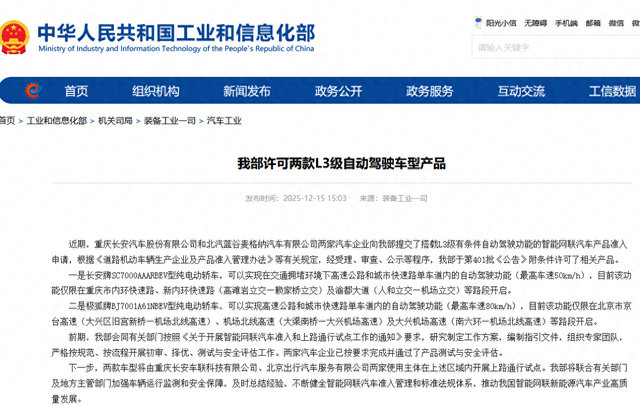
工信部:许可长安汽车(000625.SZ)和北汽蓝谷麦格纳两款L3级自动驾驶车型产品
智通财经网· 2025-12-15 07:58
智通财经APP获悉,据工信部12月15日消息,近期,重庆长安汽车股份有限公司(000625.SZ)和北汽蓝谷 麦格纳汽车有限公司两家汽车企业向工信部提交了搭载L3级有条件自动驾驶功能的智能网联汽车产品 准入申请,根据《道路机动车辆生产企业及产品准入管理办法》等有关规定,经受理、审查、公示等程 序,工信部于第401批《公告》附条件许可了相关产品。一是长安牌SC7000AAARBEV型纯电动轿车, 可以实现在交通拥堵环境下高速公路和城市快速路单车道内的自动驾驶功能(最高车速50km/h)。二是极 狐牌BJ7001A61NBEV型纯电动轿车,可以实现高速公路和城市快速路单车道内的自动驾驶功能(最高车 速80km/h)。 原文如下: 近期,重庆长安汽车股份有限公司和北汽蓝谷麦格纳汽车有限公司两家汽车企业向我部提交了搭载L3 级有条件自动驾驶功能的智能网联汽车产品准入申请,根据《道路机动车辆生产企业及产品准入管理办 法》等有关规定,经受理、审查、公示等程序,我部于第401批《公告》附条件许可了相关产品。 一是长安牌SC7000AAARBEV型纯电动轿车,可以实现在交通拥堵环境下高速公路和城市快速路单车 道内的自动驾驶功 ...