
职业教育

Search documents
职业本科招生成绩“亮眼” 考生选择更加理性
Zhong Guo Qing Nian Bao· 2025-08-11 01:48
Core Insights - The surge in enrollment for vocational undergraduate institutions indicates a shift in perception, with high-achieving students increasingly opting for these programs, reflecting a growing recognition of their value in the job market [1][8][11] Enrollment Trends - Vocational undergraduate institutions have seen a significant increase in enrollment, with 33 new institutions admitting students for the first time this year, contributing to a total of 87 vocational undergraduate schools since 2019 [1][2] - High scores in entrance exams have become common among students choosing vocational programs, with examples such as a student scoring 621 points opting for a nursing program at Jinhua Vocational and Technical University, and an average score of nearly 100 points above the undergraduate line for physics students at Guangzhou Vocational University [1][4] Institutional Performance - Beijing University of Science and Technology reported a successful first year of undergraduate admissions, with scores significantly exceeding the control line, indicating strong demand for vocational education [2][9] - In Zhejiang, institutions like Ningbo Vocational Technical University and Jinhua Vocational Technical University achieved high admission scores, with several programs exceeding 570 points, showcasing the competitive nature of vocational education [4][11] Factors Influencing Choices - The preference for vocational education is driven by practical employment considerations, with parents and students prioritizing job prospects and the quality of education [2][8] - Vocational programs are increasingly aligning with regional industry needs, offering practical training and internship opportunities that enhance employability [5][12] Future Implications - The rising popularity of vocational undergraduate programs is expected to reshape the higher education landscape, potentially leading to structural adjustments in the education system to better meet industry demands [11][12] - The increasing number of vocational institutions and their high admission scores may normalize the perception of vocational education, making high scores less of a novelty in the future [11][12]


海外消费周报:百胜中国2Q25业绩点评-20250810
Shenwan Hongyuan Securities· 2025-08-10 14:17
Investment Rating - The report maintains a "Buy" rating for Yum China, with a target price raised from 440 HKD to 450 HKD [2][9]. Core Insights - Yum China reported Q2 2025 revenue of 2.8 billion USD, a year-on-year increase of 4%, and core operating profit of 300 million USD, up 14% year-on-year, exceeding expectations due to better-than-expected restaurant profit margins [2][9]. - The company added 336 new stores in Q2, bringing the total to 16,978, with KFC and Pizza Hut contributing 12,238 and 3,864 stores respectively [2][9]. - Capital expenditure per store for KFC and Pizza Hut decreased to 1.4 million and 1.1-1.2 million respectively, attributed to optimization of investment per square meter and an increase in mini store formats [2][9]. - Same-store sales for KFC increased by 1% year-on-year, while Pizza Hut saw a 2% increase, with KFC's average transaction value rising by 1% to 38 CNY [2][9]. Summary by Sections 1. Yum China Q2 2025 Performance - Revenue reached 2.8 billion USD, a 4% increase year-on-year [2][9]. - Core operating profit was 300 million USD, reflecting a 14% year-on-year growth [2][9]. - The company opened 336 new stores, totaling 16,978, with KFC and Pizza Hut having 12,238 and 3,864 stores respectively [2][9]. 2. Store Expansion and Investment - KFC and Pizza Hut's capital expenditure per store decreased to 1.4 million and 1.1-1.2 million respectively [2][9]. - The company entered approximately 300 new cities in the past 12 months, with KFC and Pizza Hut reaching over 2,400 and 900 cities respectively [2][9]. 3. Same-Store Sales Performance - KFC's same-store sales increased by 1%, with average transaction value up by 1% to 38 CNY [2][9]. - Pizza Hut's same-store sales rose by 2%, with average transaction value down by 13% to 76 CNY, but transaction volume increased by 17% [2][9].
镜观·回响丨春风育人,硕果盈枝
Xin Hua Wang· 2025-08-10 04:21
Group 1 - Education is emphasized as the foundation for national strength and rejuvenation, with a focus on moral and comprehensive development of students [1][17][21] - The "14th Five-Year Plan" outlines the importance of prioritizing education and enhancing students' civic awareness and practical skills [1][4][21] - Collaborative educational support is highlighted, particularly the need for developed coastal regions to assist underdeveloped western areas [2][4] Group 2 - The establishment of schools like the Guoluo Xining National Middle School demonstrates the implementation of educational aid and improvement in teaching quality through external support [6][10] - The success of volunteer teaching programs in rural areas, such as the pilot program in Xinjiang, shows significant improvements in student performance [8] - Continuous efforts in vocational education reform aim to cultivate skilled workers and meet industry demands, with over 70% of new frontline workers coming from vocational schools [15][16][13] Group 3 - The development of world-class universities is aligned with the goals of socialism, focusing on nurturing well-rounded individuals for national service [17][20] - The higher education system is becoming more diverse, with accelerated construction of first-class universities and disciplines to address talent shortages [21][23] - Teacher quality and respect for the profession are being prioritized, with initiatives to enhance teacher training and improve working conditions [27][29]

陕西金叶股价微涨0.63% 职业教育概念受关注
Jin Rong Jie· 2025-08-06 16:52
陕西金叶最新股价报4.80元,较前一交易日上涨0.03元。当日成交量为201535手,成交金额达0.96亿 元,换手率为2.62%。 从资金流向来看,8月6日主力资金净流出142.27万元,近五个交易日累计净流出3054.77万元。当前公司 总市值36.90亿元,市盈率为57.37倍。 风险提示:股市有风险,投资需谨慎。 该公司主营业务涵盖包装材料和职业教育两大领域。作为陕西省属企业,其业务布局包括烟草配套材料 生产、印刷包装以及教育产业投资运营等方向。 ...

中方积极助力南非提升职业教育水平 “为南非制造业人才培养提供支撑”
Ren Min Ri Bao· 2025-08-04 21:56
Group 1 - The core viewpoint of the articles highlights the collaboration between South Africa and China in vocational education, particularly in CNC (Computer Numerical Control) machining skills training, aimed at enhancing South Africa's industrial capabilities [1][2][3] - The CNC machining skills training program, initiated in March 2024, involves over a hundred teachers from ten vocational colleges across South Africa, facilitated by Chinese institutions [1][2] - The South African government has set a target to increase the enrollment in vocational technical colleges to 2.5 million by 2030, emphasizing the importance of vocational education in national development [2][3] Group 2 - The training program includes a comprehensive curriculum that combines theoretical knowledge with practical skills, significantly improving the participants' operational capabilities [2] - The collaboration has extended to other fields such as big data, e-commerce, artificial intelligence, and cloud computing, with over 1,500 individuals trained in the past five years [3] - The partnership between Chinese enterprises and South African vocational institutions is seen as a key area of practical cooperation, with many companies seeking to recruit South African students for internships and further training in China [3]
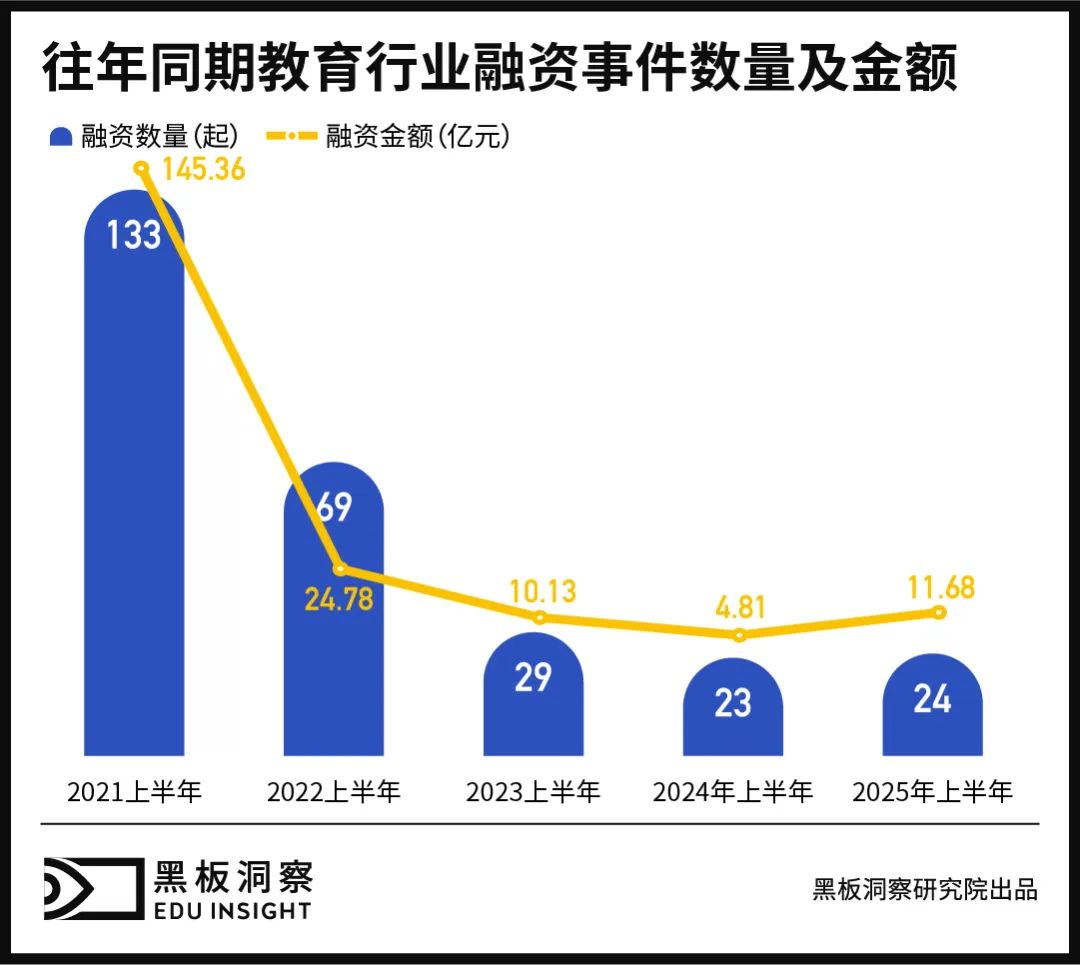
2025上半年中国教育行业融资风向报告,创投圈的钱都去哪了?
3 6 Ke· 2025-07-30 09:05
Core Insights - The education industry is experiencing a new pattern of "stable total volume and structural reconstruction" in investment and financing in the first half of 2025, driven by regulatory stabilization, demand transformation, and technological innovation [1][3] - A total of 24 financing events occurred in the first half of 2025, with an overall financing scale exceeding 1.168 billion yuan, surpassing the total amount for the entire year of 2024, indicating a marginal recovery in capital confidence and a focus on "certain tracks" [1][3] - Key investment directions include vocational education, AI empowerment, and quality education, reflecting a shift towards sectors with essential demand and growth potential [1][14] Financing Overview - The education industry's financing heat has been declining over the past five years, with a drop from 133 financing events and 14.536 billion yuan in the first half of 2021 to only 23 events and 481 million yuan in 2024 [3] - In the first half of 2025, although only 24 events were recorded, the financing amount rebounded to 1.168 billion yuan, marking a local recovery with "stable volume and increased amount" [3] Monthly Financing Trends - The financing events in the first half of 2025 were relatively evenly distributed monthly, with a notable spike in June, which accounted for 80.2% of the total financing amount for the half-year [6] - The overall financing frequency remained low, but the concentration of capital significantly increased, with a clear preference for high-certainty targets [6] Financing Rounds Distribution - Early-stage projects dominated the financing rounds, with angel rounds accounting for two-thirds of the events (16 occurrences), indicating sustained interest in innovative projects at the startup stage [9] - There were also 2 mergers and acquisitions and 1 equity investment, suggesting ongoing industry consolidation [9] Regional Financing Distribution - The financing distribution showed a pattern of "strong East, weak West," with Beijing leading with 5 events, followed by Guangdong and Jiangsu with 3 each, highlighting the continued advantage of first-tier and strong provincial cities in resource and capital supply [10] - Regions like Hubei, Hunan, Shanghai, and Zhejiang remained active, while western and central provinces showed minimal activity, indicating significant regional disparities [10] Sector-Specific Financing Distribution - Financing in the first half of 2025 was heavily concentrated in vocational education and enterprise services, which together accounted for over 90% of the total financing amount, reflecting capital's ongoing optimism towards "employment capability enhancement" and "educational toolization" [14] - Other sectors like quality education, study abroad, K12, and early childhood education had limited financing events, indicating challenges in consumer-end project financing [14] Top Financing Events - The top financing events included: - Tianyu Fei Training, an aviation training service company, acquired for 799 million yuan [16] - Cool Xuan Technology, a corporate training service platform, acquired for 180 million yuan [16] - Changxiang World, an art training intelligent service provider, raised 7 million USD in an angel round [16] Conclusion - The education industry's investment and financing landscape in the first half of 2025, while still at a low level, shows signs of structural recovery, with capital shifting focus towards vocational education and enterprise services [17] - The investment logic is transitioning from consumer-driven flow to supply-side value, indicating a move towards a quality-first, long-term oriented reconstruction cycle [17]
学过硬技能 铸大国重器(深聚焦)
Ren Min Ri Bao· 2025-07-30 07:02
Core Insights - The article highlights the significant role of vocational education in supporting major engineering projects in China, emphasizing the importance of skilled labor in the successful operation of these projects [3][4][10] Group 1: Vocational Education's Contribution - Vocational education in China has established the world's largest system, with over 30 million students and approximately 10 million skilled workers trained annually, which is crucial for the country's industrial capabilities [3][4] - The development of a comprehensive talent supply chain in vocational education ensures the safety and reliability of major engineering projects, as exemplified by the construction and operation of the Baihetan Hydropower Station [3][4] Group 2: Skills and Precision in Engineering - The precision in manufacturing and installation processes, such as those involved in the Baihetan Hydropower Station, is critical, with every component's accuracy affecting the overall performance of the power generation units [4][5] - The article illustrates the dedication of vocational graduates who work tirelessly to ensure the successful operation of major projects, highlighting their roles in monitoring, maintenance, and technical adjustments [4][5] Group 3: Innovation and Technology Integration - The integration of innovative technologies in engineering projects relies heavily on the skills acquired through vocational education, as seen in the use of intelligent positioning systems for bridge construction [5][6] - Vocational institutions are increasingly collaborating with industries to enhance practical training, ensuring that students are well-prepared for real-world challenges in engineering [6][7] Group 4: Cultivating Craftsmanship - The cultivation of a "craftsman spirit" is emphasized as essential for maintaining high standards in engineering, with vocational education playing a key role in instilling this mindset in students [8][9] - Experienced professionals contribute to vocational education by sharing their expertise, thereby enriching the learning experience and promoting a culture of precision and responsibility [9][10]

中公教育股价下跌1.32% AI就业学习机业务取得突破
Jin Rong Jie· 2025-07-29 18:51
Group 1 - The core point of the article highlights the recent performance of Zhonggong Education, which closed at 3.00 yuan on July 29, experiencing a decline of 0.04 yuan or 1.32% from the previous trading day [1] - The trading volume on that day was 3.4279 million hands, with a total transaction amount of 1.015 billion yuan [1] - Zhonggong Education is a leading vocational education training institution in China, focusing on training services for civil servants, public institutions, and teachers [1] - The company has recently disclosed progress in its AI employment learning machine business, which has enrolled over 3,000 students since its launch in March, with 70% being graduates from 2026 and 2027 [1] - The product is priced at three tiers: 4,999 yuan for the basic version, 7,000 yuan for the professional version, and between 20,000 to 40,000 yuan for the advanced version, sold through five different channels [1] Group 2 - On July 29, the net outflow of main funds was 77.2964 million yuan, accounting for 0.51% of the circulating market value [2]

前途,由热爱和打拼定义(教育时评)
Ren Min Ri Bao· 2025-07-28 22:51
Core Viewpoint - Vocational education opens doors to success for many young people, providing opportunities aligned with economic and social development [1][2][3] Group 1: Importance of Vocational Education - The significance of vocational education is increasingly recognized, with high-scoring students opting for vocational colleges and companies pre-booking students before graduation [1] - The development of vocational education is closely tied to industry needs, with a growing number of programs in high-demand fields such as smart health management and modern housekeeping, showing a growth rate of over 5% since 2021 [2] Group 2: Educational Quality and Opportunities - The potential for success in vocational education is linked to the quality of education, with some graduates achieving high accolades, such as winning world skill competitions or pursuing doctoral degrees [3] - There is a push for integrating vocational and general education, allowing for credit recognition and resource sharing, which broadens pathways for students [3] Group 3: Employment Environment and Challenges - The development of vocational education is influenced by the job market, where concerns about skill talent treatment and high barriers in recruitment persist [4] - Policies are being implemented to enhance the status and compensation of skilled workers, aiming to eliminate biases against vocational education graduates [4] Group 4: Personal Responsibility and Effort - Success in vocational education is not solely defined by academic credentials; individual interests and efforts play a crucial role in determining one's path [5] - Personal determination and hard work are emphasized as key factors in achieving success, with examples of individuals who have excelled after attending vocational schools [6]
职业教育为重大工程源源不断培养人才 学过硬技能 铸大国重器(深聚焦)
Ren Min Ri Bao· 2025-07-28 21:59
Core Insights - The article highlights the significant role of vocational education in supporting major engineering projects in China, emphasizing the importance of skilled labor in the successful execution and operation of these projects [2][3][8] Group 1: Vocational Education's Contribution - Vocational education in China has established the world's largest system, with over 30 million students and approximately 10 million high-quality laborers trained annually, which is crucial for the country's industrial capabilities [2] - The vocational education system has developed a comprehensive talent cultivation framework that supports the entire lifecycle of major engineering projects, ensuring safety and reliability in key industries [2][3] - The success of the Baihetan Hydropower Station serves as a vivid example of how vocational education contributes to major engineering projects, with skilled graduates playing essential roles in various operational aspects [2][3] Group 2: Skills and Innovations - Skilled graduates from vocational institutions are involved in critical tasks such as precision manufacturing and installation, which are vital for the successful operation of large-scale projects like the Baihetan Hydropower Station [3][4] - The application of innovative technologies in engineering projects relies heavily on the expertise of vocational education graduates, who are trained through practical, hands-on experiences [5][6] - The integration of education and industry, exemplified by partnerships between vocational schools and engineering firms, enhances the skill sets of students and prepares them for real-world challenges [5][6] Group 3: Cultivating Craftsmanship - The cultivation of a "craftsman spirit" is emphasized as essential for ensuring precision and safety in engineering projects, with vocational education playing a key role in instilling these values in students [7][8] - Experienced professionals from the industry contribute to vocational education by sharing their knowledge and skills, thereby enriching the learning experience for students [8] - The focus on moral education and professional values in vocational training aims to develop not only skilled workers but also responsible citizens who contribute to national development [8]