
耐心资本

Search documents
宁德时代又做LP了
FOFWEEKLY· 2025-12-09 10:09
Core Viewpoint - CATL has re-entered the investment scene by committing 500 million yuan to a new fund managed by Boyu Capital, signaling a recovery in China's venture capital market by the end of 2025 [4][6]. Group 1: Investment Activity - CATL announced its investment of 500 million yuan in the "Boyu New Intelligence New Industry (Ningbo) Equity Investment Partnership," which has a total subscription scale of 4 billion yuan, focusing on technology, healthcare, consumer goods, and retail sectors [6][8]. - Other companies, including Luoyang Molybdenum and Yitai B shares, have also announced their participation in the same fund, indicating a broader interest in this investment opportunity [8]. - The investment by CATL is part of a larger trend where the company is reviving its investment activities after a slowdown in recent years, having previously invested over 2.3 billion yuan in six funds within six months in 2021 [8]. Group 2: Market Sentiment and Trends - The investment by CATL reflects a shift in the overall sentiment of the primary market in 2025, moving away from caution to increased activity among investors [10]. - According to the "LP Panorama Report 2025," the private equity market in China has shown signs of recovery, with a nearly 10% increase in both fundraising and investment activities [10]. - The first three quarters of 2025 saw institutional LPs committing approximately 1.24 trillion yuan, a year-on-year increase of 9%, and the number of newly registered funds rose by 15.18% [10]. Group 3: Return of Institutional Investors - Established institutional investors like Tencent and Alibaba are returning to the market, focusing on future-oriented sectors such as AI and robotics, while new capital from various industries is also entering the equity investment space [11]. - The presence of foreign LPs is re-emerging, with several dollar institutions disclosing new fundraising activities, contributing to overall market confidence [12]. - The return of confidence is creating a positive feedback loop, with policy support for technological innovation and emerging sectors generating new opportunities [12]. Group 4: Long-term Investment Strategy - The current market recovery is characterized by a more patient capital approach, with both old and new investors seeking long-term alignment with industry evolution and national strategies [14]. - CATL's active participation in the LP market not only reflects confidence in its capital allocation but also signifies a clear marker of the primary market's transition into a new development phase [14].



视频 丨 恒安标准人寿副总经理、总精算师赵峰
Zhong Guo Jing Ying Bao· 2025-12-09 09:32
0:00 恒安标准人寿副总经理、总精算师赵峰:保险资金是真正意义上的耐心资本,客户一旦投保了一张保 单,它跟随客户短则十年、二十年,长则终身,保险这种耐心资本的长期属性是可以反过来去支持养老 社区,医疗、康养,还有高品质居家养老服务体系的建设,这种建设是长期需要更高、更大量的资金投 入,它的需求是非常刚性的,而保险产品、保险资金天然有这方面的优势。 ...
博时市场点评12月9日:两市涨跌不一,创业板继续上涨
Xin Lang Cai Jing· 2025-12-09 08:19
Market Overview - The three major indices in the A-share market showed mixed results, with the ChiNext Index rising by 0.61% and total market turnover decreasing to 1.91 trillion yuan compared to the previous day [1][6] - As of December 9, the Shanghai Composite Index closed at 3909.52 points, down 0.37%, while the Shenzhen Component Index closed at 13277.36 points, down 0.39% [9] Regulatory Developments - On December 6, the China Securities Regulatory Commission (CSRC) announced plans to "loosen" regulations for high-quality institutions, optimizing risk control indicators and increasing capital space and leverage limits to enhance capital efficiency [2][7] - The National Financial Regulatory Administration issued a notice on December 5, reducing the solvency risk factor for insurance companies holding long-term positions in the CSI 300 Index and other indices by 10% [2][8] Investment Sentiment - The regulatory guidance aims to enhance the return on equity (ROE) for brokerages and promote differentiated development for small and foreign brokerages, which may catalyze short-term sentiment in the brokerage sector [2][7] - The recent adjustments reflect a supportive attitude from regulators towards long-term investments and capital, particularly targeting blue-chip and quality growth stocks [3][8] Market Performance - In the industry performance, sectors such as comprehensive services, communication, and electronics saw significant gains, with increases of 3.45%, 2.23%, and 0.78% respectively, while sectors like non-ferrous metals, steel, and real estate experienced declines of 3.03%, 2.47%, and 2.10% [9] - A total of 1290 stocks rose, while 3855 stocks fell in the market [9] Capital Tracking - The market turnover was reported at 19,178.70 billion yuan, showing a decrease from the previous trading day, while the margin financing balance increased to 25,005.15 billion yuan [10]

2024-2000年上市公司企业耐心资本资助比例数据、机构投资者耐心
Sou Hu Cai Jing· 2025-12-09 04:51
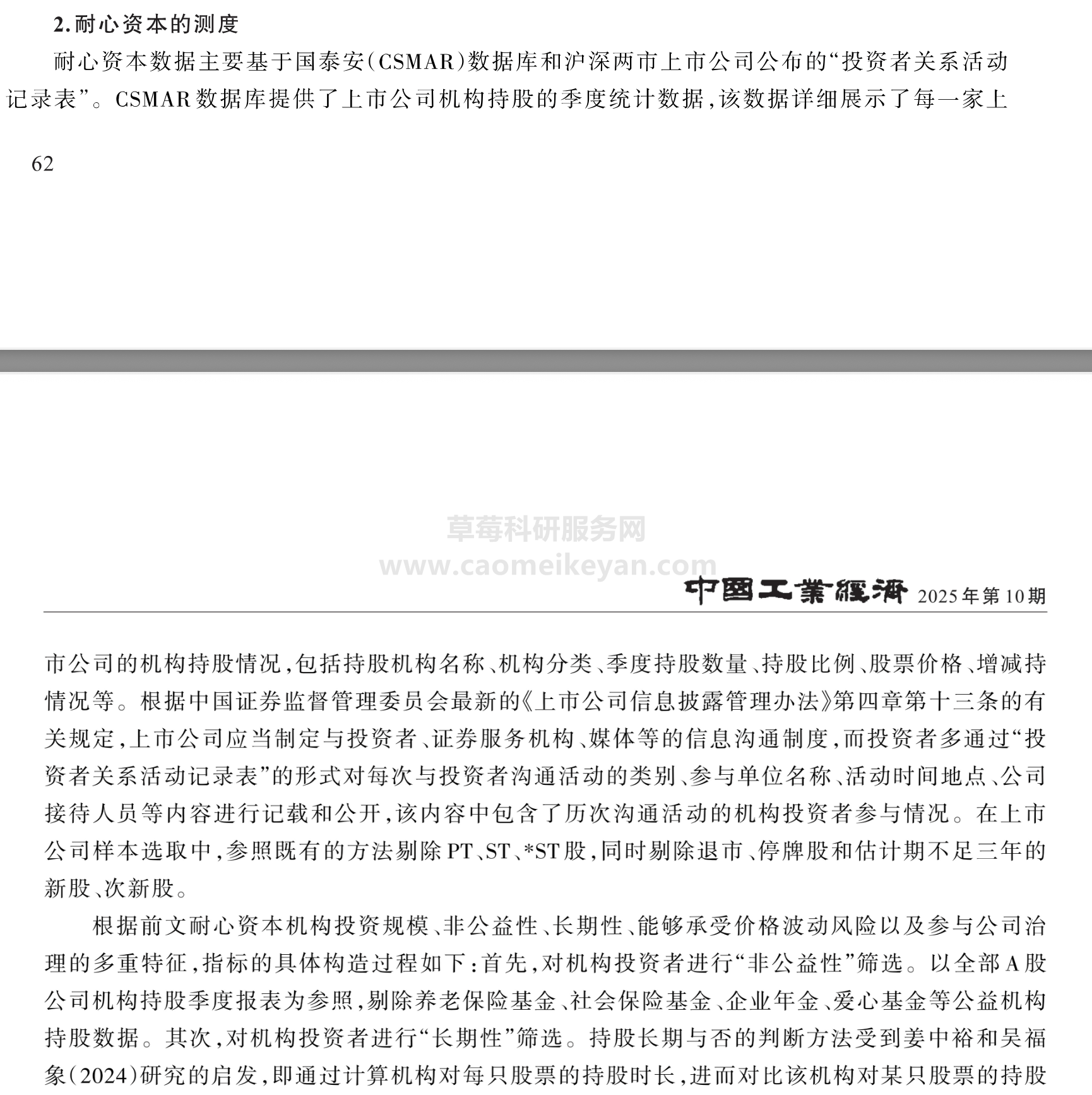
1、资料名称:2024-2000年上市公司企业耐心资本资助比例数据、机构投资者耐心资本数据 2、测算方式:参考顶刊《中国工业经济》余泳泽(2025)老师的做法,根据前文耐心资本机构投资规模、 非公益性、 长期性、 能够承受价格波动风险以 及参与公司治理的多重特征, 指标的具体构造过程如下: 首先, 对机构投资者进行 "非公益性" 筛选。以全部 A 股公司机构持股季度报表为参照, 剔除养 老保险基金、 社会保险基金、 企业年金、 爱心基金等公益机构持股数据。其次, 对机构投资者进行 "长期性" 筛选。持股长期与否的判断方法受到姜中裕 和吴福象 (2024) 研究的启发, 即通过计算机构对每只股票的持股时长, 进而对比该机构对某只股票的持股时长是否大于该机构对所有股票的平均持股时 长, 以判定该机构是否属于 "战略性持股"。最终, 以这部分资本持股在总股本中的占比来刻画 "战略性股权"。考虑到部分资本在对公司的持股上形同"耐 心", 但可能是无差别投资于某一行业的指数型基金, 这类资本的最终目标是通过指数波动而非企业成长获益。本文在这一测算思路的基础上进行了进一步 优化, 通过剔除类似于 "耐心" 的资本因素, ...
李庚南:监管调整保险相关业务风险因子传递了什么信息?
Xin Lang Cai Jing· 2025-12-09 03:49
Core Viewpoint - The recent adjustment of risk factors for insurance companies aims to enhance their solvency regulation standards, promote long-term investments, and support the real economy amidst a challenging domestic and international environment [1][2]. Group 1: Policy Background and Objectives - The policy is part of the "second generation solvency regulation" reform in the insurance industry, reflecting the need for supply-side reforms in response to current market pressures [2]. - The adjustment of risk factors is intended to encourage insurance companies to invest in A-shares and support foreign trade and investment, addressing the development challenges in these areas [2]. Group 2: Capital Market Implications - The A-share market is showing signs of recovery, with the Shanghai Composite Index fluctuating around the 4000-point mark, indicating increased market resilience [3]. - Regulatory measures are being implemented to enhance the inclusivity of the capital market, particularly to support technology innovation and new productive forces [3]. - The core task for the A-share market is to stabilize and improve the quality of listed companies, which requires sustained policy patience and long-term capital support [3]. Group 3: Foreign Trade and Investment Context - China's foreign trade is characterized by steady growth and structural upgrades, despite facing complex external challenges [4]. - The need for policy incentives to enhance insurance support for foreign trade and investment is emphasized, particularly in light of rising risks and challenges in the global environment [4]. Group 4: Impact of Risk Factor Adjustments - The adjustment of risk factors is expected to inject approximately 32.6 billion yuan of capital into the market, potentially providing around 108.6 billion yuan in incremental funds if fully allocated to the CSI 300 stocks [11]. - The policy aims to stabilize the market by encouraging long-term value investments, thereby reducing short-term volatility [11]. - The adjustments will also enhance support for the real economy by directing insurance funds towards strategic sectors such as technology innovation and high-end manufacturing [11]. Group 5: Microeconomic Effects on Insurance Companies - The reduction in risk factors will improve the solvency ratios of insurance companies by lowering the minimum capital requirements [12]. - It will also create new opportunities for business expansion and risk asset allocation for insurance companies [12]. - The changes are expected to drive a transformation in investment philosophies and assessment mechanisms within insurance companies, promoting a shift from transactional to long-term value investment [12]. Group 6: Market Signals and Future Outlook - The adjustment sends a clear signal to the market that long-term investment strategies will be favored, potentially leading to a more stable A-share market [13][14]. - The insurance sector may experience improved fundamentals and valuation opportunities as a result of increased long-term equity investments [14]. - The regulatory framework is designed to guide financial resources towards supporting the real economy and national strategies, indicating a long-term commitment rather than short-term stimulus [15].
东兴证券:降低险企部分投资业务风险因子 进一步释放险资活力
智通财经网· 2025-12-09 03:49
Core Viewpoint - The report from Dongxing Securities highlights the increased role of capital markets as stabilizers during significant changes in Sino-US economic relations, emphasizing the importance of insurance capital in maintaining market stability and improving operational efficiency for insurance companies [1][4]. Summary by Sections Regulatory Changes - The Financial Regulatory Bureau issued a notice adjusting risk factors related to insurance companies, aiming to enhance their long-term investment management capabilities and better align asset-liability management [2]. - The adjustments include differentiated risk factors based on holding periods for investments in the CSI 300 index, the CSI Low Volatility 100 index, and stocks listed on the Sci-Tech Innovation Board [2][3]. Specific Adjustments - For insurance companies holding CSI 300 and CSI Low Volatility 100 index stocks for over three years, the risk factor was reduced from 0.3 to 0.27 [3]. - For stocks on the Sci-Tech Innovation Board held for over two years, the risk factor was lowered from 0.4 to 0.36 [3]. - The risk factors for export credit insurance and overseas investment insurance were also adjusted, with the premium risk factor decreasing from 0.467 to 0.42 and the reserve risk factor from 0.605 to 0.545 [3]. Market Impact - The adjustments are expected to accelerate the entry of insurance capital into the market, thereby stabilizing market fluctuations and enhancing liquidity [4]. - The changes support a wide range of investment styles, including large-cap blue chips, high-dividend stocks, and technology growth, promoting a balanced and healthy development of the equity market [4]. Investment Recommendations - The report suggests focusing on leading companies in the non-banking sector, which are better positioned to leverage policy innovations and capitalize on policy benefits [5]. - Additionally, the investment value of securities and insurance ETFs should be closely monitored due to the growing demand for differentiated investment [5].

A股主要指数收涨 券商保险板块整体走强
Sou Hu Cai Jing· 2025-12-08 14:28
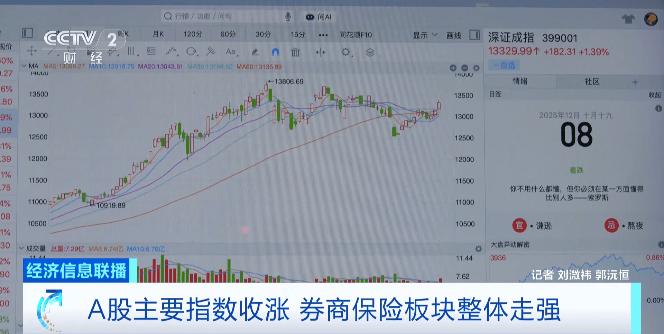
(央视财经《经济信息联播》)今天(8日),沪深股市延续上行态势,A股主要指数实现二连阳,上 证指数收报3924.08点。 截至收盘,上证指数涨0.54%,深证成指涨1.39%,创业板指涨2.6%,北证50涨1.27%。全市场成交额 2.05万亿元,较上日成交额放量3126亿元。行业板块方面,能源金属、通信设备等板块涨幅居前。证 券、保险等大金融板块整体走强。 12月5日下午,国家金融监管总局发布《关于调整保险公司相关业务风险因子的通知》,将保险公司持 仓时间超过三年的沪深300指数成分股、中证红利低波动100指数成分股的风险因子从0.3下调至0.27;保 险公司持仓时间超过两年的科创板普通股的风险因子从0.4下调至0.36,降幅均为10%。 中国银河证券首席策略分析师 杨超:该风险因子是保险监管体系中衡量投资风险程度的核心参数,直 接决定保险公司持有该资产需要计提的"最低资本"规模,引导资本流向实体经济关键领域,通过"时间 挂钩"机制,将资本成本与投资期限深度绑定,推动保险资金从短期博弈转向长期价值投资。 在刚刚过去的周末,金融监管层的政策动向成为市场关注的焦点。12月6日,证监会主席吴清表示,将 着力强化分 ...
东海证券:保险板块目前处历史低估值区间 重视配置机遇
智通财经网· 2025-12-08 11:35
东海证券主要观点如下: 智通财经APP获悉,东海证券发布研报称,金监总局于12月5日发布《关于调整保险公司相关业务风险 因子的通知》,以进一步完善保险公司偿付能力监管标准,充分发挥保险资金作为耐心资本的优势,提 升服务实体经济质效。此次调整有望降低险企资本占用压力,提升资金使用效率,推动长期价值投资进 一步深化。同时,对保险资金"耐心资本"的持续引导,也将进一步支持科技创新和实际经济赋能,优化 行业资产负债匹配结构。保险板块目前处历史低估值区间,重视板块配置机遇,建议关注拥有明显护城 河的大型上市险企。 事件: 金监总局于12月5日发布《关于调整保险公司相关业务风险因子的通知》,以进一步完善保险公司偿付 能力监管标准,充分发挥保险资金作为耐心资本的优势,提升服务实体经济质效。 通知对出口信用保险业务和中国出口信用保险公司海外投资保险业务的保费风险因子从0.467下调至 0.42,准备金风险因子从0.605下调至0.545,且仅调整基础因子而保持特征系数不变,既降低了险企开 展该业务的资本占用成本与准备金计提压力,又确保了监管标准的连贯性。这一调整精准对接国家稳外 贸、支持"一带一路"跨境贸易的战略需求,既能释 ...
保险新规助力培育耐心资本,证券保险ETF(512070)、证券ETF易方达(512570)标的指数双双三连涨
Sou Hu Cai Jing· 2025-12-08 11:05
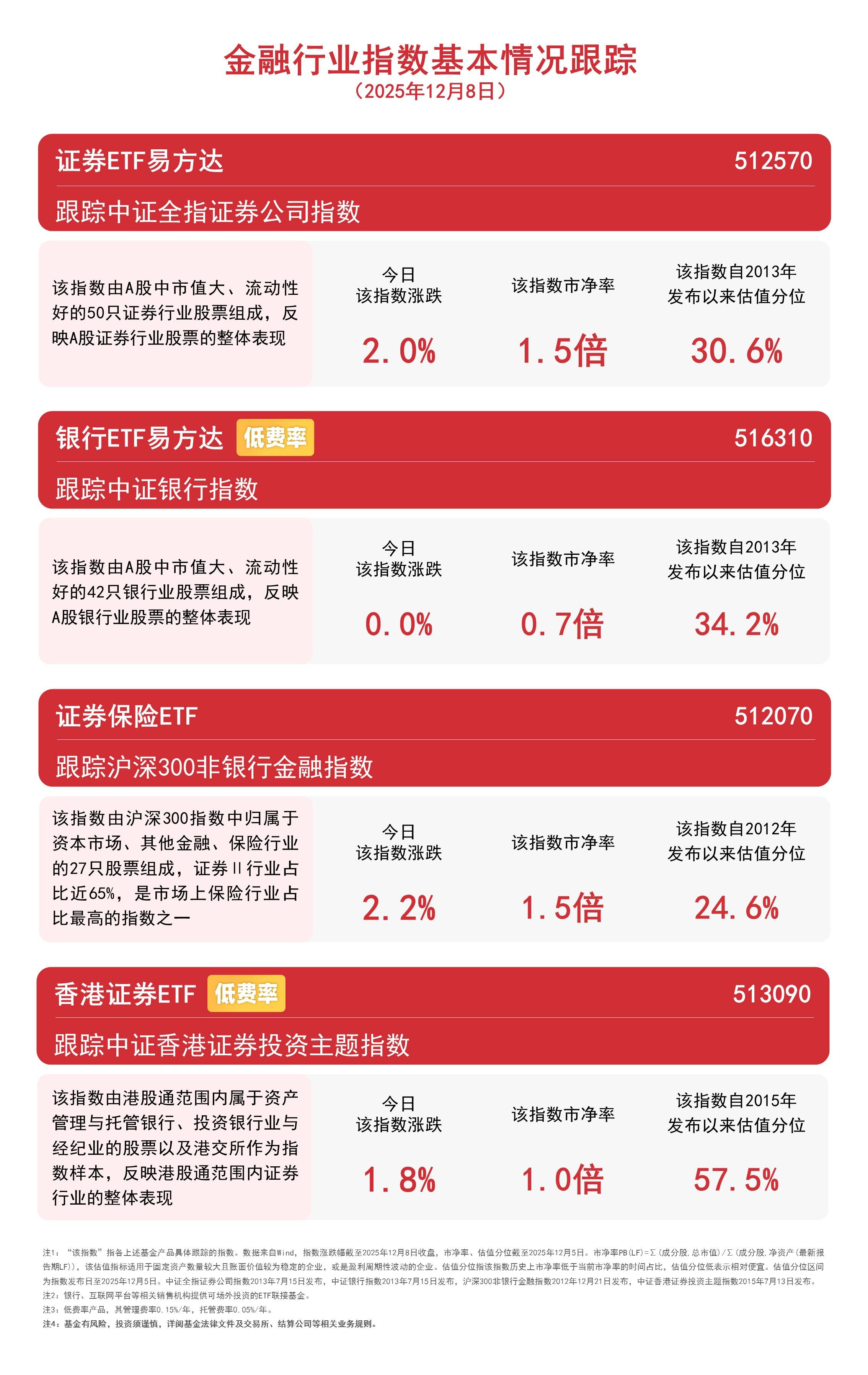
Group 1 - The non-bank sector continued its upward trend, with the CSI 300 Non-Bank Financial Index rising by 2.2%, the CSI All Share Securities Company Index increasing by 2.0%, and the Hong Kong Securities Index up by 1.8% [1] - The National Financial Regulatory Administration's notification to adjust risk factors for insurance companies has lowered the risk factors for long-term holding assets such as the CSI 300, Dividend Low Volatility, and STAR Market, which is expected to cultivate patient capital and support technological innovation [1] - The implementation of this policy is anticipated to continuously drive medium to long-term capital into the market, enhancing the equity allocation capability of insurance funds [1] Group 2 - The CSI 300 Non-Bank Financial Index consists of 27 stocks from the CSI 300 Index related to capital markets, other financial services, and the insurance industry, with the securities sector accounting for nearly 65% [3] - The Hong Kong Securities ETF tracks the CSI Hong Kong Securities Investment Theme Index, which reflects the performance of stocks within the asset management, custody banks, investment banking, and brokerage sectors [4][5]
非银行金融:降低险企部分投资业务风险因子,进一步释放险资活力
Dongxing Securities· 2025-12-08 10:42
Investment Rating - The industry investment rating is "Positive" [6] Core Viewpoints - The recent adjustment of risk factors by the financial regulatory authority aims to enhance the long-term investment management capabilities of insurance companies, thereby better serving the real economy and promoting stable operations [1][4] - The adjustments include differentiated risk factors based on holding periods for specific indices, which will encourage insurance capital to enter the market more rapidly and stabilize market fluctuations [2][4] - The lowered risk factors for insurance companies' investments in major indices and export credit insurance are expected to boost the efficiency of capital utilization and investment returns for insurance companies [5] Summary by Sections Risk Factor Adjustments - The risk factor for insurance companies holding stocks in the CSI 300 index and the CSI Dividend Low Volatility 100 index for over three years has been reduced from 0.3 to 0.27 [3] - The risk factor for insurance companies holding stocks in the Sci-Tech Innovation Board for over two years has been reduced from 0.4 to 0.36 [3] - The risk factor for premium and reserve in export credit insurance has been adjusted from 0.467 to 0.42 and from 0.605 to 0.545, respectively [3] Market Context - The ongoing de-globalization and trade tensions between China and the U.S. have introduced unpredictability into the domestic economic recovery, making insurance capital a key stabilizing factor in the capital market [4] - The adjustments are expected to provide liquidity to the capital market and support the development of domestic enterprises, particularly in alignment with national strategies like the Belt and Road Initiative [4] Investment Recommendations - In the context of significant changes in Sino-U.S. trade relations, the role of insurance capital as a stabilizer in the capital market is emphasized [5] - The report suggests focusing on leading companies in the non-bank financial sector, which are better positioned to leverage policy innovations and enhance their operational performance [5] - The growing trend of ETFs is highlighted, indicating continued investment value in securities and insurance ETFs [5]