
量子通信

Search documents
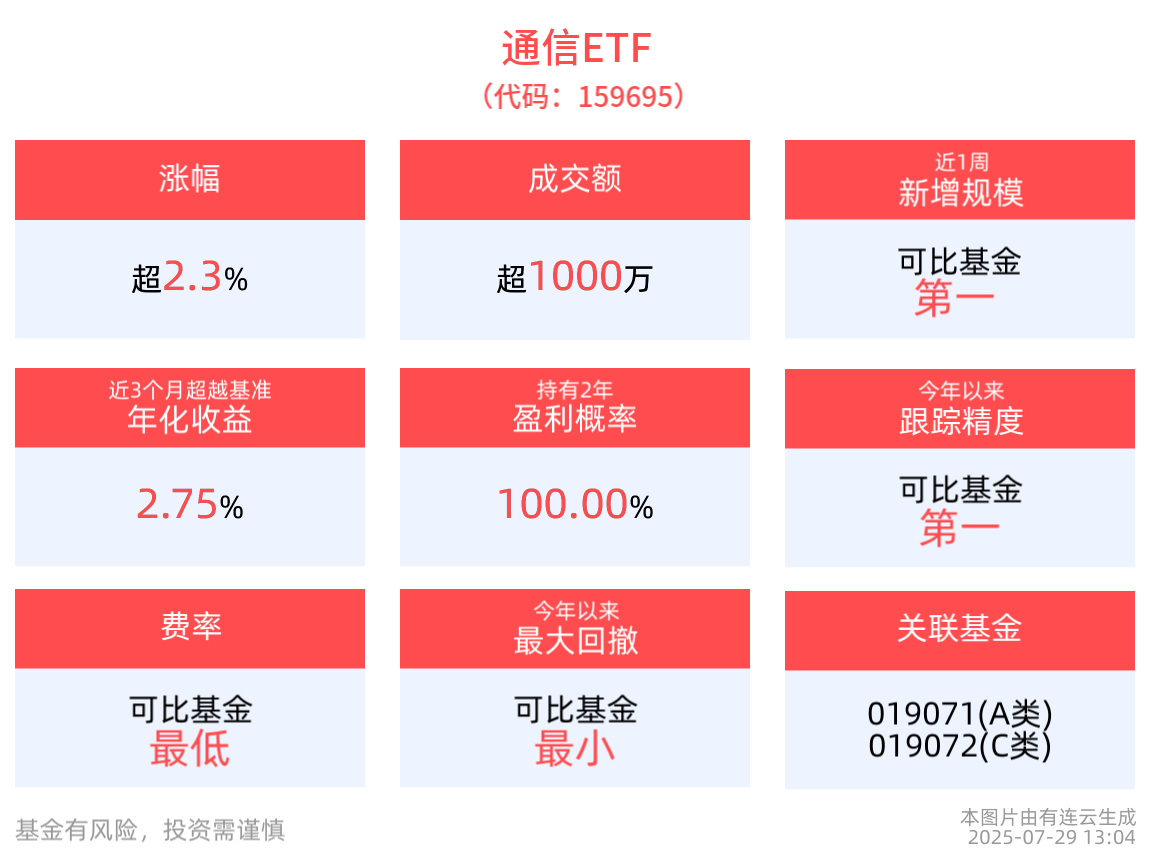
通信ETF(159695)午后上涨2.35%,机构:2025年通信行业处于技术迭代与政策红利叠加期
Sou Hu Cai Jing· 2025-07-29 05:30
Group 1: Market Performance - The communication ETF had an intraday turnover of 16.27%, with a transaction volume of 18.2966 million yuan, indicating active market trading [3] - Over the past week, the communication ETF's average daily transaction volume was 15.4895 million yuan [3] - The communication ETF's net value increased by 45.57% over the past year [3] Group 2: Fund Growth and Returns - The communication ETF saw a growth of 1.0009 million yuan in scale over the past week, ranking first among comparable funds [3] - Since its inception, the communication ETF recorded a highest monthly return of 24.48%, with the longest consecutive monthly gains being three months and the longest gain percentage being 23.48% [3] - The average return during the rising months was 6.09% [3] Group 3: Industry Outlook - The communication industry in China is experiencing stable operations, with growth in telecom business volume and orderly progress in new infrastructure construction [4] - By 2025, the communication sector is expected to benefit from technological iterations and policy dividends, with new growth drivers from AI, quantum communication, and low-altitude economy [4] - The top ten weighted stocks in the national communication index accounted for 59.17% of the total index as of June 30, 2025 [4] Group 4: Key Stocks Performance - The top weighted stocks include Zhongji Xuchuang (9.34%), China Telecom (8.56%), and Xinyi Sheng (8.25%), among others [6] - Notable stock performances include Zhongji Xuchuang with a rise of 9.09% and Tianfu Communication with a rise of 12.64% [6] - Investors can access AI-driven optical communication investment opportunities through the communication ETF linked fund (019072) [6]







国富量子(00290)追投RTree:加注RWA赛道,构建数字资产全价值链
智通财经网· 2025-07-29 02:54
Core Viewpoint - The company Guofu Quantum (00290) has made a strategic investment in Rtree Tech Service Co., Limited to strengthen its position in the Real World Assets (RWA) sector and enhance its digital asset ecosystem [1][10]. Group 1: RWA and Rtree's Role - RWA refers to the tokenization of traditional assets (such as bonds, real estate, and commodities) through blockchain technology, which enhances liquidity, reduces transaction costs, increases transparency, and expands asset categories [3]. - Rtree is positioned as a rapidly growing RWA technology company focused on the tokenization of real-world assets, providing a solid technological foundation for Guofu Quantum's RWA business [3][4]. - Rtree has already launched RWA services such as art collateral lending and on-chain fixed-income bonds, with plans to expand into various asset classes including gold, stocks, ETFs, and futures [4]. Group 2: Strategic Dual-Track Approach - Guofu Quantum's board believes that RWA and stablecoins represent breakthrough directions for the scalability of fintech, with significant potential to reshape asset value [5]. - The company has previously gained market attention by strategically investing in Yuan Coin Technology, which became one of the first participants in the Hong Kong Monetary Authority's stablecoin sandbox [5]. - Guofu Quantum plans to tokenize high-value assets such as art, trade receivables, and letters of credit to improve liquidity ratios and enhance capital returns [6]. Group 3: Compliance and Licensing Advantages - Guofu Quantum possesses a comprehensive licensing matrix, including licenses from the Hong Kong Securities and Futures Commission, which supports its digital asset business [8]. - The company aims to leverage RWA to merge traditional and new financial assets, facilitating the activation of traditional wealth into the new financial ecosystem [9]. - The investment in Rtree and the focus on RWA are seen as strategic moves to capitalize on current market trends while preparing for future opportunities in quantum technology [10].
上半年我国服务业经济保持较快增长 向新向好态势继续巩固
Zhong Guo Chan Ye Jing Ji Xin Xi Wang· 2025-07-28 22:42
Group 1 - The service industry in China showed a strong growth in the first half of the year, with a value added of 39,031.4 billion yuan, representing a year-on-year increase of 5.5% and accounting for 59.1% of the GDP, an increase of 0.7 percentage points compared to the previous year [1][2] - The contribution rate of the service industry to national economic growth was 60.2%, up by 5.8 percentage points year-on-year, with the service sector driving GDP growth by 3.2 percentage points, an increase of 0.5 percentage points [2] - In the second quarter, the service industry added value reached 19,517.2 billion yuan, growing by 5.7% year-on-year, with a contribution rate to economic growth rising to 61.2% [2] Group 2 - The service retail sales increased by 5.3% year-on-year, outpacing the growth of goods retail sales by 0.2 percentage points, while per capita service consumption expenditure rose by 4.9%, accounting for 45.5% of total per capita consumption expenditure [2] - Cultural and tourism consumption saw significant growth, with tourism services and cultural sports services increasing by 31.9% and 7.4% respectively, and the national box office exceeding 29.2 billion yuan, growing over 20% year-on-year [3] Group 3 - The high-tech service sector experienced robust demand, with fixed asset investment in high-tech services growing by 8.6% year-on-year, and investment in information services increasing by 37.4% [5] - The business activity index for the service industry remained above the critical point, averaging 50.2, indicating continued expansion and positive market expectations [6][7] Group 4 - The integration of technological and industrial innovation is deepening, with high-tech service enterprises showing revenue growth of 9.9% and strategic emerging service enterprises growing by 9.5% from January to May [4] - The digital technology application sector also saw a revenue increase of 11.2% year-on-year, reflecting ongoing innovation and optimization in digital service supply [4]
通信行业双周报(2025、7、11-2025、7、24):上半年我国电信业务收入累计完成9055亿元-20250725
Dongguan Securities· 2025-07-25 10:17
Investment Rating - The report maintains an "Overweight" rating for the communication industry, expecting the industry index to outperform the market index by more than 10% in the next six months [2][41]. Core Viewpoints - In the first half of 2025, China's telecommunications business revenue reached CNY 905.5 billion, showing a year-on-year growth of 1% [20]. - The communication industry is experiencing a period of technological iteration and policy dividends, with growth drivers from AI, quantum communication, and low-altitude economy [38]. - The report suggests focusing on companies that align with the themes of "technology commercialization + policy catalysis + performance certainty" [38]. Summary by Sections 1. Industry Market Review - The communication sector index increased by 6.78% from July 11 to July 24, outperforming the CSI 300 index by 3.31 percentage points, ranking 7th among 31 sectors [11]. - Year-to-date, the communication sector has risen by 17.04%, surpassing the CSI 300 index by 11.60 percentage points [11]. 2. Industry News - Dell'Oro report indicates a 6% CAGR for the global 5G core network market from 2024 to 2029, driven by accelerated deployment of 5G SA architecture [16]. - China Mobile's procurement for data center switches includes major players like Huawei and ZTE, with an estimated procurement of approximately 33,300 units [18]. - The Ministry of Industry and Information Technology reported that the number of mobile phone users reached 1.81 billion, with 5G users at 1.118 billion, accounting for 61.8% of mobile users [20]. 3. Company Announcements - Zhongji Xuchuang expects a net profit increase of 53%-87% for the first half of 2025, driven by strong demand for high-end optical modules [22]. - New Yisheng anticipates a net profit growth of 328%-385% for the same period, benefiting from AI-related investments [24]. - StarNet Ruijie forecasts a net profit increase of 43.81%-91.75% due to accelerated orders for data center switch products [26]. 4. Industry Data Updates - As of June 2025, the length of optical cable lines reached approximately 73.77 million kilometers, a year-on-year increase of 9.91% [29]. - The total number of 5G base stations reached 4.549 million, with a net increase of 298,000 from the end of the previous year [34]. 5. Weekly Perspective on the Communication Sector - The report emphasizes the stable operation of the communication industry, with ongoing growth in telecommunications business volume and new infrastructure construction [38]. - It recommends focusing on companies such as China Telecom, FiberHome, and Changfei Fiber for potential investment opportunities [39].
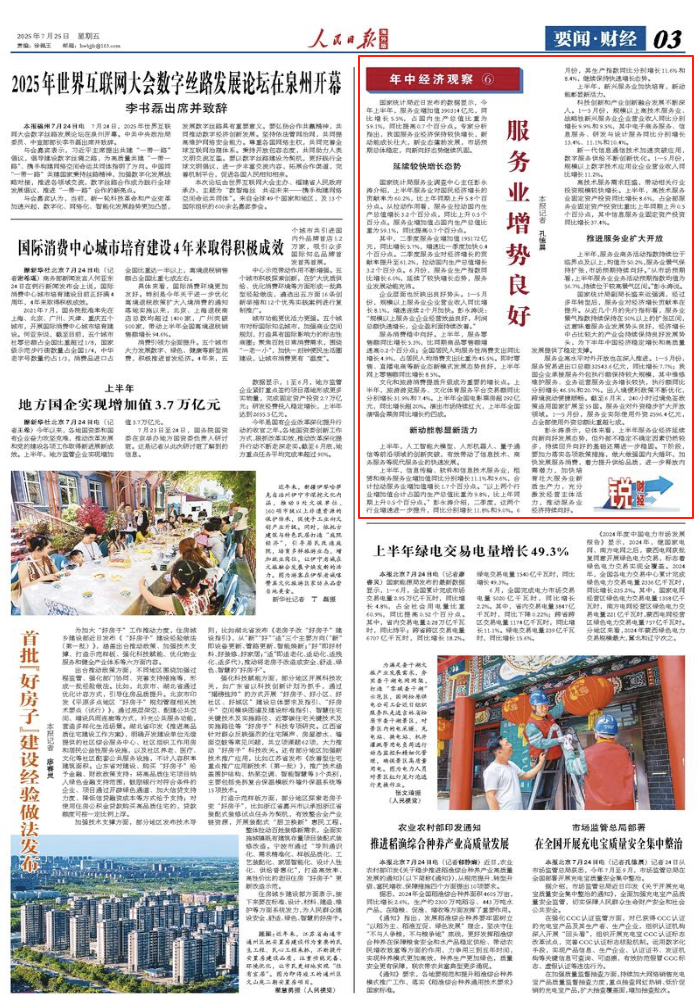
服务业增势良好(锐财经·年中经济观察⑥)
Ren Min Ri Bao Hai Wai Ban· 2025-07-24 22:28
Core Insights - The service industry in China has shown robust growth in the first half of the year, with a value added of 39,031.4 billion yuan, representing a year-on-year increase of 5.5% and accounting for 59.1% of the GDP, an increase of 0.7 percentage points compared to the previous year [1][2][15]. Group 1: Economic Contribution and Growth - The service sector contributed 60.2% to national economic growth, an increase of 5.8 percentage points year-on-year, driving GDP growth by 3.2 percentage points, which is a 0.5 percentage point increase from the previous year [2][7]. - In the second quarter, the service sector's value added reached 19,517.2 billion yuan, growing by 5.7%, with a contribution rate to economic growth rising to 61.2% [2][4]. - The service production index in June grew by 6.0% year-on-year, indicating sustained growth momentum [2][4]. Group 2: Business Performance - From January to May, revenue from large-scale service enterprises increased by 8.1%, with profit margins improving and overall business performance showing positive trends [2][5]. - Service retail sales grew by 5.3%, outpacing the growth of goods retail sales by 0.2 percentage points, while per capita service consumption expenditure rose by 4.9%, accounting for 45.5% of total per capita consumption [2][3]. Group 3: Emerging Trends and Innovations - Cultural and tourism consumption has become a significant growth driver, with tourism services and cultural sports services seeing transaction growth of 31.9% and 7.4% respectively [3][4]. - The first half of the year saw significant advancements in emerging service sectors, with high-tech service industries and strategic emerging service industries reporting revenue growth of 9.9% and 9.5% respectively [5][6]. - The digital services sector also thrived, with revenue from digital technology application enterprises increasing by 11.2% [5][6]. Group 4: Market Outlook and Policy Support - The service industry business activity index remained above the critical point, averaging 50.2, indicating ongoing expansion and positive market expectations [6][7]. - The total value of service trade imports and exports reached 32,543.6 billion yuan, a year-on-year increase of 7.7%, with foreign investment in the service sector accounting for over 70% of total foreign investment [7][8].
未来40年材料革命:这13大领域将重塑人类文明!
材料汇· 2025-07-24 15:52
Metal Materials - The future focus is on breaking traditional alloy performance limits, evolving towards multifunctional integration and sustainable manufacturing [3] - The industry impact shifts from "structural support" to "functional load-bearing," with metal materials remaining the backbone of high-end equipment [4] Polymer Materials - Advanced high-strength lightweight alloys such as magnesium, aluminum, and titanium alloys achieve "weight reduction and efficiency increase" through nano-precipitation and texture control, with topology optimization and 3D printing of customized alloy components becoming mainstream after 2040 [5] - High-entropy alloys (HEAs) break traditional design thinking with the "cocktail effect," offering high strength, corrosion resistance, and radiation resistance, making them irreplaceable in nuclear reactors and deep-sea equipment [5] - Sustainable metallurgy, including hydrogen metallurgy technology, aims for a metal closed-loop recycling rate exceeding 90% by 2050, reshaping the carbon neutrality path for the steel industry [5] Ceramic Materials - The future focus is on overcoming brittleness to expand applications in energy and aerospace [11] - The industry impact highlights the irreplaceable role of ceramics in aerospace, nuclear energy, and semiconductors, with significant domestic substitution potential [12] Carbon Materials - The future focus is on the industrialization of two-dimensional materials and the rise of carbon-based electronics [15] - China holds 70% of global graphene patents, necessitating a faster transition from laboratory to factory [16] Composite Materials - Graphene is expected to achieve low-cost mass production after 2030, with applications in ultrafast sensors, flexible electrodes, and seawater desalination membranes [17] - Carbon nanotubes (CNTs) are candidates for lightweight conductive composites, replacing copper wires [17] - Carbon fiber (CFRP) supports new-generation domestic T1100-grade carbon fiber for large aircraft and hydrogen storage tanks [17] Advanced Materials - Fiber-reinforced resin-based composites (FRP) are key to automotive lightweighting, with carbon fiber costs projected to drop to $10/kg by 2050 [21] - Smart composite materials with embedded sensors enable structural health monitoring [21] Information Materials - The future focus is on supporting computational power explosion and quantum communication [27] - The industry impact directly influences China's chip discourse power in the "post-Moore era" [28] Energy Materials - The future focus is on enhancing energy conversion and storage efficiency [31] - Material costs account for 60% of new energy device expenses, making them critical for achieving carbon neutrality goals [32] Biomedical Materials - The future focus is on personalization and bioactivity [35] - The aging global population creates a trillion-dollar market, with biocompatibility evaluation being a core entry criterion [36] Environmental Materials - The future focus is on pollution control and resource recycling [39] - Environmental policies drive mandatory replacements, with green certification becoming a standard for exports [40] Building Materials - The future focus is on transforming from energy consumers to producers [43] - New materials are seen as breakthroughs for urban carbon neutrality, given that buildings consume 40% of global energy [44] Material Surface Engineering - The future focus is on nanotechnology and multifunctional integrated coatings [47] - The industry impact emphasizes the value of coatings in remanufacturing [48] Material Analysis and Evaluation - The future focus is on AI-driven material analysis combining high-throughput experiments, computational simulations, and AI [51] - The industry impact shifts from "trial and error" to "rational design," reshaping material R&D paradigms [52] Conclusion - Over the next 40 years, material innovation will showcase four main themes: green, intelligent, composite, and precise [54] - The transition from a "material power" to a "material strong power" in China depends on breakthroughs in original basic research, key equipment autonomy, and collaborative ecosystems [56]

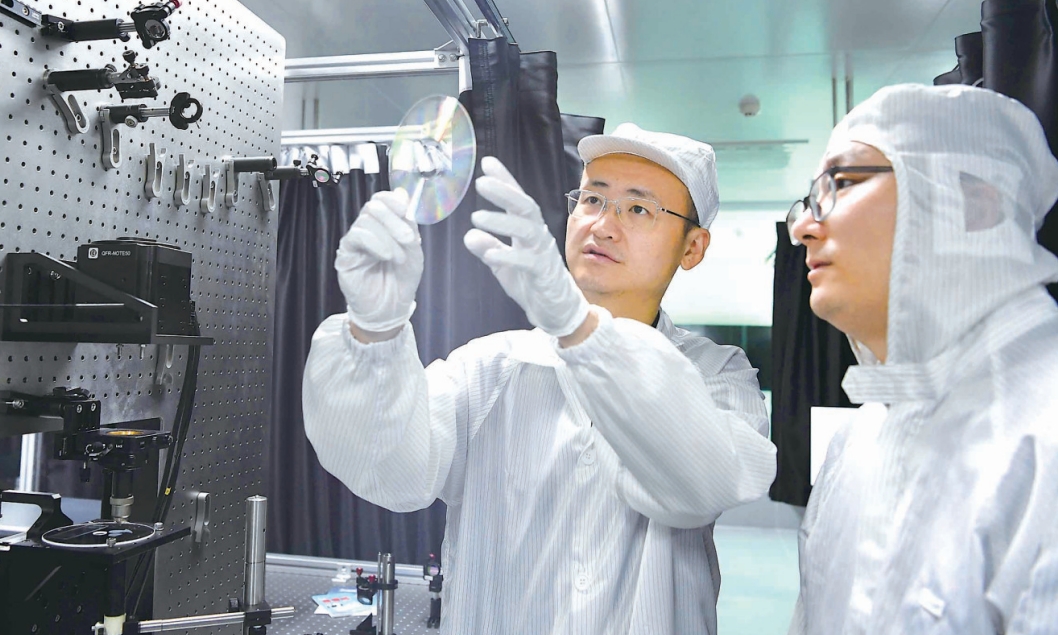
2毫米厚玻璃硬盘年底量产
Chang Jiang Ri Bao· 2025-07-24 00:25
Core Viewpoint - The development of a revolutionary glass hard drive technology by a research team led by Zhang Jingyu at Huazhong University of Science and Technology is set to transform data storage, offering a capacity of up to 360TB and the ability to permanently retain data [2]. Group 1: Glass Hard Drive Technology - The glass hard drive can store 25,000 HD movies and is designed for long-term data preservation, with a single write operation capable of retaining massive amounts of data [2]. - This technology has won the Excellence Award at the 2024 National Disruptive Technology Innovation Competition and is expected to be industrialized by the end of this year [2]. - The technology aims to serve critical areas such as internet data centers, AI model training data storage, and long-term preservation of historical archives [2]. Group 2: Innovations in Imaging Technology - The research team has achieved breakthroughs in single-photon imaging technology, reaching a resolution of up to one million pixels [3]. - This advancement allows for high-resolution imaging even in low-light conditions, which is crucial for applications in quantum communication and deep space exploration [3]. - The laboratory has facilitated the incubation of several tech companies and has initiated nearly 100 research projects, resulting in 46 authorized invention patents, with many technologies reaching international leading standards [3].
艾融软件20250722
2025-07-22 14:36
Summary of Airosoft Conference Call Company Overview - Airosoft has established a comprehensive intelligent banking service system covering various areas such as business development, service, operations, and risk control, achieving coverage of all domestic systemically important banks and 31 out of 34 banks with assets over 1 trillion yuan [2][3] Financial Performance - The company has demonstrated stable financial health with both revenue and net profit showing an upward trend, indicating strong operational performance [5] - The financial status has remained steady without significant fluctuations, reflecting good management practices [5] Strategic Planning - The 2025 strategic plan is defined as "1+2+3+10," focusing on expanding development tasks for large banks, enhancing customer base, and promoting new technology applications to increase market share and brand influence while achieving profit growth [6] - Specific measures include optimizing product structure and increasing R&D investment [6] Business Expansion - Airosoft is gradually exploring overseas business, leveraging Chinese banks' overseas branches to expand into international settlement, cross-border trade, and payment systems [7] - The company aims to extend its services from front-end to core systems, particularly in the construction of distributed banking core systems [7] Technological Advancements - Significant breakthroughs have been made in three key technology areas: HarmonyOS, quantum communication, and artificial intelligence [8] - HarmonyOS: Deep development of applications and the launch of a PC version [8] - Quantum Communication: Promotion of quantum encryption applications in the financial sector [8] - Artificial Intelligence: Implementation of large model applications in areas such as facial recognition and credit [8] Product Focus - Key product offerings include enterprise mobile banking, AI-based facial recognition, data middle platform, and digital marketing solutions [9] - The company is involved in the infrastructure development for cross-border payments and digital currency, while also focusing on opportunities presented by stablecoins [9] Industry Trends - The banking sector's digitalization investments continue to grow, with a significant focus on the "Xinchuang" (indigenous innovation) transformation, which is a national requirement to be completed by 2026 [4][15] - Despite a slight decrease in digital investment growth among major banks, smaller banks are increasing their digitalization efforts, indicating a mismatch with the overall economic cycle [14] Competitive Position - Airosoft holds 24 invention patents and 485 software copyrights, which enhance its competitive edge in the financial software sector [13] - The company has received recognition from major banks, which supports its ability to secure large orders [13] Quantum Communication - Airosoft has a competitive advantage in quantum encryption, having developed specialized equipment for quantum key distribution, which is crucial for securing financial systems against national-level attacks [20] - The company is actively involved in pilot projects for quantum communication encryption with several commercial banks [21] Future Outlook - The software development market in the banking sector is expected to concentrate, with a significant portion of market share likely to be held by leading companies [28][29] - Airosoft plans to maintain its leading position through internal growth and strategic acquisitions [29] Conclusion - Airosoft is well-positioned in the financial technology landscape, with a robust strategy for growth, a strong focus on technological innovation, and a commitment to expanding its market presence both domestically and internationally.
中际旭创涨超8%,创业板50ETF华夏(159367)上涨1.39%
Mei Ri Jing Ji Xin Wen· 2025-07-18 02:12
Group 1 - The core viewpoint of the news highlights the strong performance of TSMC in Q2 2025, with a net profit increase of nearly 61% year-on-year, significantly exceeding market expectations, driven by high demand for AI chips from major clients like Nvidia and AMD [1] - TSMC has raised its full-year revenue growth forecast to approximately 30% in USD terms, up from a previous estimate of 25%, indicating robust demand that surpasses its current production capacity [1] - The communication industry is expected to experience growth driven by technological advancements and policy incentives, with ongoing demand for infrastructure such as base stations, optical cables, and data centers [1] Group 2 - The ChiNext 50 Index selects the top 50 stocks from the ChiNext Index based on market capitalization and liquidity, representing leading companies with strong growth potential in sectors like batteries, securities, and communication equipment [2] - The ChiNext 50 ETF (159367) offers advantages such as a 20% price fluctuation limit, providing greater trading flexibility compared to traditional broad-based indices, and has low management and custody fees, reducing investment costs [2]
彭永涛:上半年服务业经济持续向好 发展动能不断增强
Guo Jia Tong Ji Ju· 2025-07-16 02:04
Group 1: Economic Growth of the Service Sector - The service sector maintained a rapid growth rate, with a value added of 39,031.4 billion yuan in the first half of the year, representing a year-on-year increase of 5.5% [2] - The contribution rate of the service sector to national economic growth was 60.2%, an increase of 5.8 percentage points compared to the same period last year [2] - In the second quarter, the service sector's value added accelerated to 195,172 billion yuan, with a year-on-year growth of 5.7% [2] Group 2: High-Quality Development and New Momentum - Modern service industries, such as information technology and business services, showed strong growth, with value added increasing by 11.1% and 9.6% respectively in the first half of the year [3] - The combined value added of these sectors contributed 1.7 percentage points to the overall growth of the service sector [3] - High-tech service industries saw significant investment growth, with fixed asset investment in high-tech services increasing by 8.6% year-on-year [4] Group 3: Service Consumption Trends - Service consumption showed steady improvement, with service retail sales growing by 5.3% year-on-year, outpacing the growth of goods retail sales [5] - Online retail sales increased by 8.5% year-on-year, indicating a positive trend in new business models such as instant retail and live e-commerce [5] - Cultural and tourism services also experienced significant growth, with transaction volumes increasing by 31.9% and 7.4% respectively [5] Group 4: International Trade and Investment in Services - The total import and export value of service trade reached 32,543.6 billion yuan, a year-on-year increase of 7.7% [6] - The actual use of foreign capital in the service sector was 259.64 billion yuan, accounting for over 70% of total foreign capital utilization [6] - The e-commerce service industry saw a remarkable increase in foreign investment, growing by 146% year-on-year [6] Group 5: Market Sentiment and Future Outlook - The business activity index for the service sector remained above the critical point, averaging 50.2, indicating expansion [8] - The business activity expectation index averaged 56.7, reflecting a positive market sentiment [8] - The service sector is expected to continue its upward trend, but external uncertainties remain, necessitating further policy support to strengthen domestic circulation and enhance service quality [8]