
科技金融

Search documents
证券公司学习宣传贯彻党的二十届四中全会精神 | 招商证券党委书记、董事长霍达:以专业为“器”服务大局,以改革为“道”激发动能
Zhong Guo Zheng Quan Bao· 2026-01-19 12:13
Core Viewpoint - The article emphasizes the strategic opportunities for the securities industry in China, particularly focusing on the high-quality development path that companies like China Merchants Securities are pursuing in alignment with national economic goals and reforms [1][2]. Group 1: Company Development and Achievements - China Merchants Securities has evolved into a comprehensive leading brokerage firm since its establishment in 1991, adhering to its core values of professionalism and national service [1]. - The company has achieved steady improvements in development quality and operational efficiency during the "14th Five-Year Plan" period, integrating its growth with national economic strategies [3][6]. - As of the end of 2024, the total assets of the company reached 721.2 billion yuan, a 44.31% increase from the end of 2020, while net assets grew by 23.08% to 130.3 billion yuan [6]. Group 2: Strategic Focus Areas - The company is focusing on technology finance, establishing specialized departments to enhance its competitive edge in key sectors like semiconductors, and promoting a virtuous cycle between technology, industry, and finance [3]. - In the green finance sector, the company has developed a low-carbon strategic plan and has facilitated equity financing of 43.1 billion yuan for companies related to carbon neutrality and new energy since 2021 [3][4]. - The "Leaping Plan" was launched to provide comprehensive financial services to early-stage technology enterprises, with 645 companies registered and an investment of 2.6 billion yuan [4]. Group 3: Industry Trends and Future Directions - The securities industry is positioned to play a crucial role in supporting the development of new productive forces and enhancing technological self-reliance, which are core directions for high-quality development [7]. - The implementation of new policies is expected to optimize product service systems and deepen inclusive finance practices, leveraging technologies like AI and big data to enhance service efficiency [8]. - Internationalization is identified as a necessary path for high-quality development, with plans to expand into global markets, particularly in Southeast Asia, to enhance the industry's international competitiveness [9]. Group 4: Commitment to Compliance and Culture - The company is committed to strengthening compliance management and establishing a comprehensive risk management system to ensure robust operational integrity [12]. - Emphasizing the importance of a strong cultural foundation, the company aims to integrate Chinese financial culture into its operations, promoting values that align with national interests and societal well-being [13].

首创证券:256亿元金融“活水”精准滴灌 赋能北京企业高质量发展
Zhong Zheng Wang· 2026-01-19 11:58
Core Viewpoint - The article emphasizes the role of securities companies, particularly Shouchao Securities, in providing comprehensive financial services to support the real economy and enhance productivity in Beijing, aligning with the city's strategic development goals [1]. Group 1: Financial Services and Support - Shouchao Securities aims to guide 25.6 billion yuan in financial resources to support the real economy in Beijing by 2025 through various financing channels, including bond financing, asset securitization, and equity financing [1]. - In the bond financing sector, the company has completed 8.9 billion yuan in bond financing for key enterprises, marking a 37% increase from the previous year [2]. - The company has issued 5.3 billion yuan in technology innovation bonds to support R&D and infrastructure in key sectors, contributing to the upgrade of the capital's industrial value chain [2]. Group 2: Asset Securitization and Equity Financing - Shouchao Securities has increased its asset management scale by 37.4 billion yuan, a 92% year-on-year growth, ranking 12th in the industry [2]. - The company has facilitated 16.7 billion yuan in asset-backed securities (ABS) financing for Beijing enterprises, covering various asset types [2]. - In equity financing, the company is actively participating in the capital market for technology enterprises, with projects like "Qilong Ocean" receiving unconditional approval for listing [3]. Group 3: Resource Coordination and Ecosystem Development - Shouchao Securities has organized 8 specialized events to enhance the connection between government, enterprises, and financial institutions, improving the capital market utilization capabilities of enterprises [4]. - The company has been involved in the Chaoyang District's enterprise listing accelerator project, providing customized consulting and dynamic information services to prospective listed companies [4]. - The firm aims to create a financial ecosystem that responds to enterprise needs, government support, and financial services, moving from "point-to-point" connections to "ecosystem empowerment" [4]. Group 4: Future Development Strategy - Shouchao Securities plans to focus on the capital's strategic positioning by developing tailored financial solutions for key areas such as international technology innovation and cultural centers [5]. - The company will integrate into the Beijing-Tianjin-Hebei coordinated development strategy to optimize financial resource allocation in the region [5]. - The firm aims to enhance its comprehensive financial service quality by focusing on technology finance, green finance, inclusive finance, pension finance, and digital finance [5].

平安融易谱写“五篇大文章”时代答卷
Zhong Zheng Wang· 2026-01-19 11:01
Core Viewpoint - The article emphasizes the commitment of Ping An Rongyi to support the real economy through various financial services, aligning with national strategies for inclusive, digital, technological, and green finance [1]. Group 1: Inclusive Finance - Inclusive finance is described as the "source of vitality" for small and micro enterprises, breaking traditional financial service barriers to provide accessible and effective support [2]. - Specific examples illustrate how Ping An Rongyi has provided timely financial assistance to small businesses, such as a 74.7 million yuan financing support in Jiangsu and a 10 million yuan loan in Chongqing, demonstrating the impact of AI technology in credit assessment [2][3]. - By the third quarter of 2025, 13.68 million customers had received financing guarantees, with significant funds allocated to agricultural support and the restaurant industry in various regions [3]. Group 2: Digital Finance - Digital finance is highlighted as a key driver for enhancing the accessibility and convenience of financial services, with Ping An Rongyi leveraging digital transformation to create a smart financial ecosystem [4]. - The "Prism" project focuses on local industry needs, delivering 3.8 billion yuan in financial support through data-driven risk control [4]. - The "Xingyun 2.0" AI loan system allows small business owners to apply for loans with minimal input, while the "Yunfan AI" solution has significantly reduced costs and improved productivity [4]. Group 3: Technological Finance - Technological finance is positioned as essential for facilitating innovation, with Ping An Rongyi utilizing AI, big data, and blockchain to enhance financial service models [6]. - Examples include a 40 million yuan no-collateral loan for a crab farmer and a 1 million yuan loan for a cooperative affected by flooding, showcasing the rapid response capabilities of Ping An Rongyi's smart risk control systems [7]. Group 4: Green Finance - Green finance is framed as crucial for achieving high-quality development, with Ping An Rongyi integrating green development principles into its business strategy [8]. - Specific initiatives include providing 250,000 yuan in loans to support a transition from plastic recycling to green planting, and assisting farmers with funding for deep processing projects that increased their income [8][9]. - The company has also launched a "Che e-loan" program for new energy vehicle owners, facilitating over 4.22 billion yuan in preferential loans by September 2025 [8]. Group 5: Future Directions - Looking ahead to 2026, Ping An Rongyi aims to deepen its commitment to serving the real economy, enhancing its AI strategy, and continuing to innovate in inclusive, technological, and green finance [10]. - The company plans to strengthen its financial services for small and micro enterprises, support technological innovation, and contribute to the realization of carbon neutrality goals [10].
深圳工行正式“换将”,科技金融或是新行长熊焘的关键考卷
Nan Fang Du Shi Bao· 2026-01-19 09:49
按照公开履历,熊焘2002年加入工商银行广东省分行,职业履历路径也比较清晰。2007年前后,他从授 信审批部转岗至投资银行部,并逐步升任该部副总经理、总经理。他也有二级分行的历练,曾先后担任 河源分行行长、东莞分行行长等职。2023年,他出任工行广东省分行副行长,期间曾兼任广州分行行 长。 南都湾财社记者注意到,熊焘是一位从工行成长起来、拥有丰富的对公业务和分行管理经验,其任命成 为工行在关键区域进行的一次重要人事布局。 实际上,工行广东省分行是工行体系的一面旗帜。按照其官网描述,广东省分行是工行系统最大的省级 分行,个人客户接近8000万,对公客户为138万。 一纸批复,意味着"宇宙行"在深圳有了新动作。1月中旬,深圳金融监管局批复了"熊焘中国工商银行深 圳市分行行长任职资格",这意味着深圳工行"掌门人"正式落定。南都湾财社记者注意到,早在2025年 底,深圳工行已经"换将",原分行行长董建军调任总行战略管理与投资者关系部总经理,其职位由工行 广东省分行副行长熊焘接任。 截至2025年2月末,深圳工行科技企业投融资余额超1500亿元,累计为超15000家科技企业提供全方位金 融支持,聚焦机器人、人工智能等硬 ...

民生银行广州分行:金融活水润园区 赋能产业筑高地
2 1 Shi Ji Jing Ji Bao Dao· 2026-01-19 09:46
Group 1 - The core viewpoint of the article emphasizes the role of financial services in empowering technological innovation and supporting the development of the Guangdong Province's artificial intelligence and robotics industry [1] - Minsheng Bank's Guangzhou branch has initiated a comprehensive research project to address financing challenges faced by technology enterprises, aligning with the province's strategic goals [1][3] - The bank aims to provide integrated financial services that encompass financing, settlement, and policy alignment to support the growth of technology parks and their resident companies [3] Group 2 - Minsheng Bank's Guangzhou branch actively engages with technology parks through various non-financial services, such as financial lectures and policy salons, to foster deep interactions with enterprises [4] - The bank has established a rapid approval process for financing requests, exemplified by a case where a small enterprise received a 30 million yuan mortgage loan within a week to support its expansion [4] - The bank has developed specialized financial products tailored to the characteristics of technology enterprises, including the "Minsheng Hui" online product and "Yichuang E-loan" for startups, which streamline the application and approval process [5] Group 3 - The bank is focused on building a smart service ecosystem that goes beyond traditional credit services, aiming to enhance operational efficiency and digital service levels in industrial parks [7] - The "Smart Industrial Park" solution integrates systems and smart hardware to facilitate the transformation of traditional parks into intelligent, information-driven communities [7] - Minsheng Bank's initiatives include a smart payment platform and "One Card for the Park" service, which enhance convenience for enterprises and employees, thereby reducing resource search and matching costs [8] Group 4 - The bank is committed to long-term strategies that focus on policy transformation, digital integration, and ecosystem development to drive the intelligent upgrade of industries [8] - Minsheng Bank aims to create a comprehensive service ecosystem that covers the entire lifecycle of technology enterprises, fostering collaboration among parks, enterprises, and partners [8]



向新赛道“变轨” 科技保险加速走向台前
Bei Jing Shang Bao· 2026-01-19 08:22
Core Viewpoint - The development of technology insurance is accelerating under the dual drive of policies and industries, showcasing its important value in supporting high-level technological self-reliance and innovation [1][2]. Group 1: Industry Growth and Policy Support - Technology insurance is increasingly recognized as a foundational tool in the technology financial system, with a reported 30% year-on-year growth in premium income for the first three quarters of 2025 [2]. - The Chinese government has issued policies to enhance the insurance product and service system covering the entire lifecycle of technology enterprises, aiming for expansion, quality improvement, and efficiency enhancement in technology insurance over the next five years [2][3]. Group 2: Local Initiatives and Innovations - Various local governments are actively supporting the implementation of technology insurance, with Shanghai introducing a unique "Shanghai Science Points" system for precise pricing based on innovation capabilities [3]. - New products such as "Qin Science Insurance" in Shaanxi and premium subsidies for major technological equipment in Beijing are examples of localized efforts to enhance technology insurance offerings [3][4]. Group 3: Challenges and Market Demand - Despite advancements, there are challenges such as weak awareness of insurance among technology enterprises, which often prioritize financing over risk management [5]. - The supply side faces issues like product homogeneity and insufficient customized offerings for emerging technologies, indicating a misalignment between service capabilities and market needs [6]. Group 4: Future Directions and Innovations - To overcome development bottlenecks, technology insurance must enhance its capabilities across multiple dimensions, including talent development, technology investment, and product innovation [6][7]. - The industry is encouraged to create more adaptable and customized insurance products while exploring collaborative risk-sharing platforms involving government, research institutions, and enterprises [7][8]. Group 5: Transitioning Roles in Risk Management - Insurance companies are urged to shift from being mere risk bearers to proactive risk managers, integrating risk reduction services into their offerings [8]. - Establishing deep collaborative mechanisms with cybersecurity firms and technology enterprises is essential for real-time risk monitoring and embedding risk prevention measures into operational processes [8].
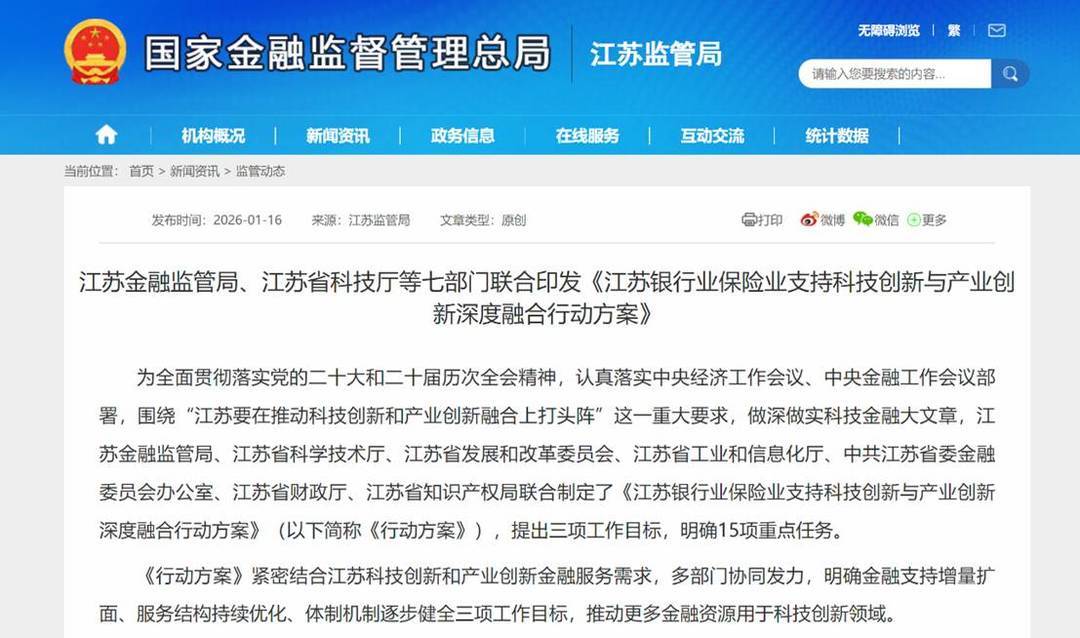
金融支持科技创新与产业创新深度融合,江苏七部门联合印发行动方案
Yang Zi Wan Bao Wang· 2026-01-19 06:55
Core Viewpoint - The Jiangsu Financial Regulatory Bureau, along with several provincial departments, has jointly developed an action plan to support the deep integration of technology and industrial innovation in Jiangsu, aiming to enhance financial services for technological innovation and industry development [1][3]. Group 1: Action Plan Overview - The action plan is designed to implement the spirit of the 20th National Congress of the Communist Party and subsequent meetings, focusing on Jiangsu's role in promoting the integration of technological and industrial innovation [3]. - It sets three main goals: increasing financial support, optimizing service structures, and gradually improving institutional mechanisms to channel more financial resources into technology innovation [3][4]. Group 2: Key Tasks - The action plan outlines 15 key tasks across four areas: 1. Enhancing professional service capabilities, including improving organizational structures and risk management [4]. 2. Innovating product service systems, such as expanding technology finance policy trials and increasing technology credit [4]. 3. Strengthening support for key areas, including backing technological research and modern industrial system construction [4]. 4. Promoting external collaboration, focusing on information sharing and establishing financial reward mechanisms [4]. Group 3: Financial Goals - By the end of 2025, the total balance of technology loans in Jiangsu is projected to reach 5.46 trillion yuan, an increase of 800.3 billion yuan from the beginning of the year, reflecting a growth rate of 17.18% [5].

陪伴硬科技 穿越新周期,浙商银行赋能浙商创新路
Zhong Guo Jing Ji Wang· 2026-01-19 06:29
Core Insights - The article highlights the significant advancements in key industries such as aerospace, semiconductors, and pharmaceuticals in Zhejiang, driven by innovative private enterprises and supported by financial institutions like Zheshang Bank [1][2][3][4][5][6]. Group 1: Aerospace Industry - Blue Arrow Aerospace's "Zhuque-3" rocket, China's first reusable rocket, successfully launched and entered orbit, marking a critical step in China's commercial space sector [2]. - Zheshang Bank has provided long-term financial support to Blue Arrow Aerospace since its establishment in 2018, facilitating the company's transition from research and development to large-scale production [2]. Group 2: Semiconductor Industry - ChipLink Integrated Circuit Manufacturing Co., Ltd. has emerged as a key player in the semiconductor sector, ranking among the top ten globally in wafer foundry revenue [3]. - Zheshang Bank has innovated financing solutions for ChipLink, including the issuance of a 500 million yuan technology innovation bond, supporting the company's market expansion and operational needs [3]. Group 3: Pharmaceutical Industry - Innovent Biologics, founded by Dr. Yu Dechao, has successfully launched 18 new drugs, with 12 included in the national medical insurance directory, benefiting over 600,000 patients [5][6]. - Zheshang Bank has provided cross-border financial solutions to Innovent Biologics, facilitating its global expansion and offering substantial credit lines to support its international operations [5][6]. Group 4: Financial Support and Strategy - Zheshang Bank has served over 35,000 technology-based enterprises, with a financing balance exceeding 460 billion yuan, demonstrating its commitment to supporting innovation in Zhejiang [6][7]. - The bank aims to enhance its technology finance services, aligning with national strategies to foster innovation and support the growth of private technology enterprises [7].
从世界工厂到创新沃土,科技金融助力东莞“关键一跃”
2 1 Shi Ji Jing Ji Bao Dao· 2026-01-19 06:14
Core Insights - Financial support is increasingly crucial for technological innovation in the Guangdong-Hong Kong-Macao Greater Bay Area, with Dongguan emerging as a hub for tech companies leveraging core technologies for rapid growth [1] - A diversified financial service system that adapts to the entire lifecycle of enterprises is taking shape in Dongguan, moving from traditional asset-based evaluations to a focus on future growth potential and technological capabilities [1][7] Financial Innovation - Financial institutions in Dongguan are innovating credit approval models and financial products, adopting the philosophy of "looking at patents rather than bricks" to better understand and support tech enterprises [1][3] - The "investment, loan, and guarantee" integrated credit model has been developed, allowing for a combination of equity investment and credit loans, which enhances banks' willingness to lend by distributing risks [3][4] Case Studies - Guangdong Blue Ocean Technology Company has seen significant growth in demand for its underwater robots, supported by loans from China Bank Dongguan Branch, which alleviated immediate funding pressures for R&D [2][3] - Dongdian Testing Technology Co. faces substantial funding needs for upgrading its facilities and services, with a recent investment of 70 million yuan for a new testing platform, supported by loans from CITIC Bank Dongguan Branch [5][6] Market Trends - The financial landscape in Dongguan is shifting from traditional asset-based assessments to a forward-looking approach that emphasizes technology and innovation, enabling more small and medium-sized tech companies to invest in R&D and market expansion [7][8] - The integrated financial service model and specialized products like "mid-test loans" are designed to meet the unique needs of tech enterprises, facilitating smoother access to funding and accelerating technological upgrades [6][7]
四中全会精神在基层丨金融“贷”动农民增收
Jing Ji Ri Bao· 2026-01-19 04:01
Group 1 - The "Credit Village" initiative by Agricultural Bank of China in Tianjin addresses financing challenges for farmers by providing timely loans and flexible repayment plans, enhancing agricultural productivity [1][2] - In 2025, a farmer in Baodi District received 3 million yuan in credit loans, allowing for an expansion of 2,000 acres in grain cultivation due to improved credit access [1] - The bank's approach includes collaboration with local party committees, on-site visits, and mobile technology for efficient loan processing, significantly improving service timeliness [1] Group 2 - Agricultural Bank of China has increased credit support for rice farmers, addressing the need for upfront investment in quality production processes, with a specific loan of 500,000 yuan issued to a rice grower in 2025 [2] - The bank's financial support also extends to the grain circulation sector, with a company receiving 4.9 million yuan in credit to ensure stable market supply during peak sales periods [2] - The bank emphasizes the importance of financial support throughout the agricultural value chain, aligning with national policies promoting various forms of finance to enhance agricultural stability and farmer income [3]
