
经济全球化

Search documents
【众行致远】习言道|我们要继续坚持拆墙不筑墙、融合不脱钩
Zhong Guo Xin Wen Wang· 2025-09-01 11:27
Core Points - President Xi Jinping emphasized the need for a more just and reasonable global governance system during the "Shanghai Cooperation Organization+" meeting, advocating for a community with a shared future for mankind [2][3][5] Group 1: Global Governance Initiatives - Xi proposed a global governance initiative aimed at promoting equality among sovereign nations and adherence to international law [3][5] - The call for multilateralism and a people-centered approach was highlighted as essential for addressing new global challenges [3][4] Group 2: Role of the Shanghai Cooperation Organization - The Shanghai Cooperation Organization (SCO) is urged to take a leading role in global governance and contribute to world peace and stability [5][9] - The organization is expected to demonstrate its commitment to global cooperation and uphold international fairness and justice [5][14] Group 3: Economic Globalization - Xi called for the promotion of high-quality economic globalization that is inclusive and beneficial to all [9][10] - The importance of cultural exchange and mutual understanding among different nations was also stressed [10]

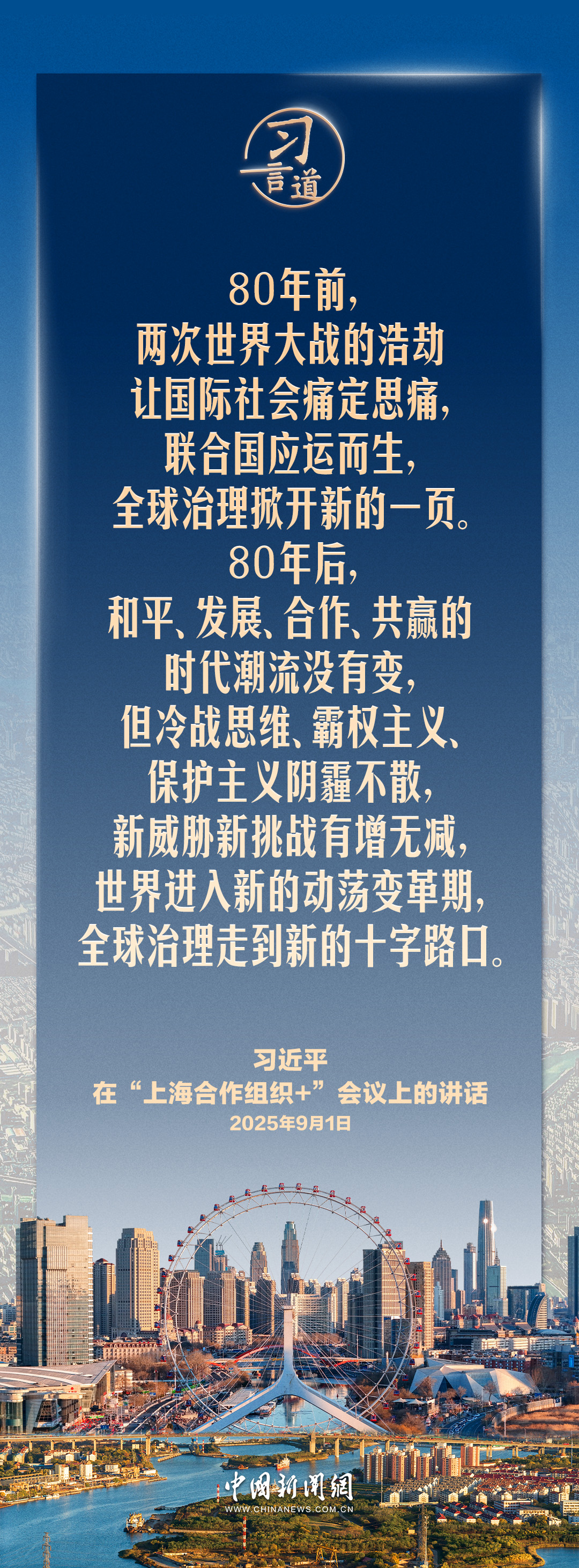
习近平:坚持拆墙不筑墙、融合不脱钩 推动经济全球化朝着更加普惠包容的方向发展
Yang Shi Xin Wen· 2025-09-01 08:25
Core Viewpoint - The meeting of the "Shanghai Cooperation Organization+" emphasizes the importance of promoting high-quality development of the Belt and Road Initiative and advancing economic globalization towards a more inclusive direction [1]. Group 1 - The meeting was held on September 1 in Tianjin, hosted by President Xi Jinping [1]. - Xi Jinping highlighted the need to continue the approach of "tearing down walls instead of building them" and fostering integration rather than decoupling [1]. - The focus is on advancing the Belt and Road Initiative to enhance global economic cooperation [1].
习近平在上海合作组织成员国元首理事会第二十五次会议上的讲话(全文)
第一财经· 2025-09-01 04:34
Core Viewpoint - The Shanghai Cooperation Organization (SCO) has achieved significant milestones over the past 24 years by adhering to the "Shanghai Spirit" of mutual trust, mutual benefit, equality, consultation, respect for diverse civilizations, and seeking common development [2][4]. Group 1: Achievements and Contributions - The SCO has established a military trust mechanism in border areas, promoting cooperation and addressing conflicts while opposing external interference to maintain regional peace [2]. - The organization has initiated the Belt and Road Initiative, resulting in numerous significant projects and enhancing regional economic cooperation, with trade among SCO countries exceeding $2.3 trillion ahead of schedule [2]. - A comprehensive network of international road transport has been developed, with nearly 14,000 kilometers of routes established and over 110,000 China-Europe freight trains operated [2]. Group 2: Future Directions - The SCO aims to uphold the principle of seeking common ground while respecting differences, enhancing strategic communication, and fostering collective responsibility for regional stability and development [5]. - The organization emphasizes mutual benefit and high-quality cooperation, particularly in areas such as energy, infrastructure, green industries, digital economy, and technological innovation [5]. - Open and inclusive cooperation is encouraged, promoting cultural exchanges and economic collaboration among member states [5]. Group 3: Governance and Reform - The SCO advocates for fairness and justice in international relations, opposing hegemonic practices and supporting a multilateral trade system centered around the World Trade Organization [6]. - The organization is committed to practical and efficient reforms, enhancing resource allocation and capacity building to improve decision-making and action effectiveness [6]. Group 4: China's Role and Contributions - China has invested over $84 billion in SCO member countries, with annual bilateral trade exceeding $50 billion [7]. - Plans include implementing 100 small-scale livelihood projects in member countries, providing 2 billion RMB in aid, and doubling the number of scholarships for SCO students [7].
习近平:推动构建更加公正合理的全球治理体系
Yang Shi Xin Wen· 2025-09-01 02:45
Core Points - The meeting of the Shanghai Cooperation Organization (SCO) member states' heads of state was held on September 1 in Tianjin, emphasizing the importance of fairness and justice in international relations [1] - President Xi Jinping advocated for a correct understanding of World War II history, opposing Cold War mentality, bloc confrontation, and bullying behavior [1] - The need to maintain an international system centered around the United Nations and support a multilateral trade system led by the World Trade Organization was highlighted [1] - The call for a more equitable and orderly multipolar world and inclusive economic globalization was made, aiming to promote a fairer global governance system [1]
特朗普公开喊话,中国必须向美提供稀土,美国手上握有反制筹码
Sou Hu Cai Jing· 2025-09-01 01:16
Core Viewpoint - The article discusses President Trump's demands for China to supply rare earth magnets to the U.S., threatening a 200% tariff if compliance is not met, highlighting the implications for U.S.-China trade relations and the potential impact on global supply chains [1][3]. Group 1: U.S.-China Trade Relations - Trump's statements reflect a belief that the U.S. holds greater influence over China in trade matters, asserting that the U.S. has sufficient countermeasures, such as halting the supply of Boeing parts, which could leave 200 aircraft grounded in China [3][5]. - The article critiques Trump's unilateral approach, suggesting it misjudges the interdependence of U.S. and Chinese industries, particularly in high-end manufacturing [5][7]. Group 2: Rare Earth Magnet Industry - Rare earth magnets are essential for strategic industries like electric vehicles, high-end chips, and aerospace, with China's dominance in this sector resulting from long-term resource advantages and technological development [5][9]. - The potential U.S. tariffs and trade halts could disrupt the established global supply chain, which is based on mutual economic needs rather than political maneuvering [5][9]. Group 3: Economic Implications - A halt in U.S. supplies of Boeing parts could adversely affect Boeing's stability and the livelihoods of U.S. suppliers, creating a detrimental cycle for both nations [7][9]. - The article emphasizes that the U.S. is increasingly dependent on China for various sectors, while China's reliance on the U.S. is decreasing, suggesting that extreme pressure tactics may backfire and accelerate China's self-sufficiency in key industries [9].
特稿|创新进取 合作共赢——中阿经贸合作助力经济全球化进程
Xin Hua She· 2025-08-28 16:27
Core Viewpoint - The China-Arab Economic and Trade Cooperation is advancing steadily, showcasing resilience and vitality in the context of global economic downturn and rising protectionism, thus becoming an important force in promoting economic globalization and world economic growth [1] Group 1: Steady Progress in Cooperation - The energy trade between China and Arab countries continues to grow, with energy trade accounting for a significant portion of bilateral trade, particularly with Qatar being China's second-largest liquefied natural gas supplier [2] - Qatar Energy Company has signed long-term agreements with Chinese companies for liquefied natural gas, highlighting China's role as a key market for Qatari energy products [2] - The China-Egypt TEDA Suez Economic and Trade Cooperation Zone has become a model project for connecting the Belt and Road Initiative with Egypt's Suez Canal Economic Corridor, with ongoing expansion efforts [2][3] Group 2: Innovation and New Areas of Cooperation - China and Arab countries are accelerating cooperation in emerging fields such as wind power, photovoltaics, green low-carbon technologies, and digital economy, aligning with national development strategies [4] - The 200 MW photovoltaic power station project in Algeria is a key initiative for achieving the country's renewable energy goals, creating approximately 500 local jobs [4] - Saudi Arabia views strengthening cooperation with China as essential for achieving its Vision 2030, expanding collaboration beyond traditional energy sectors into renewable energy, technology, logistics, and advanced manufacturing [4] Group 3: Digital Economy as a New Frontier - The digital economy is emerging as a new avenue for China-Arab economic cooperation, with initiatives in artificial intelligence, cloud computing, and digital infrastructure [5] - In Egypt, the "One Network, One Cloud, One Platform" project is set to provide cloud computing services to 185 enterprises, enhancing the development of the digital economy [5] - China's Beidou system and IoT technology are significantly benefiting Egypt's computing infrastructure development [5] Group 4: Deepening Cooperation for Mutual Benefit - The China-Arab Expo has become a vital platform for deepening practical cooperation and promoting high-quality development of the Belt and Road Initiative, facilitating active exchanges across various levels [7] - China remains the largest trading partner for Arab countries, with increasing demand for products such as Saudi shrimp, Tunisian olive oil, and Egyptian oranges [7] - Chinese companies are actively participating in infrastructure projects in conflict-affected regions, such as the "Smart Oilfield" project in Iraq, which is enhancing oil and gas development efficiency [7]
特稿丨创新进取 合作共赢——中阿经贸合作助力经济全球化进程
Xin Hua Wang· 2025-08-28 12:20
Core Viewpoint - The China-Arab Economic and Trade Cooperation is advancing steadily, showcasing resilience and vitality in the context of global economic downturn and rising protectionism, thus becoming an important force in promoting economic globalization and world economic growth [1] Group 1: Steady Progress and Foundation of Cooperation - The energy trade between China and Arab countries continues to grow, with energy trade accounting for a significant portion of bilateral trade, particularly with Qatar being China's second-largest liquefied natural gas supplier [2] - Qatar Energy Company has signed long-term agreements with China National Petroleum Corporation and Sinopec, highlighting China's role as a key market for Qatari energy products [2] - The China-Egypt TEDA Suez Economic and Trade Cooperation Zone has become a model project for connecting the Belt and Road Initiative with Egypt's Suez Canal Economic Corridor, with ongoing expansion efforts [2][3] Group 2: Innovation and New Areas of Cooperation - China and Arab countries are accelerating cooperation in emerging fields such as wind and solar energy, green low-carbon technologies, and digital economy, aligning with national development strategies [4] - The 200 MW solar power project in Algeria is a key initiative for achieving the country's renewable energy goals, creating approximately 500 local jobs [4] - Saudi Arabia views strengthening cooperation with China as essential for achieving its Vision 2030, expanding collaboration beyond traditional energy sectors into renewable energy, technology, logistics, and advanced manufacturing [4] Group 3: Digital Economy as a New Arena - The digital economy is emerging as a new avenue for China-Arab economic cooperation, with initiatives in artificial intelligence, cloud computing, and digital infrastructure [5] - In Egypt, the "One Network, One Cloud, One Platform" project is providing cloud computing services and communication infrastructure support to 185 enterprises, enhancing the development of the digital economy [5] Group 4: Deepening Cooperation for Mutual Benefit - The China-Arab Expo has become a vital platform for deepening practical cooperation and promoting high-quality development of the Belt and Road Initiative, facilitating active exchanges at various levels [7] - China remains the largest trading partner for Arab countries, with increasing demand for products such as Saudi shrimp, Tunisian olive oil, and Egyptian oranges [7] - Chinese enterprises are actively participating in infrastructure projects in conflict-affected regions, such as the "Smart Oilfield" project in Iraq, which is enhancing oil and gas development efficiency [7]
墨西哥计划在2026年预算提案中提高对华关税 外交部回应
Xin Jing Bao· 2025-08-28 10:33
Core Viewpoint - The Mexican government plans to increase tariffs on Chinese imports in its 2026 budget proposal to protect domestic businesses from cheap imports, which has drawn a response from China emphasizing mutual benefit in trade relations [1] Group 1: Trade Relations - Mexico is China's second-largest trading partner in Latin America, while China is Mexico's third-largest export destination [1] - The essence of China-Mexico economic cooperation is characterized by mutual benefit and win-win outcomes [1] Group 2: Economic Principles - China advocates for inclusive and beneficial economic globalization, opposing unilateralism, protectionism, and discriminatory measures [1] - China firmly opposes any restrictions imposed under coercion that harm its legitimate rights and interests [1] Group 3: Diplomatic Stance - China expresses confidence that relevant countries will maintain independence and properly address related issues [1]
(抗战胜利80周年)中方谈普京出席九三纪念活动:宣示中俄共同捍卫二战胜利成果
Zhong Guo Xin Wen Wang· 2025-08-28 07:20
Group 1 - The core viewpoint of the article emphasizes the significance of Russian President Putin's attendance at the 80th anniversary of the victory in World War II, highlighting the high-level strategic partnership between China and Russia and their commitment to safeguarding the achievements of the war [1] - The Chinese Foreign Ministry Assistant Minister Hong Lei stated that China and the Soviet Union were pivotal in the fight against militarism and fascism during World War II, making significant sacrifices and contributions to the victory [1] - Hong Lei mentioned that during President Xi Jinping's visit to Russia in May, important consensus was reached with Putin regarding the historical truth of World War II, the denial of its achievements, and the challenge to the post-war international order [1] Group 2 - This year marks the 80th anniversary of the United Nations, and Hong Lei indicated that China and Russia, as founding members and permanent members of the UN Security Council, will continue to uphold the authority of the UN and international justice [2] - The participation of leaders from many Global South countries in the commemorative activities reflects the historical unity against fascism, which laid the foundation for post-war international order [2] - The article expresses a desire to work with Global South countries to promote a multipolar world and inclusive economic globalization, contributing to global peace and development [2]
王晓泉:上合组织树起新型国际关系典范
Jing Ji Ri Bao· 2025-08-27 00:14
Core Points - The 2025 Shanghai Cooperation Organization (SCO) Summit will be held in Tianjin from August 31 to September 1, marking China's fifth time hosting the summit and the largest in SCO's history [1] - The SCO has matured over 24 years, embodying the "Shanghai Spirit" which emphasizes mutual trust, mutual benefit, equality, consultation, respect for diverse civilizations, and common development [1][2] - The SCO aims to enhance cooperation among member states, aligning national interests with regional needs to foster a conducive environment for development [2] Group 1 - The SCO represents a new type of international organization composed of developing countries, showcasing true multilateralism and a commitment to equality and mutual benefit [1][2] - The "Shanghai Spirit" opposes hegemony and emphasizes equal consultation and win-win cooperation, resonating with the voices of developing countries [2] - The SCO has established a consultation system that includes regular meetings among heads of state and government, enhancing mutual understanding and trust among member countries [1][2] Group 2 - The SCO is positioned to lead the "Global South" in building a more just and reasonable world order, collaborating with other international organizations like the UN and BRICS [3] - The organization aims to promote a more equitable and orderly multipolar world, with its member countries accounting for nearly half of the global population and about a quarter of the global economy [3] - The SCO is actively working to make economic globalization more inclusive, focusing on practical cooperation in infrastructure, capacity building, and green economy [3] Group 3 - The SCO seeks to improve the global governance system by introducing more non-Western perspectives and advocating for rules that align with the common interests of its member states [4] - The organization promotes a new paradigm of multilateral cooperation that emphasizes common security and development, reflecting equality and fairness [4] - The integration of the "Shanghai Spirit" with other cooperative ideologies aims to enhance international relations and foster a tighter network of partnerships among member states [4]